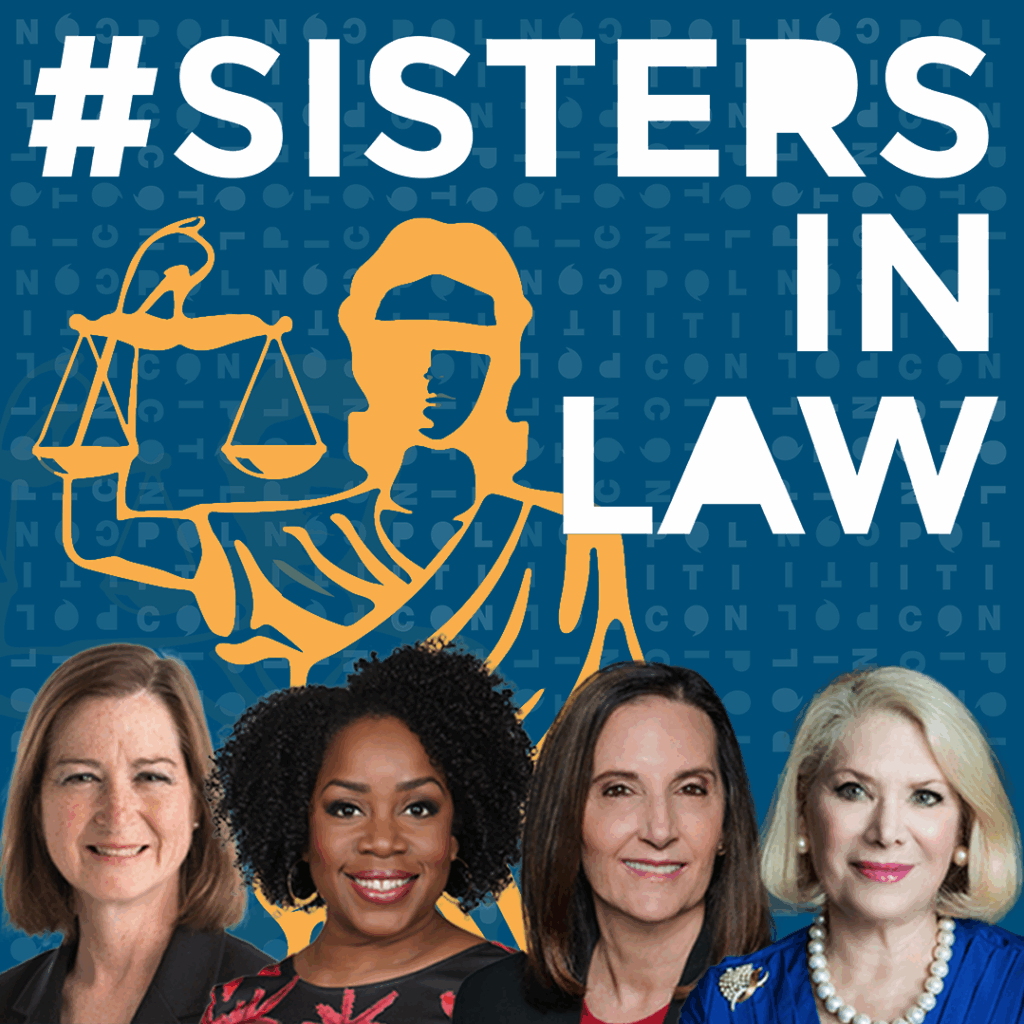
Barb McQuade hosts #SistersInLaw to review the FBI search warrant executed at the Fulton County Elections Operations Center in Georgia, the implications for election integrity, odd things about the case, and how it relates to MAGA conspiracy theories surrounding the integrity of the 2020 election. Then, the #Sisters discuss the civil rights investigation of the Pretti shooting taking place in Minnesota, other recent legal developments concerning ICE, and chilling instances of journalists being targeted in spite of press freedom. They also review a lawsuit against the government by the families of men killed in the recent Venezuelan boat strikes and explain the relevance of the Death on the High Seas Act and the Alien Tort Statute.
#SistersInLaw has launched a new companion podcast: #SistersInLaw Sidebar, airing Wednesdays wherever you normally get your podcasts!
Start 2026 with style! Get the brand new ReSIStance T-Shirt, Mini Tote, and other #SistersInLaw gear at politicon.com/merch!
Additional #SistersInLaw Projects
Check out Jill’s Politicon YouTube Show: Just The Facts
Check out Kim’s Newsletter: The Gavel
Joyce’s new book, Giving Up Is Unforgivable, is now available, and for a limited time, you have the exclusive opportunity to order a signed copy here.
Pre-order Barb’s new book, The Fix. Her first book, Attack From Within, is now in paperback.
Add the #Sisters & your other favorite Politicon podcast hosts on Bluesky
Get your #SistersInLaw MERCH at politicon.com/merch
Email: SISTERSINLAW@POLITICON.COM or Thread to @sistersInLaw.podcast
Get text updates from #SistersInLaw and Politicon.
From the #Sisters
Kim’s ReSiStance Protest Song Playlist
From Joyce: Today Fulton County, Tomorrow???
Support This Week’s Sponsors
IQ Bar:
Text SISTERS to 64000 to get 20% off all IQBAR products, plus FREE shipping. Message and data rates may apply.
ASPCA:
You can get a $25 Amazon Gift Card when you enroll in an ASPCA Pet Health Insurance Plan using the link aspcapetinsurance.com/SISTERS. Note: The ASPCA® is not an insurer and is not engaged in the business of insurance.
Thrive Causemetics:
Amplify your everyday look in 2026. Go to thrivecausemetics.com/sisters for an exclusive offer of 20% off your first order.
DeleteMe:
Get 20% off your DeleteMe plan when you go to joindeleteme.com/ SISTERS and use promo code SISTERS at checkout.
Mill:
Try Mill risk-free for 90 days and get $75 off at mill.com/SISTERS and use code SISTERS at checkout.
Get More From The #SistersInLaw
Joyce Vance: Bluesky | Twitter | University of Alabama Law | Civil Discourse Substack | MSNBC | Author of “Giving Up Is Unforgiveable”
Jill Wine-Banks: Bluesky | Twitter | Facebook | Website | Author of The Watergate Girl: My Fight For Truth & Justice Against A Criminal President | Just The Facts YouTube
Kimberly Atkins Stohr: Bluesky | Twitter | Boston Globe | WBUR | The Gavel Newsletter | Justice By Design Podcast
Barb McQuade: barbaramcquade.com | Bluesky | Twitter | University of Michigan Law | Just Security | MSNBC | Attack From Within: How Disinformation Is Sabotaging America
Welcome back to Hashtag Sisters-in-Law with Jill Winebanks, Joyce Vance, Kimberly Atkins-Stor, and me, Barb McQuade. Kick off the new year with some Hashtag Sisters-in-Law gear. Hoodies and T-shirts are available at politicon.com slash merch. You can find the link in our show notes. We also have some exciting news. Last week, we launched a companion podcast called Sisters Sidebar. where we’ll answer questions we couldn’t get to on the main show. We’ll dive deeper into our opinions on the news and we’ll share more about our legal journeys. It airs on Wednesdays, so you can send in those questions and remember to tune in.
Now today we’ll be discussing some topics in the news that DOJ search in Georgia, the latest on ICE in Minnesota and the wrongful death lawsuit that’s been filed over the Venezuelan boat strikes.
But first, before we get into it, I wanted to chat with my sisters about, did you guys hear that new song by Bruce Springsteen about Minneapolis? I think it’s called The Streets of Minneapolis. Have you heard that? It’s kind of a protest song, an anthem. he named checks Kristi Noem and Stephen Miller. Have you guys heard it?
Joyce (01:27)
Yes, great.
Jill (01:28)
Fabulous, fabulous.
Barb (01:30)
Yeah, it’s interesting. And Joyce, you were mentioning that how important it is to a cause to have an anthem because it brings attention to an issue and can capture some public attention. So I think it’s great that somebody with the profile of Bruce Springsteen is bringing attention to this issue. But it got me thinking about other great protest songs. And I wondered if you guys had a favorite protest song.
Joyce (01:57)
You know, I’m ⁓ of an age where I grew up in the 60s and the protest movement of the 60s is sort of the soundtrack of my childhood. So I like all of that. I mean, I just have to confess, I still listen to that music, but blowing in the wind has got to be my all time favorite. Still on my current playlist.
Barb (02:17)
That’s a Minnesotan, isn’t it? Bob Dylan, isn’t it?
Joyce (02:20)
He be in fact a good Jewish boy from Minnesota.
Barb (02:23)
There you go. What about you, Jill? You got any favorites?
Jill (02:27)
Well, I would have to say that there were at least three that I struggled to choose between, one of which was Blown in the Wind. And that’s partly because my husband’s favorite singer in the whole wide world is Bob Dylan. But there’s also a Sam Cooke civil rights anthem, also an anti-war one. I also really love Sam Cooke’s A Change is Going to Come. And that was from like 1964, still not exactly my childhood. because I was graduating college, but definitely part of my soundtrack. But I have to say that the one that really makes me cry to this day and that I think is relevant to what’s going on in our country right now has to still be my favorite, and it’s We Shall Overcome. And one of my favorite renditions is by Joan Baez. It’s based on a 1900 gospel song, and it is probably the only song in the whole wide world that I actually sang aloud as part of a group. Because that was sort of like, you you all know I don’t, I think I have the worst voice in the world and I don’t like to sing even the national anthem. And I think by the way that Minneapolis should be our current national anthem.
Joyce (03:40)
You know, Jill, can I just say there is nothing like hearing We Shall Overcome sung inside of 16th Street Baptist Church in Birmingham. mean, if you’re ever having a down day and you need to understand that change is possible in the face of great evil, it’s so moving. I wish we could find a recording of that. There’s something called the Movement Choir that sings there a lot and it’s just a beautiful rendition.
Barb (04:05)
Shukam, you’re our songstress.
Kim (04:07)
Yeah, I think for me, I get energized when it’s, and all the songs you’ve mentioned are incredible and absolutely crucial and have been used ⁓ throughout many protests eras of our country. But what really gets me going is a song that is upbeat, that makes me want to move and it makes me want to take action. And one actually just came up while I was ⁓ walking Snickers the other day and it really sort of crystallized for me at a time that I was beginning to become discouraged that ⁓ we can do this and we can fight on and that was Higher Ground by Stevie Wonder. It really sort of, you know, reinforced. In fact, I started just making a playlist of songs that I turned to when I really want to ⁓ keep that energy and keep moving forward. So they weren’t necessarily all
Barb (04:43)
That’s great.
Kim (05:02)
written as protest songs, but they are songs that make me think about what is coming up. Things like Taking It To The Streets by the Doobie Brothers or This Is It by Kenny Loggins and just songs that talk about we need to do something, we need to act now. There’s no time to waste.
Barb (05:21)
Those are good.
Joyce (05:22)
Are you gonna share the playlist?
Kim (05:24)
I should. I know what, will do it together.
Barb (05:27)
Will you put a link in the show notes? That’s awesome. Well, I’m glad you talk about Stevie Wonder. I know you two have Motown roots. ⁓ One that I really like is What’s Going On. ⁓ It’s a great song that goes back to the Vietnam War era. ⁓ And it’s so interesting because it’s Marvin Gaye who’s from Detroit.
Kim (05:29)
Put a link in the show notes.
Barb (05:56)
It was a song that was inspired by events that occurred in Berkeley when a member of the Four Tops was traveling there and he came across a Vietnam War protest that erupted into police violence where the police were beating participants in this protest. And the song begins with like party sounds with a bunch of guys just talking and he hired members of the Detroit Lions to participate in that beginning part. It’s Lem Barney and Mel Pharr among other guys who just.
Like they’re having a good time having a party and you know, what’s going on? Like we gotta pay attention, same as you just said, to what’s going on. We can’t just, you know, be involved in our party little life. We have to figure out what’s going on here. And what’s interesting is the four tops wanted to record it and Barry Gordy said, too controversial. But Marvin Gaye said, I’m gonna record that. I wanna record that. I don’t wanna sing silly love songs when this is going on. ⁓ So that arrangement, including like the party talk at the beginning, I think.
is so great because he’s trying to cut through sort of the distractions of life and focus on like people, we gotta pay attention what’s going on here. So it’s a great song. So thanks, great songs.
Kim (07:03)
I knew about the beginning of this song and the origins, but I didn’t know everybody who was in it, including Melfar. So for people from Michigan, even if you don’t remember him on The Lions, you know him as the ⁓ Melfar superstar for a far better deal.
Barb (07:24)
deal with.
Kim (07:25)
car dealership, but really a celebrity in the Detroit era. That’s great story, Barb. Thanks for sharing that.
Yes, I hear your voice singing through the bloody mist We’ll take our stand for this land and the stranger in our midst
Killed and roamed in the winter of 26 We’ll remember the names of those who died on the streets of Minneapolis
Joyce (08:18)
This episode is brought to you by IQ Bar, our exclusive snack, hydration and coffee sponsor. IQ Bar protein bars, IQ Mix hydration mixes, and IQ Joe mushroom coffees are delicious. They’re the low sugar brain and body fuel you need to win your day. There’s no better way to start off 2026 with a clean slate. And now is the perfect time to transform frustration into fuel and power your day with IQ Bar.
Kim (08:46)
They have something for everyone, but we recommend the Ultimate Sampler Pack. It’s a great way to try all IQ Bar products and flavors, complete with nine IQ Bars, eight IQ Mixtix, and four IQ Joe Stix. Unlike a lot of the stuff out there, you don’t have to worry about what you’re getting. All IQ Bar products are clean label certified and entirely free from gluten, dairy, soy, GMOs, and artificial ingredients.
so you know you’re treating yourself to the best. Plus, all IQ Bar products are packed with clean, delicious ingredients that keep you physically and mentally fit, like magnesium, Lion’s Mane, and more.
Barb (09:28)
convenience of IQ bars. know, whenever I fly, always bring a snack and an IQ bar is the perfect snack to stash in your bag in case you never know when you’re going to get your next meal. All of us run around. teaching, I’m podcasting, I’m running around with my family. Sometimes it can be hard to find time to get the nutrition and energy we might need to beat the clock. That’s why I’m so glad we discovered IQ bar and their awesome products.
Let me tell you about a few of them. They’re chocolate sea salt plant protein bars, are so not only convenient to carry around when you’re in a rush, but they’re actually very tasty and delicious. They also have the original Black IQ Joe. It’s a tasty burst of delicious caffeinated mushroom coffee. The only problem is deciding which flavor you might want that day because there’s so many. That’s why the Ultimate Sampler Pack is a great place to start. There’s so much variety, you need to try it for yourself.
Jill (10:23)
And the new year gives us all a chance to reset and maximize our brain and body potential using IQBar for protein, hydration mixes, and mushroom coffees. Don’t forget, their Ultimate Sampler Pack includes all three. And right now IQBar is offering our special podcast listeners 20 % off all IQBar products, including the Ultimate Sampler Pack. Plus free shipping to get your 20 % off.
Sisters to 64,000. Again, text sisters to 64,000. 64000. That’s sisters to 64,000. Message and data rates may apply. See terms for details. The link is also in our show notes.
Joyce (11:20)
Well, the FBI executed a search warrant on the Fulton County, Georgia Elections Operations Center this past Thursday. They walked out with thousands of ballots from the 2020 election and more party favors. That’s right, the big lie is back, just in time for the midterm elections. And the story has not been reported in as much detail as it merits. To be fair, this has been quite a newsweek that we’re up against this week.
But this is a critically important story, so we’ll break it down for you in some detail. And let’s start with the search warrant itself. Barb, can you explain what the search warrant authorized the FBI to do and what charges they’re investigating?
Barb (12:05)
Yeah, so we know a little bit, but we don’t know everything because the search warrant itself has become public, but not the affidavit, which is what really tells you the details about probable cause, about why they think they’re going to find evidence there. But it alleges that they are investigating violations of two federal statutes, Title 52, United States Code, Section 20701. That’s a misdemeanor offense that requires election officials to retain
election documents for 22 months after an election. We’re well past that, so I’m not sure what the basis for that one is. But another one, is ⁓ Title 52, Section 205.11, and that one actually essentially makes it a crime to defraud ⁓ residents of a state from a fair election process by a number of ways, ⁓ permitting fraudulent voter registration, false ballots, people who aren’t entitled to vote to cast a vote.
So, we’re not sure exactly how they believe that that has been charged or violated, but that’s the gist of the search. So, they went in and among the items that they were permitted to seize were physical ballots from Fulton County from the 2020 election, including absentee ballots and their envelopes, the tabulator tapes, the ballot images, all voter rolls from the 2020 election.
⁓ They’re allowed to gather all of those things under this warrant to look for violations of those two laws I just mentioned.
Joyce (13:41)
You know, as you say, Barb, when you execute a search warrant, presumably you’re looking for evidence of crimes, right? That’s the whole reason you’re authorized to do that, to find evidence or fruits of a crime so that you can evaluate whether a crime occurred and whether there’s a prosecutable offense. But Jill, when you look at this, and as Barb says, we don’t know what’s in the affidavit, but just based on what’s known, do you think it’s likely that they’ll turn up evidence of new crimes to prosecute?
Jill (14:09)
I would give you a very quick answer. No, I don’t think it’s very likely. And I’ll tell you why. I mean, first of all, we have looked to death at these documents. There were 60 lawsuits filed, all dismissed as being without evidence. And yes, it’s true. We haven’t seen the affidavit. It’s hard for me to imagine what probable cause they alleged could possibly apply to a crime which
under a statute of limitations of five years, and I will talk about there are maybe some extensions that could be argued here, but basically the five-year statute has run. 22 months is over. It’s not five years after the 22 months, so maybe there’s some example of that, but how are they going to prove that something wasn’t maintained unless they can prove it was there to begin with, and they can’t? How are we, who don’t trust this government anymore, going to believe that they aren’t
somehow manipulating whatever they took or destroying whatever they took. I’m sorry. It’s sad that I have to say this, that I don’t trust our government right now, but I don’t. And I think, you know, Mark Elias said, this has been recounted, audited, and litigated to death already. So how are they going to find something new in this? I just don’t see it. And I’m frankly more worried what the purpose of their seizure was and what they will do that
could destroy evidence.
Joyce (15:38)
Yeah, I totally agree, right? Three recounts of the vote in Georgia. I think that there were eight lawsuits. Mark may have litigated all of them. ⁓ And what really worries me here is exactly what you say. Not that there are legitimate charges that will surface this late in the day, but that there are illegitimate charges that this Justice Department, which seems more than willing to pursue the obviously deficient
might try to bring and maybe we’ll get into that a little bit more. But Kim, before we think about criminal consequences, as our resident civil expert, wanted to ask you, DOJ has already filed a civil case to try to get the ballots. Can you talk about what’s going on in the civil proceeding?
Kim (16:22)
Yeah, they did file a civil case. Actually, they filed a couple, but they’ve been hitting roadblocks. As you said, a federal judge dismissed the first lawsuit that was filed seeking access to unredacted ⁓ voting records in Georgia ⁓ because ⁓ of a lack of jurisdiction. A judge found that they filed the case in the wrong place.
So someone should get the folks at DOJ a map of Georgia because ⁓ the ballots they’re seeking are in Fulton County, which is where Atlanta is, not in the middle district of Georgia, which is where they filed this ⁓ particular action. it’s just one of many. We’ve talked many times about how the DOJ doesn’t know how to shoot straight often.
in their ⁓ attempts to carry out what seems to me, I agree with y’all, an attempt to ⁓ not only just discredit the 2020th election, something that Donald Trump will never let go, but certainly an attempt to intimidate and create a sense of distrust in the 2026 election results before they’re even cast.
Joyce (17:35)
Yeah. So, Barb, back to the search warrant. Devil is always in the details. And when I read this search warrant, I noticed something unusual and ⁓ I’m willing to bet that you did too. This is a North Georgia search warrant issued by a magistrate judge in the metro Atlanta area. But there was someone in the mix in this search warrant who was not from North Georgia. Can you explain that and tell us what you make of it?
Barb (18:02)
Yes. ⁓ Attorney General Pam Bondi has appointed the U.S. attorney in St. Louis to handle this case, which is very strange because typically you handle cases that arise out of your own district. But she utilized a federal statute that does allow her to appoint somebody to be a special attorney to oversee certain kinds of cases. There’s a statute that allows her to do it, and she has appointed him to oversee these
you know, so-called election fraud cases. So he is handling this. It really does cause you to wonder though, you know, why can’t they simply entrust the people who are federal prosecutors in Georgia to handle this? And I think there’s some things about the background of this prosecutor’s name is Thomas Albus that suggests why perhaps she believed that he was particularly a good choice in this case. He ⁓ has, you know, a decent background. He was
a lawyer in private practice. was an assistant US attorney. But then he worked for the Missouri attorney general as the first assistant to the Missouri attorney general, ⁓ whose name is Eric Schmidt. In 2020, the state of Missouri was one of the states that filed a lawsuit. It was led by Texas and Ken Paxton there, the attorney general. But the attorney general in Missouri, ⁓ and this was ⁓ Eric Schmidt and Thomas Albus, ⁓
joined into this lawsuit to challenge the outcome of the 2020 election. They said that, ⁓ you know, on behalf of voters of Pennsylvania and Georgia and all these places where there are allegations of wrongdoing, we think this should go straight to the Supreme Court and ⁓ they should throw out the results of the election. That lawsuit failed, but the fact that Thomas Albus was an advocate for that cause, I think suggests that he is part of
the Stop the Steal movement that may be why Pam Bondi appointed him to handle this case. you know, I don’t know that this is the kind of person that we would expect to be acting independent of partisan politics.
Joyce (20:15)
Well, I think it’s helpful to have all of that background on Albus to put his role in context. I mean, it’s not unheard of for the attorney general to assign a U.S. attorney to handle maybe an overarching investigation, but this one just doesn’t smell right. I mean, the appointment of Albus, the fact that they’re revisiting old charges, the fact that his district has no nexus, usually the person you ask to look at something that crosses jurisdictions,
would probably be the U.S. attorney who initiated the case. So I think we’re wise to be skeptics. Which takes me to this question, Jill. I mean, what’s the end game here? This feels like more of that classic Trump tactic. Don’t worry about whether anything comes of it. Just give me an investigation I can make hay with. How many times have we seen that, right? I mean, there’s the origin story for his first impeachment when he told that to
Vladimir Zelensky in an effort to gin up a bogus investigation into Joe Biden and corruption. What’s Trump trying to do here?
Jill (21:18)
exactly the same thing. He’s trying to get people to not trust our elections. He’s trying to resurrect the false claims and all the conspiracy theories that went along with his election defeat, which has been resoundingly proved that he lost. And even his own team at the time told him he had lost. He just is too big a baby to move on. And he wants to keep on going and going.
and going and looking at these totally bogus claims and to the extent that he can use it as some way to interfere in the upcoming midterms and maybe even in the primaries, although that seems so far-fetched that I can’t even believe that that’s a possibility. But for sure, the midterms are going to be involved and people are afraid. People are going to be afraid that their vote won’t count because he’s going to do everything he can to stop it.
So this has nothing to do with actual investigation of a potential crime. ⁓ As we’ve talked about already, there is no potential crime here. They’re not going to find evidence. And this is just an abuse of the Department of Justice using it as his own personal tool.
Joyce (22:36)
Kim, there’s one final oddity in the mix here that before we leave this subject for today, I’m sure we’ll be visiting this for a long time. I think this is critically important as we enter the midterm season. But this final weird piece in what was going on earlier this week, there was reporting that Tulsi Gabbard, who is not someone who works in domestic law enforcement, not an FBI employee,
She’s the DNI, the Director of National Intelligence. She works in the intelligence community. And she was seen at the site of the search. So what’s going on with that?
Kim (23:12)
That’s a good question, Joyce. That’s exactly the question I had when I saw the reporting and the photograph of her ⁓ on site there. So I was listening with, you know, deep interest when someone asked that question of Todd Blanche on Friday during his little press conference that he had. And he said some interesting and perhaps conflicting things in the answer to that question first.
He said something to the effect of, she just happened to be in Atlanta. I’m sorry, what? She just happened to be in Atlanta.
Joyce (23:47)
See, right? I mean…
Kim (23:50)
What do mean? And then he went on to say, well, her presence should not be questioned. So when a reporter asked for a follow-up question, say, well, what do you mean? Was she walking by? Was she there on different business? He goes, oh, no, no, no. I did not say that. I did not say that she was not a part of this. He said, this administration works closely together in all kinds of
So it’s no surprise that the administration is working together to protect election integrity. Now keep in mind, again, as Joyce said, the office of ⁓ the director of national intelligence is the lead intelligence community agency to deal with and defend against national security, to defend national security, to deal with threats to national security. On what earth is…
the votes in Fulton County, a national security concern. I’m inclined to agree with ⁓ Senator Mark Warner of Virginia, who said, ⁓ quote, there are only two explanations for why the director of national intelligence would show up to a federal read tied to Donald Trump’s obsession with losing the 2020 election. Either Gabbard believes there was a legitimate Ford intelligence nexus.
⁓ In which case she is in clear violation of her obligation under law to keep intelligence committees like his informed or she is once again demonstrating her other utter lack of fitness for office that she holds by injecting the nonpartisan intelligence community. She is supposed to be leading into a domestic political stunt. I think it’s the latter. It’s what it feels like to me, but that’s just my opinion.
Joyce (25:36)
You know, I mean, there’s just some crazy sauce going on out there and I will just, you know, I’m not one to give into conspiracy theories. I’m going to just float this one for a second as the final point here before we leave you. There’s been some talk that maybe Tulsi Gabbard is involved because this is really about Dominion voting machines. Y’all remember all those stories that circulated before Dominion slapped a couple of media entities with huge defamation cases?
And there were these persistent rumors that foreign countries were involved in hacking those machines. And maybe that’s something that would get the DNI involved. And you would think that that’s a lot of bunk, except for two things. Dominion Voting Machines is based in St. Louis, where Barb’s friend, the US attorney Albus is based. And if that’s not enough to pique your interest, ⁓ Eagle Ed Martin, the guy who
flunked out of the Senate as Trump’s US attorney choice to be the US attorney in the Eastern District of Virginia. He actually retweeted something yesterday, of floating the there’s testimony under oath from Dominion about this. So look, not normally a purveyor of conspiracy theories is Joyce Vance, but just this one time I’m going to say there’s enough weirdness going on in this case, I think, to support looking at a couple of crazy random conspiracy theories.
And this might be actually where this administration is headed with this one, given Jill’s amazing explanation of the fact that there just ain’t no there there for them to go after otherwise.
Jill (27:13)
And can I just add one other thing? Dominion Voting Machines has now been sold to a GOP official in a surprise deal. When I say just, was, I think, last October it was reported. So doesn’t that add a little to your conspiracy theory,
Joyce (27:31)
You know, it does, and that was the predication for Martin’s tweet. So we shall see.
Kim (27:36)
you
You know what, Jill? I’m just kind of discombobulated because my assistant isn’t here. She usually helps me. You know Snickers.
Jill (27:51)
Of course, and I know how much she helps.
Kim (27:54)
She’s giving me answers. She’s helping me, you know, know the difference between state and federal rules. And I think she’s upstairs napping. So, you know, I really can’t do this without her.
Jill (28:05)
Oh my goodness, you need your emotional support and intellectual support dog. of course, I have Brisbane sitting by my side, giving me all the peace I need to deal with all the problems of the day. It is really amazing how much we all love our pets and how much we care for them. And I’m very happy to say that there is a quick message from today’s sponsor, the ASPCA Pet Health Insurance Program.
Barb (28:11)
This is a-
Jill (28:35)
We all have had so many fun times and amazing memories with our animal friends, and we know that your pet is part of your family too. Like us, you would do pretty much anything for them, but those vet bills can add up quicker than you think. That’s why it’s worth checking out ASPCA Pet Health Insurance.
Joyce (28:57)
Well, now I feel like the bad pet mom in the family because I’ve had to banish Elsa from my office this afternoon. I spent an hour and a half on a meeting this morning, throwing a ball for her, year old German shepherd puppy, and she’s relentless. All she wants people to do all day long is to throw that ball. I mean, she wears me out that she’s so adorable.
And you’re absolutely right, Jill. mean, there’s no pretty much about it. We would do anything for our dogs and for our cats in this family. They are cherished family members. Pet insurance can help manage the vet bills so you can focus on what really matters, making sure your pet gets the care they need, when they need it. And right now there’s a little bonus perk for enrolling. When you enroll in an ASPCA pet health insurance plan,
you can get a $25 Amazon gift card. It’s a little treat for you while you’re doing something great for your pet. The program offers customizable accident and illness plans, making it easier to get your pet the care they may need.
Kim (30:03)
You can tailor your plan to fit your budget, your lifestyle, and your pet’s particular quirks. To explore coverage, visit aspcapetinsurance.com slash sisters. Again, that’s aspcapetinsurance.com slash sisters. Eligibility restrictions apply. Visit aspcapetinsurance.com slash
Amazon terms for more info. The link is in our show notes.
Barb (30:36)
This is a paid advertisement. Insurance is underwritten by either Independence American Insurance Company or United States Fire Insurance Company and produced by PTZ Insurance Agency Limited. The ASPCA is not an insurer and is not engaged in the business of insurance.
Kim (31:01)
⁓ it has been freezing. And if the start of the year hasn’t been crazy enough, it can be really hard to find the energy to get out of the house, period. Like it took me two days just to dig out after this last snow of the house ⁓ in the middle of this deep freeze. But that’s why it’s so important to have a little ritual to start the day that centers you and gets you feeling excited to take the day on. And for me, you know, it means mascara.
It really does. I don’t feel myself without my mascara on no matter what’s going on. So I love getting out my stash of Thrive Cosmetics and putting together a nice cozy winter look. And it helps that I know that every product is 100 % vegan, cruelty-free, and made with clean, skin-loving ingredients that work with your skin and not against it. It’s one of many reasons why they are the go-to for amplifying your everyday look.
Jill (31:59)
I agree with you and I love Thrive’s mascara, but I also love their lip balm, their eyebrow tint, their brilliant eye brighteners. All their products are really good quality and great colors. And recently I’ve been obsessed with their Empower Matte Precision Lipstick Crayon. It’s your new best age-defying friend for lips that have lived a little bit. And it is the perfect way to show your confidence in lipstick form with
18 beautiful and buildable shades, they have something to suit any style or outfit. So indulge your lips with a creamy, long-lasting, velvety matte color that is packed with staying power and enjoy the lightweight and non-sticky formula. I like the long-wearing weightless lip perfection formula. It can be so layered and it can be either bold and opaque, or it can leave your lips looking luscious and fuller. You have to try them all and find your empowered fashion fit.
Barb (32:57)
Another thing we love about Thrive Cosmetics is that cause is in the name for a reason. Thrive not only defines luxury beauty with their uncompromising standards, but they give back too. Every time you use Thrive, you’re doing more than enhancing your glow. You’re helping others shine too. With more than $150 million in product and cash donations to 600 plus giving partners, your purchase directly fuels real impact. Imagine making a difference in things like education.
fight against cancer, stopping domestic abuse, and more with every purchase. That’s beauty with purpose.
Joyce (33:33)
You know, it really is. And I’m with Kim. I didn’t used to be a makeup person, but I noticed now that I’m using Thrive, I start my morning by just putting enough color on my face that I feel really good before I go downstairs and meet the day. And maybe it’s a little bit superficial, but it’s great and it makes me feel good about myself. I just love Thrive. So don’t wait, amplify your everyday. Go to thrivecosmetics.com slash sisters.
for an exclusive offer of 20 % off your first order. That’s Thrive Cosmetics, C-A-U-S-E-M-E-T-I-C-S.com slash sisters. The link is in our show notes.
Kim (34:16)
Literally putting my lip gloss on right now is great.
Joyce (34:19)
It is such good stuff. I’m like totally sold. But it’s true. The proof is in the pudding. Ellie has stolen mine up in Maine. I got up there and I was like, where’s all my makeup? And she was like in my bathroom.
Barb (34:31)
Yeah.
Jill (34:44)
Minnesota State Attorney General Ellison and Minnesota’s Hennepin County DA, Mary Moriarty, are doing their best to fill the gap that we thought was left by the federal governments in action in investigating the deaths of Renee Good and Alex Preddy at the hands of federal agents. But, there is some breaking news. The DOJ and the FBI are now investigating civil rights violations in the Alex Preddy case, but not in
the case of Goods Death. Does that change the role that Minnesota should be playing in investigating and in what crimes should be investigated?
Barb (35:22)
It is great that we are getting this ⁓ announcement, I suppose, that the Alex Pretti death will be investigated as a civil rights violation. ⁓ It’s still stunning to me that there is not any investigation into Renee Good’s death. Ordinarily, anything, any kind of police shooting like this where there are questions about whether somebody’s civil rights were abused ⁓ results in investigation. ⁓
you know, that’s really important. Number one, to hold people accountable if they did violate someone’s civil rights. But also number two, to give the public confidence that there is transparency, that there’s not this circle the wagons idea that we’re going to protect law enforcement whenever something goes wrong. And, ⁓ you know, there’s a lot of difference of opinion as to what goes on in that ⁓ Renee Good video. But I think, you know, the standard is very high. You have to show
that a federal officer willfully violated the civil rights of someone. Civil rights, constitutional rights can be violated by an illegal seizure, which can be use of excessive force resulting in death or something else. And you do have to show that it was committed willfully. ⁓ Perhaps some people think there’s reasonable doubt as to whether he acted willfully, maybe, but I think it’s important that people know what happened before, during, and after. What was said? What was the intent? What did other officers hear?
We only know part of the story by looking at video. And so not investigating the Renee Good case, I think, is a big mistake. Now, the fact that they’re investigating Alex Preti, they’re only announcing it now, month, you know, what, a week later? And ⁓ I have to believe some of that is based on the outcry that we are seeing ⁓ after not one, but now two deaths and a third shooting that occurs there. you know.
call me skeptical, but we have been lied to by this administration so many times that if the FBI or DOJ is going to investigate this, the Civil Rights Division, and they say, no crime here, we’re declining to bring charges, do you think that’s gonna satisfy people that it was fair and transparent? I don’t think so. I kind of feel like at this stage, it needs to be independent and needs to be conducted by state investigators who will apply state law, murder laws or manslaughter laws, and they’ll still have to overcome
qualified immunity, but at least we’ll know that the investigation is being done in a fair way.
Jill (37:49)
Yeah, and we have to remember that everybody from the federal government has already said he’s a domestic terrorist. They’ve reached a conclusion before they investigated.
Kim (38:00)
Including the president on the day that Todd Blanch announced this investigation referred to Alex Pretti in that way. So yeah.
Jill (38:09)
and Secretary Noem, which relates to a sort of follow-up bar because DHS was given the evidence to conduct an investigation that they got from the FBI. So why would the FBI give it to the department that is investigating itself? It’s sort of like, Joyce will like this analogy, putting the Fox in charge of the hen house, because it’s ridiculous to say.
Yeah, I’m going to investigate myself. I can do that without any problem. It’s worse than not having a special prosecutor in justice to investigate a president who might be accused. So how can they be trusted at this point, either DHS or DOJ, FBI?
Barb (38:55)
Yeah, when it was first announced that DHS would be investigating this case, said to myself, this is number one, it’s not going to be independent, right? Because you have an agency investigating itself. But also it’s not DHS that has the jurisdiction to conduct criminal investigations in civil rights cases. That jurisdiction belongs to the FBI. So it was clear when they said it was just DHS that this was not being taken as a criminal investigation, but just as ⁓ a process investigation for
compliance with DHS standards. I mean, maybe somebody could be disciplined or fired for it, but it wasn’t going to be a criminal investigation. So I am pleased now that it’s been handed over to the FBI because at least it is nominally a criminal investigation. Although as I said before, I don’t know that they have a whole lot of credibility.
Jill (39:42)
That’s for sure. And Kim, not only that, but you have the state having been barred from the crime scene, the state having been barred from having access to the evidence. And so how can this investigation go forward unless there is a special counsel or unless somehow the state can take over? And what crime should the state investigate?
Kim (40:07)
Yeah, so, you know, there would have been a time that I would have said, you know, if ever something cries out for a special counsel to be brought in, in order to have an independent investigation that people can have trust in, this is that situation. I honestly think that now, I’m not sure that people would have trust in ⁓ even the special counsel investigation. First of all, I think it would be very difficult to get one.
I don’t think we have, we’re not in a place where we have even the partisan appetite to come together and see that clearly. Secondly, I think after the attacks on recent independent investigators like Jack Smith and like Robert Mueller, I don’t think that that would do what it ought to do, which is give the public confidence that this is being carried out on the up and up. I do think that is critical, critical that the state
be able to investigate this. As we said many times, normal times, state and ⁓ federal investigations not only are able to be conducted at the same time, they are usually done with cooperation, which we don’t have here. So I think that one big difference in this case is for ⁓ the state investigators, despite whatever, you know,
stonewalling that the feds are doing trying to stymie their investigation is the plethora of evidence and witnesses, particularly video evidence that they have that will allow them to see if any laws were broken. mean, you know, what should they investigate for? I’m not ⁓ an expert on Minnesota law, but I would definitely be interested to see what crimes took place if this was an assault, if this was ⁓ some sort of manslaughter.
under Minnesota statutes. I would be interested to see if there was obstruction of state officials and state investigators under this. I think there could be any number of things that should be investigated and carried through. you know, knowing, you know, Keith Ellison formerly, who was formerly in Congress here when I was a congressional reporter, ⁓ I think whatever can be done, I’m pretty sure he is doing all he can to
to make that happen.
Jill (42:30)
Yeah, I’m very proud of what they’re doing in Minnesota, but they have been barred from getting some of the evidence. They even got a search warrant to get access to the crime scene. But Joyce, what evidence do they need that the feds have barred them from either physically or otherwise getting? I mean, things like Prettie’s phone, his gun, anything else from the crime scene. And one of our listeners has actually sent in a question sort of
about this saying, you how is it legal for the FBI to block Minnesota officials from conducting an investigation? Is that legal? What can be done to prevent our Minnesota officials, this was obviously a listener from Minnesota, from being excluded from our own investigation?
Joyce (43:17)
Yeah, so to the point of your first question, Jill, you what evidence do they need? They need all of it. That’s how investigators operate, right? I have never gone into an investigation and said, this must be the five pieces of evidence, so let’s go get those. No, that’s the whole point of being on the ground. You’re trying to discover what all is out there that you need. So yes, they need the phone. Yes, they need any bullets or any telemetry that was recovered at the scene.
They need all of the above and they need the evidence that they don’t know is out there. That’s what good investigators do and what the federal government prevented from happening in this case. When you prevent something like that from happening, another way of describing that is to say that you obstruct the investigation. And that’s very much what went on here. But at a minimum, they’re going to need the gun, body camera footage.
interviews with all of the agents that were there to the extent that they’re legally available. Sometimes they’re a little bit restricted, but they need all of that. And then to the point of our listener question, which is a really excellent question to ask, know, ICE shouldn’t be able to block the state from investigating a crime that it has jurisdiction over that occurs in its territory. They shouldn’t be able to do that any more than they should be able to execute civilians on American streets.
But we’ve seen that what ICE can and can’t do no longer seems to matter. That I think is what everybody in Minnesota is struggling for now. They’re trying to figure out how do they restore the rule of law and that legal balance. Can the state AG do it? He’s incredibly talented. Can Mary Moriarty, the local, they don’t call it a district attorney in Minnesota, she’s the county attorney.
But there are ways to restore it. think one of the most important things that we’re seeing happen is we’re seeing private citizens use their voices and in many cases their bodies to demand that the rule of law be restored.
Jill (45:22)
And ⁓ Barb, I want to follow up because, I’m really sad to have to say this, but the state went and got an injunction that the federal government preserve the evidence. mean, it’s pathetic that that would be something that one would even consider, but I think it’s a realistic, common sense thing ⁓ that it is necessary. So what’s going to happen next on that? Will they ever get the evidence? Is it essential?
to the proceeding with estate charges? Or can they go ahead just on whatever they can gather from the video that citizens are giving them from witnesses that they identify through that process? And one final part, is this like ignoring the Epstein Transparency Act? ⁓ because they just ignore it and they do destroy evidence or don’t turn it over, what’s going on?
Barb (46:16)
Yeah, first let me just say how highly unusual this is. ⁓ I’ve been part of cases with overlapping jurisdiction, all kinds of cases, but in particular when there are police shootings, there is an understanding that there will be a parallel investigation. That’s because the federal and the state government are separate sovereigns and they each have ⁓ laws that should be enforced. they have a duty, you know, for Minnesota, one of their
citizens has been killed. They want to vindicate the loss of life to their state. And so the idea that the feds are not sharing the evidence is really bizarre to me. ⁓ But nonetheless, that’s happening. They went into court and as you say, a judge said you must preserve the evidence. But they didn’t go any further than that, right? Because they don’t want it destroyed. It seems like there is a sense that at some point, the state should get that evidence, right? If they’re going to actually preserve it. But the court did not go so far.
I would imagine that at some point, ⁓ if there is not a disclosure and a sharing of the evidence, that the state could go back and ask for further relief. I don’t know whether they’ll get it because if the Feds just say, we need it for our case and they can’t have it, and we get five years until the statute of limitations expires and we’re actively involved, it may be that they hold on to it.
I would think at some point when they make a decision, either we are going forward with a prosecution or declining a prosecution, at least at that point it should be shared with the state. the state can get some evidence. They’ve opened a portal online to say, please share with us video evidence that you may have and other kinds of things. ⁓ But we know that they were shooed off from the crime scene. They certainly don’t have access to the gun, which would be helpful.
know, ballistics reports would be very important to find out who shot how many times from what distance and when. ⁓ Interviewing the agents, you know, there, again, you’d have to they acted willfully. ⁓ It would be important to give them what is known as garrity warnings that ⁓ these statements could be used against them in a criminal case. Do these amateurs at the Civil Rights Division even know how that works? ⁓ Which is a requirement before you question.
⁓ a government employee. And I think those interviews would be really important to help them understand what kind of mental state they had when they fired. Were they panicking and thinking that they were being fired upon and had to shoot in self-defense? Or, you know, did they get angry with him for having a gun? We’ve heard President Trump say, can’t bring a gun to a protest. You absolutely can. So the fact that he had a gun alone did not justify the shooting. So it’s possible, but seems unlikely
that state court prosecutors would be able or want to proceed without access to all of the evidence so that they could assess it for themselves. Yeah. And of course, the defense is entitled to any exculpatory evidence. And it would be important to get their arms around that so that the defendant could get it too.
Kim (49:15)
Second Amendment crusader. ⁓
Jill (49:26)
Exactly. ⁓ And of course, the government would have a obligation to present anything exculpatory that is within their possession. So would they have a right to get it at that point so that they could turn it over? ⁓ But anyway, when you said about the First Amendment and the Second Amendment, you said the Second Amendment, the right to carry a gun, ⁓ you don’t lose that right because you’re using your First Amendment rights. And when the president said bad for him,
except if your name is Kyle Rittenhouse, who becomes a hero for bringing a gun and using it at a rally. Anyway, Kim, we’ve already discussed the possibility of removal of this case to federal court. If the state brings a case, the federal agents might be able to remove it to federal court. But they would still be tried by state prosecutors under state law, and the president would not be able to pardon that crime if they are convicted. But I want to explore a
slightly different aspect because, and again, we’re relying on you as our civil litigation expert to say whether there’s any civil liability. Maybe it’s just for breaking windows, for wrongful death, for smashing in doors as they are doing as part of warrantless searches. ⁓ You know, we’ve discussed the Federal Tourist Claim Act, but I just want to know, are there any other ways that it could go? And again, one of our listeners named Shannon, and by the way, the last listener was
Barry in Minnesota, who had asked the previous question, this is Shannon in Virginia, wants to know if victims of ICE can get compensation and whether that would come from the government or from their own insurance companies. ⁓ And who’s on the hook for all this? Is it us taxpayers?
Kim (51:11)
Yeah, so these are all really, really good questions, Jill. Again, I am not certain that there is much liability available in current form. Now, when it comes to what the reader is talking about, can victims of ICE seek compensation? Generally speaking, that is done through what is called a Bivens action. That means that if somebody who is acting under codler of law, like a federal law enforcement official, violates someone’s
rights, some of their constitutional rights, there is a statute that allows for bringing civil claims to recover from that. if somebody is, you know, roughed up by an ICE agent in violation of their Fourth Amendment rights, or if they’re retaliated against, against an ICE agent for speaking up or blowing a whistle that’s in violation of their First Amendment rights, and they suffer some sort of tangible harm, they would be able to bring a suit against the government. But the problem is,
The Supreme Court a couple years ago limited the ability to bring a Bivens claim to almost nothing. So they’re really, they can try to bring the claim, but the likelihood is that the government will be considered all but immune and that those claims are all but surely to be thrown out because of the broad immunity that folks have. I wrote about this in my gavel newsletter this week that when, you know, we all scoffed when ⁓
you know, Stephen Miller made that post saying to the ICE agents, to the immigration agents, you have full immunity for everything that you do. And we’re like, no, you don’t. No, don’t. But you know what? When you think about it, between the fact that the federal government is highly unlikely to hold these guys criminally accountable and the fact that Bivens has been whittled down to almost nothing, actually in reality, is kind of true that it’s really hard for them to be held accountable in any way. Some states
are trying to pass laws. know Illinois already did with respect to what federal agents, immigration agents do inside and near courthouses that allow for liability to be brought in state court. And I know other states are trying to pass similar laws. And there are laws, you know, that I will hear from ⁓ the offices of ⁓ my sort of hometown lawmakers, Ed Markey and Ayanna Pressley in Massachusetts, if I don’t mention that they have a bill to ⁓ limit.
⁓ immunity for law enforcement officers who for their actions in the line of duty. It really will take state and federal lawmakers to act to make a difference here.
Jill (53:47)
So one final question about what’s going on in Minnesota, and that is that Don Lemon, ⁓ formerly of CNN and currently a freelance journalist, ⁓ says that he was reporting on the protests, but has now been arrested and charged with two crimes. They tried to get him originally through an arrest without an indictment, and the magistrate who looked at it said no. And now…
He’s been indicted by a grand jury. I don’t know what the prosecutors said to the grand jury, but he is in custody as of the time we are recording this. And I’ll start with you, Kim, as a reporter. What does this mean for the First Amendment if, and there are videos of him interviewing people in the church ⁓ and outside the church and leaving the church. What do you think?
Kim (54:41)
I think that this is a horrific way to try to stifle the press, stifle the ability of anyone, and including in this would be people who are recording and aiding in the press’s coverage because when we see these videos ⁓ in media, they are taken by bystanders who too have First Amendment rights. It’s an attempt to chill that entirely. We’ve seen…
ICE agents try to snatch people’s phones out of their hands and confiscate them when they videotape them. This is an effort to chill the press. We see in those videos that you talk about Don Lemon’s coverage that he is saying when he was at that church and he was saying, I’m not a part of the…
I’m I’m documenting this, I am here as a journalist, I’m covering this. He’s clearly identifying himself as a member of the press. We clearly know who he is, that he is a member of the press, and this is an attempt to silence us. This is an attempt to intimidate us. And it is horrific and it’s awful, but at the same time, he still has to go through this process. This is what I meant when I said last week, that we have these strong constitutional rights, but they are no good in real time when the government is not abiding by them.
Right, Don Lemon’s still in jail. He still has to face all these costs and the rigmarole of being a criminal defendant. And this is still chilling to a lot of people, particularly independent journalists who don’t have, as I said, the backing that the news organizations that I work for provide me. So this is horrific, it is awful, and people have to stand up and be just as vocal and reject.
this as thoroughly as they reject all the other constitutional trampling that we are seeing before our eyes.
Jill (56:22)
And Joyce, did you want to add anything because your book really makes this clearly a step toward authoritarian ⁓ control of our lives, our government, our rights.
Joyce (56:35)
mean, it is, right? Because as Kim is explaining, the First Amendment, the free press, provides the entire context in which democracy can survive. And look, this is not a strong case. I’ve used both of these statutes. The prosecution of Don Lemon probably won’t survive a motion to dismiss. But I think what this administration hopes that it can do is that it can intimidate the press.
particularly new media that’s developing and evolving, but as Kim says, is less well-resourced for a setting where their First Amendment rights are being confronted. And so maybe this makes it more important than ever for all of us to support independent media.
Jill (57:15)
Absolutely. And it goes back to what you said when we were talking about the Fulton County search warrant, that Donald Trump doesn’t care about the outcome. He just cares about, I want you to just say there’s an investigation. Doesn’t matter if you do one or if there’s anything there. Same thing here. It’s really sad.
Kim (57:33)
you
you
Alright, delete me.
Jill (57:44)
I won’t delete you, no one.
Barb (57:45)
We would never do that!
Jill (57:48)
But I will say that Delete Me makes it easy, quick, and safe to remove your personal data online at a time when surveillance and data breaches are really all too common. It makes everyone vulnerable. I’ve been getting a lot of phishing scams lately, and I’m worried that one of these days I’ll make a mistake and answer it. And so I want to be sure that I have Delete Me so that I can protect myself. Privacy is so important to online safety.
and DeleteMe is the perfect tool to up your digital security.
Joyce (58:23)
It’s scary out there. In 2026, it’s easier than ever to find personal information about people online. Unfortunately, having your address, phone number, and family member’s names hanging out on the internet can have actual consequences in the real world, and they can put everyone at risk. With Delete Me, you can protect your personal privacy, your family’s privacy,
and the privacy of your business from doxing attacks before sensitive information is exploited. Consider it like your personal warrior, protecting your data, your autonomy, and your privacy.
Barb (59:00)
Hey, I like that idea, my personal warrior. Even if you’re not a public figure, in the internet age, all of us are potential targets for malicious actors, blackmailers, or worse. Especially if you have minors or children in your family, delete me is a must. Once we got started with them, the peace of mind was such a relief. I trust them to protect me, my sisters, and my loved ones. And I know that they can help you and your family be safe too.
Kim (59:26)
Take control of your data and keep your private life private by signing up for Delete Me, now at a special discount for our listeners. Get 20 % off your Delete Me plan when you go to joindeleteeme.com slash sisters and use promo code sisters at checkout. The only way to get 20 % off is to go to joindeleteeme.com slash sisters and enter code sisters at checkout. That’s joindeleteeme.com slash sisters
And the link is in our show notes.
Might the government actually face some accountability for its military strikes on boats off the Venezuelan coast? Remember that? This is still going on, you guys. This is still something that is a live legal issue. A new lawsuit is trying to achieve just that result. And it raises some really interesting legal issues we don’t often get to talk about here. So Jill, I want to start with you. These lawsuits, the first lawsuit and what ⁓ it seems to be ⁓ will be many.
⁓ is being brought by some interesting plaintiffs. So tell us who they are and what they claim happened to their family members.
Jill (1:00:46)
So this is so great that someone was able to do this with, of course, the support of the ACLU. Thank you, ACLU, for your involvement. But family members of two men who were traveling between Venezuela and their home country of Trinidad and Tobago. And for those who don’t have a clear map in their mind, it’s only 30 nautical miles. It’s like a three-hour boat ride between the two. And if you look at a map,
They’re really like almost touching each other. They’re very close together. And apparently a lot of people fish off Venezuela and work in farms in Venezuela who are from Trinidad and Tobago. And the two members of families who were killed, Chad Joseph and Rishi Samaru, were in that situation. They had called home and said, ⁓ we finally got a boat ride back.
So we’ll be home in a day or two. And then they never showed up. And then the families heard about the boat strike and wondered. And they kept trying to call their family members, were unable to reach them, and are distraught over the loss of their families. And they both had been working on a farm in Venezuela. now their families are suing under two very specific laws.
Kim (1:02:13)
And it’s important to note that according to the family members, they are not, I mean, these strikes are supposed to be against drug smugglers, know, narco terrorists, as the government labels them. The way the family paints it is that these people are farmers. are not, they were not ⁓ furrying drugs. I don’t know what evidence that the government may have that they were doing that, but they just seem to be in the wrong place at the wrong time.
or in the right place at the wrong time maybe.
Jill (1:02:43)
They
to be hitching a ride on this boat. wasn’t their boat.
Kim (1:02:46)
Right, right. So, Barb, the families are suing under two federal laws that we haven’t, I’m not sure we’ve talked about on this podcast. One is the Death on the High Seas Act, and the other is the Alien Tort Statute. Tell us about them and how they come into play here.
Barb (1:03:02)
Yeah, so as alleged in this complaint, the Death on the High Seas Act says that when the death of an individual is caused by wrongful acts that occur on the high seas, and they define that as anything that’s beyond three nautical miles of the shore of the United States. And it permits a personal representative, a family member, to bring a civil case.
⁓ They’d have to show that this was a homicide and a wrongful act under that statute, it gives jurisdiction if we’re beyond three nautical miles of the United States. Then the alien tort statute is another one that also permits non-citizens to bring suit in the United States for violations of laws or treaties of the United States. The argument here is that the United States is a party to the UN Charter.
Congress ratified the UN Charter in 1945 and the UN Charter says that the United States will not attack other countries unprovoked except in self-defense. And so if a death occurred in violation of that treaty, then that can constitute a tort for which the family can claim damages and liability from the United States.
Kim (1:04:23)
So this was really making me think, ⁓ wow, know, there may actually be some accountability for what up to now has just been the government militarily striking these boats really for any or, you know, no reason at all in the lead up to the, ⁓ you know, apprehension of Maduro ⁓ from Venezuela.
And hey, maybe there’s a way that there can be some civil liability, particularly to the families that are hurt by this. But then, Joyce, cue that. Remember the Price is Right and that music when you did win. Boom, boom, ba-doom, wow.
Barb (1:05:05)
That was good, yeah, that was good.
Kim (1:05:08)
Because this case could get caught, it could get tossed out before it even gets going, Joyce. Tell us why.
Joyce (1:05:17)
You know, y’all, I had always hoped that my college internship at the American Society of International Law and my college thesis on the international law of the sea, that that expertise would come in handy one day. law of the sea?
Barb (1:05:30)
I your
chicken of
Joyce (1:05:35)
Sorry to disappoint, Barb, law of the sea. ⁓ But I mean, I didn’t think it would be in this context with our country killing farmers on the oceans, right? It’s just so nuts. And I think sometimes we start to treat this stuff like it’s normal. And I think it’s always good for all of us to have that moment where we step back and I can’t say what I was going to say because Barb will get mad, say that this is bat ⁓ crazy.
And just doesn’t really make any sense that we’re living in this moment where our government is using our taxpayer dollars to do this stuff. mean, Kim, you’re asking about sovereign immunity and whether the United States can assert that doctrine as a bar to letting these families recover damages for the loss of their loved ones. Sovereign immunity is a doctrine that protects the federal government from being sued in US courts.
Unless there’s an explicit express statutory consent to being sued or a waiver, which is how it’s usually phrased. And usually the way that private parties can sue the United States is under the Federal Tort Claims Act. We’ve talked about that a time or two on the podcast. It’s a waiver of sovereign immunity. This is super interesting in a very nerdy way. The FTCA doesn’t apply to these sorts of admiralty, these sorts of law of the sea claims. It gets really interesting here.
⁓ because these people may actually be able to, and they’re certainly attempting to file these individualized personal claims using what’s called in personam jurisdiction. And the law seems to allow people to sue the United States over claims where a vessel is privately owned or operated, or a private person is involved in an admiralty sort of a setting. So that suggests that maybe these plaintiffs can get past sovereign immunity.
But it’s a very technical legal question. There’s been a lot of litigation over this over the years. Some of it suggests these suits may be permissible. Others suggest no. I mean, this is one of those times where we have to say, we can’t give you a firm answer. It will be up to the courts. And so stay tuned.
Kim (1:07:41)
Let’s hope that we get some form of accountability for that because Joyce is absolutely right. That was not okay. That was really some insane stuff. ⁓ let’s, I for one will be biased and I will be rooting for the plaintiffs here.
Jill (1:08:06)
There are so many crazy things going on in the world that it’s easy to overlook the things right in our own backyards or even our kitchens. Food waste is one of those problems that feels huge and impossible to fix. But here’s the crazy thing. Most food waste comes from our homes and that means we can actually do something about it. That’s why we wanted to tell you about mill. Since we found out about them,
We couldn’t wait to get them for our homes and start forming habits that were better for our families and the planet.
Barb (1:08:40)
To fill you in, Mill is an odorless, effortless, fully automated food recycler that can handle anything while looking great in any kitchen. Forget about loud grinding disposals that strain your plumbing. Just throw anything from potato peels to avocado pits, chicken bones, or even dairy into your Mill. And while you sleep, it quietly transforms those scraps into nutrient-rich, shelf-stable grounds.
It’s so powerful that it can process up to 10 pounds overnight, and it can work for weeks before you have to empty it. Best of all, once you have a mill, there’s no more mess, smells, or fruit flies.
Jill (1:09:19)
Thanks
Joyce (1:09:20)
With a mill, things are so much simpler. You barely have to take the trash out and your kitchen will be filled with the delicious smell of fresh meals instead of whatever was wafting out of the garbage bag. In the past, you may have hated chasing down bugs trying to beat the southern heat. But mill handles things while you, the cook, can get some well-deserved rest. And the grounds are garden-ready in the morning. Your plants will look better than ever, but even if you don’t have a garden, you can add them to your curbside compost.
Mill can even pick them up and get them to a small farm for you.
Kim (1:09:53)
Mill turns a huge climate problem into a simple daily habit. And you’ll find it fun using the Mill app to see how much food you’re keeping out of landfills. So far, Mill customers have put over 15 million pounds of food to good use. Plus, they offer a 90-day risk-free trial. So if you don’t absolutely love it, you can just send it back.
Try Mill risk-free for 90 days and get $75 off at mill.com slash sisters and use code sisters at checkout. That’s $75 off at mill.com slash sisters and use code sisters. Again, that’s mill.com slash sisters and use code sisters. And the link is in our show notes.
Barb (1:10:46)
Well now comes the part of the show that we really do enjoy the most, the part where we answer your questions. We like it so much that we’re doing a separate midweek show on it. But today I want to tell you that if you have a question for us, you can email us at sistersinlawatpoliticon.com or tag us on social media using hashtag SistersInLaw. If we don’t get to your question during the show, keep an eye on our feeds throughout the week where we’ll answer as many of your questions as we can and also answering them at the Sisters sidebar.
Wednesday drop. Our first question comes to us from Justin in Paso Robles, California. Justin asks, if the opposing counsel refers to someone on trial as a murderer, abuser, thief, etc. in the court or media and they are declared innocent, is there a case for defamation? Kim, what do think about that?
Kim (1:11:37)
That’s a really, really good question, Justin. So there is no immunity for lawyers when it comes to civil ⁓ redress for a claim of defamation. If a lawyer can libel someone just like anybody else could, if they knowingly make a false statement, the statement has to be false, truth is an absolute defense.
and ⁓ a person about whom that false statement is made suffers some sort of harm. That is why what usually happens in a criminal proceeding, well, what always happens in a criminal proceeding when we’re talking about in court is that there is a complaint, there is ⁓ either an indictment or a criminal complaint against the person being charged. And so in that case, what an attorney will usually say is that it is alleged.
that this person is a murderer. It is alleged that this person killed his wife and suffocated the children or whatever. The complaint states X, Y, and Z, and you’ll usually say that. ⁓ And lawyers usually evolve liability in that case. Now, the part about being declared innocent, mine, the US courts, they do not declare people innocent. They declare people guilty or not guilty. So even if there is a not guilty verdict and someone said,
that they were charged with a crime, that they were charged with murdering someone, that still remains the truth. That is not a false statement. So it’s really, really rare for something like this to happen. It would have to be a really bad lawyer to open himself up to that kind of, or herself up to that kind of liability. And that’s why you don’t see it very often.
Barb (1:13:21)
All right, our next question comes to us from Liz in Los Angeles, California. She says, I can’t stand Justice Roberts. Okay, okay, Liz, we got you. Can you outline a path forward to elevate Justice Jackson to Chief Justice? How does that process work? Okay, fair enough, Joyce. You got any hope for Liz?
Joyce (1:13:44)
love a woman who speaks her mind. And I have a serious answer for you, right? I mean, it’s important to understand how you become the Chief Justice of the United States Supreme Court. We may well live to see the day where it’s Justice Jackson, and wouldn’t that be an amazing, amazing way for the pendulum to swing back? The Chief Justice, like the other justices, is nominated by the President and confirmed by the United States Senate.
And it’s interesting, you you don’t have to already be on the court to be nominated to be the Chief Justice. Sometimes that happens, other times it doesn’t. So next time there is a vacancy in the role of the Chief Justice, and I’m certainly not wishing the current Chief Justice any bad luck, but I hope that he will have the opportunity to enjoy a long and robust retirement with his family. And perhaps one day we’ll have the opportunity to see who the next Chief Justice will be.
A very important consideration to keep in mind, by the way, when you vote in presidential elections, who those next justices are going to be.
Kim (1:14:50)
And an interesting note, if you remember, ⁓ John Roberts was not tapped to be Chief Justice. It was a fluke that when he was nominated to ⁓ replace Sandra Day O’Connor, it just so happened that during his nomination process, Chief Justice William Rehnquist died. And so what George W. Bush did was withdraw ⁓ the nomination of John Roberts to be an Associate Justice and put his nomination in to be Chief.
because he was young and he was a conservative and would tick all the boxes. And then Samuel Alito was subsequently nominated to replace O’Connor. So yeah.
Joyce (1:15:30)
Thank you, President Bush.
Barb (1:15:32)
⁓ Our final question, we’ve actually got two kind of related questions. So Jill, I’m going to kind of combine these two. ⁓ Linda in Sarasota, Florida asks, based on the Fourth Amendment, is it legal for ICE to smash car windows and drag people from their cars? Good question. And then we also hear from Shannon in Virginia who says, regarding compensation for victims of ICE who have suffered property damage or personal injury, are insurance companies receiving claims
And who is on the hook? Will there be payouts?
Jill (1:16:03)
So such interesting questions. Again, so sad that we are asking questions like this and saying it’s a legitimate thing that we have to consider. And the answer is sort of complicated. The Fourth Amendment does have an exception for vehicles because it’s viewed that you have less privacy interest in your vehicle. But I think these all depend on facts. Was the breaking of the window a
excessive force situation, was pulling someone out of the window, cutting their seatbelt, et cetera. We have to look at the facts of each one, but it’s easier to look at, you you have to balance the individual rights ⁓ against legitimate government interests, in this case, none, in my view. ⁓ But the destruction has to be necessary. It can’t just be something that they do because they’re angry or whatever the reason is.
And in terms of insurance, the government actually is self-insured. So if there were damages and they were paid, it would be out of our taxpayer dollars. A lot of people aren’t going to want to go through the Federal Towards Claim Act that we’ve been talking about. And they’re going to submit this to their own insurance company. And then the questions are going to be, does their policy cover the breaking down of their door in a warrantless and unwarranted
search, which has been happening a lot, as opposed to when there is someone that they know is in there and they have a search warrant ⁓ or an arrest warrant to arrest, or breaking of windows in the car. The insurance companies oftentimes have exceptions for riots or illegality, and so your own insurance may not cover it.
And if this is in connection with your own arrest for an alleged crime, you probably aren’t going to get your insurance company to pay it. So it’s complicated, but in the end, I think the unreasonableness of what’s going on will allow claims for reimbursement and may protect people under the Fourth Amendment as well.
Barb (1:18:22)
Well, thank you for listening to Hashtag Sisters-in-Law with Jill Winebanks, Joyce Vance, Kimberly Atkins-Stor, and me, Barb McQuade. Follow Hashtag Sisters-in-Law wherever you listen, and please give us a five-star review. It really helps others find the show. Don’t forget to pick up Hashtag Sisters-in-Law merch and other goodies at politicon.com slash merch. And make sure you check out our new companion podcast, Sisters Sidebar, on Wednesdays. We can’t wait to have you there.
And please show some love to this week’s sponsors, IQ Bar, ASPCA, Thrive Cosmetics, Delete Me, and Mill. The links are in the show notes. Please support them because they make this podcast possible. See you next week with another episode. Hashtag sisters-in-law.
Jill (1:19:08)
you
Barb (1:19:10)
I don’t think he’s in business anymore. ⁓ but I went here as a kid
Kim (1:19:16)
with a cape and everything? It’s like that? Fine.
Barb (1:19:19)
Don the horse? The woman on the horse? With the woman in the fur coat?
Joyce (1:19:25)
I have no idea what you guys are talking about, but this sounds fabulous and I’m so sad this wasn’t my childhood.
Kim (1:19:32)
Sorry, it was a fur company that closed after over 100 years in business ⁓ very recently. so I’ve been seeing the Dietrich Furs commercial in my social media. ⁓ It’s just like, this is my childhood. Anyway, sorry.
 Barbara McQuade
  Jill Wine-Banks
  Joyce Vance
  Kimberly Atkins Stohr
 Welcome back to Hashtag Sisters-in-Law with Jill Winebanks, Joyce Vance, Kimberly Atkins-Stor, and me, Barb McQuade. Kick off the new year with some Hashtag Sisters-in-Law gear. Hoodies and T-shirts are available at politicon.com slash merch. You can find the link in our show notes. We also have some exciting news. Last week, we launched a companion podcast called Sisters Sidebar. where we’ll answer questions we couldn’t get to on the main show. We’ll dive deeper into our opinions on the news and we’ll share more about our legal journeys. It airs on Wednesdays, so you can send in those questions and remember to tune in.
Now today we’ll be discussing some topics in the news that DOJ search in Georgia, the latest on ICE in Minnesota and the wrongful death lawsuit that’s been filed over the Venezuelan boat strikes.
But first, before we get into it, I wanted to chat with my sisters about, did you guys hear that new song by Bruce Springsteen about Minneapolis? I think it’s called The Streets of Minneapolis. Have you heard that? It’s kind of a protest song, an anthem. he named checks Kristi Noem and Stephen Miller. Have you guys heard it?
Joyce (01:27)
Yes, great.
Jill (01:28)
Fabulous, fabulous.
Barb (01:30)
Yeah, it’s interesting. And Joyce, you were mentioning that how important it is to a cause to have an anthem because it brings attention to an issue and can capture some public attention. So I think it’s great that somebody with the profile of Bruce Springsteen is bringing attention to this issue. But it got me thinking about other great protest songs. And I wondered if you guys had a favorite protest song.
Joyce (01:57)
You know, I’m ⁓ of an age where I grew up in the 60s and the protest movement of the 60s is sort of the soundtrack of my childhood. So I like all of that. I mean, I just have to confess, I still listen to that music, but blowing in the wind has got to be my all time favorite. Still on my current playlist.
Barb (02:17)
That’s a Minnesotan, isn’t it? Bob Dylan, isn’t it?
Joyce (02:20)
He be in fact a good Jewish boy from Minnesota.
Barb (02:23)
There you go. What about you, Jill? You got any favorites?
Jill (02:27)
Well, I would have to say that there were at least three that I struggled to choose between, one of which was Blown in the Wind. And that’s partly because my husband’s favorite singer in the whole wide world is Bob Dylan. But there’s also a Sam Cooke civil rights anthem, also an anti-war one. I also really love Sam Cooke’s A Change is Going to Come. And that was from like 1964, still not exactly my childhood. because I was graduating college, but definitely part of my soundtrack. But I have to say that the one that really makes me cry to this day and that I think is relevant to what’s going on in our country right now has to still be my favorite, and it’s We Shall Overcome. And one of my favorite renditions is by Joan Baez. It’s based on a 1900 gospel song, and it is probably the only song in the whole wide world that I actually sang aloud as part of a group. Because that was sort of like, you you all know I don’t, I think I have the worst voice in the world and I don’t like to sing even the national anthem. And I think by the way that Minneapolis should be our current national anthem.
Joyce (03:40)
You know, Jill, can I just say there is nothing like hearing We Shall Overcome sung inside of 16th Street Baptist Church in Birmingham. mean, if you’re ever having a down day and you need to understand that change is possible in the face of great evil, it’s so moving. I wish we could find a recording of that. There’s something called the Movement Choir that sings there a lot and it’s just a beautiful rendition.
Barb (04:05)
Shukam, you’re our songstress.
Kim (04:07)
Yeah, I think for me, I get energized when it’s, and all the songs you’ve mentioned are incredible and absolutely crucial and have been used ⁓ throughout many protests eras of our country. But what really gets me going is a song that is upbeat, that makes me want to move and it makes me want to take action. And one actually just came up while I was ⁓ walking Snickers the other day and it really sort of crystallized for me at a time that I was beginning to become discouraged that ⁓ we can do this and we can fight on and that was Higher Ground by Stevie Wonder. It really sort of, you know, reinforced. In fact, I started just making a playlist of songs that I turned to when I really want to ⁓ keep that energy and keep moving forward. So they weren’t necessarily all
Barb (04:43)
That’s great.
Kim (05:02)
written as protest songs, but they are songs that make me think about what is coming up. Things like Taking It To The Streets by the Doobie Brothers or This Is It by Kenny Loggins and just songs that talk about we need to do something, we need to act now. There’s no time to waste.
Barb (05:21)
Those are good.
Joyce (05:22)
Are you gonna share the playlist?
Kim (05:24)
I should. I know what, will do it together.
Barb (05:27)
Will you put a link in the show notes? That’s awesome. Well, I’m glad you talk about Stevie Wonder. I know you two have Motown roots. ⁓ One that I really like is What’s Going On. ⁓ It’s a great song that goes back to the Vietnam War era. ⁓ And it’s so interesting because it’s Marvin Gaye who’s from Detroit.
Kim (05:29)
Put a link in the show notes.
Barb (05:56)
It was a song that was inspired by events that occurred in Berkeley when a member of the Four Tops was traveling there and he came across a Vietnam War protest that erupted into police violence where the police were beating participants in this protest. And the song begins with like party sounds with a bunch of guys just talking and he hired members of the Detroit Lions to participate in that beginning part. It’s Lem Barney and Mel Pharr among other guys who just.
Like they’re having a good time having a party and you know, what’s going on? Like we gotta pay attention, same as you just said, to what’s going on. We can’t just, you know, be involved in our party little life. We have to figure out what’s going on here. And what’s interesting is the four tops wanted to record it and Barry Gordy said, too controversial. But Marvin Gaye said, I’m gonna record that. I wanna record that. I don’t wanna sing silly love songs when this is going on. ⁓ So that arrangement, including like the party talk at the beginning, I think.
is so great because he’s trying to cut through sort of the distractions of life and focus on like people, we gotta pay attention what’s going on here. So it’s a great song. So thanks, great songs.
Kim (07:03)
I knew about the beginning of this song and the origins, but I didn’t know everybody who was in it, including Melfar. So for people from Michigan, even if you don’t remember him on The Lions, you know him as the ⁓ Melfar superstar for a far better deal.
Barb (07:24)
deal with.
Kim (07:25)
car dealership, but really a celebrity in the Detroit era. That’s great story, Barb. Thanks for sharing that.
Yes, I hear your voice singing through the bloody mist We’ll take our stand for this land and the stranger in our midst
Killed and roamed in the winter of 26 We’ll remember the names of those who died on the streets of Minneapolis
Joyce (08:18)
This episode is brought to you by IQ Bar, our exclusive snack, hydration and coffee sponsor. IQ Bar protein bars, IQ Mix hydration mixes, and IQ Joe mushroom coffees are delicious. They’re the low sugar brain and body fuel you need to win your day. There’s no better way to start off 2026 with a clean slate. And now is the perfect time to transform frustration into fuel and power your day with IQ Bar.
Kim (08:46)
They have something for everyone, but we recommend the Ultimate Sampler Pack. It’s a great way to try all IQ Bar products and flavors, complete with nine IQ Bars, eight IQ Mixtix, and four IQ Joe Stix. Unlike a lot of the stuff out there, you don’t have to worry about what you’re getting. All IQ Bar products are clean label certified and entirely free from gluten, dairy, soy, GMOs, and artificial ingredients.
so you know you’re treating yourself to the best. Plus, all IQ Bar products are packed with clean, delicious ingredients that keep you physically and mentally fit, like magnesium, Lion’s Mane, and more.
Barb (09:28)
convenience of IQ bars. know, whenever I fly, always bring a snack and an IQ bar is the perfect snack to stash in your bag in case you never know when you’re going to get your next meal. All of us run around. teaching, I’m podcasting, I’m running around with my family. Sometimes it can be hard to find time to get the nutrition and energy we might need to beat the clock. That’s why I’m so glad we discovered IQ bar and their awesome products.
Let me tell you about a few of them. They’re chocolate sea salt plant protein bars, are so not only convenient to carry around when you’re in a rush, but they’re actually very tasty and delicious. They also have the original Black IQ Joe. It’s a tasty burst of delicious caffeinated mushroom coffee. The only problem is deciding which flavor you might want that day because there’s so many. That’s why the Ultimate Sampler Pack is a great place to start. There’s so much variety, you need to try it for yourself.
Jill (10:23)
And the new year gives us all a chance to reset and maximize our brain and body potential using IQBar for protein, hydration mixes, and mushroom coffees. Don’t forget, their Ultimate Sampler Pack includes all three. And right now IQBar is offering our special podcast listeners 20 % off all IQBar products, including the Ultimate Sampler Pack. Plus free shipping to get your 20 % off.
Sisters to 64,000. Again, text sisters to 64,000. 64000. That’s sisters to 64,000. Message and data rates may apply. See terms for details. The link is also in our show notes.
Joyce (11:20)
Well, the FBI executed a search warrant on the Fulton County, Georgia Elections Operations Center this past Thursday. They walked out with thousands of ballots from the 2020 election and more party favors. That’s right, the big lie is back, just in time for the midterm elections. And the story has not been reported in as much detail as it merits. To be fair, this has been quite a newsweek that we’re up against this week.
But this is a critically important story, so we’ll break it down for you in some detail. And let’s start with the search warrant itself. Barb, can you explain what the search warrant authorized the FBI to do and what charges they’re investigating?
Barb (12:05)
Yeah, so we know a little bit, but we don’t know everything because the search warrant itself has become public, but not the affidavit, which is what really tells you the details about probable cause, about why they think they’re going to find evidence there. But it alleges that they are investigating violations of two federal statutes, Title 52, United States Code, Section 20701. That’s a misdemeanor offense that requires election officials to retain
election documents for 22 months after an election. We’re well past that, so I’m not sure what the basis for that one is. But another one, is ⁓ Title 52, Section 205.11, and that one actually essentially makes it a crime to defraud ⁓ residents of a state from a fair election process by a number of ways, ⁓ permitting fraudulent voter registration, false ballots, people who aren’t entitled to vote to cast a vote.
So, we’re not sure exactly how they believe that that has been charged or violated, but that’s the gist of the search. So, they went in and among the items that they were permitted to seize were physical ballots from Fulton County from the 2020 election, including absentee ballots and their envelopes, the tabulator tapes, the ballot images, all voter rolls from the 2020 election.
⁓ They’re allowed to gather all of those things under this warrant to look for violations of those two laws I just mentioned.
Joyce (13:41)
You know, as you say, Barb, when you execute a search warrant, presumably you’re looking for evidence of crimes, right? That’s the whole reason you’re authorized to do that, to find evidence or fruits of a crime so that you can evaluate whether a crime occurred and whether there’s a prosecutable offense. But Jill, when you look at this, and as Barb says, we don’t know what’s in the affidavit, but just based on what’s known, do you think it’s likely that they’ll turn up evidence of new crimes to prosecute?
Jill (14:09)
I would give you a very quick answer. No, I don’t think it’s very likely. And I’ll tell you why. I mean, first of all, we have looked to death at these documents. There were 60 lawsuits filed, all dismissed as being without evidence. And yes, it’s true. We haven’t seen the affidavit. It’s hard for me to imagine what probable cause they alleged could possibly apply to a crime which
under a statute of limitations of five years, and I will talk about there are maybe some extensions that could be argued here, but basically the five-year statute has run. 22 months is over. It’s not five years after the 22 months, so maybe there’s some example of that, but how are they going to prove that something wasn’t maintained unless they can prove it was there to begin with, and they can’t? How are we, who don’t trust this government anymore, going to believe that they aren’t
somehow manipulating whatever they took or destroying whatever they took. I’m sorry. It’s sad that I have to say this, that I don’t trust our government right now, but I don’t. And I think, you know, Mark Elias said, this has been recounted, audited, and litigated to death already. So how are they going to find something new in this? I just don’t see it. And I’m frankly more worried what the purpose of their seizure was and what they will do that
could destroy evidence.
Joyce (15:38)
Yeah, I totally agree, right? Three recounts of the vote in Georgia. I think that there were eight lawsuits. Mark may have litigated all of them. ⁓ And what really worries me here is exactly what you say. Not that there are legitimate charges that will surface this late in the day, but that there are illegitimate charges that this Justice Department, which seems more than willing to pursue the obviously deficient
might try to bring and maybe we’ll get into that a little bit more. But Kim, before we think about criminal consequences, as our resident civil expert, wanted to ask you, DOJ has already filed a civil case to try to get the ballots. Can you talk about what’s going on in the civil proceeding?
Kim (16:22)
Yeah, they did file a civil case. Actually, they filed a couple, but they’ve been hitting roadblocks. As you said, a federal judge dismissed the first lawsuit that was filed seeking access to unredacted ⁓ voting records in Georgia ⁓ because ⁓ of a lack of jurisdiction. A judge found that they filed the case in the wrong place.
So someone should get the folks at DOJ a map of Georgia because ⁓ the ballots they’re seeking are in Fulton County, which is where Atlanta is, not in the middle district of Georgia, which is where they filed this ⁓ particular action. it’s just one of many. We’ve talked many times about how the DOJ doesn’t know how to shoot straight often.
in their ⁓ attempts to carry out what seems to me, I agree with y’all, an attempt to ⁓ not only just discredit the 2020th election, something that Donald Trump will never let go, but certainly an attempt to intimidate and create a sense of distrust in the 2026 election results before they’re even cast.
Joyce (17:35)
Yeah. So, Barb, back to the search warrant. Devil is always in the details. And when I read this search warrant, I noticed something unusual and ⁓ I’m willing to bet that you did too. This is a North Georgia search warrant issued by a magistrate judge in the metro Atlanta area. But there was someone in the mix in this search warrant who was not from North Georgia. Can you explain that and tell us what you make of it?
Barb (18:02)
Yes. ⁓ Attorney General Pam Bondi has appointed the U.S. attorney in St. Louis to handle this case, which is very strange because typically you handle cases that arise out of your own district. But she utilized a federal statute that does allow her to appoint somebody to be a special attorney to oversee certain kinds of cases. There’s a statute that allows her to do it, and she has appointed him to oversee these
you know, so-called election fraud cases. So he is handling this. It really does cause you to wonder though, you know, why can’t they simply entrust the people who are federal prosecutors in Georgia to handle this? And I think there’s some things about the background of this prosecutor’s name is Thomas Albus that suggests why perhaps she believed that he was particularly a good choice in this case. He ⁓ has, you know, a decent background. He was
a lawyer in private practice. was an assistant US attorney. But then he worked for the Missouri attorney general as the first assistant to the Missouri attorney general, ⁓ whose name is Eric Schmidt. In 2020, the state of Missouri was one of the states that filed a lawsuit. It was led by Texas and Ken Paxton there, the attorney general. But the attorney general in Missouri, ⁓ and this was ⁓ Eric Schmidt and Thomas Albus, ⁓
joined into this lawsuit to challenge the outcome of the 2020 election. They said that, ⁓ you know, on behalf of voters of Pennsylvania and Georgia and all these places where there are allegations of wrongdoing, we think this should go straight to the Supreme Court and ⁓ they should throw out the results of the election. That lawsuit failed, but the fact that Thomas Albus was an advocate for that cause, I think suggests that he is part of
the Stop the Steal movement that may be why Pam Bondi appointed him to handle this case. you know, I don’t know that this is the kind of person that we would expect to be acting independent of partisan politics.
Joyce (20:15)
Well, I think it’s helpful to have all of that background on Albus to put his role in context. I mean, it’s not unheard of for the attorney general to assign a U.S. attorney to handle maybe an overarching investigation, but this one just doesn’t smell right. I mean, the appointment of Albus, the fact that they’re revisiting old charges, the fact that his district has no nexus, usually the person you ask to look at something that crosses jurisdictions,
would probably be the U.S. attorney who initiated the case. So I think we’re wise to be skeptics. Which takes me to this question, Jill. I mean, what’s the end game here? This feels like more of that classic Trump tactic. Don’t worry about whether anything comes of it. Just give me an investigation I can make hay with. How many times have we seen that, right? I mean, there’s the origin story for his first impeachment when he told that to
Vladimir Zelensky in an effort to gin up a bogus investigation into Joe Biden and corruption. What’s Trump trying to do here?
Jill (21:18)
exactly the same thing. He’s trying to get people to not trust our elections. He’s trying to resurrect the false claims and all the conspiracy theories that went along with his election defeat, which has been resoundingly proved that he lost. And even his own team at the time told him he had lost. He just is too big a baby to move on. And he wants to keep on going and going.
and going and looking at these totally bogus claims and to the extent that he can use it as some way to interfere in the upcoming midterms and maybe even in the primaries, although that seems so far-fetched that I can’t even believe that that’s a possibility. But for sure, the midterms are going to be involved and people are afraid. People are going to be afraid that their vote won’t count because he’s going to do everything he can to stop it.
So this has nothing to do with actual investigation of a potential crime. ⁓ As we’ve talked about already, there is no potential crime here. They’re not going to find evidence. And this is just an abuse of the Department of Justice using it as his own personal tool.
Joyce (22:36)
Kim, there’s one final oddity in the mix here that before we leave this subject for today, I’m sure we’ll be visiting this for a long time. I think this is critically important as we enter the midterm season. But this final weird piece in what was going on earlier this week, there was reporting that Tulsi Gabbard, who is not someone who works in domestic law enforcement, not an FBI employee,
She’s the DNI, the Director of National Intelligence. She works in the intelligence community. And she was seen at the site of the search. So what’s going on with that?
Kim (23:12)
That’s a good question, Joyce. That’s exactly the question I had when I saw the reporting and the photograph of her ⁓ on site there. So I was listening with, you know, deep interest when someone asked that question of Todd Blanche on Friday during his little press conference that he had. And he said some interesting and perhaps conflicting things in the answer to that question first.
He said something to the effect of, she just happened to be in Atlanta. I’m sorry, what? She just happened to be in Atlanta.
Joyce (23:47)
See, right? I mean…
Kim (23:50)
What do mean? And then he went on to say, well, her presence should not be questioned. So when a reporter asked for a follow-up question, say, well, what do you mean? Was she walking by? Was she there on different business? He goes, oh, no, no, no. I did not say that. I did not say that she was not a part of this. He said, this administration works closely together in all kinds of
So it’s no surprise that the administration is working together to protect election integrity. Now keep in mind, again, as Joyce said, the office of ⁓ the director of national intelligence is the lead intelligence community agency to deal with and defend against national security, to defend national security, to deal with threats to national security. On what earth is…
the votes in Fulton County, a national security concern. I’m inclined to agree with ⁓ Senator Mark Warner of Virginia, who said, ⁓ quote, there are only two explanations for why the director of national intelligence would show up to a federal read tied to Donald Trump’s obsession with losing the 2020 election. Either Gabbard believes there was a legitimate Ford intelligence nexus.
⁓ In which case she is in clear violation of her obligation under law to keep intelligence committees like his informed or she is once again demonstrating her other utter lack of fitness for office that she holds by injecting the nonpartisan intelligence community. She is supposed to be leading into a domestic political stunt. I think it’s the latter. It’s what it feels like to me, but that’s just my opinion.
Joyce (25:36)
You know, I mean, there’s just some crazy sauce going on out there and I will just, you know, I’m not one to give into conspiracy theories. I’m going to just float this one for a second as the final point here before we leave you. There’s been some talk that maybe Tulsi Gabbard is involved because this is really about Dominion voting machines. Y’all remember all those stories that circulated before Dominion slapped a couple of media entities with huge defamation cases?
And there were these persistent rumors that foreign countries were involved in hacking those machines. And maybe that’s something that would get the DNI involved. And you would think that that’s a lot of bunk, except for two things. Dominion Voting Machines is based in St. Louis, where Barb’s friend, the US attorney Albus is based. And if that’s not enough to pique your interest, ⁓ Eagle Ed Martin, the guy who
flunked out of the Senate as Trump’s US attorney choice to be the US attorney in the Eastern District of Virginia. He actually retweeted something yesterday, of floating the there’s testimony under oath from Dominion about this. So look, not normally a purveyor of conspiracy theories is Joyce Vance, but just this one time I’m going to say there’s enough weirdness going on in this case, I think, to support looking at a couple of crazy random conspiracy theories.
And this might be actually where this administration is headed with this one, given Jill’s amazing explanation of the fact that there just ain’t no there there for them to go after otherwise.
Jill (27:13)
And can I just add one other thing? Dominion Voting Machines has now been sold to a GOP official in a surprise deal. When I say just, was, I think, last October it was reported. So doesn’t that add a little to your conspiracy theory,
Joyce (27:31)
You know, it does, and that was the predication for Martin’s tweet. So we shall see.
Kim (27:36)
you
You know what, Jill? I’m just kind of discombobulated because my assistant isn’t here. She usually helps me. You know Snickers.
Jill (27:51)
Of course, and I know how much she helps.
Kim (27:54)
She’s giving me answers. She’s helping me, you know, know the difference between state and federal rules. And I think she’s upstairs napping. So, you know, I really can’t do this without her.
Jill (28:05)
Oh my goodness, you need your emotional support and intellectual support dog. of course, I have Brisbane sitting by my side, giving me all the peace I need to deal with all the problems of the day. It is really amazing how much we all love our pets and how much we care for them. And I’m very happy to say that there is a quick message from today’s sponsor, the ASPCA Pet Health Insurance Program.
Barb (28:11)
This is a-
Jill (28:35)
We all have had so many fun times and amazing memories with our animal friends, and we know that your pet is part of your family too. Like us, you would do pretty much anything for them, but those vet bills can add up quicker than you think. That’s why it’s worth checking out ASPCA Pet Health Insurance.
Joyce (28:57)
Well, now I feel like the bad pet mom in the family because I’ve had to banish Elsa from my office this afternoon. I spent an hour and a half on a meeting this morning, throwing a ball for her, year old German shepherd puppy, and she’s relentless. All she wants people to do all day long is to throw that ball. I mean, she wears me out that she’s so adorable.
And you’re absolutely right, Jill. mean, there’s no pretty much about it. We would do anything for our dogs and for our cats in this family. They are cherished family members. Pet insurance can help manage the vet bills so you can focus on what really matters, making sure your pet gets the care they need, when they need it. And right now there’s a little bonus perk for enrolling. When you enroll in an ASPCA pet health insurance plan,
you can get a $25 Amazon gift card. It’s a little treat for you while you’re doing something great for your pet. The program offers customizable accident and illness plans, making it easier to get your pet the care they may need.
Kim (30:03)
You can tailor your plan to fit your budget, your lifestyle, and your pet’s particular quirks. To explore coverage, visit aspcapetinsurance.com slash sisters. Again, that’s aspcapetinsurance.com slash sisters. Eligibility restrictions apply. Visit aspcapetinsurance.com slash
Amazon terms for more info. The link is in our show notes.
Barb (30:36)
This is a paid advertisement. Insurance is underwritten by either Independence American Insurance Company or United States Fire Insurance Company and produced by PTZ Insurance Agency Limited. The ASPCA is not an insurer and is not engaged in the business of insurance.
Kim (31:01)
⁓ it has been freezing. And if the start of the year hasn’t been crazy enough, it can be really hard to find the energy to get out of the house, period. Like it took me two days just to dig out after this last snow of the house ⁓ in the middle of this deep freeze. But that’s why it’s so important to have a little ritual to start the day that centers you and gets you feeling excited to take the day on. And for me, you know, it means mascara.
It really does. I don’t feel myself without my mascara on no matter what’s going on. So I love getting out my stash of Thrive Cosmetics and putting together a nice cozy winter look. And it helps that I know that every product is 100 % vegan, cruelty-free, and made with clean, skin-loving ingredients that work with your skin and not against it. It’s one of many reasons why they are the go-to for amplifying your everyday look.
Jill (31:59)
I agree with you and I love Thrive’s mascara, but I also love their lip balm, their eyebrow tint, their brilliant eye brighteners. All their products are really good quality and great colors. And recently I’ve been obsessed with their Empower Matte Precision Lipstick Crayon. It’s your new best age-defying friend for lips that have lived a little bit. And it is the perfect way to show your confidence in lipstick form with
18 beautiful and buildable shades, they have something to suit any style or outfit. So indulge your lips with a creamy, long-lasting, velvety matte color that is packed with staying power and enjoy the lightweight and non-sticky formula. I like the long-wearing weightless lip perfection formula. It can be so layered and it can be either bold and opaque, or it can leave your lips looking luscious and fuller. You have to try them all and find your empowered fashion fit.
Barb (32:57)
Another thing we love about Thrive Cosmetics is that cause is in the name for a reason. Thrive not only defines luxury beauty with their uncompromising standards, but they give back too. Every time you use Thrive, you’re doing more than enhancing your glow. You’re helping others shine too. With more than $150 million in product and cash donations to 600 plus giving partners, your purchase directly fuels real impact. Imagine making a difference in things like education.
fight against cancer, stopping domestic abuse, and more with every purchase. That’s beauty with purpose.
Joyce (33:33)
You know, it really is. And I’m with Kim. I didn’t used to be a makeup person, but I noticed now that I’m using Thrive, I start my morning by just putting enough color on my face that I feel really good before I go downstairs and meet the day. And maybe it’s a little bit superficial, but it’s great and it makes me feel good about myself. I just love Thrive. So don’t wait, amplify your everyday. Go to thrivecosmetics.com slash sisters.
for an exclusive offer of 20 % off your first order. That’s Thrive Cosmetics, C-A-U-S-E-M-E-T-I-C-S.com slash sisters. The link is in our show notes.
Kim (34:16)
Literally putting my lip gloss on right now is great.
Joyce (34:19)
It is such good stuff. I’m like totally sold. But it’s true. The proof is in the pudding. Ellie has stolen mine up in Maine. I got up there and I was like, where’s all my makeup? And she was like in my bathroom.
Barb (34:31)
Yeah.
Jill (34:44)
Minnesota State Attorney General Ellison and Minnesota’s Hennepin County DA, Mary Moriarty, are doing their best to fill the gap that we thought was left by the federal governments in action in investigating the deaths of Renee Good and Alex Preddy at the hands of federal agents. But, there is some breaking news. The DOJ and the FBI are now investigating civil rights violations in the Alex Preddy case, but not in
the case of Goods Death. Does that change the role that Minnesota should be playing in investigating and in what crimes should be investigated?
Barb (35:22)
It is great that we are getting this ⁓ announcement, I suppose, that the Alex Pretti death will be investigated as a civil rights violation. ⁓ It’s still stunning to me that there is not any investigation into Renee Good’s death. Ordinarily, anything, any kind of police shooting like this where there are questions about whether somebody’s civil rights were abused ⁓ results in investigation. ⁓
you know, that’s really important. Number one, to hold people accountable if they did violate someone’s civil rights. But also number two, to give the public confidence that there is transparency, that there’s not this circle the wagons idea that we’re going to protect law enforcement whenever something goes wrong. And, ⁓ you know, there’s a lot of difference of opinion as to what goes on in that ⁓ Renee Good video. But I think, you know, the standard is very high. You have to show
that a federal officer willfully violated the civil rights of someone. Civil rights, constitutional rights can be violated by an illegal seizure, which can be use of excessive force resulting in death or something else. And you do have to show that it was committed willfully. ⁓ Perhaps some people think there’s reasonable doubt as to whether he acted willfully, maybe, but I think it’s important that people know what happened before, during, and after. What was said? What was the intent? What did other officers hear?
We only know part of the story by looking at video. And so not investigating the Renee Good case, I think, is a big mistake. Now, the fact that they’re investigating Alex Preti, they’re only announcing it now, month, you know, what, a week later? And ⁓ I have to believe some of that is based on the outcry that we are seeing ⁓ after not one, but now two deaths and a third shooting that occurs there. you know.
call me skeptical, but we have been lied to by this administration so many times that if the FBI or DOJ is going to investigate this, the Civil Rights Division, and they say, no crime here, we’re declining to bring charges, do you think that’s gonna satisfy people that it was fair and transparent? I don’t think so. I kind of feel like at this stage, it needs to be independent and needs to be conducted by state investigators who will apply state law, murder laws or manslaughter laws, and they’ll still have to overcome
qualified immunity, but at least we’ll know that the investigation is being done in a fair way.
Jill (37:49)
Yeah, and we have to remember that everybody from the federal government has already said he’s a domestic terrorist. They’ve reached a conclusion before they investigated.
Kim (38:00)
Including the president on the day that Todd Blanch announced this investigation referred to Alex Pretti in that way. So yeah.
Jill (38:09)
and Secretary Noem, which relates to a sort of follow-up bar because DHS was given the evidence to conduct an investigation that they got from the FBI. So why would the FBI give it to the department that is investigating itself? It’s sort of like, Joyce will like this analogy, putting the Fox in charge of the hen house, because it’s ridiculous to say.
Yeah, I’m going to investigate myself. I can do that without any problem. It’s worse than not having a special prosecutor in justice to investigate a president who might be accused. So how can they be trusted at this point, either DHS or DOJ, FBI?
Barb (38:55)
Yeah, when it was first announced that DHS would be investigating this case, said to myself, this is number one, it’s not going to be independent, right? Because you have an agency investigating itself. But also it’s not DHS that has the jurisdiction to conduct criminal investigations in civil rights cases. That jurisdiction belongs to the FBI. So it was clear when they said it was just DHS that this was not being taken as a criminal investigation, but just as ⁓ a process investigation for
compliance with DHS standards. I mean, maybe somebody could be disciplined or fired for it, but it wasn’t going to be a criminal investigation. So I am pleased now that it’s been handed over to the FBI because at least it is nominally a criminal investigation. Although as I said before, I don’t know that they have a whole lot of credibility.
Jill (39:42)
That’s for sure. And Kim, not only that, but you have the state having been barred from the crime scene, the state having been barred from having access to the evidence. And so how can this investigation go forward unless there is a special counsel or unless somehow the state can take over? And what crime should the state investigate?
Kim (40:07)
Yeah, so, you know, there would have been a time that I would have said, you know, if ever something cries out for a special counsel to be brought in, in order to have an independent investigation that people can have trust in, this is that situation. I honestly think that now, I’m not sure that people would have trust in ⁓ even the special counsel investigation. First of all, I think it would be very difficult to get one.
I don’t think we have, we’re not in a place where we have even the partisan appetite to come together and see that clearly. Secondly, I think after the attacks on recent independent investigators like Jack Smith and like Robert Mueller, I don’t think that that would do what it ought to do, which is give the public confidence that this is being carried out on the up and up. I do think that is critical, critical that the state
be able to investigate this. As we said many times, normal times, state and ⁓ federal investigations not only are able to be conducted at the same time, they are usually done with cooperation, which we don’t have here. So I think that one big difference in this case is for ⁓ the state investigators, despite whatever, you know,
stonewalling that the feds are doing trying to stymie their investigation is the plethora of evidence and witnesses, particularly video evidence that they have that will allow them to see if any laws were broken. mean, you know, what should they investigate for? I’m not ⁓ an expert on Minnesota law, but I would definitely be interested to see what crimes took place if this was an assault, if this was ⁓ some sort of manslaughter.
under Minnesota statutes. I would be interested to see if there was obstruction of state officials and state investigators under this. I think there could be any number of things that should be investigated and carried through. you know, knowing, you know, Keith Ellison formerly, who was formerly in Congress here when I was a congressional reporter, ⁓ I think whatever can be done, I’m pretty sure he is doing all he can to
to make that happen.
Jill (42:30)
Yeah, I’m very proud of what they’re doing in Minnesota, but they have been barred from getting some of the evidence. They even got a search warrant to get access to the crime scene. But Joyce, what evidence do they need that the feds have barred them from either physically or otherwise getting? I mean, things like Prettie’s phone, his gun, anything else from the crime scene. And one of our listeners has actually sent in a question sort of
about this saying, you how is it legal for the FBI to block Minnesota officials from conducting an investigation? Is that legal? What can be done to prevent our Minnesota officials, this was obviously a listener from Minnesota, from being excluded from our own investigation?
Joyce (43:17)
Yeah, so to the point of your first question, Jill, you what evidence do they need? They need all of it. That’s how investigators operate, right? I have never gone into an investigation and said, this must be the five pieces of evidence, so let’s go get those. No, that’s the whole point of being on the ground. You’re trying to discover what all is out there that you need. So yes, they need the phone. Yes, they need any bullets or any telemetry that was recovered at the scene.
They need all of the above and they need the evidence that they don’t know is out there. That’s what good investigators do and what the federal government prevented from happening in this case. When you prevent something like that from happening, another way of describing that is to say that you obstruct the investigation. And that’s very much what went on here. But at a minimum, they’re going to need the gun, body camera footage.
interviews with all of the agents that were there to the extent that they’re legally available. Sometimes they’re a little bit restricted, but they need all of that. And then to the point of our listener question, which is a really excellent question to ask, know, ICE shouldn’t be able to block the state from investigating a crime that it has jurisdiction over that occurs in its territory. They shouldn’t be able to do that any more than they should be able to execute civilians on American streets.
But we’ve seen that what ICE can and can’t do no longer seems to matter. That I think is what everybody in Minnesota is struggling for now. They’re trying to figure out how do they restore the rule of law and that legal balance. Can the state AG do it? He’s incredibly talented. Can Mary Moriarty, the local, they don’t call it a district attorney in Minnesota, she’s the county attorney.
But there are ways to restore it. think one of the most important things that we’re seeing happen is we’re seeing private citizens use their voices and in many cases their bodies to demand that the rule of law be restored.
Jill (45:22)
And ⁓ Barb, I want to follow up because, I’m really sad to have to say this, but the state went and got an injunction that the federal government preserve the evidence. mean, it’s pathetic that that would be something that one would even consider, but I think it’s a realistic, common sense thing ⁓ that it is necessary. So what’s going to happen next on that? Will they ever get the evidence? Is it essential?
to the proceeding with estate charges? Or can they go ahead just on whatever they can gather from the video that citizens are giving them from witnesses that they identify through that process? And one final part, is this like ignoring the Epstein Transparency Act? ⁓ because they just ignore it and they do destroy evidence or don’t turn it over, what’s going on?
Barb (46:16)
Yeah, first let me just say how highly unusual this is. ⁓ I’ve been part of cases with overlapping jurisdiction, all kinds of cases, but in particular when there are police shootings, there is an understanding that there will be a parallel investigation. That’s because the federal and the state government are separate sovereigns and they each have ⁓ laws that should be enforced. they have a duty, you know, for Minnesota, one of their
citizens has been killed. They want to vindicate the loss of life to their state. And so the idea that the feds are not sharing the evidence is really bizarre to me. ⁓ But nonetheless, that’s happening. They went into court and as you say, a judge said you must preserve the evidence. But they didn’t go any further than that, right? Because they don’t want it destroyed. It seems like there is a sense that at some point, the state should get that evidence, right? If they’re going to actually preserve it. But the court did not go so far.
I would imagine that at some point, ⁓ if there is not a disclosure and a sharing of the evidence, that the state could go back and ask for further relief. I don’t know whether they’ll get it because if the Feds just say, we need it for our case and they can’t have it, and we get five years until the statute of limitations expires and we’re actively involved, it may be that they hold on to it.
I would think at some point when they make a decision, either we are going forward with a prosecution or declining a prosecution, at least at that point it should be shared with the state. the state can get some evidence. They’ve opened a portal online to say, please share with us video evidence that you may have and other kinds of things. ⁓ But we know that they were shooed off from the crime scene. They certainly don’t have access to the gun, which would be helpful.
know, ballistics reports would be very important to find out who shot how many times from what distance and when. ⁓ Interviewing the agents, you know, there, again, you’d have to they acted willfully. ⁓ It would be important to give them what is known as garrity warnings that ⁓ these statements could be used against them in a criminal case. Do these amateurs at the Civil Rights Division even know how that works? ⁓ Which is a requirement before you question.
⁓ a government employee. And I think those interviews would be really important to help them understand what kind of mental state they had when they fired. Were they panicking and thinking that they were being fired upon and had to shoot in self-defense? Or, you know, did they get angry with him for having a gun? We’ve heard President Trump say, can’t bring a gun to a protest. You absolutely can. So the fact that he had a gun alone did not justify the shooting. So it’s possible, but seems unlikely
that state court prosecutors would be able or want to proceed without access to all of the evidence so that they could assess it for themselves. Yeah. And of course, the defense is entitled to any exculpatory evidence. And it would be important to get their arms around that so that the defendant could get it too.
Kim (49:15)
Second Amendment crusader. ⁓
Jill (49:26)
Exactly. ⁓ And of course, the government would have a obligation to present anything exculpatory that is within their possession. So would they have a right to get it at that point so that they could turn it over? ⁓ But anyway, when you said about the First Amendment and the Second Amendment, you said the Second Amendment, the right to carry a gun, ⁓ you don’t lose that right because you’re using your First Amendment rights. And when the president said bad for him,
except if your name is Kyle Rittenhouse, who becomes a hero for bringing a gun and using it at a rally. Anyway, Kim, we’ve already discussed the possibility of removal of this case to federal court. If the state brings a case, the federal agents might be able to remove it to federal court. But they would still be tried by state prosecutors under state law, and the president would not be able to pardon that crime if they are convicted. But I want to explore a
slightly different aspect because, and again, we’re relying on you as our civil litigation expert to say whether there’s any civil liability. Maybe it’s just for breaking windows, for wrongful death, for smashing in doors as they are doing as part of warrantless searches. ⁓ You know, we’ve discussed the Federal Tourist Claim Act, but I just want to know, are there any other ways that it could go? And again, one of our listeners named Shannon, and by the way, the last listener was
Barry in Minnesota, who had asked the previous question, this is Shannon in Virginia, wants to know if victims of ICE can get compensation and whether that would come from the government or from their own insurance companies. ⁓ And who’s on the hook for all this? Is it us taxpayers?
Kim (51:11)
Yeah, so these are all really, really good questions, Jill. Again, I am not certain that there is much liability available in current form. Now, when it comes to what the reader is talking about, can victims of ICE seek compensation? Generally speaking, that is done through what is called a Bivens action. That means that if somebody who is acting under codler of law, like a federal law enforcement official, violates someone’s
rights, some of their constitutional rights, there is a statute that allows for bringing civil claims to recover from that. if somebody is, you know, roughed up by an ICE agent in violation of their Fourth Amendment rights, or if they’re retaliated against, against an ICE agent for speaking up or blowing a whistle that’s in violation of their First Amendment rights, and they suffer some sort of tangible harm, they would be able to bring a suit against the government. But the problem is,
The Supreme Court a couple years ago limited the ability to bring a Bivens claim to almost nothing. So they’re really, they can try to bring the claim, but the likelihood is that the government will be considered all but immune and that those claims are all but surely to be thrown out because of the broad immunity that folks have. I wrote about this in my gavel newsletter this week that when, you know, we all scoffed when ⁓
you know, Stephen Miller made that post saying to the ICE agents, to the immigration agents, you have full immunity for everything that you do. And we’re like, no, you don’t. No, don’t. But you know what? When you think about it, between the fact that the federal government is highly unlikely to hold these guys criminally accountable and the fact that Bivens has been whittled down to almost nothing, actually in reality, is kind of true that it’s really hard for them to be held accountable in any way. Some states
are trying to pass laws. know Illinois already did with respect to what federal agents, immigration agents do inside and near courthouses that allow for liability to be brought in state court. And I know other states are trying to pass similar laws. And there are laws, you know, that I will hear from ⁓ the offices of ⁓ my sort of hometown lawmakers, Ed Markey and Ayanna Pressley in Massachusetts, if I don’t mention that they have a bill to ⁓ limit.
⁓ immunity for law enforcement officers who for their actions in the line of duty. It really will take state and federal lawmakers to act to make a difference here.
Jill (53:47)
So one final question about what’s going on in Minnesota, and that is that Don Lemon, ⁓ formerly of CNN and currently a freelance journalist, ⁓ says that he was reporting on the protests, but has now been arrested and charged with two crimes. They tried to get him originally through an arrest without an indictment, and the magistrate who looked at it said no. And now…
He’s been indicted by a grand jury. I don’t know what the prosecutors said to the grand jury, but he is in custody as of the time we are recording this. And I’ll start with you, Kim, as a reporter. What does this mean for the First Amendment if, and there are videos of him interviewing people in the church ⁓ and outside the church and leaving the church. What do you think?
Kim (54:41)
I think that this is a horrific way to try to stifle the press, stifle the ability of anyone, and including in this would be people who are recording and aiding in the press’s coverage because when we see these videos ⁓ in media, they are taken by bystanders who too have First Amendment rights. It’s an attempt to chill that entirely. We’ve seen…
ICE agents try to snatch people’s phones out of their hands and confiscate them when they videotape them. This is an effort to chill the press. We see in those videos that you talk about Don Lemon’s coverage that he is saying when he was at that church and he was saying, I’m not a part of the…
I’m I’m documenting this, I am here as a journalist, I’m covering this. He’s clearly identifying himself as a member of the press. We clearly know who he is, that he is a member of the press, and this is an attempt to silence us. This is an attempt to intimidate us. And it is horrific and it’s awful, but at the same time, he still has to go through this process. This is what I meant when I said last week, that we have these strong constitutional rights, but they are no good in real time when the government is not abiding by them.
Right, Don Lemon’s still in jail. He still has to face all these costs and the rigmarole of being a criminal defendant. And this is still chilling to a lot of people, particularly independent journalists who don’t have, as I said, the backing that the news organizations that I work for provide me. So this is horrific, it is awful, and people have to stand up and be just as vocal and reject.
this as thoroughly as they reject all the other constitutional trampling that we are seeing before our eyes.
Jill (56:22)
And Joyce, did you want to add anything because your book really makes this clearly a step toward authoritarian ⁓ control of our lives, our government, our rights.
Joyce (56:35)
mean, it is, right? Because as Kim is explaining, the First Amendment, the free press, provides the entire context in which democracy can survive. And look, this is not a strong case. I’ve used both of these statutes. The prosecution of Don Lemon probably won’t survive a motion to dismiss. But I think what this administration hopes that it can do is that it can intimidate the press.
particularly new media that’s developing and evolving, but as Kim says, is less well-resourced for a setting where their First Amendment rights are being confronted. And so maybe this makes it more important than ever for all of us to support independent media.
Jill (57:15)
Absolutely. And it goes back to what you said when we were talking about the Fulton County search warrant, that Donald Trump doesn’t care about the outcome. He just cares about, I want you to just say there’s an investigation. Doesn’t matter if you do one or if there’s anything there. Same thing here. It’s really sad.
Kim (57:33)
you
you
Alright, delete me.
Jill (57:44)
I won’t delete you, no one.
Barb (57:45)
We would never do that!
Jill (57:48)
But I will say that Delete Me makes it easy, quick, and safe to remove your personal data online at a time when surveillance and data breaches are really all too common. It makes everyone vulnerable. I’ve been getting a lot of phishing scams lately, and I’m worried that one of these days I’ll make a mistake and answer it. And so I want to be sure that I have Delete Me so that I can protect myself. Privacy is so important to online safety.
and DeleteMe is the perfect tool to up your digital security.
Joyce (58:23)
It’s scary out there. In 2026, it’s easier than ever to find personal information about people online. Unfortunately, having your address, phone number, and family member’s names hanging out on the internet can have actual consequences in the real world, and they can put everyone at risk. With Delete Me, you can protect your personal privacy, your family’s privacy,
and the privacy of your business from doxing attacks before sensitive information is exploited. Consider it like your personal warrior, protecting your data, your autonomy, and your privacy.
Barb (59:00)
Hey, I like that idea, my personal warrior. Even if you’re not a public figure, in the internet age, all of us are potential targets for malicious actors, blackmailers, or worse. Especially if you have minors or children in your family, delete me is a must. Once we got started with them, the peace of mind was such a relief. I trust them to protect me, my sisters, and my loved ones. And I know that they can help you and your family be safe too.
Kim (59:26)
Take control of your data and keep your private life private by signing up for Delete Me, now at a special discount for our listeners. Get 20 % off your Delete Me plan when you go to joindeleteeme.com slash sisters and use promo code sisters at checkout. The only way to get 20 % off is to go to joindeleteeme.com slash sisters and enter code sisters at checkout. That’s joindeleteeme.com slash sisters
And the link is in our show notes.
Might the government actually face some accountability for its military strikes on boats off the Venezuelan coast? Remember that? This is still going on, you guys. This is still something that is a live legal issue. A new lawsuit is trying to achieve just that result. And it raises some really interesting legal issues we don’t often get to talk about here. So Jill, I want to start with you. These lawsuits, the first lawsuit and what ⁓ it seems to be ⁓ will be many.
⁓ is being brought by some interesting plaintiffs. So tell us who they are and what they claim happened to their family members.
Jill (1:00:46)
So this is so great that someone was able to do this with, of course, the support of the ACLU. Thank you, ACLU, for your involvement. But family members of two men who were traveling between Venezuela and their home country of Trinidad and Tobago. And for those who don’t have a clear map in their mind, it’s only 30 nautical miles. It’s like a three-hour boat ride between the two. And if you look at a map,
They’re really like almost touching each other. They’re very close together. And apparently a lot of people fish off Venezuela and work in farms in Venezuela who are from Trinidad and Tobago. And the two members of families who were killed, Chad Joseph and Rishi Samaru, were in that situation. They had called home and said, ⁓ we finally got a boat ride back.
So we’ll be home in a day or two. And then they never showed up. And then the families heard about the boat strike and wondered. And they kept trying to call their family members, were unable to reach them, and are distraught over the loss of their families. And they both had been working on a farm in Venezuela. now their families are suing under two very specific laws.
Kim (1:02:13)
And it’s important to note that according to the family members, they are not, I mean, these strikes are supposed to be against drug smugglers, know, narco terrorists, as the government labels them. The way the family paints it is that these people are farmers. are not, they were not ⁓ furrying drugs. I don’t know what evidence that the government may have that they were doing that, but they just seem to be in the wrong place at the wrong time.
or in the right place at the wrong time maybe.
Jill (1:02:43)
They
to be hitching a ride on this boat. wasn’t their boat.
Kim (1:02:46)
Right, right. So, Barb, the families are suing under two federal laws that we haven’t, I’m not sure we’ve talked about on this podcast. One is the Death on the High Seas Act, and the other is the Alien Tort Statute. Tell us about them and how they come into play here.
Barb (1:03:02)
Yeah, so as alleged in this complaint, the Death on the High Seas Act says that when the death of an individual is caused by wrongful acts that occur on the high seas, and they define that as anything that’s beyond three nautical miles of the shore of the United States. And it permits a personal representative, a family member, to bring a civil case.
⁓ They’d have to show that this was a homicide and a wrongful act under that statute, it gives jurisdiction if we’re beyond three nautical miles of the United States. Then the alien tort statute is another one that also permits non-citizens to bring suit in the United States for violations of laws or treaties of the United States. The argument here is that the United States is a party to the UN Charter.
Congress ratified the UN Charter in 1945 and the UN Charter says that the United States will not attack other countries unprovoked except in self-defense. And so if a death occurred in violation of that treaty, then that can constitute a tort for which the family can claim damages and liability from the United States.
Kim (1:04:23)
So this was really making me think, ⁓ wow, know, there may actually be some accountability for what up to now has just been the government militarily striking these boats really for any or, you know, no reason at all in the lead up to the, ⁓ you know, apprehension of Maduro ⁓ from Venezuela.
And hey, maybe there’s a way that there can be some civil liability, particularly to the families that are hurt by this. But then, Joyce, cue that. Remember the Price is Right and that music when you did win. Boom, boom, ba-doom, wow.
Barb (1:05:05)
That was good, yeah, that was good.
Kim (1:05:08)
Because this case could get caught, it could get tossed out before it even gets going, Joyce. Tell us why.
Joyce (1:05:17)
You know, y’all, I had always hoped that my college internship at the American Society of International Law and my college thesis on the international law of the sea, that that expertise would come in handy one day. law of the sea?
Barb (1:05:30)
I your
chicken of
Joyce (1:05:35)
Sorry to disappoint, Barb, law of the sea. ⁓ But I mean, I didn’t think it would be in this context with our country killing farmers on the oceans, right? It’s just so nuts. And I think sometimes we start to treat this stuff like it’s normal. And I think it’s always good for all of us to have that moment where we step back and I can’t say what I was going to say because Barb will get mad, say that this is bat ⁓ crazy.
And just doesn’t really make any sense that we’re living in this moment where our government is using our taxpayer dollars to do this stuff. mean, Kim, you’re asking about sovereign immunity and whether the United States can assert that doctrine as a bar to letting these families recover damages for the loss of their loved ones. Sovereign immunity is a doctrine that protects the federal government from being sued in US courts.
Unless there’s an explicit express statutory consent to being sued or a waiver, which is how it’s usually phrased. And usually the way that private parties can sue the United States is under the Federal Tort Claims Act. We’ve talked about that a time or two on the podcast. It’s a waiver of sovereign immunity. This is super interesting in a very nerdy way. The FTCA doesn’t apply to these sorts of admiralty, these sorts of law of the sea claims. It gets really interesting here.
⁓ because these people may actually be able to, and they’re certainly attempting to file these individualized personal claims using what’s called in personam jurisdiction. And the law seems to allow people to sue the United States over claims where a vessel is privately owned or operated, or a private person is involved in an admiralty sort of a setting. So that suggests that maybe these plaintiffs can get past sovereign immunity.
But it’s a very technical legal question. There’s been a lot of litigation over this over the years. Some of it suggests these suits may be permissible. Others suggest no. I mean, this is one of those times where we have to say, we can’t give you a firm answer. It will be up to the courts. And so stay tuned.
Kim (1:07:41)
Let’s hope that we get some form of accountability for that because Joyce is absolutely right. That was not okay. That was really some insane stuff. ⁓ let’s, I for one will be biased and I will be rooting for the plaintiffs here.
Jill (1:08:06)
There are so many crazy things going on in the world that it’s easy to overlook the things right in our own backyards or even our kitchens. Food waste is one of those problems that feels huge and impossible to fix. But here’s the crazy thing. Most food waste comes from our homes and that means we can actually do something about it. That’s why we wanted to tell you about mill. Since we found out about them,
We couldn’t wait to get them for our homes and start forming habits that were better for our families and the planet.
Barb (1:08:40)
To fill you in, Mill is an odorless, effortless, fully automated food recycler that can handle anything while looking great in any kitchen. Forget about loud grinding disposals that strain your plumbing. Just throw anything from potato peels to avocado pits, chicken bones, or even dairy into your Mill. And while you sleep, it quietly transforms those scraps into nutrient-rich, shelf-stable grounds.
It’s so powerful that it can process up to 10 pounds overnight, and it can work for weeks before you have to empty it. Best of all, once you have a mill, there’s no more mess, smells, or fruit flies.
Jill (1:09:19)
Thanks
Joyce (1:09:20)
With a mill, things are so much simpler. You barely have to take the trash out and your kitchen will be filled with the delicious smell of fresh meals instead of whatever was wafting out of the garbage bag. In the past, you may have hated chasing down bugs trying to beat the southern heat. But mill handles things while you, the cook, can get some well-deserved rest. And the grounds are garden-ready in the morning. Your plants will look better than ever, but even if you don’t have a garden, you can add them to your curbside compost.
Mill can even pick them up and get them to a small farm for you.
Kim (1:09:53)
Mill turns a huge climate problem into a simple daily habit. And you’ll find it fun using the Mill app to see how much food you’re keeping out of landfills. So far, Mill customers have put over 15 million pounds of food to good use. Plus, they offer a 90-day risk-free trial. So if you don’t absolutely love it, you can just send it back.
Try Mill risk-free for 90 days and get $75 off at mill.com slash sisters and use code sisters at checkout. That’s $75 off at mill.com slash sisters and use code sisters. Again, that’s mill.com slash sisters and use code sisters. And the link is in our show notes.
Barb (1:10:46)
Well now comes the part of the show that we really do enjoy the most, the part where we answer your questions. We like it so much that we’re doing a separate midweek show on it. But today I want to tell you that if you have a question for us, you can email us at sistersinlawatpoliticon.com or tag us on social media using hashtag SistersInLaw. If we don’t get to your question during the show, keep an eye on our feeds throughout the week where we’ll answer as many of your questions as we can and also answering them at the Sisters sidebar.
Wednesday drop. Our first question comes to us from Justin in Paso Robles, California. Justin asks, if the opposing counsel refers to someone on trial as a murderer, abuser, thief, etc. in the court or media and they are declared innocent, is there a case for defamation? Kim, what do think about that?
Kim (1:11:37)
That’s a really, really good question, Justin. So there is no immunity for lawyers when it comes to civil ⁓ redress for a claim of defamation. If a lawyer can libel someone just like anybody else could, if they knowingly make a false statement, the statement has to be false, truth is an absolute defense.
and ⁓ a person about whom that false statement is made suffers some sort of harm. That is why what usually happens in a criminal proceeding, well, what always happens in a criminal proceeding when we’re talking about in court is that there is a complaint, there is ⁓ either an indictment or a criminal complaint against the person being charged. And so in that case, what an attorney will usually say is that it is alleged.
that this person is a murderer. It is alleged that this person killed his wife and suffocated the children or whatever. The complaint states X, Y, and Z, and you’ll usually say that. ⁓ And lawyers usually evolve liability in that case. Now, the part about being declared innocent, mine, the US courts, they do not declare people innocent. They declare people guilty or not guilty. So even if there is a not guilty verdict and someone said,
that they were charged with a crime, that they were charged with murdering someone, that still remains the truth. That is not a false statement. So it’s really, really rare for something like this to happen. It would have to be a really bad lawyer to open himself up to that kind of, or herself up to that kind of liability. And that’s why you don’t see it very often.
Barb (1:13:21)
All right, our next question comes to us from Liz in Los Angeles, California. She says, I can’t stand Justice Roberts. Okay, okay, Liz, we got you. Can you outline a path forward to elevate Justice Jackson to Chief Justice? How does that process work? Okay, fair enough, Joyce. You got any hope for Liz?
Joyce (1:13:44)
love a woman who speaks her mind. And I have a serious answer for you, right? I mean, it’s important to understand how you become the Chief Justice of the United States Supreme Court. We may well live to see the day where it’s Justice Jackson, and wouldn’t that be an amazing, amazing way for the pendulum to swing back? The Chief Justice, like the other justices, is nominated by the President and confirmed by the United States Senate.
And it’s interesting, you you don’t have to already be on the court to be nominated to be the Chief Justice. Sometimes that happens, other times it doesn’t. So next time there is a vacancy in the role of the Chief Justice, and I’m certainly not wishing the current Chief Justice any bad luck, but I hope that he will have the opportunity to enjoy a long and robust retirement with his family. And perhaps one day we’ll have the opportunity to see who the next Chief Justice will be.
A very important consideration to keep in mind, by the way, when you vote in presidential elections, who those next justices are going to be.
Kim (1:14:50)
And an interesting note, if you remember, ⁓ John Roberts was not tapped to be Chief Justice. It was a fluke that when he was nominated to ⁓ replace Sandra Day O’Connor, it just so happened that during his nomination process, Chief Justice William Rehnquist died. And so what George W. Bush did was withdraw ⁓ the nomination of John Roberts to be an Associate Justice and put his nomination in to be Chief.
because he was young and he was a conservative and would tick all the boxes. And then Samuel Alito was subsequently nominated to replace O’Connor. So yeah.
Joyce (1:15:30)
Thank you, President Bush.
Barb (1:15:32)
⁓ Our final question, we’ve actually got two kind of related questions. So Jill, I’m going to kind of combine these two. ⁓ Linda in Sarasota, Florida asks, based on the Fourth Amendment, is it legal for ICE to smash car windows and drag people from their cars? Good question. And then we also hear from Shannon in Virginia who says, regarding compensation for victims of ICE who have suffered property damage or personal injury, are insurance companies receiving claims
And who is on the hook? Will there be payouts?
Jill (1:16:03)
So such interesting questions. Again, so sad that we are asking questions like this and saying it’s a legitimate thing that we have to consider. And the answer is sort of complicated. The Fourth Amendment does have an exception for vehicles because it’s viewed that you have less privacy interest in your vehicle. But I think these all depend on facts. Was the breaking of the window a
excessive force situation, was pulling someone out of the window, cutting their seatbelt, et cetera. We have to look at the facts of each one, but it’s easier to look at, you you have to balance the individual rights ⁓ against legitimate government interests, in this case, none, in my view. ⁓ But the destruction has to be necessary. It can’t just be something that they do because they’re angry or whatever the reason is.
And in terms of insurance, the government actually is self-insured. So if there were damages and they were paid, it would be out of our taxpayer dollars. A lot of people aren’t going to want to go through the Federal Towards Claim Act that we’ve been talking about. And they’re going to submit this to their own insurance company. And then the questions are going to be, does their policy cover the breaking down of their door in a warrantless and unwarranted
search, which has been happening a lot, as opposed to when there is someone that they know is in there and they have a search warrant ⁓ or an arrest warrant to arrest, or breaking of windows in the car. The insurance companies oftentimes have exceptions for riots or illegality, and so your own insurance may not cover it.
And if this is in connection with your own arrest for an alleged crime, you probably aren’t going to get your insurance company to pay it. So it’s complicated, but in the end, I think the unreasonableness of what’s going on will allow claims for reimbursement and may protect people under the Fourth Amendment as well.
Barb (1:18:22)
Well, thank you for listening to Hashtag Sisters-in-Law with Jill Winebanks, Joyce Vance, Kimberly Atkins-Stor, and me, Barb McQuade. Follow Hashtag Sisters-in-Law wherever you listen, and please give us a five-star review. It really helps others find the show. Don’t forget to pick up Hashtag Sisters-in-Law merch and other goodies at politicon.com slash merch. And make sure you check out our new companion podcast, Sisters Sidebar, on Wednesdays. We can’t wait to have you there.
And please show some love to this week’s sponsors, IQ Bar, ASPCA, Thrive Cosmetics, Delete Me, and Mill. The links are in the show notes. Please support them because they make this podcast possible. See you next week with another episode. Hashtag sisters-in-law.
Jill (1:19:08)
you
Barb (1:19:10)
I don’t think he’s in business anymore. ⁓ but I went here as a kid
Kim (1:19:16)
with a cape and everything? It’s like that? Fine.
Barb (1:19:19)
Don the horse? The woman on the horse? With the woman in the fur coat?
Joyce (1:19:25)
I have no idea what you guys are talking about, but this sounds fabulous and I’m so sad this wasn’t my childhood.
Kim (1:19:32)
Sorry, it was a fur company that closed after over 100 years in business ⁓ very recently. so I’ve been seeing the Dietrich Furs commercial in my social media. ⁓ It’s just like, this is my childhood. Anyway, sorry.