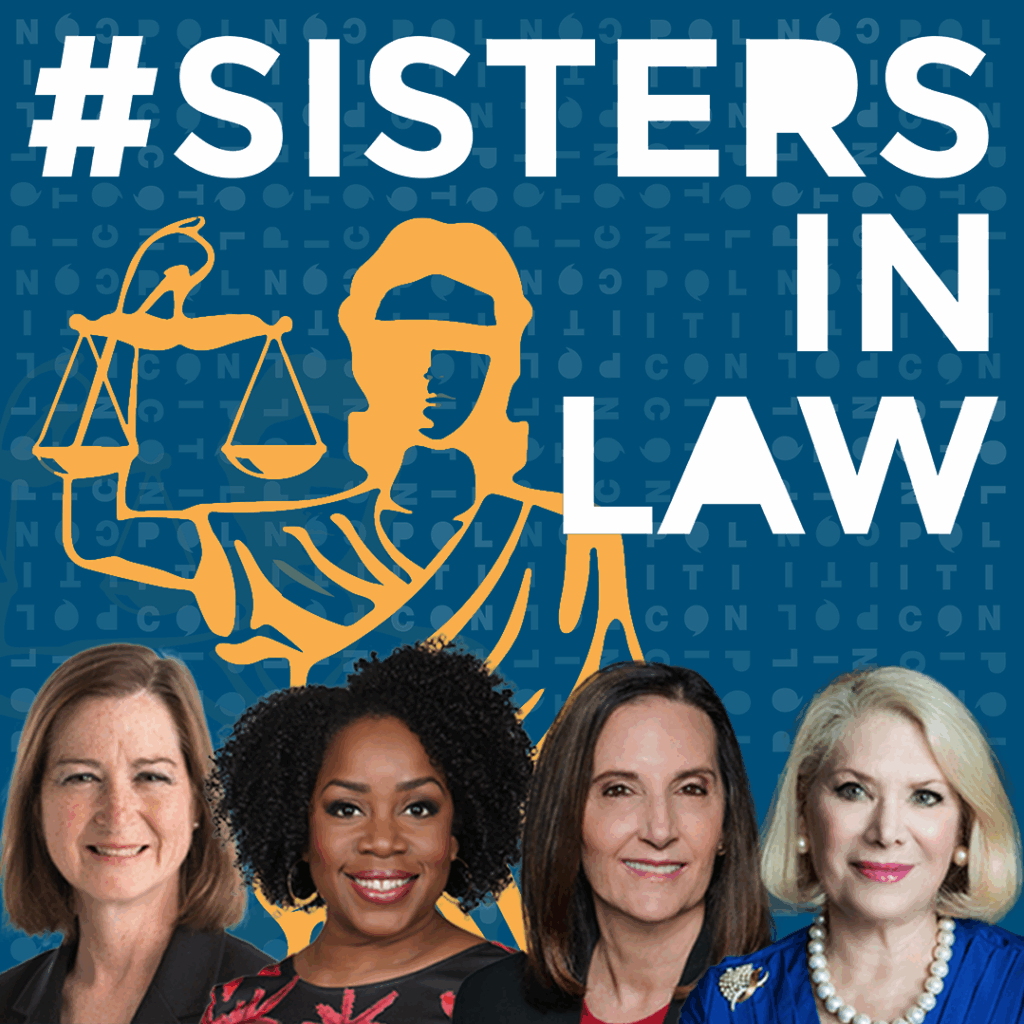
Kimberly Atkins Stohr hosts #SistersInLaw to discuss the SCOTUS ruling in Louisiana v. Callais, looking at the history of district allocation, how it undermines the Voting Rights Act, the significance of Justice Kagan’s dissent, and what it could mean for the country going forward. Then, the #Sisters explain the indictment of former FBI Director James Comey, the legal definition of a true threat, and the protection the 1st Amendment affords political speech. They also review the criminal charges against the attempted presidential assassin at the White House Correspondents’ Dinner and the ethics of using it as leverage for a White House ballroom.
Remember to send in audio questions to SistersInLaw@politicon.com for the #Sisters to answer on their new companion podcast, SistersInLaw Sidebar! It airs Wednesdays wherever you normally get your podcasts!
Get the brand new ReSIStance T-Shirt, Mini Tote, and other #SistersInLaw gear at politicon.com/merch!
Additional #SistersInLaw Projects
Check out Jill’s Politicon YouTube Show: Just The Facts
Check out Kim’s Newsletter: The Gavel
Joyce’s new book, Giving Up Is Unforgivable, is now available, and for a limited time, you have the exclusive opportunity to order a signed copy here.
Barb is going on a book tour! You can also pre-order Barb’s new book, The Fix. Her first book, Attack From Within, is now in paperback.
Add the #Sisters & your other favorite Politicon podcast hosts on Bluesky
Get your #SistersInLaw MERCH at politicon.com/merch
Email: SISTERSINLAW@POLITICON.COM or Thread to @sistersInLaw.podcast
Get text updates from #SistersInLaw and Politicon.
Mentioned By The #Sisters
From Barb: What is a Reasonable Expectation of Privacy in the Digital Age?
From Barb: The second James Comey indictment is another DOJ embarrassment
Support This Week’s Sponsors
Pocket Hose:
Text LAW to 64000 for your 2 free gifts with the purchase of any Pocket Hose Ballistic hose. By texting 64000, you agree to receive recurring automated marketing messages from Pocket Hose. Message frequency varies, and data rates may apply. Text STOP at any time to opt out. Text HELP for additional Information. No purchase required. Terms apply, available at http://PocketHose.com/terms
Osea Malibu:
Get a spring-worthy glow with 10% off your first order of clean beauty products from OSEA Malibu when you go to oseamalibu.com and use promo code: SISTERS10
IQBar:
Text SISTERS to 64000 to get 20% off all IQBAR products, plus FREE shipping. Message and data rates may apply.
HexClad:
Find your forever cookware @hexclad and get 10% off at hexclad.com/SISTERS! #hexcladpartner
Get More From The #SistersInLaw
Joyce Vance: Bluesky | Twitter | University of Alabama Law | Civil Discourse Substack | MSNBC | Author of “Giving Up Is Unforgiveable”
Jill Wine-Banks: Bluesky | Twitter | Facebook | Website | Author of The Watergate Girl: My Fight For Truth & Justice Against A Criminal President | Just The Facts YouTube
Kimberly Atkins Stohr: Bluesky | Twitter | Boston Globe | WBUR | The Gavel Newsletter | Justice By Design Podcast
Barb McQuade: barbaramcquade.com | Bluesky | Twitter | University of Michigan Law | Just Security | MSNBC | Attack From Within: How Disinformation Is Sabotaging America
Kim (00:11)
Welcome back to Hashtag Sisters in Law with Jill Wine Banks, Joyce Vance, Barb McQuade, and me, Kim Atkins-Stohr. Boy, what a week this has been. So as you might have already guessed our topics, I’m going to give them to you anyway. We’re talking about the absolutely devastating Supreme Court decision that guts just about all that was left of the Voting Rights Act after the last few times the Supreme Court ⁓ took a hatchet to it. We are also talking about the Groundhog Day style indictment of Jim Comey. Have we been there before? We sure have. And also we’re going to talk about the horrific attack on the White House correspondents, dinner, and the legal implications of that. As a journalist, I have a lot of feelings about that, and we are going to dig in.
But first, usually this is the time where we have a little chitchat about some topic beforehand, but honestly, it has been such a week. I can’t even think of anything fun to talk about, so I’m just gonna ask y’all, is there anything fun happen? Just give it to us, Barb, you start.
Barb (01:23)
boy, it has been a rough week with some of those ⁓ decisions that you talked about we’re gonna get into later. But you know what actually brought me a little joy this week? From the most unlikely source, cause I’m not a fan, but it was King Charles. The King Charles visit I thought was really refreshing. For one, did you see they made a bunch of funny like social media things where they’re bringing like Rue along on the trip and they played it to the Jay-Z, know, New York. You know, they had like some funny videos of them arriving, which were kind of fun.
Joyce (01:35)
Thanks.
Barb (01:52)
But the speech he gave, the King’s speech before Congress, we talked about the Magna Carta and the importance of checking executive power. I mean, here is a King telling a president, like, don’t get too big for your britches. I mean, listen to this.
Kim (02:05)
This is the country we defeated in the revolution. Coming and saying, okay, well, if you’re gonna do this democracy thing, well, at least do it right. Like, yeah.
Barb (02:15)
Isn’t that amazing?
Joyce (02:16)
You know, I saw a great meme on Instagram this morning that said that and I tried to find it. I can’t find it real quick. But it said something like, you had told the founding fathers that a British king would come to America to tell us to uphold the rule of law, they would have never believed it.
Kim (02:32)
Yeah. Yeah. So Joyce, what about you?
Barb (02:33)
That was great. Way to go, Charles.
Joyce (02:37)
You know, ⁓ so it’s allergy season here, which means I’m grumpy and grouchy and forgive me if you see me like shoving drinks into my face the whole time we tape today. But I’ll tell you something really exciting happened. ⁓ One of my neighbors has dragged me to a new exercise class. It’s a bar class and y’all know, our listeners may not know, I danced ⁓ ballet seriously for a really long time. And then tragically during pregnancy number
I jumped up, I came down, I tore my Achilles heel. That was more or less the end of my ballet career, although I tried to dance for a few more years. So this bar class, it’s not really ballet, but it’s close enough to scratch the itch, and it is bringing me an enormous amount of joy.
Kim (03:23)
that’s really great. know, it’s often that we hear about the mind-body connection, but it’s really real. It’s really real. Jill, what are you doing to lift your spirits this week?
Jill (03:35)
Well, we certainly all need a lot. And ⁓ I agree with Barb about King Charles’s visit, but also how the comedians reported on his visit. There were some pretty funny lines and remarks about that, but I would say in general, my friends and Brisby, of course, my husband, and theater. ⁓ And this week I went to a really amazingly amusing piece of theater at a tiny little
local place called Theo Ubique, and it just cheered me up so much. It made me really happy. And watching stupid stuff on television. I’ve just discovered Veronica Mars, and that’s making me just laugh. It’s really kind of, I’ve never seen it before, and I have enjoyed it a lot. So you gotta look for things. It’s what you do proactively to get over the mess that we are in. And then of course, as Joyce would say, we’re all in this together, and we have to do something. So once we get
a little laughter, we have to go back to making sure that we do everything we can to protect the democracy we grew up with.
Kim (04:43)
That is good. So here’s a little bit of trivia. The lead actress in Veronica Mars, Kristen Bell, like Barb and I, is a Michigander. And in fact, she went to the same high school as I did. Although I was a little older than her, so I was long gone. But she went to Shrine High School in Royal Oak, Michigan, just like me. So we are both, we are both knights.
Barb (05:05)
You’re a Shriner, did you wear the little skirt and everything?
Kim (05:08)
You know what, never did, so ⁓ Shrine had a uniform, which at the time was, we either had to get this ⁓ plaid skirt or wear navy pants or skirts. And I was actually kind of excited about going to a Catholic, I’m not Catholic, I just went to Catholic high school and getting the little plaid skirt, but ours was so ugly that I got through all four years never having bought that skirt. I made my own like pants and skirts in navy, but then I didn’t want to wear navy for like five years.
But, so anyway, the one thing.
Joyce (05:40)
Pat Kim just casually says, and then I made my own pants.
Kim (05:44)
I was so like I made like the baggy hammer style pants from the night, you
Joyce (05:51)
Yeah, that’s style of-
Barb (05:52)
the
Kim (05:53)
all kinds of different things. So in terms of what I’m trying to do, one thing I’ve been doing this week at night is watching old movies because like honestly, modern stuff just given how crazy real life is just doesn’t cut it. You got to go back to like the 30s and 40s to get to the craziness to really be escapism. And so one of my favorite movies that I watched is Arsenic and Old Lace. you?
Barb (06:17)
that’s a great one. We’re silly.
Kim (06:21)
It had me howling. I don’t know how this old movie about these two sweet old ladies who are actually serial killers can be so funny, but it is. ⁓ And so I ⁓ suggest that we go back and go to the campy old style movies because that’s the only thing that can be actually stranger than what’s going on right now.
So it is springtime. I have ⁓ on my list to do this weekend is to hose off the porch because it’s covered in all of the pollen from the spring. And I think we’re finally on the other side of that. My nose is telling me we are. Hose? you talking nose? Pocket hose? You got ahead of me, Barb. You got to the pocket hose. You did a spoiler. I’m excited to tell you about the world’s number one expanding garden hose.
Barb (07:08)
You use the
Kim (07:21)
and their brand new product, the Pocket Hose Ballistic. I’ve been really excited to use this because, you know, we’ve all grown up with the terrible green rubber hose and they’re old fashioned and they kink and they, you you push the nozzle and nothing comes out and you’re like, is a kink in it somewhere and you gotta go out and find it. They’re also really heavy. But one thing that I like about the Pocket Hose is that it’s super light. I was actually really surprised at how light it was when I used it
the first time and it has so many settings that you can do everything from very gently watering your flowers to really power washing ⁓ the patio like I need to do this weekend. know, that’s what the pocket hose is here for and that’s why it’s the number one expandable hose in the world.
Barb (08:08)
I love the pocket hose. The pocket hose is super lightweight. It’s easy to manage. It’s easy to store. I squirt stuff just cause I can with my pocket hose. You turn the water on, Kim, correct me if I’m wrong, right? Back me up on this. You turn the water on. It’s this tiny little thing and it grows and you can spray whatever you want, but then you turn the water off and it shrinks back to pocket size. Seriously, like something out of science fiction.
Kim (08:31)
Yeah.
Barb (08:35)
The pocket hose ballistic is even reinforced with a liquid crystal polymer. The same thing that’s used in bulletproof vests, making the anti-burst sleeve practically indestructible. And that same polymer fiber is actually five times stronger than steel. And better yet, it comes with the pocket pivot, the pocket pivot, which gives you total freedom of movement.
at the spigot with 360 degree rotation. So when you move, it follows and the water flows. Can you tell I love the pocket?
Kim (09:10)
I really can, Barb. I can tell you love it to death.
Joyce (09:13)
You know, so I’m either lazier than you guys or maybe I’m just an early adapter, but I got so tired of those old green hoses that like, you know, because in my garden, I carry my hose maybe 100 feet to water and I do it every day and those hoses, they wouldn’t bend with me. It was just so annoying and so frustrating. So I discovered the idea of collapsible hoses four or five years ago. And since then, I’m fairly confident that I’ve tried everything on the market.
Love the idea. Sometimes it works really well, but the pocket hose, this is my favorite one. It’s a game changer. It’s easily the best yard and garden upgrade we’ve ever made. I’ve been slowly replacing every hose around our house with one of these. I’m totally sold. No matter how much I need the water, and I do live in the deep South, this hose moves with me. It saves a lot of time. used to use unkinking and it was like just such a pain in the neck to do it.
⁓ When you’re done, this is out of sight, out of mind. And I have to say, it’s really fun to, you know, as you turn off the water to watch the hose collapse back in on itself, it sort of freaks my dogs ⁓ out. They sort of walk, wondering what it’s doing, but it makes a very annoying chore, a lot of fun.
Jill (10:33)
I can’t wait to try it, but it’s too cold here. I’m so sad. It’s really pathetic. But when it arrived in the mail, I was like shocked. It’s this small and it’s, you know, you hold it in less than one hand. It’s just amazing. So make your yard a hobby instead of a chore. And now for a limited time, when you purchase a new pocket hose ballistic, you’ll get a free 360 degree rotating pocket pivot
and a free thumb drive nozzle. Just text LAW to 64,000. Again, that’s LAW to 64,000. 6400 for your two free gifts with purchase. Text LAW to 64,000. Message and data rates may apply. The link is in our show notes.
Joyce (11:33)
Now though, we’re going to talk about a Supreme Court case that I have been discussing with my sisters for at least two years. This is an unusual case, Colle versus Louisiana. It was briefed last term. It was argued last term. It was ready for the Supreme Court to make a decision in. And then they punted. They said, we have some other questions we’d like to address. We’re going to hold this over for next term, the current term that we’re living through.
And those of us who read that as a signal that this court, that the conservative majority on this court was up to no good, we were absolutely correct. So, Barb, can you set up the table? I’ve sort of just talked about the basic contours, but talk with us about the procedure that brought Calais to the United States Supreme Court. It’s procedurally tortured and such an unusual situation, starting with who the plaintiffs are, for instance.
Barb (12:32)
Yeah, you know, it did have ⁓ a tortured history. It all began, after the 2020 census. And so, you know, after every decennial census, there is redistricting that occurs to allocate the correct number of representatives to ⁓ each state and each district. And so Louisiana ended up with six congressional districts and about one third of the people in Louisiana are black. You would think that would mean then
likely three congressional districts that are majority black. You would be wrong. Instead, they ⁓ revised their lines and said, you know what, we had one minority district before and by gum, we’re going to have one now. So the GOP controlled legislature in Louisiana created a map with one district that was a majority black district. And so there were some black voters who challenged that and said that violates the Voting Rights Act.
It violated section two by ⁓ discriminating against race in elections. And the district court agreed with that. ⁓ The Fifth Circuit Court of Appeals said that the state legislature had to come up with a new map that would ⁓ comply with the Voting Rights Act. So the legislature draws up a new map. This time they come up with two majority minority districts and say, okay,
There you go. Instead of one, now you get two, even though half the state, a third of the state is black. This time, a group calling itself non-African American voters said, we think that this map was racially gerrymandering, gerrymandered and should not be used in the upcoming election. The Supreme Court allowed it to be used in 2024, because they were just too close to that time. Scheduled oral argument in this case for 2025.
And instead of deciding the case after hearing oral argument, the court relisted it for oral argument in this term, this year, the October, 2025 term, and heard argument last fall. And this time it asked the parties to submit briefs addressing whether these new maps violated not only the Voting Rights Act, but also the 14th and 15th amendments to the constitution. And that was the point where I think most of us went, uh-oh. Because to simply ⁓ comply with the law,
would not have required this supplemental briefing. This time around, Louisiana, with its geopiect-controlled legislature, said, you know, never mind. Remember we said we would do two districts? Yeah, we’re going to say that’s no longer valid, and we’re not going to defend that anymore. ⁓ Instead, we’re going to argue that these new maps do indeed violate the 14th and 15th Amendments. And so that’s how they got to us. The case was argued in the fall, and the decision came out this week.
Joyce (15:24)
You know, that is such a great scholarly layout. Something that I appreciate about y’all so much is that I just wanted to come in here and smash and burn. I hate these decisions so much. And I appreciate that you took the time to set it up in such a measured fashion. I mean, here’s the part that makes my blood boil and y’all make me stop if I jump in to the deep end. But this is a court that spends all of its time talking about tradition and history, you know?
Women can’t have a right to abortion anymore because historically they didn’t have it or people can go and shoot up schools because historically Americans had the right to have a musket at the time of the founding. And now, you know, here we are in this case where we’ve got post-Civil War amendments that were enacted to end a history of racial discrimination among other things in voting. And the court is willing to totally ignore that and look at white voters.
who’ve never been discriminated against. And just to say, you poor people, having a second district where black people have an opportunity, not a lock, by the way, an opportunity to elect the candidate of their choice, even though they’re 30 % of the population, as Barb says, that’s discriminatory and we’re not gonna allow it. They make my blood boil. Kim, explain to us this court’s holding. I mean, it’s complicated.
Tarsip for us.
Kim (16:55)
It’s complicated and it isn’t. mean, I’m with you. Like, I’m glad that Barb set it up and I think now you and I are ready to set it on fire. So in a 6-3 opinion, usual suspects written by Samuel Alito, which we already kind of figured out based on who had written an opinion on that first argument, we kind of knew who was going to
Barb (17:16)
When this is coming out, I’m sure you guys are like watching the, maybe you’re there, Kim, I’m watching the SCOTUS website, you ⁓ Like, you remember the line from Jerry Maguire, like he had me at hello? This is like, you had me at Alito, like, no. Exactly. He’s not gonna be good news.
Kim (17:30)
Yo!
Joyce (17:33)
We
did that in our Denver show, right? I mean, we were reading the tea leaves about a leader not having done a major case yet.
Kim (17:40)
But I gotta say, even though we knew what was coming and how, it was still just devastating. in this opinion, joined by the other conservatives, ⁓ Samuel Alito basically holds this. And what gets me isn’t just the effect, it’s the gaslighting. He essentially says, okay, no, we’re not gonna strike down section two of the Voting Rights Act, which is something that they could have done. They were considering the constitutionality of the section, which as Joyce said,
uses the word opportunity. ⁓ conscription, what the Voting Rights Act protects is that voters of color have an opportunity to elect the candidate of their choice. Doesn’t mean they get it. Doesn’t mean there isn’t all kinds of other shenanigans that keeps them from getting it. Just enough critical mass in a district to even have their votes be as powerful as that of white vote.
white voters, right? Leveling the playing field. So that’s what we’re trying to get to. And that’s what Louisiana did with these two districts, right? Two out of six is a third. So that kind of makes sense that they would do it that way. ⁓ So what Alito said is like, okay, that’s not unconstitutional. And it’s not even unconstitutional to have the remedy that if you find a violation of the Voting Rights Act, that a state has to redraw its maps. That’s all okay. But
If in that remedy you consider race, you violated the 14th Amendment’s Equal Protection Clause, which prohibits, wait for it, discrimination on the basis of race. And then he threw in another zinger. In the past, we have talked about ⁓ gerrymandering for political purposes, right? Partisan gerrymandering. And we’ve talked about how the Supreme Court, not only
did not rule that partisan gerrymandering is unconstitutional. They ruled that courts can’t even consider partisan gerrymandering challenges, right? Partisan gerrymandering, A-OK. So Alito added in this that not only is it important to guard against the racial discrimination that takes place in rectifying racial discrimination, but especially it’s terrible to do when you have ⁓ incumbents
in Louisiana who may risk losing their seats based on this redistricting. Excuse me, I did not know that there was a constitutional protection of incumbent Republicans in Louisiana, but apparently Alito does. And how that consideration, protecting the incumbent Republicans in Louisiana is more important than the Voting Rights Act, 60 years of work in keeping
voting suppression from happen. They actually wrote that in the opinion and five, count them, five justices signed on and to boot, Clarence Thomas and Neil Gorsuch were just like, yeah, we would have gone further and just like said that you can never allow for redistricting as a remedy for racial gerrymandering. This is your Supreme Court, ladies and gentlemen.
Joyce (20:55)
I you know, I have deja vu all over again because where you started, Kim, it’s so reminiscent of Shelby County versus Holder, where the court didn’t say Section 5 was unconstitutional. They just gutted it by saying the criteria that were being used to protect voters under Section 5 were unconstitutional. We have that same monkey business going on here with Section 2, right?
Kim (21:20)
Brnovich too. Brnovich said did that too.
Joyce (21:23)
I mean, like, they just keep pulling the wool over most of Americans’ eyes and thinking that they’ll get away with it. They will not get away with that sort of stuff here at Hashtag Sisters-in-Law. We will call it out. ⁓ Jill, how do you react to the majority’s opinion? What are your views?
Jill (21:41)
Well, I would not say I was shocked because, as we all have said, we predicted that this would be, despite whatever hopes we might have had, that this was going to be the outcome. But I am revolted. am totally, I don’t know what other word to use. It’s something, you know, I’m the oldest of us and I was definitely an activist during the civil rights movement. And I never would have predicted that the civil rights
movement would be undone by the Supreme Court of the United States and that’s what’s happened even though they said well we’re not undoing it we’re just updating the requirements. ⁓
Kim (22:22)
See you soon.
Barb (22:23)
It’s
time for an update! President whatever!
Joyce (22:29)
I’m going to update. just don’t get it.
Jill (22:32)
Constitution
makes me wonder really how many ways MAGA has around the Constitution, especially when the court and Congress are doing nothing to stop it from happening. the court, I mean, the court is supposed to be the court of last resort, the court that will stop unconstitutional acts. And I want to just say the Voting Rights Act was not only passed in 65, it’s been re-upped multiple times.
And it was amended to specifically make sure that you didn’t need to prove intent. All you needed to prove was that it affected your opportunity to vote. And now they’ve gone, yeah, no, not so much. So they’re completely obliterating the act and everything that Congress, mean, if congressional intent ever meant anything, it would have ruled here that no, it cannot be undone in the way they have. I’m really…
You know, I’m just, I’m revolted and upset and concerned about our democracy.
Joyce (23:37)
I think that’s all fair. Barb, what’s your reaction to the majority opinion?
Barb (23:41)
Yeah, you know, ⁓ very much in line with what we’ve heard so far. But I think one of the things I want to add is this distinction between intent and effect. I think it is so important here and in all other contexts about how we think about race in the law and in society. Keep in mind that in 1982, in response to a Supreme Court opinion, Congress specifically renewed the Voting Rights Act and clarified
that it was enough to show discriminatory effect without showing discriminatory intent. Because after all, who are we thinking about here? The people whose rights are violated or the hurt feelings of those who violated them? And I really think so much of the discussions around race come around to this. People say, how can this be racism when I didn’t intend racism? How can this be discrimination when I didn’t intend discrimination?
It isn’t about you. It’s about the people whose rights are being restricted. And that’s the whole concept of systemic racism or systemic discrimination. It is that in Louisiana, where a third of the state are African-American, of its six districts, only one is majority minority. I don’t care if it was intentional. And frankly, it’s hard to avoid concluding that it is.
That is not intentional when you end up with five majority white does, but be that as it may, it can be very difficult to prove intent to discriminate. Why do we need it? Congress said we don’t. And if we’re trying to improve and truly have a colorblind society, as Chief Justice Roberts likes to say, then why do we need to talk about whether there was this intent? I hear this in conversations with white friends and white colleagues from time to time about this argument that
Why should there be a remedy if there is no intent to discriminate? ⁓ That’s what it is. It’s because we want to equalize the playing field. And there’s also, I think, this idea that the worst thing you can call me is racist. You know, I can think of some worst things that people are called by racists. Get over yourself, right? It isn’t about you. It isn’t about whether you intended or not. It’s all good.
Whatever happened, we’re all doing our best here, maybe. But regardless of what you intended, what matters is the outcome. I also sometimes hear people say this, look, it’s 2026. My answers came from, you know, Yugoslavia, Poland, wherever it is. I did not in any way participate in racism or Jim Crow or any discrimination against black people. Why is it being held against me? It’s not being held against you. You are benefiting.
from a system that favors white people. We are trying to have a system where all are equal. And that’s this distinction between intent and effect that I think gets missed so often by even people of good faith. And I most certainly don’t think that Justice Alito is a person of good faith, but that’s what matters in my view. And I think that because it’s so difficult to ever prove intent that as a result of this case,
Jill (26:40)
equal.
Barb (27:03)
it will essentially eviscerate Section 2 of the Voting Rights Act.
Joyce (27:08)
You know, is so much out of her, right? Needed to be said. Thank you, Barb. I will add a boring point to your very eloquent one, which is that as a lawyer, it’s not easy to prove that a legislator intended to discriminate. They’re usually smart enough to say that it’s just about politics, which the Supreme Court has said that they can do. Yeah. But there are exceptions. I’m looking at you, Alabama.
Kim (27:09)
Barbara McQuade.
Joyce (27:37)
where in Milligan, a case that is still working its way through the courts, there actually was proof that the legislature intended to discriminate on a racial basis. ⁓ But you don’t get that lucky very often as a lawyer. And unfortunately, this majority opinion says even having proof of intent is not enough. There are still hoops that you have to jump through.
And it’s essentially no longer possible to bring a Section 2 case. You know, the Chief Justice, when he wrote Shelby County, ⁓ said, well, yeah, Section 5 is going away. But don’t worry, folks, because you can still get a remedy under Section 2. And now you can no longer get a remedy under Section 2. But Justice Kagan had some things to say about that, Kim. Let’s talk about the dissent. You were so sweet. You were reading the dissent.
and you texted us, I think you just said, I’m weeping.
Jill (28:36)
I’m I’m gonna cry.
Joyce (28:38)
Is that what it was? was an ugly pride. That’s ⁓ dead on the money. Tell us about it.
Barb (28:40)
I’m
Kim (28:46)
Yeah. So, ⁓ Elena Kagan, who often writes very eloquently about things like voting rights, ⁓ just did not mince her words. mean, despite the gaslighting that Alito did, she made it plain that ⁓ the Voting Rights Act was, a dead letter now. And I’m going to read a little bit from her dissent, in which she did not say respectfully. She said, I dissent. There was no respectfully in it. And I agree with that sentiment. ⁓
She said, the Voting Rights Act is, or now more accurately was, one of the most consequential, efficacious, and aptly justified exercises of federal legislative power in our nation’s history. And that gets to Joyce’s point that this was a Reconstruction era. It was empowered by a Reconstruction era amendment, the 14th amendment, the same one that Alito used to kill it. So Kagan continues.
It was born of the literal blood of Union soldiers and civil rights marchers. It ushered in awe-inspiring change, bringing this nation closer to fulfilling the ideals of democracy and racial equality. And it has been repeatedly and overwhelmingly reauthorized by the people’s representatives in Congress. Only they have the right to say it is no longer needed, not the members of this court. I dissent then from this latest chapter in the majority’s now completed
demolition of the Voting Rights Act. I mean, she said it. She said it.
Joyce (30:16)
⁓ You know, Jill, is there another part, I appreciate that Kim read the text. I actually wrote in my newsletter last night, I sort of had to take an extra day to calm down a little bit. And then I tried to pull out some of the actual language because I think Justice Kagan is writing for Americans. She wanted people to be able to read her dissent. It’s about half the length of the case. It’s about 45 pages or so long. What stood out to you, Jill?
Jill (30:46)
Well, first of all, let me say, my printer failed, because I was going to read parts of it as well, but I couldn’t, and I tried taking notes. There are so many parts that stand out to me, ⁓ and it sort of builds to a crescendo. So when I started taking notes when I realized my printer had failed, I started at page 30 of her descent, which goes to 44, 45.
Joyce (31:14)
Flow.
Jill (31:15)
Yeah, and it really just builds and builds and builds. And she does have some snarky comments in there where she goes out of her way to be particularly hostile. Like, presumably the majority thinks the ⁓ details do not matter about how this could be proved, which it can’t be. I mean, you just look at all the things that could not be proved except, as you said, there’s one case or…
Fox News that actually sent out emails saying, yeah, we intend to do these lies about the voting machines. But I’m just not sure there were so many things. I think maybe her comments about stare decisis no longer mattering because she goes through a very lengthy and brilliant explanation of why the cases, why the 1982 amendment to undo what the court had said and to make
clear that it was, as Barbara said, affects not the intent, partly because intent can’t be proved. And I also love to reference back to Ginsburg’s comment about saying you’re not getting wet because you have an umbrella and then throwing away your umbrella. It’s the same thing here. They say, well, minorities are voting and getting more power. They have people elected to office. So let’s throw away the reason that they have accomplished that, which is the Voting Rights Act.
So to me, it was so evocative of that comment. ⁓ And I think also her distinction between ⁓ using historical data versus what’s happening now and distinguishing why when they abolished Section 5, that was different because that was based on picking out districts that had in the past discriminated. Whereas this law says, you have to show what’s happening now. Is there an effect?
effect right now. And I thought that was really good. So, I mean, there are just so many parts. I reading it is the only way to understand how powerful and correct. One can only hope that it is what will happen in the future, that there will be a Supreme Court who then adopts the dissent as the majority opinion.
Joyce (33:32)
Yeah, mean, Barb, that’s the question I was going to ask you. Funny enough that we all keep finishing each other’s sentences after five years of doing this. know, Justice Ginsburg used to say, she said in a couple of very powerful interviews, that she wrote dissents for the future, that it was a future vision. Do you think Jill’s right? Do you think that this dissent, is there a path for it to become the law or are we just done here?
Barb (34:00)
sure, and I agree, that’s why you write it down, to just say, I vote against it, the end would not be to memorialize one’s reason and there’d really be no reason to do it. mean, if you want to look for hope to the future, just look back to ⁓ the role that ⁓ Chief Justice Roberts and Justice Alito played back in the early administrations, in Republican administrations.
when they were fighting the Voting Rights Act, right? In the 1980s in the Reagan administration, ⁓ they were writing about why the Voting Rights Act was unconstitutional back then, and they failed back then. And they kept at it for 40 years, and here they are today. ⁓ You know, I think maybe people need that sort of awakening that we’re getting right now, that sort of slap in the face, that without the hard work it takes to reclaim these rights.
they’re going to be taken from us. And so I hope that Justice Kagan writes out a path for the future ⁓ and that when some crackpot like me says something, I’m just some crackpot saying something. But when you’ve got a justice of the Supreme Court writing it and supporting it with legal argument, people have to read that and take that seriously. And so I hope that that scholarship ⁓ will follow and I hope that lawmaking will follow that will ⁓ ultimately
bear fruit and help us move toward that more perfect union that she describes about the literal blood of soldiers in the Civil War and of people during the Civil Rights Movement will not have been in vain ultimately.
Joyce (35:37)
Well, we’re already seeing the political fallout from this decision. Louisiana interrupting elections. There are moves in other states like Florida to redraw maps. I think we’ll leave that for next week when we’ll have more of a sense of what the actual political fallout looks like. But there is no doubt that Calais makes a major impact on American elections and not for the better.
Jill (36:11)
The best part about the start of summer is when you have taken care of your to-do list and take your first step outside to feel the sun caressing your skin. Instantly, your worries melt away and you feel vibrant and refreshed. I know I can’t wait for that, but fortunately that feeling comes in a bottle thanks to seaweed-powered clinically tested formulas of Osea. Not only do they deliver visible results, but their full line of body care staples
means they have something for everyone. In my case, I had to learn to share that with my husband. It is a shock, but Michael loves the fragrance and the texture so much that he’s using it too. So make sure you get enough for your whole household.
Kim (36:58)
Yeah, the temperatures are rising and we outside showing skins. You know what that means. That means it’s time for Osea’s anti-aging body balm. It’s a liquid silk body balm that combines the lasting hydration of a lotion with the firming power of a serum, leaving your skin smoother, firmer, and beautifully supple. My skin feels so much softer and it feels really relaxing to apply it. It’s like a personal spa day that leaves my face feeling so much more vibrant
And afterwards, the glow lingers for days and it’s perfect for putting me in a vacation state of mind.
Joyce (37:33)
You know, because we’re using these products, I’m not surprised by what scientists found in OCEA’s clinical trials. We believe in science here at Hashtag Sisters-in-Law, and an independent third-party consumer perception study conducted among 32 women discovered that 94 % agreed their skin felt nourished, moisturized, and softer. 94 % agreed their skin looked smoother, more supple, and glowing.
and 84 % agreed their skin looked firmer. That lets you know that you’re getting a winner.
Barb (38:08)
Osea’s products are truly transformative and we love that everything is vegan, cruelty-free, and comes in sustainable packaging. So don’t wait, get a spring-worthy glow with clean, clinically tested skincare from Osea. And right now we have a special discount just for our listeners. Get 10 % off your first order site-wide with code SISTERS10 at oseamalibu.com. That’s O-S-E-A-malibu.com, code SISTERS10.
The link is in our show notes.
Jill (38:49)
Last September, former FBI Director James Comey got indicted for lying to Congress. Although I think Comey wanted that to go to trial so he could prove how wrong those allegations were and that he was innocent. It was dismissed because the only signatory to the indictment was the improperly appointed US attorney, Lindsay Halligan. She’s now out of office and the case went away. It was dismissed by the court, but…
Now we have Todd Blanch as the acting US Attorney General, and he’s not giving up. He’s bringing another case. This one is based on a photograph of seashells by the seashore. I hope I said that properly because that’s one of those things you learn how to not say. She sells seashells by the seashore. ⁓ it’s seven months after
⁓ He was indicted the first time. the timing may be strange, but there it is. And I want to talk about the case. It happened to be indicted in North Carolina. And it was almost exactly a year ago that he posted this. He’s now charged with death threats under 18 USC 871 and transmitting those threats through interstate commerce.
in violation of 875. And Joyce, let’s talk about what would the government have to prove? What are the elements that would make this a prosecutable case?
Joyce (40:29)
Yeah, I mean, the statutes are almost self-explanatory, right? You’ve just referred to them. 871A makes it a crime to knowingly and willfully make a threat to take the life of, to kidnap, or to inflict bodily harm on the President of the United States. So that statute is specific to the President and other high elected officials. But the core of the statute is proof.
that the person that you’ve charged intends to inflict bodily harm upon the president. Then we have 875C. It’s a much more generic statute. It talks about making it a crime to threaten to injure a person, right? Not to post some frickin’ seashells on the beach in North Carolina. You have to actually have the intent to hurt someone or to cause other people to hurt them.
And that’s frankly the core of the crimes that are charged here, you know? And we all know the basics. Government must prove those elements of the crime beyond a reasonable doubt to the satisfaction of every member of a jury. So I guess you already know what I think about this indictment just based on that explanation.
Jill (41:44)
And, and Barb, let’s follow up on that because Joyce mentioned one of the key essential element is intent. Yeah. Or even whether a reasonable person, because this is other part of it, is a reasonable person has to be able to understand the image or the threat as a threat to the president’s life. Was that properly pleaded? Was, is there any evidence of that? What do you think?
Barb (42:10)
No, I am all over this, ⁓ When I served as US Attorney, ⁓ so often people would come to us with things they saw as threatening. And no doubt there are lots of really frightening, awful things that people post online that are deeply hurtful, insulting, hateful, ⁓ and even sound dangerous. But that which is sort of ⁓ advocacy. ⁓
in theory, is not the same thing as a true threat. And so there are a couple of cases we look to that define true threats. One was a case called Alanis about somebody who wrote like a rap song over Facebook and posted it that sounded like a threat. was, you know, it was a song that was derogatory about the subject. But what the court held there is that true threats, which are prosecutable.
are serious expressions conveying that a speaker means to commit an act of unlawful violence. So we’ve got that, serious expressions conveying that a speaker means to commit an act of unlawful violence. So that’s the first piece. And then in 2023, you may recall, our listeners may recall, we discussed this case at the time, the Supreme Court came down with a case called Counterman versus Colorado to clarify this because what they said there is, remember when you’ve got a crime,
you look at the intent of the defendant, not the intent of the victim. And that standard about what a reasonable person might ⁓ assume is all about the victim’s intent and not the defendant’s intent. And so what the court held in counterman is that the defendant themselves must have at least a level of recklessness. It could be purposeful, it could be knowing, but at least reckless when they communicate that threat.
And as they described in that case, it’s a deliberate disregard of a known risk that the statute could be seen as a serious expression conveying that the speaker means to commit an act of unlawful violence. And one thing I’ll note is that in the indictment, they use that old Alanis standard, the pre-2023 standard, where they talk about a reasonable recipient who is familiar with the circumstances would interpret the communication as a serious expression.
Somebody got an old go-by here. This is the pre-2023 standard. ⁓
Kim (44:32)
They did not jeopardize that case.
Barb (44:34)
That’s
right. This is not the current legal standard. But even if they were correctly articulating the legal standard, I just don’t see any way they make out this case because as Jim Comey said, the very next day, he took it down, he was questioned by Secret Service, and he said, I had no idea people associated those numbers with violence. I’m opposed to violence of any kind, and I’m taking it down, and that is not what I intended to communicate.
The idea that they are going to try to persuade 12 jurors unanimously to decide beyond a reasonable doubt that he ⁓ was aware of the risk that this would be perceived as a serious intention to cause unlawful harm of violence and deliberately disregarded that risk, I just don’t see how they make that out.
Jill (45:23)
So Kim, let’s follow up on that a little bit because just to make clear to our listeners, I’m not sure we clarified, this was a picture of shells on the beach that were organized to look like 8647. And so first of all, let’s talk about, could that reasonably be considered a threat? What’s the ordinary meaning of 86? Obviously, 47 is a reference to the 47th president.
And why, if it was such a serious threat, did they wait a year after the posting on Instagram to file charges?
Kim (46:03)
Well, these are easy questions. So first of all, 86 comes from the culinary world. Now, I am not a chef, but I watch The Bear, so I feel qualified to talk about this. When you are at a restaurant, okay, say you’re at a restaurant and you did not get Parmesan cheese with your order that day, but you have chicken parm on the menu, that means that the chicken parm dish is 86 from the menu. You are unable to provide the thing, so you take it off the menu.
The has also been used, for example, in sports, sort of adopted for that. ⁓ To indicate, for example, in some sports that all the players are off the field, all right, the field’s been 86th, or that there is a player that’s not gonna play a certain position, they’re 86th from the lineup or something like that. I cannot find a single, and I did a little research, equating that to,
any sort of violent act. Now, I’m gonna give you something to contrast that to. People who are either from California or ⁓ are familiar with hip hop culture from the 90s. There is something called 187, right? If y’all listen to Snoop Dogg, you know where I’m going. So that is the section of the California Code.
that pertains to homicide. It breaks down the elements of the different types of homicide, murder, and manslaughter, so forth. And so it became colloquially used to 187 somebody, or that’s a 187. That means you’re talking about a homicide, right? It became that. 86 isn’t that. Now, if James Comey said 187, 47, I’d be like, oh, Comey, you shouldn’t have done that. Like, that’s crazy. But he didn’t do.
You didn’t post that. Like, I think this is a stretch. And why? A year? Because the first one didn’t work. The president is raging on true social. He wants somebody. He wants a pound of flesh from his perceived political enemies. And Todd Blanch, who wants the job at the top of DOJ, is doing all he can to get it. That’s it.
Jill (48:14)
You are so right. And Joyce, this isn’t the first time someone has used 86. But in reference to President Biden, ⁓ a pro-Trump influencer, Jack, I’m not sure how to say his name, Pozjak, Pozobiak, Pozobiak, thank you. ⁓ He wasn’t indicted for posting that and neither was the creator of Dilbert.
Barb (48:31)
Psobiac. ⁓
Jill (48:41)
And in 2020, Gretchen Whitmer, your governor, displayed a sign behind her in a shot that said 8645, which is.
Kim (48:51)
don’t believe it was a pin, Jill. I think it’s a pin.
Jill (48:54)
Gosh, I need that pin.
Barb (48:56)
Jill, do you have that pen? Watch it. Watch yourself now. might get indented
Jill (49:00)
No,
I’m that tin. man.
Kim (49:03)
Although it said 45, so how long is the statute of limit?
Barb (49:07)
Five years, it’s too late. was in…
The republic has been clamoring for her indictment. It’s time barred.
Jill (49:16)
my God, just was gonna ask him or Joyce or someone is she next? And I guess the answer is I
Joyce (49:24)
No,
she is not next. There’s still merchandise on Amazon that carries that. I mean, you know, it’s like, this is just as Joe Biden would have said, malarkey, right? People make far worse threats than 86, 47. mean, Donald Trump, I know you guys all remember this, right? When Trump posts on Truth Social, that video with the truck that had the banner of a kidnapped, bound,
Jill (49:26)
No.
Joyce (49:53)
gagged Joe Biden and everybody was pussyfooting around. I just remember like, I was even pussyfooting around. said, well, I hope that the Secret Service has a stern conversation. Former president. Nobody talked about lighting his ⁓ up and indicting him and putting him in prison for doing it. This is just crazy talk. I mean, this is like when Trump, you know, was trying to DM Pam Bondi, but instead he accidentally.
on Truth Social and he was like, it’s embarrassing, Pam, that you have not gotten Jim Comey yet. This is just, as Kim said, this is just Todd Blanch auditioning for the job of attorney general by pandering to the president.
Jill (50:38)
Okay, so that raises a question again, because I mean, selective prosecution. There are all these non-indictments of people who have posted 86 something. And I’m just wondering whether this will, ⁓ Barb, maybe you can talk about this, support vindictive selective prosecution, or what other motions to dismiss would you file besides that one?
Barb (51:03)
Yeah, so this is a great opportunity to clarify the two things. People always talk about selective and vindictive prosecution as if they are the same thing. They’re two very different things. Jim Comey actually raised both the last time he was indicted. And although he may have had a good charge for selective prosecution, a good claim, both are violations of the due process clause and can be a reason to dismiss a case. But vindictive prosecution actually means something different. Let me say what that is. That is when a person is charged
⁓ based on their exercise of a known legal right. It happens most frequently when say somebody ⁓ appeals their conviction, the case gets reversed on appeal, and this time the prosecutor comes back with more. yeah, wise guy, you appealed your case for one count of bank robbery. Well, guess what? This time I’m charging you with bank robbery and armed robbery and obstruction of justice. I’ll teach you to exercise your legal rights. That’s vindictive prosecution.
When Comey raised it, his theory was that he was being retaliated against for exercising other unrelated First Amendment rights, like speaking out against President Trump. I don’t think that’s a close enough nexus. Maybe he’s right and it will expand the doctrine, but typically it has to be within the same or related case. So I don’t think he will succeed with vindictive prosecution. Selective prosecution is a different story. That is, there was no legitimate law enforcement reason for charging me with this crime and other
people similarly situated have not been charged with a crime. Most often it’s very difficult to prove that and that’s why most selective prosecution defenses fail. It’s because how do you find people who did the same thing I did, the exact same thing, but haven’t been charged with a crime, right? It’s like the dog that didn’t bark. How do I find them? Well, in this case, the crowdsourcing has found them for him because as we’ve just said, there are…
all kinds of t-shirts and hats and bumper stickers all over Amazon and no charges against Jeff Bezos, Trump’s buddy. The example Joyce just gave of President Trump himself posting Joe Biden at the time he was president, bound in gag depicted in the back of his truck. And how about just Saturday night where Carolyn Levitt, the White House spokesperson who was asked about the speech Trump would deliver that night said, there will be shots fired.
Was she threatening to kill the journalists in the room? Of course not. And so I think selective prosecution is actually a winner in this case, whereas it’s very difficult in most cases. And then Jill, the final, ask your last piece of the question, what other motions might I file? I think I would file a motion for a First Amendment violation. Not only is this not a true threat, I think it is protected by the First Amendment. It is speech that is critical of the president. It is political speech that gets a high level of protection.
And I think that could be an additional grounds for dismissing these charges.
Joyce (54:10)
This episode is brought to you by IQ Bar, our exclusive snack, hydration, and coffee sponsor. IQ Bar protein bars, IQ Mix hydration mixes, and IQ Joe mushroom coffees are the delicious low sugar brain and body fuel you need to win your day. They have something for everyone, but we recommend the Ultimate Sampler Pack. It’s a great way to try all of IQ Bar’s products and flavors, complete with nine IQ bars,
8 IQ Mix Sticks and 4 IQ Joe Sticks.
Jill (54:43)
Unlike a lot of the stuff out there, you don’t have to worry about what you’re getting. All IQ Bar products are Clean Label Certified and entirely free from gluten, dairy, soy, GMOs, and artificial ingredients. So you know you’re treating yourself to the best. Plus, all IQ Bar products are packed with clean, delicious ingredients that keep you physically and mentally fit, like magnesium, Lion’s Mane, and more.
Barb (55:10)
Between teaching and podcasting and keeping up with the news, it can be hard to time to get the nutrition and energy we all need to beat the clock. That’s why I’m so glad we discovered IQ Bar and their awesome products. Their chocolate sea salt plant protein bars are so convenient to carry around in your bag. And when I’m in a rush, the original black IQ Joe is a powerful burst of delicious caffeinated mushroom coffee. With everything from mint chocolate chip,
protein bars to blueberry pomegranate hydration mixes, vanilla spice coffee and more, there’s so much variety. The only problem is deciding on what flavor I want that day. So the ultimate sampler pack is a must. You need to try it for yourself.
Kim (55:55)
With over 20,000 five-star reviews and counting, more people than ever are fueling their busy lifestyles with IQ Bar’s brain and body boosting bars, hydration mixes, and mushroom coffee. And their ultimate sampler pack includes all three. And right now IQ Bar is offering our special podcast listeners 20 % off all IQ Bar products, including the ultimate sampler pack, plus free shipping. To get your 20 % off, text.
sisters to 64,000. Again, text sisters to 64,000, 64000. That’s sisters to 64,000. Message and data rates may apply. See terms for details, and the link is in our show notes.
Barb (56:53)
Well, this week we saw criminal charges against the man who attacked the White House Correspondents’ in an alleged attempt to assassinate the president. Let’s start by saying unequivocally, we condemn all acts of political violence and we are grateful that this offender was not successful in hurting anybody. First choice, the charges against this alleged shooter, Cole Allen, were filed this week in a complaint.
What was he charged with and do you think the facts will support those charges?
Joyce (57:26)
Yeah, this is pretty interesting. have it pulled up to read because it’s a little bit different than what the U.S. attorney in the District of Columbia suggested she would charge Saturday night. I don’t say that to criticize her in these fast moving situations that evidence can evolve. And so where they landed was a count of 18 U.S. codes 1751. That’s an attempt to assassinate the president.
prove that, you need to show, in essence, two things. That he had the intent to do that. Here, there’s really good evidence. They’ve got his writings to his family, the so-called manifesto that the government releases. It includes it in the affidavit that they used to arrest him. Good evidence of intent. And then to prove an attempt, you have to show that the defendant took a substantial step towards committing the crime.
I feel confident that as a prosecutor, I could play that video of this defendant running through the security checkpoint full force with a loaded long gun and they would be convinced that he took a substantial step. So that’s the lead charge and it looks good. The second charge, I think the government’s got a little bit of trouble, but it’s not fatal. They’ve charged him with 18 U.S. code 924C.
Prosecutors love this statute because the sentence is a mandatory minimum. It takes discretion away from the judge. But different conduct can be involved in this statute, which prohibits using a firearm in furtherance of a violent felony. Here they’ve charged Allen under the part of the statute that talks about discharging a firearm. And as the evidence has evolved this week,
It looks like he was not actually discharging it, that there was friendly fire that harmed a Secret Service agent, not his gun. You know, it’s very easy, by the way, to prove this up. The ballistic experts will just look at the agent’s firearms and they can determine which guns were fired. They’ve also got the shooter’s guns. They can do the same thing. And look, if the government charged this wrong, they go back, they get a superseding indictment charging him with brandishing.
the sentence is a little bit lower, but they will be able to prove he brandished. And then there’s the last charge. It’s sort of part of the same statute. It’s 18 U.S. Code 924B. It’s a very basic charge that this defendant traveled in interstate commerce with the firearms, which he did. We know he got on a train in California, went, I think, to Chicago, and then from there went to the District of Columbia. So these charges, this indictment looks
pretty good at first blush.
Barb (1:00:09)
Yeah, and you know, the point you make about the gun charge, I think ⁓ even if they end up charging brandishing instead of discharging, that’s still a mandatory seven. And I think the attempted assassination charge is gonna bring life in prison anyway. So I think it’s gonna be academic, but I agree with you.
Joyce (1:00:25)
I shouldn’t say the guideline ranges are always lower than the statutory sentences that are provided for, but this is serious conduct. I think Barb is right. Even under the guidelines, he could be in that range that’s 360 months to life. And I think that a judge will sentence with a heavy hand here.
Barb (1:00:44)
yeah, I think so too. And am rightfully so, think. Jill, following the shooting, following the old caveat to never allow a crisis go to waste, we saw acting attorney general Todd Blanch file a document in a lawsuit brought by the National Trust for Historic Preservation, challenging the construction of the White House ballroom. What was the gist of Monday’s filing by Todd Blanch?
Jill (1:01:09)
So, first of all, of course you’re right. Why let a good crisis go to waste and bring up something completely unrelated to what you want? And completely ignoring the legal requirements that you go to a court that actually has jurisdiction over the case. Todd Blanche asked for the dismissal of the National Trust case against the building of the White House ballroom. And that has been appealed.
by those very dependents. The White House has appealed the hold on construction, which means that the appellate court now has jurisdiction, not the district court. But he went to the district court, not to the appellate court, and asked that it be dismissed on the grounds that the life of the president, that national security, the life of the cabinet members mandated that we have this ballroom, that he could never be in a place that wasn’t with drone protected
⁓ glass and roofing and that he needed this ballroom to protect himself. And that is just nonsense, especially because, of course, there’s no way the White House correspondents can have their dinner in a White House-owned facility when they are the hosts, not the White House.
Barb (1:02:28)
Yeah, I really thought that was an offensive filing, especially with all of the… With the all caps? …derangement syndrome. it looked like something that…
Joyce (1:02:37)
So short staffed at DOJ, I think that they let Trump draft the motion.
Jill (1:02:41)
⁓ my God. They haven’t denied that he had a pardon. They’ve sort of said he’s ultimately involved and it does have fake in all caps. And it has Trump derangement syndrome and TDS. It is clearly like a social media posting by Donald Trump more than a legal filing. It’s the kind of thing that should get the filing parties maybe.
Kim (1:03:08)
There
should be 12b6 sanction motions for that.
Jill (1:03:13)
Absolutely. It’s disgusting.
Joyce (1:03:16)
and you know, we should say as well.
Kim (1:03:17)
Sorry,
12b6, rule 11. I’m so angry. I’m I’m the wrong thing. There should be rule 11 sanctions for that and a 12b6, all the things.
Joyce (1:03:26)
To your point, Kim, know, the rule 11 sanctions motion. I mean, this was not a motion that the court had asked for, right? This is something the government just drops out of the blue under this rarely used provision because this case is on appeal. The district judge doesn’t even have jurisdiction over this issue anymore. And they just say, Judge, we would like you to issue an advisory opinion that says this comes back to you. You would dismiss, you know, your injunction because
Jill (1:03:49)
If the
Kim (1:03:56)
in an answer in federal courts in law school at Flunk.
Joyce (1:04:00)
would
get sanctioned. You would just staunch about the laws for doing this.
Barb (1:04:05)
It was a stunt to please Trump and that’s what professional lawyers don’t do, right? You say to your client, hey, I understand what you’re saying, but that’s not appropriate to file in a court briefing. Like, what are you doing?
Jill (1:04:16)
It’s sort of like what William Barr did to audition to be attorney general. It You write this little thing that is like, please, Mr. President, look how loyal and wonderful I am. You should make me the attorney general.
Barb (1:04:27)
on your lap dog. Well, let me just round this out by asking Kim ⁓ about the White House Correspondents’ Dinner. I know as a journalist, you’ve gone to this event in the past. It’s a celebration of the free press, right? Do you think it’s likely or even appropriate for the White House Correspondents’ Dinner to be held at the White House in the future, ⁓ at this ballroom? And does the Trump administration really envision a future where the president never leaves the White House? Like they’re not going to events, they’re not going to political conventions?
held all over the country, they’re not going to political rallies. I mean, what’s your take on the substance of the point that Todd Blanch is making?
Kim (1:05:04)
sure that the president is even thinking that far out. think the president is thinking about all the deep-pocketed donors who have given money for this ballroom, who he wants to make sure that something comes from it. He’s thinking about his own delusions of grandeur that this should be like a monarchy. ⁓ But no, to answer your first question, absolutely not. Under no circumstances should the White House Correspondents’ Dinner ever be held at
a White House facility or any other public place. The White House Correspondents Association is an organization of journalists. I am not a member, but it is an organization of journalists that the entire purpose is to uphold the First Amendment and to grant, ⁓ to raise funding that aids the cause of journalism. It comes in the form of scholarships and other things.
But this has nothing to do, this is not Trump’s party. That’s why I was so gobsmacked on the night after this happened. I, listen, I had many friends in that room. I was not there. But the idea that there was a shooting there, knowing how many people are in that room, knowing that how many of us journalists too, we’re talking a lot about the president, but journalists too get death threats on the regular. And I can only imagine how traumatic it was for the people in that room who had to turn around and start working because it was traumatic for me sitting at home.
and texting my friends and being in my friends to see if they were okay, right? So the whole idea that the president then got up and said in a message through the president of the the WHCA that this should take place again in 30 days, excuse me, sir, you are not, this is not your call. This is not your call. And that they didn’t say, and I can understand in real time.
You know, you can’t have someone from the correspondent’s dinner saying, okay, this is not the president’s call. But I wish they hadn’t even read that part of the post because it is up to them. I hope they don’t redo it. I mean, again, traumatic, awful. I don’t think you can, you know, turn around and doing it just to give the president what? Another shot to give whatever nasty speech that Caroline Levitt said. Shots will be fired. To give to these journalists to their faces after they went through this traumatic experience. No, they should not have it again. And they should never.
ever, ever do it under the control of the White House. That is not protecting the First Amendment. That would be a kowtow to the powers that be. Of course Trump wants that, but that’s not how it works.
Jill (1:07:39)
Spring is a time of renewal where the old gives ways to the new and there’s no better place to start your reset than your kitchen. Don’t just clean out the cabinets. Get rid of your scratched up, difficult to clean pots and pans and make the upgrade that will take your cookware and your meals to the next level. If you’ve been hanging on to your old ones for far too long, as I was, do what I just did. Give them to goodwill and get hex clad. You deserve the best.
Plus having shiny new tools that liven up your kitchen makes the effort you put in much more enjoyable, much more delicious and so easy to clean up.
Barb (1:08:20)
That’s why we want to tell you about Hexclad. Hexclad’s beautiful design combines the performance of stainless steel with the convenience of nonstick. So you get the best of both worlds without the drawbacks. We all know how fast nonstick pans get scratched up and worn out, and stainless steel does great until it’s time to clean up. Then it’s a disaster. And believe me, I am all about easy to clean. That’s why you’ll love how Hexclad’s revolutionary features deliver on both performance and convenience.
Not only are they oven safe to 900 degrees with stay cool handles, the heat control is unmatched. The sears are spectacular and cleanup is easy every time. Instead of scrubbing stuck on burnt on food, all it takes is a quick wipe down and a move to the dishwasher. Now you can actually relax and enjoy your culinary creations.
Joyce (1:09:12)
Hexclad will change the way you cook. Once you make the switch, confidence in the kitchen comes naturally. My son swiped our set when he got his own place and he absolutely swears by them. He’s become a really good cook. I actually enjoy eating over there now. You know, that’s why Gordon Ramsay cooks with Hexclad at home and in his restaurants. And he’s the toughest critic on the planet. Thanks to Hexclad’s lifetime warranty, this is truly the last set of pans you’ll ever need to buy.
Kim (1:09:43)
It’s no surprise that Hexclad has over one million customers and over 50,000 five-star reviews, including ours. You know, it’s fun. I not only enjoy cooking with Hexclad, but Greg and I have a rule that when one of us cooks, the other one cleans. So when it’s his turn to cook, I’ll like, you know, set out the Hexclad fans because I know that will make it easier for me to clean up later. And you know, now that the secret is out, don’t wait. Spring is the perfect time to upgrade your kitchen with cookware that actually works as hard as you do.
For a limited time, our listeners get 10 % off with our exclusive link. Just head to hexclad.com slash sisters, support our show and check them out at H-E-X-C-L-A-D.com slash sisters. Make sure to let them know that we sent you. Let’s cook smarter this spring with Hexclad’s revolutionary cookware. The link is in our show notes.
Now we’ve reached the point in our show that is our favorite point, which is when we answer our listener questions. You can send in your questions by using hashtag SistersInLaw in your socials or by emailing us at sistersinlawatpoliticon.com. And you don’t just have to type out your questions anymore. You can leave a voice note in an email, sistersinlawatpoliticon.com. Send us your voice note and you may hear your voice on an episode of Sister Sidebar.
That’s the podcast that drops on Wednesdays where we get to even more questions than we do in our normal Sisters-in-Law episodes. Let’s get right to them, shall we? ⁓ We have someone from Ninja Cat Cheryl from Blue Sky. I like that name. ⁓ And the question is, is there anything that can legally block acting Attorney General Blanche from just handing Trump
a billion dollars as a ridiculous settlement for non-existent damages caused by leaked IRS info. Jill, what about that?
Jill (1:11:50)
Well, what a great question. So interesting. And the answer is yes, because Donald Trump actually filed a lawsuit asking for a billion dollars because of a leak of some of his tax information by a contractor who I believe is now in jail for having done that. But because it’s a lawsuit, it can’t be settled without the judge approving the settlement. And this is
First of all, a ridiculous amount of money. As you said, what damages did he suffer? None. ⁓ And even if he had, it’s not a billion dollars worth. And in addition, the judge is sort of suspicious and has said, I’m not sure that this is a valid case. So I think all in all, we can count on the judge not approving the settlement. Judge Kathleen Williams is her name. And she sort of…
question the concerns about the suit, questioning if there is any ⁓ president who can sue himself and take money from the Treasury by suing himself from an agency he controls. And I think that’s the right thing to be concerned about and that it should be absolutely not allowed.
Kim (1:13:07)
So our next question comes from Erica in Fairfax, Virginia, not far from where I am in Washington, D.C. And the question is, there different charges for attempted assassination versus murder, Barb? We talked about this a little bit, but elaborate.
Barb (1:13:21)
Yeah, this is a great question. under federal law, in general, murder is a state law. You can only be charged with murdering certain people, a federal witness or federal official like a president. And so the statute that makes it a crime to assassinate a president is 18 USC section 1751. It’s the same statute that is used to charge both the murder of a president
or assassination of a president, or the attempted assassination of a president. The only difference is the penalty. And I find it very interesting. The penalty for murdering a president is, ⁓ or other federal official, is up to death. It is a death eligible offense. The penalty for attempt is only life in prison. And if you think about it, in many ways, the person who attempts but fails through just dumb luck, you know, they got
⁓ somebody intervened and caused them to be unsuccessful, isn’t anything that makes them less culpable. And so when you think about the reasons for punishment, it’s about ⁓ deterrence of this person and others, it’s about incapacitation of this person, it’s about rehabilitation of this person. If there’s nothing different about that person other than their luck, then why do we treat them differently in sentencing? And I think the answer lies in something that I’m often reluctant to say out loud, which is,
The criminal justice system also has a retributive aspect of it. There is an aspect of punishing people and holding them accountable ⁓ to avenge the harm that they have committed. And so when you are successful in assassinating a president, it is a death eligible offense.
Kim (1:15:05)
Yeah, it’s interesting because to that point, mean, John Hinckley Jr. is free now ⁓ after his attempt on a president. All right, last question comes from John who asks, is it possible for Congress to pass a bill that prevents a president from providing pardons related to specific offenses? That’s a great question. What do you think, Joyce?
Joyce (1:15:27)
John, I honor the question. I see exactly where you’re going with this one. I mean, we are all watching this White House do things that we believe should be prosecuted. Even if the Supreme Court has given the president a pass, it would be nice to see people who are working with him in his various, let’s just say, criminal enterprises, not be pardon-proofed. But unfortunately, the pardon power is granted in the Constitution. It’s an unrestricted power.
The way to change it is with a constitutional amendment. That is extremely unlikely. We will not see, I don’t believe, a statutory, passed-by-Congress ⁓ restriction on the president’s pardon powers that will be effective.
Kim (1:16:14)
But you know what, in this 250th year, I know there have been a lot of organizations and news organizations and other people sort of thinking about where we are at our 250th anniversary and what has been working and what has not. And I think that this is a time for scholars and other folks to take a look at our Constitution and see how it might work better for all Americans and in a fairer, more just way. And I think that ⁓ exercise in itself is really valuable.
Well, thank you for watching Hashtag Sisters-in-Law with Joyce Fanz, Barb McQuade, Jill Weinbanks, and me, Kimberly Atkins-Stor. Don’t forget to follow and like Hashtag Sisters-in-Law wherever you get your pods. We also want you to give it up for our sponsors this week, Pocket Hose, Osea Malibu, IQ Bar, and Hexclad.
They help us bring this show to you. We’re so grateful to them and we would love it if you show them love. And also show love for our other podcast that drops on Wednesdays where we answer more of your questions, Sisters Sidebar. We really enjoy hearing your voice there. So don’t forget to drop that voice memo at sistersinlaw at politicon.com. If you want to have a chance to hear yourself, ask us a question. See you next week with another episode, hashtag Sisters In Law.
Jill (1:17:40)
And the ballroom won’t be big enough. There were more than 1,400 people there, and it only holds 999. ⁓
 Barbara McQuade
  Jill Wine-Banks
  Joyce Vance
  Kimberly Atkins Stohr