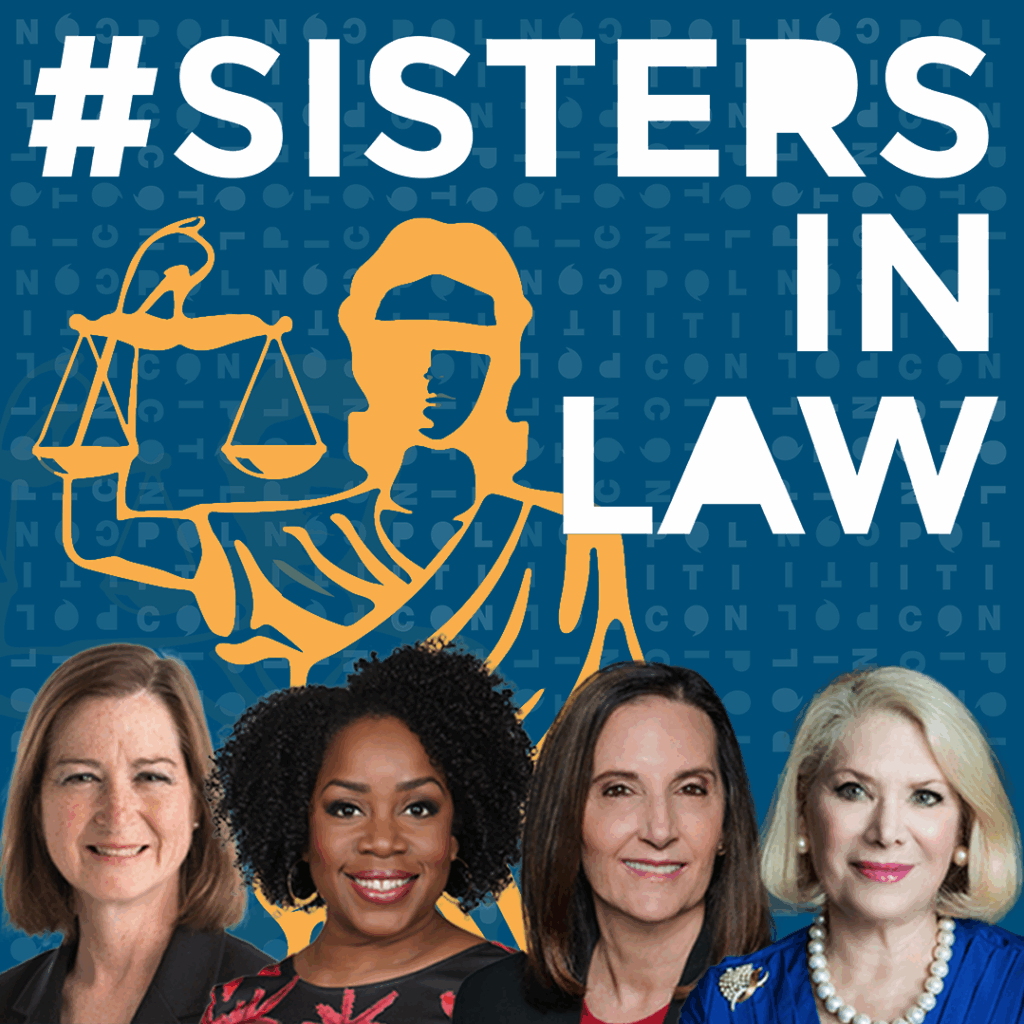
Jill Wine-Banks hosts #SistersInLaw to discuss the State Department’s war on immigrants, the revocation of B1 and B2 visas, how it affects asylum seekers, and the legal basis for extradition after being targeted by ICE. Then, the #Sisters review the legal basis for Trump’s proposed inscription of his name on the Kennedy Center, the issues it raises, and the political motivations involved. They also explain the legal back-and-forth over Trump’s Executive Order 14399 on mail-in voting, why a judge blocked it, where it sits on the SCOTUS shadow docket, and what it might mean for the midterm elections.
Remember to send in audio questions to SistersInLaw@politicon.com for the #Sisters to answer on their new companion podcast, SistersInLaw Sidebar! It airs Wednesdays wherever you normally get your podcasts!
Get the brand new ReSIStance T-Shirt, Mini Tote, and other #SistersInLaw gear at politicon.com/merch!
Additional #SistersInLaw Projects
Check out Jill’s Politicon YouTube Show: Just The Facts
Check out Kim’s Newsletter: The Gavel
Joyce’s new book, Giving Up Is Unforgivable, is now available, and for a limited time, you have the exclusive opportunity to order a signed copy here.
Barb is on a book tour! You can also order Barb’s new book, The Fix. Her first book, Attack From Within, is now in paperback.
Add the #Sisters & your other favorite Politicon podcast hosts on Bluesky
Get your #SistersInLaw MERCH at politicon.com/merch
Email: SISTERSINLAW@POLITICON.COM or Thread to @sistersInLaw.podcast
Get text updates from #SistersInLaw and Politicon.
Mentioned By The #Sisters
From Joyce: Judge Talwani’s Most Recent Order On Voting By Mail
Support This Week’s Sponsors
ASPCA:
To explore coverage, visit aspcapetinsurance.com/sisters
The ASPCA® is not an insurer and is not engaged in the business of
insurance. For terms and conditions, visit: https://www.aspcapetinsurance.com/more-info/state-documents-and-sample-policies/. Products are underwritten by either Independence American Insurance Company (NAIC #26581), or United States Fire Insurance Company (NAIC #21113) and distributed by PTZ Insurance Agency Ltd.
Gusto:
Try Gusto today at Gusto.com/sisters, and get three months free when you run your first payroll.
HoneyLove:
Save 20% Off Honeylove by going to honeylove.com/SISTERS! #honeylovepod
Smalls:
For a limited time, get 60% off your first order, plus free shipping and treats for life when you head to Smalls.com/SISTERS
Boll & Branch
Get 15% off your first order of cold and comfortable high-quality 100% organic cotton sheets, plus free shipping at BollAndBranch.com/sisters with code SISTERS
Get More From The #SistersInLaw
Joyce Vance: Bluesky | Twitter | University of Alabama Law | Civil Discourse Substack | MSNBC | Author of “Giving Up Is Unforgiveable”
Jill Wine-Banks: Bluesky | Twitter | Facebook | Website | Author of The Watergate Girl: My Fight For Truth & Justice Against A Criminal President | Just The Facts YouTube
Kimberly Atkins Stohr: Bluesky | Twitter | Boston Globe | WBUR | The Gavel Newsletter | Justice By Design Podcast
Barb McQuade: barbaramcquade.com | Bluesky | Twitter | University of Michigan Law | Just Security | MSNBC | Attack From Within: How Disinformation Is Sabotaging America | The Fix
Jill (00:10)
Welcome back to #SistersInLaw We’re glad you’re here this week. I’m here with Kimberly Atkins Stohr and Joyce Vance. Barb is out this week, but she’ll be back. Today we have three really serious topics that are really important. One is some more bad things that’s happening in immigration. Another is updating you on the latest on the Kennedy Center and Trump’s attempt to get his name on it. And then
The newest on mail in ballads and how the courts are helping to protect us. But before we get to those subjects, I want to talk to my sisters about Dolly Parton. I personally really didn’t know how wonderful she was. I mean, I loved her in Nine to Five, the movie. Fabulous, fabulous. I liked her music, but I just didn’t know what a gloriously generous person she was. How wonderful. And I I’m sorry that I had to learn.
because of her un unfortunately untimely demise. But what did you guys think? What what’s your favorite things about what she did in terms of charity and singing and her talent? I mean, she was just amazing. Kim, let me start with you.
Kim (01:24)
Yeah, I’ve been a Dolly Stan for so long. It it’s still really difficult to imagine a world without her in it because all of the cool things that she did do. I mean, her music goes without saying, you know. if anybody has not seen Bestler Horror House in Texas, like you have to watch, like watch it tonight. It is just delightful. and she’s always been delightful. Dolly Parton was like everybody’s fairy godmother, right? She not only was
bigger than life and had this incredible voice and this incredible music. I felt like you I I was always finding s out something that she did that she did on the down low. Like I remember during the pandemic finding out, right, she helped fund the research that led to the NRA vaccine for COVID, Dolly Parton. you know, I was talking to someone who I know who was in an attorney in show business and is like, did you know that Dolly Parton was a unnamed producer of Buffy the Vampire Slayer? I was like, wait what?
It’s like, yeah, yeah, she, you know, she wanted that project to move forward. So she got behind it. She I did know about her donating just millions upon millions of books to libraries across the country. I remember after, you know, her song, I Will Always Love You became such a big hit when Whitney Houston recorded it. And so after Whitney Houston passed,
She wanted to do something for the community in Nashville. And so she bought this office building in an underserved neighborhood and renovated it so that black businesses could thrive there and it can help the I mean, she just did this stuff because it was on her heart to do. And you I think that’s why you never didn’t hear anybody say a bad thing about her. I was worried about how somebody in Washington DC may or may not treat the moment
kindly, but even he lowered the had the flags lowered at half staff for a week. So Dolly brought everybody. She was probably the only person on earth that could bring any everybody together in that way. So even though my heart was broken, I was so heartened by the fact that her life and the way she lived it brought everybody together in that
Jill (03:31)
And Joyce, what about you?
Joyce (03:33)
Yeah, I mean Kim has said it so well. I heard somebody on T V this weekend saying that Dolly was the last American that everybody liked, right? It didn’t matter who you were. everybody found something to love. and so like you, Kim, you know, especially her her just practice of of making sure kids got books.
really spoke to me as a kid who relied on a a very intensive reading agenda when I when I was little and it was sort of an escape but also an advance for me. I appreciated the fact that she didn’t need credit for all the good she did in the world and I aspire to be more like Dolly. I think that’s a wonderful way to be. Barb and I are on a chat loop with some of our former DOJ friends and and one of the women sent us
This great video of I’m gonna kill the terminology, but it it the British I think did you say it’s the Kingsguard Jill, what you know, the guys in the red jackets and the big black hats, you know, playing Jolene, which is my favorite dolly song. It was really, really great. but what I remember, y’all, when I moved from Washington, DC, where I was practicing law to Birmingham when Bob and I got married.
I obviously had to drive down through Tennessee and I stopped at Dollywood. I had never been before. My dad had turned me into a Dolly Parton fan on a long driving trip after my junior year in high school. And before then I just thought I didn’t like country music, or at least most of it. but daddy convinced me of the air of my ways, and we listened to a lot of Dolly Parton. and I kept listening to her, and so I just decided to stop.
all by myself and see Dollywood, which was not something that twenty seven year old me did very often. and I’ve carried that around in my heart for a long time. She’s an inspiration. We are gonna miss her. what a horrible thing to lose Dolly Parton right now.
Jill (05:30)
Yeah, she is an inspiration that we should all aspire to be like. her devotion to children and reading her help for her own community when there was a devastating I can’t remember now if it was a fire or a flood. She ten
Joyce (05:46)
Yeah.
Jill (05:47)
thousand dollars each who had lost their homes. She just did so much and I’ve also been reading her lyrics, as they’re printing them this week. And her lyrics are really, really
meaningful. Everyone should take some time to read them. And I’m gonna recommend Nine to Five, the movie, in addition to the best little whorehouse in Texas. They’re it’s really terrific and we should all remember and try to act like Dolly Parton.
Kim (06:23)
You know, last week I went on a little vacation with my husband and it was a reminder of how much Snickers loves us because whenever we pull out suitcases, she gets really upset. Like she will just get in her feelings and sad. She’ll get very clingy because she knows that a suitcase means that we’re leaving. And it’s funny, I’ve talked to other pet owners about this too, and they have stories about
you know, their dogs, like pulling clothes out of suitcases as they’re trying to be packed or trying to get in a suitcase. And it just, you know, it reminds me of not only do we love her to pieces, but you know what? I think she loves us too.
Jill (07:05)
Today’s episode is sponsored by the ASPCA Pet Health Insurance Program. If you’ve ever found yourself awake at 2 a.m., phone in hand, Googling things like, is this normal for dogs? Or do I need to call the vet right now? You’re not alone. Those unexpected moments are part of having a pet, which is exactly why ASPCA Pet Health Insurance exists. It helps take some of the financial stress out of vet care.
so that you can focus more on your pet and less on the cost.
Joyce (07:36)
The ASPCA Pet Health Insurance Program offers customizable accident and illness plans that can fit your budget, your lifestyle, and even your pet’s particular quirks. Because let’s be honest, vet bills they can add up fast. You need someone you can trust, and ASPCA Pet Health Insurance has been around for almost 30 years, and they’ve covered over 1 million pets. When it’s time to submit a claim, it’s easy. Just use their app
and receive reimbursement for eligible vet bills directly into your bank account so you can get back to focusing on what really matters, your pet.
Kim (08:14)
To explore coverage, visit ASPCA petinsurance dot com slash sisters. That’s ASPCA petinsurance dot com slash sisters. Again, that’s ASPCA petinsurance dot com slash sisters. The link is in our show notes.
This is a paid advertisement. Insurance is underwritten by either Independence American Insurance Company or United States Fire Insurance Company and produced by PTZ Insurance Agency Limited. The ASPCA is not an insurer and is not engaged in the business of insurance.
Jill (09:01)
A lot has been happening in terms of immigration in the last week or so. And I want to talk about some of the things that are happening. I want to start, Kim, with the announcement from the State Department that they are going to start revoking B one and B two visas. So there’s a lot to learn before we can analyze all that. So I want you to sort of set out the facts and the analysis of what it means.
Kim (09:28)
Yeah. So the State Department announced that they would revoke B one and B two visas that have been issued since twenty twenty six twenty sixteen rather to present. and B one and B two visas are visas that are for people who are here on a temporary basis because of their work or profession. people who are here
On the short term, because of visiting, vacationing, visiting family, getting medical care, certain things that re that allow them to be here in a legal capacity during that time. Well, what they’re trying to do is revoke the visas of those who during that time, that time that they were legally in the United States, applied for asylum. Now, it’s really important to note that under federal law, under the Immigration and Naturalization Act,
You can apply for asylum if you’re in the United States. You can also apply for it if you present at the border as well. But these are all legal things to do. But the State Department is trying now to revoke those claiming that people are making quote unquote bogus claims of asylum. Now we don’t know how many people that that could apply to. It could be anywhere up to 200,000 people, but
it it probably would be less, but we don’t know exactly who it is. But it’s part of this attack on legal forms of coming into the country, especially for people like asylum seekers who of course have to prove that they can’t go back to their home country
countries because the situation there is too dangerous to sustain for them to return to safely, either because they’re war-torn or that there’s political violence or there was some natural disaster or something that makes it impossible and puts them in grave danger to return. You’ve already seen the administration try to be cute and block people from ever even presenting at the border before they get there so that they can’t even make
an asylum claim and we’ve seen the Supreme Court allow them to go ahead and do that. So this is just the next level of that to me.
Jill (11:32)
Yeah, it seems like it’s just another way of going after what they would define as others. They don’t want any immigrants and they’re trying to eliminate all immigration and they’re using, to me, ridiculous definitions to get at this. and they’re ignoring things like conditions change. You know, you got to America and then something happened to your country and there was either, you know, an earthquake or an election that resulted in
a whole new government that you would be targeted by. Anyway, there’s also an issue of extradition. and there’s international and interstate extradition. I mean we we have the Tate brothers who are under an extradition order, but there’s also some stuff going on with immigration. And you have an ICE agent who was detained in Texas on a request for extradition to Minnesota because
He had shot an immigrant and then lied about the reason he said he was being attacked when obviously that was totally not true. and he has now been released from his im his detention. Tell us what that is and what’s your explanation for why he should be held or shouldn’t be held and whether he should be extradited and what are the rules? How long can the governor
sort of sit on this and not even decide whether to extra
Joyce (13:04)
Yeah, I mean this is a great question and there’s a a lovely nerdy legal point buried in it, which is the two different legal regimes. International extradition, that’s largely treaty and statute based, and it gives the political branches of of governments control. But we’re talking about interstate extradition. That’s a constitutional obligation between states and it’s pretty close to mandatory.
So the case Jill that you’re talking about involves Christian Castro. He’s the agent who was charged in Minnesota with assault, also with falsely reporting a crime in the shooting of Julio Cesar Sosicilas. Minnesota authorities have been trying to extradite him ever since he was arrested in Texas. He was held in custody in Brownsville, which is a city that borders Mexico. He was talking, as you say, on the phone with his girlfriend.
Who was in Mexico saying he wanted to get married. And you know, here’s how the law works. Texas requires his release after 90 days if he’s not extradited or held some other way. The Texas governor dragging his feet. So Castro gets released on Thursday. and it’s worth noting, by the way, Governor Abbott in Texas his reason. He said he would not respond to the extradition request.
Because of the ongoing investigation into fraud in government social service programs in Minnesota, which is nuts. That’s the same justification Donald Trump used to justify his immigration crack down there. You know, this is this is just an excuse, a a solution in search of a problem. And it’s just sort of I don’t know what the technical legal term other than BS is, but but this is I think it’s worth pointing out that this was just nuts. to
Extradite Minnesota doesn’t have to show he’s a flight risk. The law is the extradition clause of the Constitution. It’s Article four, Section two, clause two, and the language is mandatory. A person charged in any state with a list of crimes who shall flee from justice and be found in another state shall on demand of the executive authority of the state from which he fled be delivered up.
So the only real issue here is whether a federal judge will force Texas to follow the law. The Trump appointee who this case landed in front of did not. he wanted to quibble about the meaning of fleeing from justice. And so I think really the only issue here is whether another judge will show up in this case who has a more traditional understanding of of this law.
Jill (15:39)
And you know, I wanna follow up because a listener had a very related question, which is can Governor Abbott, and this comes from, by the way, Marie in Albuquerque, New Mexico, can Governor Abbott be charged with contempt of court for defying the warrant from Minnesota? Could he be charged with a felony for violating the constitution?
Kim (15:58)
That’s not something that can happen, for it’s all to be held in contempt of court. You have to defy an order of the court, which you wouldn’t be doing in this case. And, you know, generally speaking, what governors would do would be to cooperate with leaders in other states because that’s the right thing to do. But here is another area where norms are giving way to you know, where norms were in place, but now that’s giving way to places where the law does not specifically mandate something. So no.
Those those are not options.
Jill (16:29)
Well, I hope that’s helped all of our listeners to understand the problems that are going on in immigration caused by complete political bad things, not based on the law.
Joyce (16:50)
There’s probably one or more tasks on your list you constantly wish you could push to the next week because they’re just so tedious. For many business owners, another word for that is having to do payroll. Gusto is here to take that entirely off your plate so it becomes the easy part of your job instead of a dreaded one. Unfortunately, manually running payroll and filling out HR forms can take up more of your time than the stuff you actually get paid to do.
And whether it’s a law firm or a podcast, you want to focus on the cases, the show, or client management instead of busy work that takes your focus off your mission. That’s why we wanted to tell you about Gusto. It’s perfect for anyone who wants to take charge of their operation. And I know that in addition to my sisters, many small businesses would benefit.
Jill (17:42)
For sure I know my husband would benefit. Gusto’s online payroll and benefit software is built for small businesses. It’s all in one, remote friendly, and incredibly easy to use. So you can pay, hire, onboard, and support your team from anywhere. If you’ve ever had one of those days where filling out forms and handling logistics burned all of your time, Gusto is for you. Speaking from experience, it can take up
so much of your energy when all you want to do is focus on the work you actually enjoy.
Kim (18:13)
Now, the process of running a business is so much easier and more efficient thanks to Gusto. Imagine how much simpler your workload will be when you’re saving time with built-in automated tools that handle offer letters, onboarding docs, direct deposit, and more. It’s so easy to enter a flow state when you know you’re taking care of the things that actually matter. But there’s more. With Gusto,
You even get direct access to certified HR experts to help support you through any tough HR situations.
Jill (18:45)
That can save you so much money, time, and worry. Best of all, it’s quick and simple to switch to gusto. Just transfer your existing data to get up and running really fast. Plus, you don’t pay a cent until you run your first payroll. Join them and start optimizing your business. Try gusto today at gusto.com slash sisters and get three months free when you run your first payroll. That’s three months of free payroll at
g-u-st o dot com slash sisters. One more time, gusto.com slash sisters. The link is also in our show notes.
Kim (19:35)
We always need our outfits to meet the demands of the moment, but sometimes it’s hard to find shapewear and foundational garments that don’t chafe, stab, or suffocate you. Comfort style and support are a must. And the last thing you want to do is keep readjusting your fit when you have things to do and places to go. Luckily, we found options that work with your body and fit perfectly in all the right places from our favorite independent female-founded brand called Honey Love.
Their founder, Betsy, leads a team of women who bring their talent and experience to design every product with your body and needs in mind. And the results are incredible.
Joyce (20:15)
Okay y’all, Barb is not here today, so I’m gonna put it on the line. You know, here’s what I hate in undergarments. I hate it when something’s poking me or it constantly needs adjusting. I don’t want couch-sized padding, I don’t need sharp wires for shape and support. And with Honey Love, you don’t have to put up with any of that. You can look fashionable and get form and function without all of that. Right now we can’t get enough of Honey Love’s cloud embrace.
It’s soft, it’s breathable, it’s incredibly comfortable. I wore it flying home over the weekend and forgot that I had it on, but it was still supportive enough to replace an old underwire. You know, it feels really great to put underwear on and then just to forget about it. I that’s exactly what I want, and Honey Love delivers.
Jill (21:05)
It certainly does, and even if you’re a longtime Honey Love fan like all of us are, they are always releasing exciting new pieces you’ll want to add to your collection. And I love how everything stays in place and moves with you. Recently they launched the new crossover contour bra, which features their best selling wireless crossover design with a beautiful contoured shape and built-in molded light foam pads. When you need extra support, it’s not about changing your body or
It’s about supporting it in a way that matches the occasion and actually feels good and comfortable. And Honey Love delivers at every stage.
Kim (21:43)
Honey Love has so many other things to offer. They’ve built a full line of tanks, bodysuits, shapewear, and foundational items featuring supportive structure, smoothing fabric, and premium finishes made for any occasion. As you get more experienced, comfort isn’t a luxury, it’s a requirement. You need to check them out. Treat yourself to the most advanced bras and shapewares on the market. Use our exclusive link to save 20% off Honey Love at honeylove.com/slash sisters.
That’s honeylove.com slash sisters. After you check out, they’ll ask where you heard about them. Please support our show by telling them we sent you. Experience the new standard in comfort and support with Honey Love. The link is in the show notes.
Joyce (22:38)
Okay, y’all, we are back to the District of Columbia because on Thursday there was another hearing there on a Trump vanity project, this one the Kennedy Center case. that happened, by the way, even though the judge had already very clearly told the government that when the law said that only President Kennedy’s name could appear on the memorial honoring him, the Kennedy Center, that Congress meant it, and Trump couldn’t just decide he wanted to add his own name in.
So the Trump administration in the form of its board, which now consists almost exclusively of Trump appointees, they’re still trying to find a way around that because you know the audience of one demands it. So the court holds a hearing on the plaintiff, Congresswoman, and ex officio board member Joyce Beaties, her request for an injunction to prevent the government from implementing portions of the board’s most recent resolution, and that resolution says they want to put the Trump the
They want to put Trump’s name on the Kennedy Center or its grounds. They have this devious plan now. We won’t put it on the building. We’ll put it on the campus. So Jill, can you help us understand that devious plan? I mean, what specifically are they trying to do and what sort of remedy was Congresswoman Beatty asking the court to impose?
Jill (23:56)
So first let me say I loved your substack on this subject. Thank you. And I’m wearing a pin because you said enough is enough. And that’s what my pin says. Enough is enough. It’s a protester carrying a
Joyce (24:09)
Wait,
did you notice I’m wearing a pen today too? Can you see it?
Jill (24:13)
What I can’t see it. What does it say?
Joyce (24:14)
It says we are all on the decoy plane.
Jill (24:18)
god.
Joyce (24:21)
Okay, sorry for that interruption. Do you
Jill (24:25)
So
back to your question, which is the plaintiff, Representative Beattie,
has asked for the second time, which is why you said enough is enough, has asked for the second time that an injunction be granted to prevent the destruction of the Kennedy Center for the Performing Arts. This time the board said, they said we couldn’t put his name on as we couldn’t rename the center. Okay, so we’re not going to rename it. We’re just going to put below the name Kennedy Center.
which is still covered by a tarp in case anybody forgot about that, and which appears to have been damaged in their putting it on or taking it off. Rare marble that Michelangelo carved the David out of that marble not that marble, but the marble from the same location. they were going to put an inscription honoring the work of President Trump in getting Congress to give money
To restore and renovate the Kennedy Center. I can’t remember exactly how old it is, but it was there when I lived in Washington, so it’s more than fifty or sixty years old for sure, and probably does need some renovation. but not what is requiring his name to be put on it. And they want it twice, once just saying for his work in restoring the Kennedy Center, and then a second time for his work in
Getting funding for the Trump Kennedy Center Fund, which to me is another deliberate way of making it the Trump Kennedy Center, although the word fund does follow it, but it’s it’s totally disgusting. And there’s also they voted to name the campus the Trump Plaza. I again another way of doing what the court clearly said he couldn’t do. The one thing that is missing is the threat in their
answered to the original, the first injunction which was granted, and then the court said, you know, that it would they granted the injunction.
Joyce (27:00)
So Kim, y you know, this is all I mean, I I have a hard time processing this because this can’t happen in a normal universe, right? Nobody has a big enough ego that they need their name on John F. Kennedy’s memorial. It’s just all mashugana. but it gets worse because the government, when it responds to Beatty’s new motion, they threaten in their response that they might demolish the Kennedy Center. Okay, if I can’t have my name on it, I’m just gonna tear it all down.
I mean, is that a serious threat? What’s going on here?
Kim (27:33)
No. I mean and and the fact that it even got put in there is just so ridiculous. I’m waiting for them to say they need a military bunker underneath it, so they have to take it down. no, they don’t have to to destroy the Kennedy Center. In fact, if you’ve li if you live in Washington you will have known that recently, yes, there’s probably renovations that need to be done. I know there was some
plumbing issues and stuff in the building. But they’ve recently, before Trump came in, built this great big new pedestrian walkway so that you could get to the Kennedy Center from the waterfront, at on the Potomac River. Like there there’s there’s there’s no need to tear down this absolutely gorgeous building. This is literally him saying, either you do things my way or I’m taking the whole ball and going home and I’d rather tear it down than to not
have my name on it. There is no legal justification. Congress built the Kennedy Center. Congress funds the Kennedy Center. I don’t even know what this Trump fund is, just his big money donors putting money in a pot. That the the Kennedy Center doesn’t need it, hasn’t needed it from the beginning. This is fully controlled by Congress, the funding and the building itself. So this is all just legal gobbledygook. I don’t know what they’re doing it next I expect him to try to
put in big letters Trump and the Washington monument because it’s literally the same thing.
Joyce (28:55)
That’s that’s the level of ridiculousness that’s going on here, right? And her brief I think is spectacular. Something we don’t really have time to do with with y’all. I try to write about this in my substep when I have time, is to use the actual language in briefs. Because you know it can be hard to read. There’s a lot of legalese. and there’s technical legal standards and I get that it’s a hash if you haven’t been through law school.
But here the brief is so eloquent and so nicely written. I thought maybe we would just take a moment to each share our favorite parts of the brief. Jill, do you wanna start?
Jill (29:30)
Sure. And I think it’s something that Joe DiMaggio said. Am I right on who the first person is? Who
Joyce (29:36)
But I think you’re right.
Jill (29:38)
I and I love a lot of the things he said. It’s deja vu all over again. Wait.
Kim (29:44)
Isn’t that Yogi Berra?
Jill (29:45)
Yogi Bear, you’re right. That’s who it is.
Joyce (29:47)
I’m sorry I led you astray. I’m so sorry.
Kim (29:51)
Baseball, you know.
Jill (29:52)
So
I was sort of in the right, I was in the right ball field. Wrong player. Anyway, she writes, it’s deja vu all over again. By federal statute, the John F. Kennedy Center for the Performing Arts and site thereof serve as a living memorial to John Fitzgerald Kennedy. What didn’t they get about her original ruling was that you can’t put anybody else’s name on it. And it does include and the site, because they’re arguing, well, okay, maybe not.
You could do it on the inside of the building. But this isn’t the inside. They want to inscribe this below the words Valkennady Center on the exterior and they want to do the plaza. So it’s just baloney. And I I love that she used that. as they say, you commented on that, Joyce, and it inspired my Jill’s pin today.
Joyce (30:40)
It was fun.
Kim (30:40)
Yeah, I think
for me, it’s just cut close to the case. She says that it she calls it a quote, breathtaking act of defiance of Congress and the court. It is, and that just gets to the fact that Donald Trump does not see any limits on himself, not even the limits that are within the executive branch, you know, even the Supreme Court that has gone crazy with the unitary executive theory.
has put some limits on what he could do, see his tariffs, see some other things, but that’s still not enough for him. And Congresswoman Beatty really just says what it says, says what it is.
Joyce (31:17)
I’m just gonna read my favorite part so y’all can enjoy it. I just love this part of the brief. enough is enough. Defendants’ contemptuous behavior must stop. The court decided this issue on May 29, 2026. Defendants do not like the law, and they do not like this court’s enforcement of the law, but they are not above the law, and so they must comply. Ooh, I like that so much.
You know, maybe that’s an epitophery the entire Trump administration. hopefully the Supreme Court will catch up. But Jill, speaking of the Supreme Court, what happens next? I mean, there’s been a hearing, presumably we get an order at some point.
Jill (32:00)
Yes, I’m sure we will get an order that says, I said it once, I’m saying it again, do not do this. And there has been you know, a a time that will have to be quick because I really I I truly do worry that they’ll take a wrecking ball to it the minute there’s an order. so they better be prepared to go immediately to the next court. It would be the DC Circuit Court of Appeals.
Although they could skip that and go straight to the Supreme Court and there’ll have to be an emergency injunction, again, a temporary restraining order, that nothing be done. And it’s gonna have to add not just that nothing will be inscribed, but that there will be no destruction, because that threat to me is real. And it’s ridiculous to think it could happen, but it’s real enough that I think there needs to be a court order saying you cannot do what you did to the East Wing.
You cannot take a wrecking ball to this.
Joyce (33:01)
Yeah, I mean Judge Cooper sounded really skeptical of the government’s position yesterday during the hearing. You know, they were arguing that restored and renovated by Donald Trump is just merely recognition rather than a memorial that’s prohibited by the statute. And so DOG is making this argument, and the judge, I think, finally just got exasperated and he said, you know, even if that’s true, it’s unlawful. You can’t do it. So I I think that we know how this order is going to read.
But Kim, whatever order Judge Cooper enters, it’s gonna get appealed, right? A and as our Supreme Court guru, do you think that the court will hear it, whether on the shadow docket or or on the appeals docket? Is there a reason for them to hear it? And do you think that the court will protect the Kennedy Center since Congress has spoken pretty explicitly?
Kim (33:51)
Yeah, I can’t imagine at the end that the Supreme Court will not w will back the administration on this. Either, as you point out, they can choose to when the lower courts rule against him, just stay out of it, which puts the makes the lower courts dishes decision the last say, or they can issue their own decision doing so. I I think that that is that. I I don’t know if I’m as worried as you see what
the the wrecking ball will start because honestly like with the work going on at the White House, like who who what crew can go over there? and you know, it it’s so obviously a ploy that, you know, he he’s somebody who was not welcomed at the Kennedy Center in his first term and it this is just sour grapes. That just makes him look terrible and wants to get attention away from the terrible war in Iran. so I’m not sure it’ll go that far. I I think that this will go the way of, you know, Lake America.
Jill (34:45)
Yeah. I hope the order also says and take down the tarp.
Kim (34:49)
Yes, the stupid term that’s still up there because if he c that’s the thing. If he if if it if it can’t say Trump, then nobody can see Kennedy. It’s so petty.
Jill (34:56)
Right. And and the judge said that was an act of petulance. He’s like a little baby.
Joyce (35:01)
Yeah.
We love cats. I really love cats, and cat owners can’t say enough great things about smalls. Like a lot of you, for the longest time we thought that the cat kibble in the grocery store was fine. I mean it was with the food we buy for our families, so it had to be good, right? That was wrong. And once we found out it was mostly filler, corn and ingredients that I could barely pronounce, we knew cats everywhere deserved better.
After making the switch to smalls, my cats have so much more energy and their fur is softer, they feel luxurious. If you’re a cat parent, there’s no better time to try smalls than right now.
Jill (35:50)
So I’m not a cat parent, but I have a lot of friends who are, and I recommended Smalls to them, and they all have reported back to me that it is fabulous. Smalls fresh cat food is protein-packed recipes made with preservative-free, 100% human-grade ingredients you’d find in your own fridge. And it gets conveniently delivered right to your door. In addition to Joyce, they have so many outstanding reviews. MEL said
Smalls changed my cat’s life, and I know she would no longer be here if it weren’t for finding you. She will be twenty in April. Within two months of starting Smalls, she was like a kitten again.
Kim (36:32)
I’m not surprised. Cats use protein as their main energy source, and more protein means more fuel and sustained energy. Small’s fresh, gently cooked, preservative-free cat food gives them high protein and improved hydration for strong bones and toned muscles. Plus, a balanced diet leads to less shedding, fewer hairballs, and more silky shine. Even better, lots of the nutrients in Small’s food are digestible, so less junk comes out the other end.
That means less cat related odors and that’s something we can all appreciate.
Joyce (37:07)
The team at Smalls is so confident your cat will love their product that you can try it risk-free. That means they’ll refund you if your cat won’t eat their food. And not that I’m the voice of experience here, but I have invested in food a time or two, only to find my picky little eaters turned up their noses and their tails. That has not been a problem for us with Smalls, though. So stop serving your little carnivore a bowl of processed shortcuts. For a limited time,
Because you’re a sisters-in-law listener, get 60% off your first order, free shipping, and free tweets for life when you head to smalls.com slash sisters. One last time, that’s 60% off your first order, plus free shipping and free tweets for life when you head to smalls.com slash sisters. The link is in our show notes.
Kim (38:06)
Well, this week it’s been a game of legal ping pong. And I’m talking about the challenge over the executive order by President Trump that purports to limit mail emballoting. If you are confused about what happened, you are not alone because it’s been really, really hard to keep track. So we’re gonna walk you through what’s happened and get you to what you need to know about what will be happening as best.
As we can. So of course we’re talking about the executive order, which does three things. It directs the Department of Homeland Security to create this master voting list. That’s the reason that the administration has been demanding that states produce their voting roll data so that they can pile this list. It also directs the Postal Service to only deliver ballots that are checked against this list with envelopes that have a barcode on them that are supposed to be printed.
By the states. And finally, it empowers the Justice Department to prioritize prosecutions of local and state officials who don’t comport with the order. That sounds like a threat to me. So I want to get right to this. Joyce, let’s start with what the Supreme Court did on Monday. Usually we end with the Supreme Court, but this week the Supreme Court really kind of kicked the most recent events in motion. So tell us what the court did.
Jill (39:27)
Yes.
Joyce (39:27)
Yeah, so look, if you’re confused, that’s okay. Kim already said that. I put a reminder in my notes to tell y’all, if you’re confused by this case, it’s okay. But it’s unbelievably important. So I appreciate that we’re taking the time to walk through it. Judge Tawani had entered an injunction that kept Trump’s executive order from going into effect.
Kim (39:51)
That’s a district court judge in Massachusetts.
Joyce (39:53)
Massachusetts.
And yeah, I should back up a step and say Judge Talwani has two cases in front of her. One brought by, I think, twenty three state AGs in the District of Columbia, another brought by the League of Women Voters, different plaintiffs, different claims, but but roughly the same bucket. There are other cases about this in the District of Columbia, but we’re gonna talk about Boston today. So she enters her order and the government gets it to the Supreme Court.
On the shadow docket, the decision is a procedural one. And let me tell you what I mean by procedural. It didn’t say that Trump’s executive order was lawful. It’s not a substantive decision about the executive order itself. The decision just says it was premature for her to enter the injunction that the case wasn’t ripe yet. That was sort of a weird ruling because the Postal Service had already made public notification that it had a
final rule that it was ready to publish and and implement. But either the court didn’t know about that or or my favorite theory, they just pretended that they didn’t know about it. The procurement majority like, I can’t make sense of this. But that’s sort of what happens. The Supreme Court says, sorry, Judge Talwani, no injunction, case isn’t ripe yet for a decision. And that has the impact, at least momentarily, of letting the government go ahead, letting it
Publish the final rule that the Postal Service had created in the Federal Register and pretending it was going to get to implement Donald Trump’s order.
Kim (41:25)
Yeah, so Jill, Judge Tawani, listened to the Supreme Court, lifted the injunction that was in place in both cases before her, but just before twenty four hours had passed, that injunction was back, Jill. Now tell us what happened.
Jill (41:40)
it’s so wonderful. It is just a delight to see the government stepping on its own toes because it then issued the final rule, published it. It was official. It was ripe. The case was now ripe. There was nothing to hold back. Yes, there was this rule, and it would have consequences for the states that had brought the lawsuit. and basically they were saying, we can’t possibly comply with this in time for the election. You have to
put a stop to it. And Judge Talwani did. So there’s now another injunction issued that prevents anybody having to take any actions while the litigation is pending. And further hearings will take place.
Kim (42:27)
So not content to leave it there. The Justice Department is again asking for that to be lifted. Joyce, they’re making some really strange arguments. Because before they said, okay, well, the final rule by the Postal Service hasn’t even been put out. So there’s nothing for the states to do. Like you can’t have an injunction if you’re if we’re not telling the states to do anything. And the Supreme Court bought that. Well, now we have this final rule. And so now what is the government arguing as to why the states and other plaintiffs can’t
Get involved now.
Joyce (42:58)
Yeah, I I mean, you know, I do have to say I have a lot of admiration for the judge here. She sort of threw the gauntlet down to the Supreme Court, because she she sort of created the roadmap. she she took this very generous position that the Supreme Court had been unaware of the Postal Service final rule when it entered its order. But that’s important. It’s a clever strategic decision by the judge because it means that in her view, the Supreme Court
Wasn’t aware that that had happened when they issued their opinion. And so that really makes this whole ripeness argument that we’ve been talking about moot. That means the government can’t go back to that. But she also makes her and this is a TRO, by the way, this is a 14-day injunction. There will be a hearing down the road to consider a preliminary injunction. This is what I meant when I said earlier.
Kim (43:50)
The hearing is set for support.
Joyce (43:51)
She’s super messy. I mean, it’s so hard to keep this stuff untangled. But we’re we’re in the TRO, the temporary restraining order stage. She tried to make it airtight, I think is a prelude to ruling the same way when she gets to the preliminary injunction. She finds that the plaintiffs have a strong chance of success on the merits.
That they’re suffering irreparable injury, because nothing says irreparable injury like you don’t get to vote in the midterm elections, right? I mean, not a close call. And then she talks about the balance of the equities being on the side of the plaintiffs. And these are the arguments that a plaintiff has to make or that any party has to make to get in an injunction. And they feed into the worst arguments that the government made, the questions that you’re talking about, you know, I would say among those bad arguments, Kim.
The government defendants who just days ago were arguing that this case was not ripe for the court to decide. Now they’re arguing that it’s too late for the court to intervene. I mean literally, you know, too early has become too late. There was no space in the middle that was just right, not even a minuscule one. And this again is just some some first class nonsense coming out of the Justice Department.
Any other Supreme Court, I would say no way they would fall for this. They would chastise the government. But here we’re gonna end up having to watch to see what happens, just like we’ll have to with the bottom line argument on irreparable injury. I mean, how is it possible that disenfranchising thousands of Americans because you create rules too close to an election for them to be properly implemented? There will be thousands of mistakes on lists maintained by DHS. In fact, I just let me take.
Two seconds to say there was an incident in Nevada where state officials pushed back on DHS’s claim that people who weren’t citizens were voting. They had said tens of thousands of non-citizens voted. State officials said, give us your list so we can fix this. And DHS couldn’t come up with names. They came up with like 16 names. So tell me that these people are competent to administer roles for every state. You know, this is gonna be a disaster.
The idea that there’s not irreparable injury and that Donald Trump should be permitted to do this just ’cause he’s a petulant baby who can’t take a loss, it’s crazy. It would be refreshing to see the Supreme Court say so.
Kim (46:17)
Yeah, I really do hope that they do. I’m I’m a little worried because in another case involving state law, the mail-in ballot case, yeah. The the Supreme Court seemed to come out with a rule. So there’s something called the Pur Cell principle, which is what Joyce is talking about, is that if it’s too close to an election, courts cannot issue a ruling that dramatically changes the rules of how people vote. That makes total sense. Well, the Supreme Court seemed to indicate that while courts can’t issue rulings that change the rules.
public officials can. And and in that case it was what the states were trying to do with their mail in ballot rules. I worry that they will say, Well, the administration is not bound by the person rule. So they can change the rules at the very last minute and that’s okay.
Joyce (47:02)
I just say I agree with that. I think that there’s a risk, even if they ruled that postal could come back with new regulations. But at some point, the Supreme Court just has to man up and say, we’re running a government here, not playing games. It’s not a Ponzi scheme. It’s the right to vote.
Kim (47:19)
And Jill, chaos is ensuing. Can you imagine? I mean, states all over the place. They have to start mailing their ballots out in days. And they don’t even know what the rules are. And they’re supposed to be able to present these envelopes with these barcodes that DHS is supposed to be able to read from a system that DHS hasn’t even created yet. Talk about the chaos.
Jill (47:39)
It’s it is total chaos. It is impossible for the states to comply. They can’t have a list to prepare that they haven’t got instructions on how to prepare it. The federal government hasn’t created a list that would be compared to the state list for the post office to say, I see a discrepancy here. This voter doesn’t get a ballot because he’s not on the federal list, which is the one that would govern. And
I going back to the Supreme Court, I think first of all, it would be absurd for the Supreme Court not to deal with the actual constitutional question, which is that states are in control of elections, not the federal government. And that at some point the federal government has to be told, you can’t have anything to do with setting the terms of voting in a federal election. States do that. And so I just think we’re at a point where the court is running out of ways
I also think that they might be sort of angry that the federal government is trying to make them look bad by the timing of this. First they go in, it’s too early, you can’t do it because we haven’t issued it, and then it’s immediately public that it’s there and final and that they were really playing games. It was, you know, as as I think we’ve said, it’s like Goldilocks.
No, that’s too hot. That’s too cold. this is just right. Well, for them, there is no just right. It’s one or the other, and both are losers. You know, it’s sort of like heads you win, tails I win, tails I lose. it you can’t have it both ways. So I think the court may actually come to grips with the actual substantive issue, which is that no matter what they do, it’s not proper because it interferes at a federal level with state controls.
of the elections, which is in our constitution, and it’s sort of clear that any literalist would see.
Joyce (49:41)
You know, I don’t have a lot of faith in this court, but I actually think Jill is right here because what the government was arguing until a couple of days ago was, well, you know, this isn’t ripe for a decision yet, but once we enter a final rule, the plaintiffs will have time. They will be able to object. they will be heard in court. And then now they’re saying, no, sorry, you don’t get to hear. I I mean, if the Supreme Court can’t take that and say this is not how our system works.
Then shame on them, and yes, they’ve brought a lot of shame down on their heads, but I think that this one might be a bridge too far even for this court.
Kim (50:18)
Well, there’ll be lots more twists ahead, so stay tuned.
No matter where you live, the days are hot and nights are stuffy and sleepless. The next morning you feel like an exhausted zombie in desperate need of a shower. It’s miserable, and none of us have time for it. You can curse the sun all day long, but it’s better to take action by making sure your bedding is helping you sleep comfortably, not keeping you up. The wrong sheets trap heat.
Which is why we wanted to tell you about Bolin Branch. It’s like the cool side of the pillow, but everywhere.
Jill (51:02)
Their summer bedding options are breathable, lightweight, and designed to keep you cool all night long. It’s seriously like sleeping on a cloud because their 100% organic cotton sheets are woven specifically for airflow, not just softness, although they are really soft. Synthetic cooling technology or chemically treated fabrics are a band-aid, not a solution. With Bolin Branch, the cooling is structural.
Because of how the cotton is woven, amazingly ninety four percent of Bolin Branch customers say their sheets get softer with every wash, and we have to agree.
Joyce (51:38)
Some people think sheets only come in two styles, regular and scratchy. But that’s not the case. Bowl and branch has definitely changed the game. You know, I have them on my bed right now. They’re great, they’re snug, I don’t want to get out of bed in the morning, and best of all, they’re buttery soft right from the start. You don’t have to wash them four or five times before you get to the point where you’re willing to sleep in them. They help you relax the minute you lie down.
you know, I’ve become such a fan of their signature sheet set that I have actually purchased them for a couple of the kids. It’s a big expenditure, it’s worth it because the kids notice the incredible feel, the breathability, and the temper regulation, all of which are top-notch. You really need to experience the unmatched softness for yourself.
Jill (52:28)
And you know, another feature which I particularly love, I’m a color fanatic. And they have over two dozen amazing colors that will complement any room or style. And it’s just so much fun to pick out the right one for you. While you’re shopping, you need to check out their supportive pillows, cozy blankets, and luxurious comforters, as well as the sheets. Sleep Cooler This Summer with Bolin Branch. Get 15% off your first order plus free shipping at
Bowl and branch dot com slash sisters with code sisters. That’s Bolin Branch B O L L A N D branch dot com slash sisters code sisters to unlock fifteen percent off. Boland branch dot com slash sisters code sisters exclusions apply, the link is in our show notes.
Okay, guys, it’s time for our favorite part of the show, which is answering your questions. We love you challenging us to think about new and different things, and reading your questions makes us do that every week. So please keep those emails coming to us. You can also send your questions in for Sisters Sidebar, which we answer your questions every Wednesday. So you have two opportunities to send us questions. And this week we have some really good questions.
The first question is from Susan, and Joyce I’m gonna ask you to answer Susan’s question. She asks If the Trump administration seizes ballots after the courts are closed, how can those ballads be protected? Will there be judges assigned for after hours decisions?
Joyce (54:16)
So Susan, this is one place where I can strike an absolute note of optimism based on experience, because all over the country there are lawyers getting ready to do election protection work. And a big part of that is we understand, right? The pools typically close around seven PM. Most places, most federal judges want to be at home enjoying a nice glass of scotch.
But everybody understands that that’s not how election nights work. And so in advance, the election protection teams and and sometimes those are partisan, right? Sometimes the local Republican Party and the local Democratic Party will each have lawyers running a boiler room where they’re dealing with any problems that come up the day of the election. But that can also in involve civil rights groups or groups that advocate on behalf of voters, like the League of Women Voters.
And I suspect we’ll see some conservative leaning groups in the mix too. And everybody will, in advance, create lines of communication with secretaries of state and with judges to make sure that issues like this can be dealt with. So your question is very specific. You ask if there’s a seizure of ballots. It would take a lot to get to the point where the administration could seize ballots. and before that could happen,
There would be lawyers talking to judges trying to prevent it from happening in the first instance and locking those ballots down and putting them into the court’s custody if they were actually seized. I mean, this is an extreme situation. I believe in planning for extreme situations because I think this administration is pretty desperate. But something that’s that’s like this, we know that they weren’t able to do this following the 2020 election.
Because it was just so crazy, it was so out of bounds that there was no government agency that was willing to go along. Maybe that’s part of why now Trump has his own loyalists running these agencies. But still the best thing that’s happening right now is that election protection workers understand exactly what the stakes are. This administration has not been shy about revealing them, so preparations are underway.
Jill (56:34)
Okay, and Kim, there’s a great question that I want you to answer from Ellen. She says, I was reading an opinion piece by Thomas Etzel in the New York Times about the obvious conflict of interest inherent in the Trump family’s cryptocurrency business. He said it’s quote, almost certainly unconstitutional and may well be illegal, end of quote. Her question, she says, is if something is determined to be unconstitutional.
By a court, isn’t it always illegal by definition? Great question.
Kim (57:09)
Yes, this is a good question. So the cryptocurrency part, I’m I’m d it would take a whole show to get through that. I will just suffice it to say that there are rules that prevent people, public officials from profiting off of issues that they deal with as public officials, which seems to be something that would be illegal. There’s also the emoluments clause, which prevents people from presidents from being enriched by what they do on the job. That’s a constitutional provision.
Things can be the constitution and illegal are two different things. And I think we don’t often explain that really well. So I would just focus on that. There are things that can be both unconstitutional and illegal. Illegal means it violates a law, a law that has been passed either by Congress or by a state legislature. If that is broken, that is illegal. So there are some things that are both. I think in this case it very well could be both, or racial discrimination.
For example, that’s something that violates the Constitution. It violates the 14th Amendment. But there are also federal and state laws that prevent people from being discriminated against on the basis of race, say, in employment or in school. So those are both areas where there’s both a law and the constitution. The difference between the two, and this is important, is that if something breaks a law, if something is found to be illegal, then Congress or the state legislature can always act.
to change that law or revoke that law or pass a different law if they think that that ruling on illegality is wrong. But when there’s something is ruled unconstitutional by the Supreme Court or by the state’s highest court when it comes to the state’s constitution, lawmakers can’t just pass a law saying, no, we’re poof, we make it constitutional now. The only way to change that is by changing the constitution itself. So in that way, it’s a bigger, more difficult thing to change, but they’re both two important and different things.
Jill (59:01)
And I’m going to answer the last question for this show. It comes from Ben, who asks, would limiting presidential pardon powers be a law or a constitutional amendment? Well, Ben, it definitely would be a constitutional amendment. and that goes to what Kim was just saying about the difference between being illegal and being unconstitutional. And that’s because Article 2, Section 2, Clause 1 of our Constitution says about the president.
I’m going to emphasize the first word, he, I’m still hoping for a she. He shall have power to grant reprieves and pardons for offenses against the United States, except in cases of impeachment. So you can tell from that language, it’s pretty broad. It says Pardons and reprieves except for impeachment. So that means federal cases, including court martials, can be pardoned either fully.
or you can have the sentence commuted, you can give some kind of reprieve by the president, not state crimes, but otherwise he’s totally free. It’s an unimpeded power. And unless the constitution is changed, he cannot be stopped. I mean we could stop a president by things like, for example, President Ford suffered the consequences of pardoning Richard Nixon. He was not reelected.
And one of the large reasons was because people were mad that he had done that and they showed it. But I think the other thing is SCOTIS has made it clear in several cases, going one goes back to I think 1896 and recently in 1974, saying that people who are pardoned, it’s it’s forever, the the Constitution would have to be amended, you can’t change.
Anything done by legislation. So the Supreme Court has agreed that there’s just no way around this except constitutional amendment. Thank you for being here with us today at hashtag SistersIn-Law with Kimberly Atkinsdore, Joyce Vance, and me, Jill Wine Banks. Barb will be back with us next week. Be sure to follow hashtag SistersIn-Law on Apple Podcasts or wherever you listen to your podcasts, or now on YouTube. You can see us there as well.
Join us every Saturday for hashtag SistersIn-Law and every Wednesday for hashtag Sisters Sidebar where we answer your questions.
Joyce (1:01:37)
Yeah.
Jill (1:01:37)
Thank you for being with us this week and please show some appreciation for our sponsors who make this show possible. Today’s sponsors are ASPCA Pet Insurance, HoneyLove, Smalls, and Bolin Branch. And don’t forget, go to hashtag SistersIn-Law for merch.
You can get totes and t-shirts, and now that it’s hopefully gonna cool down, especially for Joyce and Kim in DC and Alabama, you can get our hoodies as well. Please go there and look at the merch. Thank you for being with us. See you again next week.
 Joyce Vance
  Barbara McQuade
  Kimberly Atkins Stohr
  Jill Wine-Banks