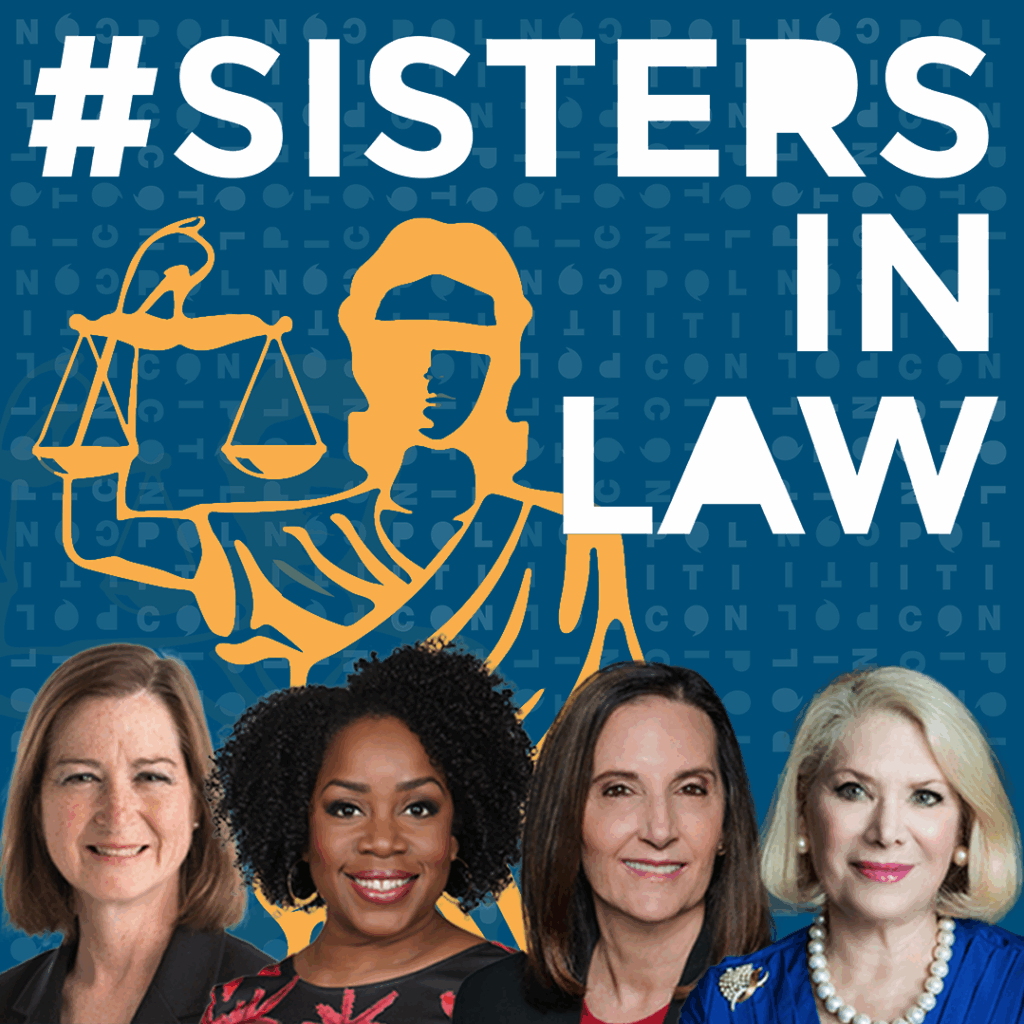
Barb McQuade hosts #SistersInLaw to discuss the recent Supreme Court rulings and how they affect our lives. They review the implications of the decisions on birthright citizenship, the president’s control over independent agencies, voting rights, transgender participation in sports, and campaign finance. During it, they analyze the court’s performance, expose its connection to Trump and the MAGA agenda, and call for more protections for the rights of all individuals. They also delve into how the court makes decisions, expose its inconsistencies, and lay out the trends it seems to be following as it heads into the upcoming term.
Remember to send in audio questions to SistersInLaw@politicon.com for the #Sisters to answer on their new companion podcast, SistersInLaw Sidebar! It airs Wednesdays wherever you normally get your podcasts!
Get the brand new ReSIStance T-Shirt, Mini Tote, and other #SistersInLaw gear at politicon.com/merch!
Additional #SistersInLaw Projects
Check out Jill’s Politicon YouTube Show: Just The Facts
Check out Kim’s Newsletter: The Gavel
Joyce’s new book, Giving Up Is Unforgivable, is now available, and for a limited time, you have the exclusive opportunity to order a signed copy here.
Barb is going on a book tour! You can also pre-order Barb’s new book, The Fix. Her first book, Attack From Within, is now in paperback.
Add the #Sisters & your other favorite Politicon podcast hosts on Bluesky
Get your #SistersInLaw MERCH at politicon.com/merch
Email: SISTERSINLAW@POLITICON.COM or Thread to @sistersInLaw.podcast
Get text updates from #SistersInLaw and Politicon.
Mentioned By The #Sisters
Order Barb’s new book, The Fix, and get tickets for her book tour!
Support This Week’s Sponsors
Smalls:
For a limited time, get 60% off your first order, plus free shipping, when you head to Smalls.com/SISTERS
Quince:
Upgrade your summer fashion and get 365-day returns and free shipping on high-quality, stylish, and affordable clothing you’ll wear for years to come at quince.com/sisters. Now available in Canada.
DeleteMe:
Get 20% off your DeleteMe plan when you go to joindeleteme.com/SISTERS and use promo code SISTERS at checkout.
Get More From The #SistersInLaw
Joyce Vance: Bluesky | Twitter | University of Alabama Law | Civil Discourse Substack | MSNBC | Author of “Giving Up Is Unforgiveable”
Jill Wine-Banks: Bluesky | Twitter | Facebook | Website | Author of The Watergate Girl: My Fight For Truth & Justice Against A Criminal President | Just The Facts YouTube
Kimberly Atkins Stohr: Bluesky | Twitter | Boston Globe | WBUR | The Gavel Newsletter | Justice By Design Podcast
Barb McQuade: barbaramcquade.com | Bluesky | Twitter | University of Michigan Law | Just Security | MSNBC | Attack From Within: How Disinformation Is Sabotaging America | The Fix
Barb (00:10)
Well, welcome back to Hashtag Sisters in Law with Joyce Vance, Jill Wine-Banks, Kimberly Atkins Stohr, and me, Barb McQuade. In today’s show, we’ll be discussing the Supreme Court’s decisions about executive power, the court’s erosion of civil rights, and our big picture thoughts about the court as we look toward the October 2026 term. But first, sisters, we’re back together. It’s been a while since we’ve had all four of us together, and I wanted to talk with you about.
America’s 250th birthday. ⁓ we’re in the middle of a heat dome as we celebrate. In fact, I don’t know if you can tell, I’m just sweltering where I am. But ⁓ you know, I I feel like President Trump has tried to appropriate the flag, patriotism, and America’s 250th birthday. I remember fondly 1976 when we celebrated the 200th, and it wasn’t at all about
president or about politics. It was about loving what’s great about America. ⁓ and so I’m just wondering what your thoughts are as we celebrate the two hundred and fiftieth. Jill, what are you thinking about as we celebrate the two hundred and fiftieth?
Jill (01:17)
I’m with you, Barb. I remember in 1976. I was on the mall watching fireworks with my Watergate partner, Rick Memvenisa. and it was a joyous national event. It was not being hijacked by a narcissistic president. And it’s really ruined it for me. I am wearing, I’m wearing, I don’t know if everyone can see.
Barb (01:42)
Yeah, I’d love to see you rocking the patriot patriotic.
Jill (01:46)
by a kindergarten grandchild of one of my friends. And it’s it’s the most adorable thing in the world. And I am patriotic, but as part of my patriotism, I’m gonna do everything in my power to keep on getting the facts out and to take down the Republican MAGA base because we need to go back to nineteen seventy six when we had real liberty and freedom and real patriotism on both sides of the aisle.
So I’m not feeling very celebratory. ⁓ I’m gonna spend ⁓ tomorrow with friends, ⁓ having we weren’t even barbecuing ’cause it’s way too hot to cook. I’m ordering in ⁓ chicken and ribs ’cause it’s just what we have to do.
Barb (02:32)
Sounds pretty good. How about you, Kim? You’re there in D C. You gonna be on the mall?
Kim (02:36)
⁓ I will not be on the mall for a million reasons, including the fact that it’s a hundred and some odd degrees here. And ⁓ I will be in ⁓ having a qu as quiet a po as possible of Fourth of July at home, ⁓ and spending some time overnight with a very drugged up Snickers whose little nervous system cannot stand fireworks. And this year, ⁓ as you may know, the fireworks here in Washington DC will be fifty times what they normally are. And they won’t start till after eleven. So nobody’s getting any sleep on the fourth of July in this house. ⁓ but aside from that, I am for me, the Fourth of July still is important to me ⁓ as somebody who has been in this nation, whose family has been in this nation for ⁓ 10 or more generations, as someone whose ancestors helped build this nation literally with their bare hands, as someone who have family members going back to the Civil War who ⁓ volunteered to fight for this country. as someone who is the daughter of a union worker who fought hard to make sure that workers in this country are paid a fair wage and who always flew the American flag out in our house ⁓ and to this day, ⁓ in in the house, my my parents’ house, the a flag still flies ⁓ alongside my dad’s marine flag. ⁓
I have always been brought up to be a proud American, and nothing that ⁓ this president can do, ⁓ nothing that those in his circle can do or any one party can do ⁓ can take that from me because I truly understand the ideals of our nation. Even if we’ve never reached them, and even if they were never meant for people like me, I still believe in them because I believe that’s the only path forward. So that’s what I’ll be thinking about on the fourth of July.
Barb (04:35)
Yeah, that’s beautiful. Joyce, I see you’re ⁓ knitting there. Are you knitting an an American flag?
Kim (04:41)
Ross.
Joyce (04:42)
I know. ⁓ it this means it’s July and I’m already behind on my Christmas knitting, so I’m trying to make up. Wow. ⁓ but but not patriotic knitting, although I do have this hat in the pattern of the Capitol dome on my needles. I’ll knit that next. Exactly.
Barb (05:01)
Put your dome on our domes.
Joyce (05:04)
⁓ you know, Kim, I love ⁓ what you had to say. I think that that’s really beautiful, this notion of generational continuity. And Jill, like you, I remember nineteen seventy-six, which was a major celebration in my family. I I saw this sort of snarky meme earlier this week, and I feel a little bit guilty about enjoying it as much as I did. But it said, July fourth does not belong to the Republicans.
January sixth does.
Jill (05:36)
that’s wonderful.
Joyce (05:38)
But look, I think the reality here is the Republican Party for too long has gotten away with claiming that they’re the party of patriotism, of family values, of pro law enforcement, whatever. And I think it’s time for us to unabashedly say that we too are patriotic, that we love this country, that we believe in this vision of the ever expanding aspiration to include more people in the American dream. And so Bob and I are.
Are planning on celebrating with a couple of our kids who are with us. We’re gonna go to a barbecue with some friends. There will be political talk. There will be really good food. We will soundly bash Donald Trump for not wanting to have ⁓ a democracy because it’s clear that Donald Trump no longer believes in the ongoing American experiment. But the the one thing that I’ll say, I’ll break a little bit of news here, is ⁓ I’m gonna propose ⁓ to
To my friends and to people that read my newsletter and to you guys that we should just take advantage of the opportunity to celebrate. And so I’m already thinking about the fact that come election day, I’m gonna throw the biggest, most fun neighborhood party that I can to encourage people to go to vote, right? We’re gonna be down to one day of voting in Alabama. We always have been more or less. That may be more true in other places.
So I think July fourth is a great day to decide that you’re gonna have an A America votes party come November, and we are just gonna celebrate who we are. And you know, if they don’t wanna participate, that’s their issue.
Barb (07:13)
That’s fantastic. Well, I love the Fourth of July. I love America. And I don’t think that we ⁓ allow anyone else to appropriate our holiday. It belongs to all of us. And I think we’re a country right now that is in trauma, and our country needs us more than ever before. So if you love America, you know, show it by celebrating and by working toward a more perfect union. And we all have a lot of work to do, whether it’s throwing a party or encouraging people to vote or having those.
difficult conversations with friends and family about just how much trauma our country is going through right now. But what makes America great is our ability to change and so onward to a more perfect union.
Kim (07:52)
And please keep Snickers in your prayers, y’all. She’s it’s not gonna be easy for her.
Joyce (08:06)
We love cats, and those of us who have them can’t say enough great things about smalls. Like a lot of you, for the longest time I thought that the cat kibble they had in the grocery store was the way to go. It’s right next to all the food I buy for my family. So it has to be good, right? Wrong. Once I found out that it was mostly filler corn and ingredients I can barely pronounce, I knew my cats deserved better.
And now that I’ve made the switch to smalls, they have so much more energy and their furs seems softer and more luxurious too. If you’re a cat parent, there’s no better time to try smalls than right now.
Jill (08:44)
Smalls Fresh Cat Food is protein packed recipes made with preservative free, 100% human-grade ingredients, the kind that you’d find in your fridge. And it gets conveniently delivered right to your door. In addition to Joyce, they have so many outstanding reviews. Emmy L said that Smalls changed my cat’s life, and I know she would no longer be here if it weren’t for finding you. She will be 20 in April.
Within two months of starting smalls, she was like a kitten again.
Kim (09:16)
I’m not surprised, cats use protein as their main energy source, and more protein means more fuel and sustained energy. Small’s fresh, gently cooked, preservative free cat food gives them high protein and improved hydration for strong bones and toned muscles. Plus, a balanced diet leads to less shedding, fewer hairballs, and a more silky shine. Even better, the nutrients in Small’s food are digestible, so less junk comes out.
the other end. That means less cat related odors, and that’s something we can all appreciate.
Barb (09:52)
I want food that gives me high protein, strong bones, toned muscles, and a silky shine. Yeah, you gotta try smalls. After switching to smalls, 88% of cat owners reported overall health improvements. And the team at Smalls is so confident that your cat will love their product that you can try it risk-free. That means they will refund you if your cat won’t eat their food. So stop serving your little carnivore a bowl of processed shortcuts.
For a limited time, because you are a hashtag sisters in law listener, get 60% off your first order plus free shipping and free treats for life when you head to smalls.com slash sisters. One last time, that’s 60% off your first order plus free shipping and free treats for life when you head to smalls.com slash sisters. The link is in our show notes.
Joyce (10:51)
So, y’all, I’m sorry to do this, but we’ve got to talk today about the increasingly ever more unitary executive that is the Donald Trump second presidency. ⁓ and and that’s at the door of the Supreme Court. They did a lot to expand presidential power this term. They did it both early on and here at the end. They dumped some of the big ones on us. In three of the big end-of-the-term cases, Trump acquired a lot more power.
There’s Barbara, the birth citizenship case. Cook and Slaughter about the Article II power to fire leaders and board members of quasi-independent executive branch agencies. I mean, there’s a lot to unpack here, and something I’ve been thinking about a lot is that when the outrages come as thick and as fast as these have, it’s difficult to really register all of them. In some ways, the outrages become incredible.
incorporated into what we accept as a new normal because we just don’t have time to pause and think them through. I thought we would do some of that today. And and Barb, I thought we would start with the birthright citizenship case. ⁓ I suppose it’s reassuring to learn that presidents can’t rewrite the Constitution with a Sharpie marker or an executive order. But beyond that threshold holding, I’ve got to ask if you were surprised by the outcome of this case.
Barb (12:14)
Well, I wasn’t surprised by the outcome, but I was surprised that it was six three and that it was five four when it comes to the interpretation of the Fourteenth Amendment. I I mean, this is the the amendment to the Constitution that says all persons born in the United States and subject to the jurisdiction thereof shall be citizens of the United States. That’s pretty clear. What Trump did, of course, with his executive order is take that that language subject to the jurisdiction thereof and say,
That excludes people whose parents are undocumented and are not in the country lawfully. So if you’re born here and your parents aren’t lawfully here, you’re excluded. Think about what the opposite of that would have meant. So if you are an undocumented person, that means you’re not subject to the jurisdiction of the United States. Chief Justice Roberts mentions this in his majority opinion. That would mean that if you’re an undocumented immigrant, you get the same treatment as diplomats.
That means you can’t be arrested. You can’t be charged with a crime. How could you even be deported? And so that language is just ⁓ outrageous to make that distinction. But we had ⁓ a rejection by the majority, and we go back to this idea of birthright citizenship. And you know, of s of course there are some critics who are saying, ⁓ they’ve they’ve ruined America by deciding that people born here are now citizens. So this has always been the case since the 14th Amendment.
was ratified at the end of the Civil War. And you know, interesting story. One of the things of throughout our nation’s history is we have welcomed immigrants. We are a nation of immigrants. And I don’t know if all of you have been following the World Cup, but there’s a great birthright citizenship story in the American World Cup team. Our best scorer is a guy named Falaran Balagun. He is ⁓ of Nigerian ancestry.
His parents are Nigerian and were living in London at the time ⁓ his mother was pregnant with him. They were visiting the United States, and she was seven months pregnant when it came time to get on a plane to return to their home in London. But the airlines said, We won’t let you fly because you’re so far along in your pregnancy, we don’t want to risk a mid-air delivery. So you’re gonna have to stay here. And as a result, Falarin Balagoon was born in the United States.
And is now the star of the US men’s national team who scored the winning goal in the last World Cup game. So birthright citizenship is welcome here.
Joyce (14:45)
You know, that is such a great story. I ⁓ like you, I was not surprised by the outcome. I I wish that I could say I was surprised by the vote, I was not. But what I was surprised by was Justice Kavanaugh’s concurrence and this notion ⁓ that he didn’t find birthright citizenship in the Fourteenth Amendment. Kim, we’ve talked about this case. We’ve been texting back and forth.
Did you have the same reaction that I did to the thing with Kavanaugh? I I’m just curious what your reaction to the decision overall was.
Kim (15:17)
I was outraged at Kavanaugh. I mean I was I was outraged at Kavanaugh, just like we talked ⁓ last week about the the series of opinions by Alito, that one was just more infuriating after another. ⁓ Tuesday was Kavanaugh Day. Like every every Kavanaugh joint that came from the Supreme Court on Tuesday was an outrage. ⁓ to say, no, no, the Constitution itself in that Reconstruction era amendment, the 14th Amendment, which explicitly
laid out the guidelines for who constitutes a citizen because the framers of the 14th Amendment n saw how black people in America were being denied the rights of citizenship. And so it didn’t just say, hey, give citizenship rights to black people. It said, okay, we are America and this is how we do things here. We do things like this. Could not have been clearer. But Kavanaugh’s like, yeah,
I don’t see it. But, you know, because there is a federal law confer conferring citizenship rights to people born here, then Donald Trump’s executive order seeking to limit it failed. And let’s remember, it’s not just undocumented immigrants whose children would not be considered citizens under this order. It is people here legally who were here temporarily either to go to school or to work a certain high you know, it’s specialty job or
Literally the kind of people that the United States should be trying to attract here, it’s those folks who would also ⁓ be denied citizenship for their children. And for this court to do anything other than at least a seven-two ruling, because there’s no accounting for Thomas or Alito anymore, and I’m not even gonna try. But they had an opportunity to have a wide margin.
Of an opinion that said, you know what, there are certain things, there are there may be a few things that are sancrosanct in our constitution. This is one of them. And it’s important because this is what our country is about. Written on the Statute of Liberties pedestal. Bring me your tired, your poor, your huddled masses yearning to be free, a torch being list lifted for the homeless tempest toss.
To welcome them through the golden door. That’s who we’re supposed to be in America, but I guess not to Brett Kavanaugh, not to Neil Gorsuch, not to anyone in the court’s conservative majority except John Roberts and Amy Coney Barrett. That is that was a shock to me. And I’m just I get sadder and sadder about the Supreme Court every week.
Joyce (18:02)
Yeah, I mean Justice Kavanaugh’s opinion really disturbed me because the idea that he only found birthright citizenship in statute, not in constitution, and then went on to issue this invitation to Congress. Hey, if you pass a different law, you can flip my vote and I’ll be on the other side the next time. It was literally an effort to have both sides of it, to have his cake and eat it too. I’m a good guy. I voted for birthright citizenship.
But hey, MAGA Republicans, I’m in your camp and you can change that vote. And Kim, I gotta ask you as our Supreme Court expert, did this feel a little bit like an audition by Brett Kavanaugh to try to be the next Chief Justice of the Supreme Court? I almost felt like he was trying to say, look at me, I’m so smart. I’ve come up with this novel theory. And at the same time, I found it to be not satisfying, deeply disturbing. And if you’re a textualist,
You should be as offended by Brett Kavanaugh’s opinion as I am. I mean he had something in it for everybody to hate.
Kim (19:05)
Yeah, I I don’t even think it’s that much of a base pander. I think that this six three conservative supermajority, the comfort of that, yeah, has allowed us to see who these justices have always been in a way that they couldn’t fully show when it was only five four. I think they vote this way because that’s what they truly believe. And I think you’re seeing, you know, the wheat being separated from the chaff. I think this is what Kavanaugh
believes. I think he doesn’t care, you know? and, you know, if he doesn’t care what it means for America and the black even the black eye that is giving the court. This is how he sees the way that immigrants and, you know, foreign nationals are in our country should be treated. And he’s voting from that. I I can’t come to any other conclusion.
Joyce (19:58)
Волжіл, вот станс ою і
Jill (20:02)
Y the same thing that you two are discussing right now, which is Kavanaugh’s concurrence, where he agrees with the outcome but not the reasoning. And I w just wanna read for our viewers and listeners some of the language that he used because it i it it is disturbing, ⁓ and it is exactly what you two were saying. He says, I respectfully disagree with the court’s constitutional holding, in my view.
The executive order does not violate the 14th Amendment, but the order does contravene a federal statute 8 USC Section 1401A. Congress should, or I’m sorry, he meant should, but could is what he wrote. Congress could, consistent with the fourteenth amendment, amend section fourteen one A or otherwise enact new legislation establishing exceptions.
To birthright citizenship for children born to foreign citizens unlawfully or temporarily in the country, but Congress has not yet done so. ‘Tis like saying, Hey, go for it, Congress.
Joyce (21:06)
There is
Invitation,
right?
Jill (21:13)
That is the most political thing that I have ever read in a Supreme Court opinion and it is disgusting.
Kim (21:20)
And remember he said, What comes around goes around. I didn’t I didn’t forget that. Did y’all forget that?
Joyce (21:25)
Yep, didn’t forget it. ⁓ well, next bad slew of cases from the court, Barb. Let’s talk about Rebecca Slaughter. She was an FTC commissioner. Lisa Cook is a current Fed governor. Trump tried to fire them both without cause, and we got two very different results from the Supreme Court. What’s your view of this new power the court has given presidents to fire away at will most of the time?
Barb (21:50)
We we we kind of saw this in the tea leaves with some of its preliminary rulings, but they overturned the case known as Humphreys Executor. This is a case you learn about in law school, but maybe not in ⁓ you know tenth grade civics class. This was the rule, almost 90 years precedent that said that when Congress creates protections, as they did for the Federal Trade Commission, that says that commissioners may only be fired for just cause, that
⁓ those meant something. And now the court has overturned that and said, No, the the the vesting clause vests all of the executive power in the president, and Congress can’t tell him who he can and can’t fire. ⁓ that has some really sweeping ramifications, I think, because among the other independent agencies are things like the Equal Employment Opportunity Commission, ⁓ consumer protection agencies, nuclear protection agencies, and even the Merit Systems Protection Board.
Which oversees federal employees. And so I think this really could have a cascading effect that opens the floodgates to the president being able to fire anybody he wants in the executive branch. Since 1883, when Congress passed the Pendleton Act, we have enjoyed this independent professional civil service. I think it is the crown jewel of American government when we’ve got these smart people who are not making decisions based on politics, but making them on the basis of
Facts and law and expert opinion. But now, of course, Donald Trump has labeled them the deep state. And I think this now enables a president to sweep out all these professionals and replace them with loyalists. This is the spoil system that we had in this country before 1883. On the other hand, in the Cook case, the court says, ooh, except we’re gonna make an exception for this one thing, and that’s the Federal Reserve Board, because these are economists who set interest rates. And if we have
political interference in the setting of interest rates, that could really blow up the economy. And we don’t want that to happen because that’s really important to us, because we got a lot of money in the stock market. We don’t want that to blow, I is what I imagine them thinking. Aren’t all of these agencies important? Isn’t they forget nuclear regulation protection?
Kim (24:03)
Consumer protection agencies. Who cares if your crib kills your baby?
Barb (24:06)
Go go for it, President. But the stock market, that’s really important. So don’t blow that. Even Amy Coney Barrett, to her credit, ⁓ says in her ⁓ opinion, you can’t have it both ways. These are logically irreconcilable. So she at least has that intellectual integrity. But ⁓ I think cook is an aberration and slaughter is a disaster for ⁓ the federal civil service.
Joyce (24:31)
You know, I’m gonna put one it’s not an optimistic asterisk, but it’s just ⁓ I’m gonna wait and see on the death of the federal bureaucracy because there’s a case pending on Bonk in the Federal Circuit that involves whether or not the president can fire not presidents, leaders of boards, commissioners, ⁓ people like Fed governors, chairman.
Not those folks, but just rank and file members of the federal bureaucracy like you and I and and Jill were for so many years as line prosecutors. ⁓ so I’m waiting on the outcome of that case before I decide that Trump can fire away at will. But I agree with you so much, Barb. Th these are deeply discouraging cases that matter beyond their individual facts. And Kim, again, this was like Brett Kavanaugh day, right? I mean, it was crazy stuff.
W was there a legal principle at work here in these two cases? Is there a rational distinction between the outcomes? I mean, I need somebody to make it make sense for me, and nobody has so far.
Kim (25:38)
No, the court made very, very clear that the president is the leader of the executive and what he says goes. The only Kavanaugh exception, the only basis for the Kavanaugh exception is, yeah, d that’s true, but please don’t crash the stock market for me. And so I don’t, you know, I don’t lose my loot because they know that giving Trump the reins of the Fed
Would probably do that. It would probably destroy the economy. And they don’t want that to happen. So they created this, no, we go back to our history and you know, the national banks have always operated independent. Get out of here. All these agencies have always operated independently. And what makes it crazy for me is Mr. Statutory construction here, as we’ve discussed. The Congress created these agencies.
And they set the rules as to how the leaders work, how they are chosen, how they are confirmed, and how they may be dismissed. But in that case, what Congress says doesn’t matter, right? It’s very convenient. It’s very convenient that he’s able to do this. I believe this is just with one exception of a age of a agency that they care about a lot, because they don’t want the economy to tank.
we see how much they made in their disclosures that they released in the busiest week of their term. ⁓ they all made a lot of money. ⁓ yeah, that that’s the only distinction that I can make here. There is no and that’s that’s what I’m trying to express to our listeners and viewers about this. It’s not just that we don’t like how these cases came out. Yeah. It’s that when you don’t have any guiding principle that you can nail down.
that when they are not creating rules that they themselves follow, it is difficult for judges, the American people, anyone who wants to rely on what the rules actually are to even know what they are. And in that sense, they are creating chaos in jurisprudence. Like I if I were a lower ⁓ court federal judge, I wouldn’t know how to read these cases and and know what principles
To apply because the Supreme Court keeps it so inconsistent. It seems that they find a way to get to the result that they want in each case and they don’t look farther beyond that. And that’s really as devastating to our rule of law. It really is
Barb (28:07)
Yeah.
Joyce (28:08)
I just don’t think anybody can say it better or more plainly than that. ⁓ that’s a perfect assessment of what’s going on here. Jill, let me see if there’s one area where we can give the court high marks or not. ⁓ Justice Kavanaugh was very transparent, as we’ve discussed, about the reason he ruled the way he did in Cook, and he talked about how devastating it could be if the president could fire more than one person from the the Fed at a time.
And throw the world into financial chaos. I mean, do you think that at least this transparency is laudable?
Jill (28:44)
No, I mean it’s it’s it’s sort of like Donald Trump saying, ⁓ you know, Richard Nixon said, I am not a crook. Donald Trump says, I am a crook, and so what? And Kamanaugh is saying the same thing. I mean, the you tell me what the difference is. Why is it more important to protect the Fed than the Consumer Product Agency or the SEC or any other of the hundreds of
People who work in the independent agencies, most of whom have the same protections as the head of the Fed, which is you can’t be fired without cause and without due process. And remember, let’s not forget that it is possible that Cook will still lose her job after getting, quote, due process. All it that this said was she has to have some proof that she did something wrong. Well, why is it necessary to prove
She did something wrong and not that Slaughter did. It’s just, it’s totally wrong. I would say it’s to Kavanaugh that he is being consistent in one way, because the same reasoning he used in s in the in Barbara, the birthright citizenship case, he uses here, which is like, it’s up to Congress. Turn this over to Congress. They can do something about this, but you know, it’s not it’s not a constitutional thing that we can do anything about. So
When I look at this case, I’m I’m happy that he’s consistent on this, even if the outcomes are totally inconsistent in terms of gerrymandering. It’s okay for the Republicans to do, but not the Democrats. And the same thing here. There’s there’s no logic to this. And I think that, you know, Barb and Kim are absolutely correct. And I I I wanna save some of this discussion for when we talk about our overall view of what’s happened in the court this year, because I think
Looking at consistency and inconsistency is what we need to talk about in that sort of overview of the court.
Summer always makes us rethink what clothes we are reaching for every day. The mood is lighter, the weather is uplifting, and we want clothes made with lighter fabrics and better materials. Pieces that look effortless and just feel good the moment you put them on. That’s why we keep coming back to Quince. They focus on high quality essentials like breathable linen, soft organic cotton, and washable silk, but without the luxury markup.
It’s the rare balance where everything feels elevated but still easy. And it’s not just for women. They have some great products for men. I just bought my husband a gorgeous belt.
Barb (31:38)
Yeah, I love the washable silk. I just got myself a washable silk blouse. You know, I love silk, but ⁓ I also love the washable part because ⁓ I can ⁓ sometimes make a mess on a shirt and I hate to ruin it when it’s silk. But washable silk, it’s like the perfect combination. Quince has beautiful everyday pieces, like 100% European linen pants, dresses, and tops with styles starting at $32. Their denim is soft and easy to wear.
And their organic cotton sweaters are perfect for layering on cool summer nights. Best of all, everything at Quince is priced 50 to 80% less than similar brands, because Quince works directly with ethical factories to cut out the middlemen. That means you’re paying for quality, not brand markup. It’s not just their clothing. Quince has truly become a destination for elevated essentials across the home, kitchen, bedding, and beyond.
making it easy and affordable to bring a more premium feel into your everyday life.
Kim (32:41)
As the weather heats up, and boy is it hot. Everyone needs Quince’s washable stretch silk blouse. The material feels amazing, and the style is perfect for relaxation at home. Enjoying the sun on vacation or taking care of business. There’s nothing better for looking your best. And now that summer is here, the ultimate workout motivation is new active wear, like the micro ripstop Midrise Hike Short from Quince.
Joyce (33:10)
You know, it is really hot down here and I am desperate for some workout clothes that will leave me anything less ⁓ than the sweatball I seem to become every morning. So I am off for some of the hike shorts later today, but honestly, everything that I get from Quince is always a home run. You can elevate your summer wardrobe too. Go to quince dot com slash sisters for free shipping on your order and three hundred and sixty-five day returns.
now available in Canada too. That’s qince.com slash sisters for free shipping and 365 day returns. Again, quince.com slash sisters, you’ll thank us, and the link is in the show notes.
Kim (33:57)
I just rummaged through my purse for something and guess where my purse is from? It’s not
Joyce (34:02)
I even need to know what I love that purse so much.
Kim (34:05)
It’s so delicious. I love it. Yeah.
The bad Supreme Court news does not stop there. This term has been a terrible one in terms of civil rights. And in particular, the right to vote, which has been hard fought, and also the right not to be discriminated against, especially if you are in the LGBTQ community. The court dealt really tough blows to both of those things. We still haven’t had time to fully absorb all the ways that the Calais decision.
⁓ really set voting back voting rights back by generations before the court dropped another little bomb on us, lifting one of the few campaign finance restrictions that remain. And that was the one that prohibited ⁓ campaigns from coordinating with parties on spending. At the very least, they held that ⁓ if you mail your ballots by election day and postmark them by election day, they can still be counted. So, you know.
Small thanks for that. Let me go to you, Joyce, because these rulings were ostensibly made for constitutional reasons. For ⁓ the Calais decision obviously was an equal protection case. when it came to campaign spending, that was based on the First Amendment, and the mail-in ballot case involved the elections clause. but I’m really suspicious because somehow they found a way to rule in a way that seems to closely align with GOP objectives. Yeah.
really nicely, because even in mail and ballot balloting, it’s Trump who doesn’t like it. Republicans like it. Let’s be really clear. Most Republicans vote by mail. So am I am I being too conspiratorial here, Joyce?
Joyce (36:03)
No, Kim, no, you’re not being too conspiratorial here. I mean, it feels like politics is the principle. And that’s not what we should expect from the Supreme Court. And Calais is a great example of what’s going on here. Calais and the and the fallout, which we’ve discussed, you know, just a few years back, the court explained it lacked jurisdiction to consider political gerrymanders, but it expressed distaste for them.
And this year in Calais, the court is embracing them. Well, man, it’s just a political gerrymander, so it must be okay. And then the next level case after Calais, not to beat a dead horse here, but I’m going to because it’s personal and I think it illustrates the point you’re making perfectly. The next thing that happens after Calais is the Alabama case, Milligan, where the Supreme Court signs off on an Alabama map that was essentially indistinguishable from one that they said that the state couldn’t use.
just a couple of terms back because it discriminated on the basis of race. It discriminated against black voters. Yes, intentionally, the three judge panel found intentional racial discrimination. But now if you’re the Supreme Court of the United States, all is forgiven. Alabama can go back to its old ways. And that does not sound like constitutional principle to me. It sounds like concern the Republicans want that second black opportunity district.
Kim (37:06)
Intentionally.
Joyce (37:31)
That the court created in Alabama, they want it back because they’re concerned about the tally in the House of Representatives. ⁓ I Justice Sotomayor got it just right. In dissent, she wrote, The majority disregards both democratic values and the rule of law. And that pretty well sums up what’s happening here.
Kim (37:50)
So Barb, Jill, do you wanna talk me off the ledge?
Jill (37:55)
Like to talk you off the ledge.
Barb (37:56)
I I want you to come in from the ledge, but you know, we can’t offer much comfort, I’m afraid. Come on, come on in. Come on, we’ll have a conversation. Come on in off the ledge. You know, when the court wants to, it recognizes this concept that all rights may be limited as long as there is a compelling governmental reason.
Joyce (38:06)
Stay on the ledge with me.
Barb (38:24)
And the limitation is narrowly tailored to achieve that reason. And that is the, you know, what they’re supposed to do, which is to presume that when Congress passes a law, it is constitutional. And they should try to hold it in the in the light most favorable to upholding it, only if it is ⁓ not for a compelling reason or it is not narrowly tailored to achieve that, should they strike it down as violating some constitutional right.
But when it comes to things like campaign finance, they’re just absolutist about First Amendment. This is speech is free is i money is speech, First Amendment. But isn’t it a compelling argument to say that keeping corruption out of politics, harming the inequality of money in politics is a compelling reason and that these laws are narrowly tailored to achieve those reasons? Or when it comes to voting, when Congress in 1982 said we are are focused not just on intent but effect of disparities in voting, ⁓ that
The court should be upholding that, these rules that are designed to prevent the kind of gerrymandering, even if it’s not intentional, if it’s just a political gerrymandering, but it has the effect of a racial gerrymandering. Shouldn’t we give ⁓ faith and life to what the Congress wanted to do? And instead, this court, I think, very selectively is striking down these laws even when they would seem to me to pass strict scrutiny and finding that they don’t.
And it’s hard to ⁓ avoid. I I don’t know if they’re, you know, in the bag with the GOP to advance their cause, but they certainly share that worldview. And they’re deciding cases, you know, in my view, that they’re they’re applying different standards in certain kinds of cases than they are in other kinds of cases to the detriment of the voting public. And I think that is what is so harmful about these decisions on voting rights and campaign finance.
Kim (40:21)
So ⁓ speaking of ⁓ not keeping it consistent ⁓ with the way that we’ve done things in the past, there’s a lot of Supreme Court precedent that holds that the Equal Protection Clause protects against discrimination on the basis of sex. Yet they allowed sport bans against trans youth playing sports, trans girls playing sports in Idaho and West Virginia.
To stand. Th there were two different kinds of challenges here. One was based on Title Nine, which is the federal statute that prohibits discrimination in schools that receive some sort of federal funding. ⁓ that argument failed by a l wide margin, essentially because the challengers in this case ⁓ conceded that in some circumstances you can discriminate on the basis of sex. I mean, the very reason that we have boys and girls sports teams.
Is a differentiation. And because they conceded that even some of the liberals joined the decision saying that that claim failed. But on the equal protection claim, ⁓ they said that it was essentially the reasoning was that it’s more important, I’m paraphrasing, to protect girls from the possibility of being harmed physically or competitively by playing against trans girls than it is to protect.
One of the most vulnerable populations in our country, which have terribly high ⁓ depression and mental health ⁓ issues, rates of depression and mental health issues, terribly high suicide rate, and who have a tough enough time trying to fit in in school to have stripped away one of the most important experiences that you can have in school. And the evidence shows, anyway, that trans girls don’t pose any physical
or competitive advantage over cisgender girls. I you can tell I’m hot about this, Barb. You’re our sports expert. ⁓ tell me what did you make of all of this?
Barb (42:24)
Yeah, you know, first I I think this case is gonna go down as the Dred Scott of ⁓ transgender rights. You know, Dred Scott, of course, is the shameful case involving a ⁓ man who had been a slave, who had fled to Illinois, who filed a lawsuit for his freedom and was told you can’t you don’t have standing because you’re not a citizen. ⁓ that was, of course, later remedied with the Fourteenth Amendment.
But I I feel like I’m living in an old timey history book when I read stuff like this. ⁓ you know, and if of course once again written by Justice Kavanaugh, he’s having a day. Yeah. you know, he he coaches his daughters in basketball, and you know, that means he’s a good guy. So he how could he possibly be sexist or a a sexual predator if he does that? ⁓ but I I think it’s it’s so much more nuanced than I think some of the debate allows for.
And ⁓ you know, he says that that y you know, he he says that this is not a violation of the Fourteenth Amendment. Justice Sotemeyer writes a a r a really great dissent, and I I I suggest people read it. in addition, there’s a a Northwestern law professor named Carol Kara Inglehart. I’ve had the benefit of hearing her speak before, and she submitted a ⁓ amicus brief on this issue. And the point is this what this decision does is it says states
You can go ahead and ban transgender girls from competing in girls’ sports. The end. You don’t have to look at what the sport is or the age group or the level of competition. It’s every sport, every age group, every level of competition, blanket ban is all okay. And instead, what Justice Sotomayor says is why aren’t we treating this the way we treat all other kinds of decisions based on ⁓
⁓ lines like gender lines or ⁓ racial lines. In when it comes to gender, typically the standard is what’s called intermediate scrutiny. We’ve talked about strict scrutiny for gender because we don’t have an equal rights amendment. We give a little more deference to lawmakers. And in when it comes to gender, it is you have to show that the government had an important interest and that its statute was had a significant connection to
advancing that interest. So if there is an interest in protecting girls or preserving competition for girls and women, that’s that’s valid. But let’s make sure that in this application, that compelling interest is narrowly tailored to address the situation. And the case out of West Virginia involved an 11 year old girl ⁓ who was a transgender girl and wanted to compete on the her school’s track and field team. There were no cuts on this track and field team.
She wanted to run. She would not be posing any safety risk to anyone else. She had not gone through puberty. In fact, she was using puberty blockers, so that she had not yet obtained any sort of physical advantage over the other girls. And rather than look at this precise situation, instead they say, for every level of sports, it can be banned. ⁓ and what this scholar, Kara Inglehart, has written is why do we presume one size fits all? Certainly there’s a difference between, say,
Weightlifting and archery. you know, Justice Kavanaugh talks about diff physical differences between men and women, like height, weight, strength, speed, endurance, and jumping ability. I don’t think jumping ability matters when it comes to archery. ⁓ also looking at the level. If we’re talking about elite Olympic level sports and there are transgender girls or women who went through puberty as males, that may make a difference. But if we are talking about 11-year-olds who want to run track with their, you know, in a participation league.
What are we doing? Because there’s a lot of other benefits that come from sports. And so I I think that ⁓ I hope someday, you know, dissents are writing for the future. I hope that someday people appreciate the logic of what Justice Sotomayer puts out there, which is that we don’t allow everybody to commute in every level. There there really are some reasons to have men’s and women’s or boys and girls sports teams. Yeah. But let’s make sure those fit before we ban everybody from participation.
Kim (46:37)
And to that point, Barb, that that’s such a good point into it, on in these cases themselves, the record that was before the court in the V West Virginia case, the challenger was the only transgender girl who tried to publicly play sports in the whole state in the whole five years that this law has been in place. So how are girl and the they said the state proved that they were narrowly tailoring.
their interest, this law to the interest presented, nobody. There’s an it out of ⁓ a recent N ⁓ NCAA ⁓ report said that even at the college level, out of more than a half of million half a million athletes, roughly ten, fewer than ten are trans. So who is where who is being threatened? I mean
Barb (47:25)
I think what it tells you is it really isn’t about the case by case situation. What it’s really about is legitimizing transgender ⁓ girls or boys ⁓ as part of the American family. And that’s what they really prevent.
Kim (47:37)
Yeah.
Yeah. And the GOP is trying to villainize them and the court goes along with this. So Jill, the the the ⁓ pièce resistance of all of this is that now conservatives are touting this ruling as pro girl and pro women, that the Supreme Court is standing up for women. You are my ultimate authority about women’s rights. Is that how this case landed for you?
Jill (48:03)
No. And the only place that you can see any cheering for this is in places like the Examiner, the Washington Examiner, which is a right wing ⁓ publication. There’s no legitimate reason to say any of that. As as you and Barb have been discussing, ⁓ five hundred and ten thousand athletes and ten are trans. There’s no real
Kim (48:28)
I will say though, it’s not it’s not just the examiner. My inbox after I wrote my last ⁓ column about this was full of people that are like, I don’t want my girls playing with, you know, I wanna protect my girls and this protects girls. There are a lot of people who buy into this, it protects girls and women.
Jill (48:46)
Also, probably read the examiner because let’s look at let’s look at some of the facts. There have been a lot of medical studies done. And recently there was one ⁓ from the British Journal of Sports Medicine. And the bottom line of that is, I’m gonna read it. It says basically, current medical evidence shows that testosterone suppression creates a level playing field so that.
Again, this goes to the specifics. If someone transitions when they’re 21 years old, there may be some residual effect, but it will go away because they are suppressing their testosterone and increasing their estrogen. And anybody who goes through and transitions from male to female when they are pre puberty will have no advantages. So it’s there’s no reason why on a competitive level,
And look, all of us are competitive in some way or another. I’m not athletically competitive because I’m I suck at competition in athletic athletics.
Barb (49:51)
Can we can we bleep out that word that Jill just said, please continue?
Jill (50:00)
It is not hurting anyone competitively. And there’s no reason for this except blind discrimination and stereotyping and hatred that is so beneath us and takes us back to a ⁓ an era in America that we should not be in. ⁓ it it also is proof of why we need an equal rights amendment, ⁓ which does not exist now and and should exist. It takes us back to
Very bad times. So yes, I am sorry, but we should not be having these discriminations. On an individualized basis, yes. Could we look at if you’re in a weightlifting category and you transitioned at twenty one, maybe you shouldn’t be able to compete. and I I personally am one who thinks that we shouldn’t have boys and girls sports. Why can’t girls who are capable of it’s the same thing in the military.
A female who can carry a hundred pounds and march a hundred miles should be able to hold the job that requires that. And we should not be borrowing people based on their gender or their sexual identity or their sex at birth. We should be looking at capacity and what they are able to do and letting people do what they can.
Joyce (51:23)
You know, there’s there’s something here that I find to be really disturbing, and I guess this is ⁓ let’s criticize Justice Kavanaugh Day to some extent, but in his opinion, he makes this big point. Barb said, you know, he’s the coach, he’s the good guy, and he has a long diatribe, and then he says no student athlete on either side of the issue, whether a biological female or transgender deserves to be ostracized or vilified.
But what I find so disturbing here is that this is a case about whether you can discriminate against transgender people. And my fear, and I think the fear in the dissent is that the next case will be about do you have to discriminate about transgender people? In other words, is this treatment mandatory? I think that that’s where this is headed. And so for all of Justice Kavanaugh’s pretty words, it’s not a very pretty world that he contemplates.
Barb (52:28)
The internet is still the Wild West and it’s full of stalkers, scammers, and hackers. You know you should protect yourself, but how? It’s easier than you think. Here’s what you do: go to www.joindeleteme.com slash sisters and enter code SISTERS get 20% off DELETEME.
Jill (52:48)
Delete me removes your personal information that’s being sold online, which is why you really need to get it. In the age of AI, we’re all especially vulnerable to scammers, using your personal data that’s floating around on the internet against you. Have you ever Googled yourself and found your home address, phone number, or the name of a family member? It’s unsettling, and there are a lot worse out there. The good news is delete me can help.
Joyce (53:18)
Delete Me does all the hard work to wipe your personal information from data broker websites, and you can get an individual plan for a little over $8 a month. Even if you’re not a public figure, in the internet age, all of us are potential targets for malicious actors, blackmailers, and worse. And especially if you’ve got kids in your family, Delete Me is a must. Once we got started with them, the peace of mind was such a relief.
I trust them to protect me, my hashtag sisters, and my loved ones. And I know that they can help keep you and your family safe too.
Kim (53:56)
Take control of your data and keep your private life private by signing up for DELETEME now at a special discount for our listeners. Get 20% off your Delete Me plan when you go to joindeleteme.com slash sisters and use promo code SISTERS at checkout. The only way to get 20% off is to go to www.joindeleteme.com slash sisters.
and enter code SISTISTES at checkout. That’s www.joindeleteme.com slash sisters code sisters. The link, as always, is in our show notes.
Jill (54:45)
So, okay, I want to keep this discussion at like the 20,000 foot level, ⁓ sort of talking in general about the Supreme Court term that just ended. And let’s reflect on it at that level. There’s been some discussion, obviously, about some of the most important decisions just now. And Joyce, I want to start with you. And it seems to me that the methodology
that has been used in analyzing and reaching decisions is driving things to, first of all, an outcome and that it allows subjectivity in reaching the outcome. So let’s talk about how the court is now saying the the strategy for their decision making and whether you agree with me that this is leading to inconsistent outcomes ⁓ because it’s so subjective.
Joyce (55:44)
You know, I would like to disagree with you, but I can’t. It’s the problem that we’ve had in this whole show. This is a court that has increasingly diminished its own objectivity. And the problem here is that there are so many examples of this. You know, one is something that we’ve talked about a lot, right? The Pur Cell principle. This notion that there shouldn’t be changes made by the courts to the conduct of elections or to state election law so close to the election that it
throws it into chaos. That actually sounds like a good principle to me. But the problem is if it’s Republicans whose votes are at stake, the court applies per cell. You know, like in the Alabama case I was talking about a minute ago, where the court acted after Calais within literally, it felt like minutes, I think it was days of the decision to tell Alabama it could use the old maps. But you know, what happened
Court originally decided the Alabama case, Milligan. This is a couple of years ago, and the court decides six months out from the election, maybe a little bit more, that Alabama’s maps are unconstitutional. And then we go through a full cycle using those old unconstitutional maps because the court says, My God, six months, it’s too close to the election to change anything at all and let black voters have their rights vindicated.
And now without explanation, same state, same maps, completely difficult res you know, completely different result. And I wish it was just Purcell, but I I mean Kim, who’s, you know, good at the long-term history, I’m sure, could pull out a bunch of these issues. One that we’ve talked about a lot is the major questions doctrine, which seems to apply mostly when it benefits Republicans.
You know, in Biden versus Nebraska, the court used that doctrine to invalidate the Biden administration’s student loan forgiveness program. And the court frequently uses the major questions doctrine to block expansive regulatory actions that Democrats propose, environmental policy, public health, you know, also student loans. And in contrast, conservative administrations have successfully utilized different legal frameworks like the unitary executive.
So it it’s it’s just really a race to the bottom, ⁓ for this court in this area.
Jill (58:11)
So, Barb, let’s follow up on what Joyce is talking about because you know, she mentions the ⁓ outcome differences in voting rights and but we also have totally inconsistent results in cook and slaughter. Yeah, you can fire one, you can’t fire the other. ⁓ and the inconsistency becomes a problem in my mind. ⁓ you know, there’s a famous saying that is actually a misquote about ⁓
Incons consistency is the hobgoblin of petty minds, is how I’ve always heard it. It actually is sort of a reverse actual quote from Ralph Waldo Emerson, but ⁓ do you think this inconsistency in outcomes is a problem for the court?
Barb (58:57)
You know, I I don’t always expect to agree with the court’s outcome, but I do expect them to use consistent methodology. And one of the things we’ve seen since the court adopted this concept of originalism, which you know only dates to like the nineteen eighties, when in in response to what they saw as legislating from the bench of the nineteen sixties, this idea that we’re going to look at the original public meaning at the time.
the language was adopted. We’re gonna look at the history and tradition of the rule. And to me, that really ⁓ is was a radical change from the kind of language courts had previously used, which was applying the evolving standards of a maturing society. Instead, we are going back ⁓ and, you know, if you want to advance a conservative agenda, you say, well, we gotta look at the history and tradition of things, right? Black back in the era when
⁓ enslaved people were three-fifths of a person and women didn’t count at all, right? I mean, this is the world that they want to look back to. But what’s e what what’s especially egregious to me is even if they do adopt this idea of originalism, the problem comes into the uneven application even of originalism or of textualism. If you’re going to be a textualist and apply the plain language of the statute, ⁓ and then y you know, not not being true to that.
I think the best example to me of how originalism is ⁓ cherry-picked comes when they discuss the the originalists discuss the Second Amendment. They completely obliterate the idea that there is the the the militia clause, right, that talks about being necessary to a well-regulated militia. We we kind of throw that out. And yeah, and and when they and rather than going back to the militia, the history and tradition and common public meaning of
Of a firearm at that time of arms, which was, you know, a one-shot musket that took another minute to reload. Now, next term, they’re gonna see whether it applies to AK forty sevens. So that inconsistency to me is what is so egregiously wrong with originalism, ⁓ and and the kind of textualism that this court, the majority of this court,
Jill (1:01:13)
purports to apply. And and I want to ask all of you, how do you think we can evaluate this term of the court? What is the standard? Do we say, ⁓ we could look at the political outcomes, how many times he they favored Donald Trump and how many times they stood up to him? Is that a legitimate way, or is the significance of things like the unitary executive decisions? Is that so important that it outweighs
any time that they actually stood up to him. So let me start with you, Kim.
Kim (1:01:47)
Yeah, in my view, this was clearly a pro-Trump term. I mean, Trump got most of what he wanted. And even where he lost, there was still left some sort of out, right? So he was furious about the tariffs decision when the court struck down his so-called emergency tariffs.
But even the court pointed out that there are other ways to impose tariffs, just not using this emergency power. And Trump immediately, the White House immediately started working on other ways to impose new tariffs. And they already have imposed new tariffs. So, you know, Trump still has power to impose tariffs. He just couldn’t do it in this very specific way. Right? Same way apparently on birthright. I thought birthright would be a, you know, full stop rejection of that power. But they’re like, you know, if Congress acts, maybe and
You know, they’re only one vote away ⁓ from striking down the constitutional protection of birthright citizenship. So what if you’re Trump, what are you thinking? I need to get another justice on this court so that I can do that and and then it wouldn’t be struck down, you know? They affirm the unitary executive by by giving Trump the right to fire whoever he wants to, even on independent agencies. But yeah, they didn’t do it for the Fed. But
It’s just the Fed and Lisa Cook may not, you know, in the end keep her job. They by and large gave him everything. And the losses were not only smaller in comparison overall, but there’s an out for him, but there’s an out for him in every single one. So this was the most pro-Trump term since he was given ⁓ immunity in everything he does as president.
Jill (1:03:28)
Anyone feel differently?
Joyce (1:03:31)
No, I mean, I think Kim is dead on the money. You know, ⁓ I’ll give you some textualism and history and tradition. The founding fathers did not believe in having a king. In fact, they created this form of government largely in response to having been under the rule of kings. And so if you’re asking how we judge this term of court, then I would judge it against its fealty to the principles it expo it espouses.
And when it comes to this basic bedrock notion that we’re supposed to have three branches of government and checks and balances, this court gets an F in my book. They’re not whole upholding that tradition, they’re not upholding that history. In fact, they’re doing everything that they can to concentrate power in the hands of a president. And I think it’s in some ways deeper than the simple question of are you pro-Trump or anti-Trump? I think this has become
A long-term concern among conservatives who see a demographic shift happening in this country. They understand that when a within a couple of decades, we’re gonna be a majority-minority country, and that makes them deeply uncomfortable. And I think that’s the animating principle behind, you know, the Federalist Society, behind Project 2025, between a lot of this policy and so.
At the risk of becoming a conspiracy theorist, which is something that I really try to avoid, it seems to me that this is a court that’s on a path to trying to preserve its own power and the place that its power emanates from. And that’s the moment that we’re living through. This question of whether or not the country will transform as it always has, based on the will of the voters, or whether the Supreme Court will play a part along with other institutions.
In freezing us in place, using a snapshot, you know, maybe from twenty twenty six or maybe from nineteen fifty and forcing us
Barb (1:05:31)
Go forward on that. Is ⁓ so much in Trump Trump’s pocket. I think the court shares his worldview though, and that’s the same worldview that’s espoused in Project 2025. It is an ultra-conservative worldview. Yes. It is a world that espouses this concept of colorblindness that fails to recognize the realities of discriminatory effect, even without discriminatory intent. I think it is a worldview that wants to preserve the status quo and
ha wants to push back of the last ninety years of jurisprudence since the New Deal of pushing the government back into the categories of the legislature legislates, the executive branch executes, and only the judicial branch gets to decide things. Instead of, you know, what has emerged as what we call some call the deep state, some call the administrative state, I call the professional civil service. And so they are sort of
force feeding us back into this world that existed before the New Deal. And, you know, that’s that’s the era of, you know, the the Gilded Age and the crash of the stock market.
If you have questions for us, please email sistersin-law at politicon.com or tag us on social media using hashtag SistersIn-Law. If we don’t get to your question during the show, we’ll try to answer it during our new show, Sisters Sidebar, every Wednesday. So let’s get started. Our first question comes from Jay, who asks: Suppose I am a private property owner of, say, a coffee shop, and I post a sign at its entrance that says it.
I’m prohibiting anyone with a gun on their person from entering my business. Would this sign hold up under the court’s recent decision in Wolford versus Lopez? ⁓ Kim, what do you think about that?
Kim (1:07:30)
That’s a really, really good question, Jay. So the Wolford decision ⁓ struck down a Hawaii law that ⁓ prohibited people from carrying concealed weapons onto private property, including stores and restaurants, without the express permission of the owner of the private property. They said that that violated that put too many burdens on gun owners, you know, because you know, a little old lady really needs to be able to carry her gun inside the grocery store when she goes to buy her eggs.
But the situation you described would be different. That law would expressly the owner is expressly saying out front to everyone who sees and enters no guns are allowed on the premises. Private owners still, as of now, according to the Supreme Court decision, have the right to say that they don’t want people to bring in concealed weapons onto their property. It’s just the onus is now on the property owners. It is not a presumption that
that against carrying concealed weapons and the onus is not on the gun carrier. So as of now, if you did that, that would still withstand Second Amendment scrutiny. But again, as we’ve mentioned, the court doesn’t keep it consistent. So let’s actually wait till we get that case and the court decides to be absolutely sure.
Barb (1:08:49)
All right, our next question comes to us from Dean Gallagher sixty five, Blue Sky Social, who asks, Is there any reason that Congress cannot override Trump in passing the housing bill? The numbers seem to be high enough, so why don’t they take that path? Joyce, you got a thought on that?
Joyce (1:09:06)
So I think the answer to this one is pretty interesting, Barb, because the housing bill automatically becomes law even without President Trump’s signature, if we stay on this same trajectory. There’s a rule under the Constitution that when a president doesn’t sign or veto a bill within 10 days, excluding Sundays in that count, ⁓ of it officially being transmitted to the White House, it then becomes a law.
So long as Congress is still in session. So you get that these counting rules are always a little bit squirrely. No Sundays, Congress has to be in session. But it looks like, you know, the bipartisan legislation here, formerly known as the 21st Century Road to Housing Act, was sent to the White House on June 29th. And then President Trump inexplicably paused the signing ceremony to demand that Congress pass the Save Act.
Before he would sign the bill. But he never took that step of actively vetoing the housing bill. So as long as he continues to take no action, that 10-day period expires. I think it expires on July 10. You know, it’s, as I said, a little bit mushy to count. But on that day or about that day, the bill becomes a law, which is all that’s necessary here. There is no need for Congress to go back into session and override the veto.
Simply because there has not been a veto. Maybe there will be one before we get to the ten day mark, but right now the Housing Act will go into effect.
Kim (1:10:39)
Can I catastrophize a little bit here? gosh. The house, the house is currently in recess. So there is some ambiguity as to what the house being in session means. Does that mean that the whole term of the house has not yet concluded? Or does that mean that lawmakers actually have to have their butts in seats in Washington, DC at the time? If if if that’s not considered in session, then we get into the schoolhouse rock category of the pocket veto.
Joyce (1:11:08)
And to the point that you’re making, right? I mean, though two days early earlier than it was supposed to go for July four, I think for this exact reason to provoke that controversy.
Jill (1:11:11)
They send the house.
Kim (1:11:20)
So Johnson will call them back. C Johnson will make sure that they’re back here.
Barb (1:11:24)
Yeah,
they also do this thing now where they keep like one person back to say they’re actually still open, to avoid that scenario. But I think you’re right, Kim, it’s never been tested like this. That counts. So we’re interested. Okay.
Kim (1:11:32)
The Senate does.
Joyce (1:11:34)
Not
Kim (1:11:36)
The Senate does pro forma sessions every like three days to keep to stop recess appointments. And man, man, the tricks that we have to employ.
Jill (1:11:46)
Well, actually it’s time that we did use those tricks. I just wanna say that the Republicans have been doing clever things to overcome everything good that happens and that it’s time for us to use clever tricks to prevent bad things from happening.
Barb (1:12:00)
So I’m I’m not an us versus them. I’m a good government person. So let’s let’s stick with that. ⁓ our last question, let’s let’s combine two. This is from Jeannie in New Jersey and Cynthia, who asks a similar question, who says, Well, if Congress can establish independent agencies or regulatory federal agencies and place them in the executive branch, in light of the court’s recent decision, could Congress just
Move those agencies out of the executive branch and into the legislative branch and then still get to call the shots? Jill, what do you think about that?
Jill (1:12:35)
So I love the idea because it could work. And, you know, Congress created these agencies so they could recreate them. They wanted them to be independent so that they would have expertise and continuity over administrations and over congressional sessions. But if necessary, why not? I don’t see anything in the Constitution that says that these agencies must be under the
supervision of the president and the executive branch. And I just wonder how Donald Trump would react if he now not only can’t fire people, but he has no control. He doesn’t get to appoint people because it’s not in the executive branch anymore. So I’m I’m sort of all for it.
Barb (1:13:23)
Yeah, I think it’s an interesting experiment. Right. We have the ⁓ congressional, what do they call Accountability office. I mean, that’s that’s an agency within the legislative branch. Why can’t we have more of these at least the rulemaking portions of the federal government within these the legislative branch? Interesting idea.
Jill (1:13:30)
Yes.
You know, there’s so many things that Congress has delegated because it doesn’t have the time or expertise to do things. And so if you change the appearance, it’s just a question of where they report and why not.
Kim (1:13:59)
Mm-hmm.
Barb (1:14:01)
Well, thank you for listening to Hashtag Sisters in Law with Joyce Vance, Chill WineBanks, Kimberly at Kinsore, and me, Barb McQuaid. If you enjoyed this podcast, please rate the show and send it to a friend. And be sure to follow Hashtag Sisters in Law on Apple Podcasts, Spotify, or wherever you listen to podcasts so that you never miss an episode. Join us every Saturday as we break down the biggest legal developments of the week. Then catch our companion podcast, hashtag sisters sidebar every Wednesday.
Where we answer your legal questions. Shop for hashtag SistersInLawTotes and other goodies at Politicon, and follow us on Instagram at sistersinlaw.podcast. And check out the special offers in this episode’s show notes from our sponsors, Smalls, Quints, and DeleteMe. See you next week with another episode: SistersInLaw.
Jill (1:14:53)
Yeah.
Barb (1:14:55)
May I say I’m so glad that we are on video now because our listeners slash viewers are able to see that when somebody makes ⁓ a little pun, they can see Kim doing her Groucho Marx impersonation.
Kim (1:15:07)
No, I was no it was a it was a finger stip it a finger stip
Barb (1:15:10)
Finger snap. Yes. Well, so that’s that’s so much more that’s so much better even than the Groucho Marocks. I thought it was more like the drum roll please but ⁓ bunch. I see. I tell
Kim (1:15:20)
It was tell it.
Jill (1:15:23)
Like a little duck to come down, like Gratu Marx used to have with his cigar.
Joyce (1:15:28)
Yeah.
 Joyce Vance
  Barbara McQuade
  Kimberly Atkins Stohr
  Jill Wine-Banks