Get tickets for the #SistersInLaw Live Show in Denver, Colorado, on 4/23/26 at politicon.com/tour
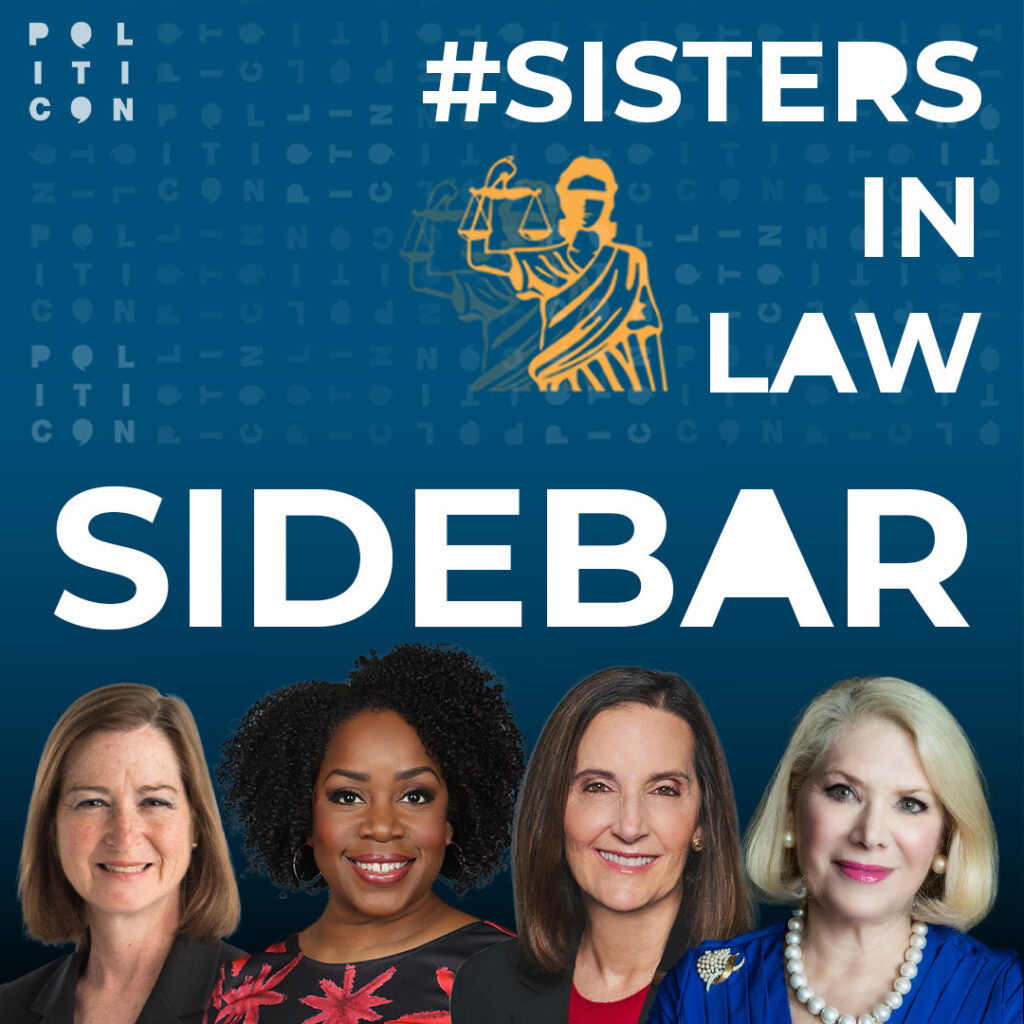
In this episode of #SistersInLaw Sidebar, Joyce Vance and Barb McQuade answer your questions on everything from Trump’s attempt to appeal the civil judgment in favor of E. Jean Carroll to the benefits of having a J.D. Together, they discuss why the SCOTUS is likely to support E. Jean, whether sentencing can be appealed, the inability of states to prosecute federal crimes, and the failure of the government to account for important Epstein-related documents. They also detail the multitude of benefits of acquiring a law degree even if you don’t practice, and explain the difference between deportation and denaturalization.
Freshen up your spring wardrobe! Get the brand new ReSIStance T-Shirt, Mini Tote, and other #SistersInLaw gear at politicon.com/merch!
Additional #SistersInLaw Projects
Jill’s Politicon YouTube Show: Just The Facts
Kim’s Newsletter: The Gavel
Joyce’s new book, Giving Up Is Unforgivable, is now available, and for a limited time, you have the exclusive opportunity to order a signed copy here.
Pre-order Barb’s new book, The Fix, or her first book, Attack From Within, now in paperback.
Add the #Sisters & your other favorite Politicon podcast hosts on Bluesky
Get your #SistersInLaw MERCH at politicon.com/merch
Email: SISTERSINLAW@POLITICON.COM or Thread to @sistersInLaw.podcast
Get tickets for the #SistersInLaw Live Show in Denver, Colorado, on 4/23/26 at politicon.com/tour
Get text updates from #SistersInLaw and Politicon.
Support This Week’s Sponsor
Pocket Hose:
Text LAW to 64-000 to get a FREE pocket pivot and their 10-pattern sprayer with the purchase of ANY size Copper Head hose. Message and data rates may apply.
Get More From The #SistersInLaw
Joyce Vance: Bluesky | Twitter | University of Alabama Law | Civil Discourse Substack | MSNBC | Author of “Giving Up Is Unforgiveable”
Jill Wine-Banks: Bluesky | Twitter | Facebook | Website | Author of The Watergate Girl: My Fight For Truth & Justice Against A Criminal President | Just The Facts YouTube
Kimberly Atkins Stohr: Bluesky | Twitter | Boston Globe | WBUR | The Gavel Newsletter | Justice By Design Podcast
Barb McQuade: barbaramcquade.com | Bluesky | Twitter | University of Michigan Law | Just Security | MSNBC | Attack From Within: How Disinformation Is Sabotaging America
Barb (00:03)
Welcome to this episode of Sisters Sidebar with Joyce Vance and me, Barb McQuade. If you have a question for us, please email us at sistersinlawatpoliticon.com or tag us on social media using hashtag SistersInLaw. But don’t just type them. Your voices are so important, which is why we want to hear them too. If you can email us a voice memo using one of your notes apps, we might play it on the show.
Before we get started, we’re delighted to share with you that we’ll be doing a live show in Denver, Colorado at the Cervantes Masterpiece on April 23rd. We are really looking forward to getting out there to Denver and we hope you’ll join us. Tickets are available now at politicon.com slash tour. We can’t wait to see you there. Let’s get started. Hello, my name is Stephen. I’m from Berkeley, California.
I just listened to the sister’s sidebar and the discussion of the E. Jean Carroll defamation case. And whoever answered said that they expected a reasonable response from Supreme Court because this was a normal defamation situation. So my legal question is, whenever referring to this administration or this Supreme Court, how can you possibly use normal in any sentence?
Joyce (01:08)
the
Hey, Stephen, thanks for this question, which is a really great one. You know, we definitely live in an era where it bodes well to be skeptical of what we hear from the administration. But sometimes we have to define our terms. And when I use the word administration, I mean the executive branch of government, the Trump administration.
The Supreme Court, which look, I mean, let’s just be candid, right? We’ve all noted that both Congress and the Supreme Court, the courts, the other branches of government have been a little bit lacking when it comes to providing a check and a balance on this administration. The Supreme Court though, is in a different situation when it comes to these sorts of routine cases that filter through the courts, even one that involves the president, because there’s an entire body.
of defamation law and law about the award of judgments when a party is successful in the lower court. And for the Supreme Court to sort of swoop in after E. Jean Carroll has won not one, but two cases, had awards scrutinized by appellate courts, and then landing in the Supreme Court, there’s only just so much they can do unless they’re willing to go full MAGA.
and disclose an actual bias for the president. And I just don’t think that we’ll see that. I think that there are clearly five votes on this court to do things in the usual and ordinary way. And that here is likely to mean either they won’t hear the case. Trump has filed for cert. E. Carroll’s lawyer, Robbie Kaplan, has filed a very strong brief explaining why the court shouldn’t even bother to take the case. The issue is just so pedestrian.
That’s one very likely outcome here, or the court might take the case just to make the point that presidents are no different than anyone else when it comes to the award of damages. Hey, Barb, there’s a question for you from Oren in New York City. He asks, can guilt be acknowledged, but the sentencing be appealed?
Barb (03:30)
yes, Orrin, this is such a great question. In fact, this happens in many cases where these are really separate things. Now, it could be that there is a plea deal where the parties agree that if the sentence does not exceed a certain amount, that there will be no appeal. That’s known as an appeal waiver. However, it is the case that at least with regard to
DOJ policy, ⁓ it’s necessary to allow a defendant to appeal if there was some sort of ineffective assistance of counsel. So that could still be done. It could be the case, however, that there’s no plea deal and a defendant just stands up in open court and says, I wish to plead guilty. And then they’re sentenced and they don’t like the sentence. ⁓ Most of the reasons that a person pleads guilty
is to reduce their sentence. They ⁓ recognize that the likelihood of conviction is great and that the best way to ⁓ reduce their sentence is to show remorse and ask for mercy from the court. So those are two separate proceedings. And unless they have agreed to contractually waive that right in a plea deal, a defendant who acknowledges guilt can still appeal their sentence.
Our next question comes to us from Allison in Santa Fe, New Mexico. of practicing law, what are some of the benefits or careers that come with a JD degree? Joyce, what do you think?
Joyce (05:07)
You know, this is such a great question. It gives me the opportunity to talk about something that I really, really love, which is the value of legal education. It’s great to be a lawyer. It’s fun to practice law. I mean, I make no bones about that. But the best thing about going to law school and getting the training is that it trains you to think like a lawyer. And that’s a very special way of thinking where you take a problem, you hold it in your hand.
You look at it from all 360 degrees before you answer it, by which I mean you learn to set aside your biases and your preconceived notions and to evaluate the facts and the law as independent of bias as you can make it so you can arrive at the best answer possible. And that process in and of itself really brings value to your life. And that’s why you’ll see all sorts of people, business people, creative people.
people who work in the nonprofit center, using a background as a lawyer, a legal education to further their goals. You even see what my father-in-law used to tickle me by calling doctor doctors. He had a number of law clerks who were both medical doctors and JDs, jurist doctors. And that’s something that you don’t see a lot, but that you do see some, because there’s so much value into this form of education and training yourself to think this way.
Planting season is here, which is why we’re so glad that this episode is brought to you by Pocket Hose, the world’s number one expandable hose. Look, I used to use that terrible green rubber hose, the old fashioned kind that kinks and creases at the spigot, not to mention that they’re super easy to trip over and get tangled up in and really heavy to move around the garden. Enter the Pocket Hose.
The Copperhead’s Pocket Pivot swivels 360 degrees for full water flow, and it gives you the freedom to water with ease all around your home.
Barb (07:18)
That alone was enough for us, but this hose is seriously like something out of science fiction. When you’re all done, this rust-proof anti-burst hose shrinks back down to pocket size, no kidding, for effortless handling and tidy storage. It never feels like you have to lasso it back into place. Your super light and ultra durable pocket hose copperhead is backed with a 10-year warranty.
Joyce (07:45)
When you combine them, the brand new Pocket Hose Copperhead with the Pocket Pivot is a total game changer. It’s easily the best yard and garden upgrade we’ve ever made. No matter how much I need to water, and I water a lot, I have a big garden, I’ve actually got four separate hose connections, this hose moves with me and it saves so much time that we used to spend unblocking the water flow or dragging the old hose from plant to plant. And best of all, when you’re done,
It’s gone, it’s out of sight, out of mind. That means your garden will look great.
Barb (08:19)
Make your yard a hobby instead of a chore. For a limited time, our listeners can get a free pocket pivot and their 10 pattern sprayer with the purchase of any size copper head hose. Just text LAW to 64000. That’s LAW to 64000, 64000. For your two free gifts with purchase, again, LAW to 64000. Message and data rates may apply. See terms for details. The link is in the show notes.
Hi, this is Pat from New Jersey. I have a question about the Epstein files. Why is it that we’ve seen input to investigation, but we haven’t seen the results of the DOJ’s investigation? In other words, they must have reports, internal memos, et cetera, analyzing the evidence and summarizing to come to the conclusion that there was no one to indict.
Where is their work? And why is nobody shouting for it? I want to see their reports. That’s a great question, Pat. ⁓ You know, the Epstein Files Transparency Act actually asks for these things or authorizes and requires the Justice Department to produce, among other things, subparagraph seven, internal DOJ communications, including emails, memos, meeting notes.
concerning decisions to charge, not charge, investigate, or decline to investigate Epstein or his associates. None of these things were produced, however. When the Justice Department produced all those documents, one of the things they were required to produce at the end was a document sort of summarizing what they had produced and what they had withheld and describing categories. And what Todd Blanch wrote ⁓ and Pam Bondi wrote in that document is that they were withholding.
all of these things pursuant to executive privilege. They said things that were deliberative processes at the Justice Department, attorney-client privilege or attorney work product, they were withholding under traditional privileges. And then they cite law that says ⁓ Congress ordinarily respects privileges except where it explicitly says it doesn’t. ⁓ Seems pretty explicit to me if they’re asking for all of these documents. And yet the Justice Department
took it upon itself to withhold those documents. We have yet to see Congress really push them on that, but I’d like to see them do that because technically they are not in compliance with the Epstein-Files Transparency Act. To me, that’s everything. I want to see who did they investigate, who did they consider a co-conspirator, why did they file charges, why did they not file charges. We know that Pam Bondi has been a little bit fast and loose with saying that there still some Democrats under investigation, but both Cash Patel and Todd Blanch
have said there’s no evidence to charge anybody else with a crime. Well, let’s see those memos to make that decision, or at least ⁓ if they’re going to be protected, let’s push this issue, right? think Congress has been a little too lax in my view in tolerating first blowing past the deadline to produce these things by months, and now kind of cherry picking what they’re going to decide to produce and not produce. So we’ll see whether anybody in Congress…
decides to push this issue. All right, Joyce, here’s one for you. ⁓ This is a question from BG. Can only the Department of Justice prosecute federal crimes? What about other federal departments or agencies or officeholders individually? Can states? Why or why not?
Joyce (12:13)
You know, this is another great question. ⁓ File this one under things that Barb and I as former federal prosecutors take for granted, but that we should really take time to explain. Sometimes when you peel back the layers of skin on the onion, you have a better understanding of how a system works. And so for starters, the answer to your question, can only DOJ prosecute federal crimes? By and large, for the most part, with some very rare exceptions.
Yes, that’s the case. mean, occasionally you’ll see, for instance, JAG officers doing misdemeanor cases that take place on military bases. But for the most part, it’s only Assistant United States Attorneys working under the direction of the Attorney General of the United States who engage in this. And that’s for the very simple reason that the Justice Department is the agency to whom power has been delegated.
to engage in federal criminal prosecutions. Congress does that by statute. For instance, every U.S. attorney is charged with three and only three tasks, and the first one is enforcing federal criminal law. So there’s no other agency that’s been given that power. You don’t have, for instance, senators or governors or anyone else who can go in and file a federal criminal case. Often they might have standing.
to bring civil cases, but federal cases are different. ⁓ And so that’s how it works and a little bit of the reasoning behind it. Well, Barb, this is a really interesting one in light of current events. It comes from Tyler in Miami, Florida. And Tyler asks, how is denaturalization different from deportation? Is it a valid legal process?
Barb (14:06)
Yeah, these are two different things. mean, certainly both relate to immigration. ⁓ Deportation occurs pretty frequently when somebody is found in the country and does not have any legal status to be here. They may be deported. There are, you know, paroles and exceptions to things, but it is a remedy that is available if somebody is, you know, either enters without permission or overstays a visa or something like that. They may be ordered
And actually the term today is removed from the country. And ⁓ ICE buys them a plane ticket and puts them on a plane and takes them back usually to their home country. Sometimes we see third countries involved. That’s deportation. It happens a lot. Denaturalization is actually quite a bit more rare. That is, I was ⁓ born in another country. I came to the United States and then I went through the naturalization process to obtain my citizenship.
And we all know people like this who immigrated to the United States. ⁓ Maybe they went through the green card process and became a permanent lawful resident for a period of time. Then they took their citizenship test. They passed, they were interviewed, and they got sworn in as a U.S. citizen. Unlike a natural born U.S. citizen, someone who is naturalized can actually become denaturalized and lose their citizenship.
But to do that, there has to be a criminal prosecution that shows that they obtained their citizenship by fraud. I once participated in a case that ⁓ had denaturalization as ⁓ a component of it. In fact, the person, there was a finding by the judge that stripped them of their citizenship because they lied on the application that gave them their citizenship in the first place. In this particular instance, the person had lied about participating
in a terrorist bombing and being a member of a terrorist organization. Had she told the truth on her citizenship application, it never would have been awarded to her in the first place. It was fraud in the procurement of citizenship. That’s denaturalization. That’s actually much rarer than deportation. Then after someone is denaturalized, it is likely that deportation may follow. It is a valid legal process.
But what you have to show is that the person used fraud to procure their citizenship in the first place and had they been truthful, would not have received it.
Joyce (16:42)
Thank you for listening to Sisters Sidebar with Barb McQuade and me, Joyce Vance. Keep sending in more of your great questions for next week’s show. And if you send in a voice memo, we’ll try to play your question during our next episode. We hope to see you at our live show in Denver, Colorado at the Cervantes Masterpiece on April 23rd. Tickets are still available at politicon.com slash tour. So make sure you get yours before they sell out.
Follow Sister’s sidebar and hashtag SistersInLaw wherever you listen. And please give us a five-star review. It really helps others find the show. Show some love to this week’s Pocket Hose. The link is in the show notes. We absolutely adore them. And your support for them will be helpful because they make this podcast possible. Don’t forget to pick up hashtag SistersInLaw merch and other goodies at politicon.com slash merch.
See you every week on Wednesdays and Saturdays for new episodes of Hashtag Sisters-in-Law and Sisters Sidebar.
Barb (17:57)
I got it. Pocket hose, reply yes to opt in to receive recurring text offers. 64000 is where you send it and you type in the word law.
Joyce (18:00)
What am I doing wrong? Six fours.
Yeah, that’s exactly what I did. It does not like me. Hmm, that’s odd. As long as it works for everybody else, it’s fine, though.
So I just got something back from the pocket hose people,
Barb (18:17)
All right, let’s move along. Let’s move along here. All right, I’m going to start.
Joyce (18:18)
All right.
 Kimberly Atkins Stohr
  Barbara McQuade
  Joyce Vance
  Jill Wine-Banks