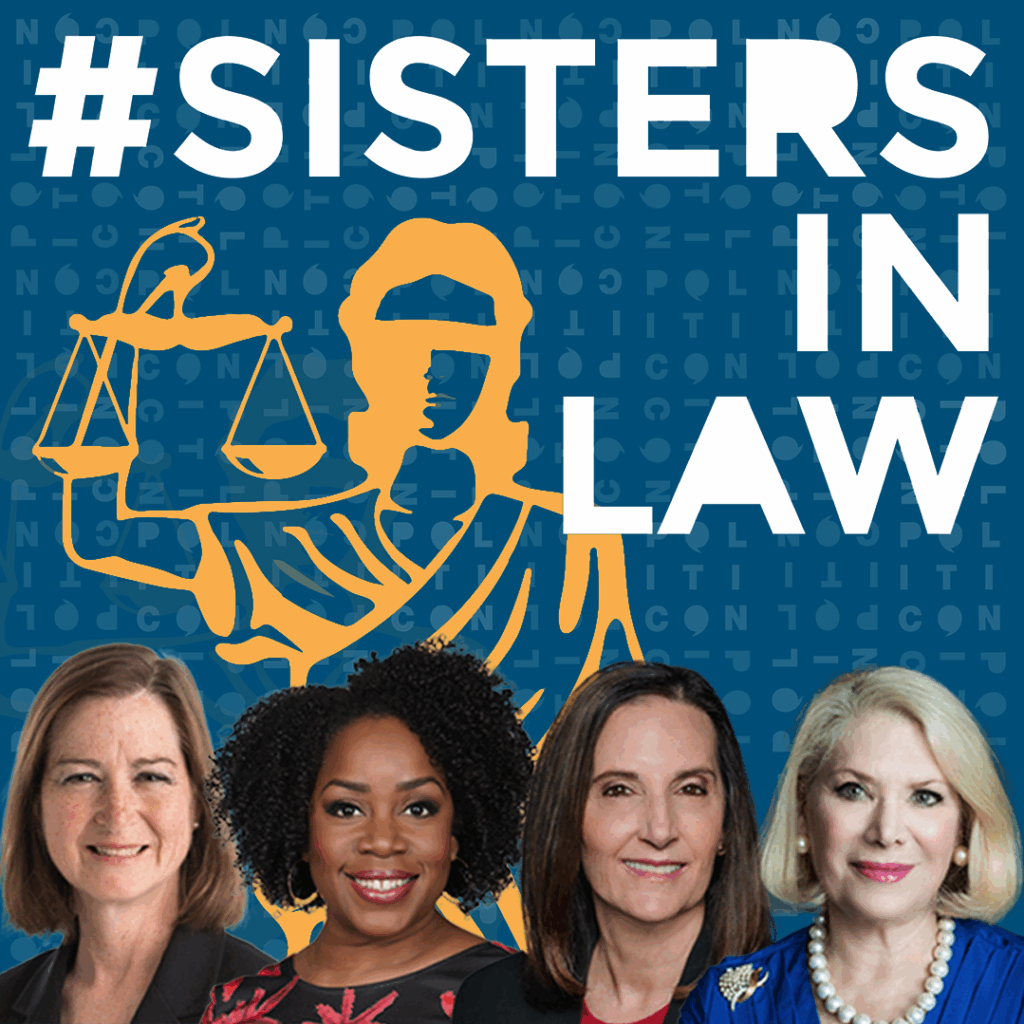
Joyce Vance hosts #SistersInLaw to discuss the state of voting rights going into the midterm elections, looking at the DOJ’s challenges in Alaska and California, the future implications of federal interference in the states, and the history of dirty tricks in politics. Then, the #Sisters explain Maureen Comey’s victorious lawsuit against the administration for wrongful termination, and the latest lawfare targeting her father, James Comey. They also review litigation pushing back against Trump’s attempt to restrict media access to the administration, the importance of press freedom, and the nuances governing the issuance of press credentials.
Remember to send in audio questions to SistersInLaw@politicon.com for the #Sisters to answer on their new companion podcast, SistersInLaw Sidebar! It airs Wednesdays wherever you normally get your podcasts!
Get the brand new ReSIStance T-Shirt, Mini Tote, and other #SistersInLaw gear at politicon.com/merch!
Additional #SistersInLaw Projects
Check out Jill’s Politicon YouTube Show: Just The Facts
Check out Kim’s Newsletter: The Gavel
Joyce’s new book, Giving Up Is Unforgivable, is now available, and for a limited time, you have the exclusive opportunity to order a signed copy here.
Barb is on a book tour! You can also order Barb’s new book, The Fix. Her first book, Attack From Within, is now in paperback.
Add the #Sisters & your other favorite Politicon podcast hosts on Bluesky
Get your #SistersInLaw MERCH at politicon.com/merch
Email: SISTERSINLAW@POLITICON.COM or Thread to @sistersInLaw.podcast
Get text updates from #SistersInLaw and Politicon.
Mentioned By The #Sisters
Sign Up For Kim’s Newsletter: The Gavel
From Joyce:
Sign up for Joyce’s Newsletter and read about An Epic Opinion From Judge Carter
From Jill:
Reopen Watergate? Of Course Trumpworld Is Intrigued.
From Barb:
The Comey Prosecution Gets Even More Outrageous
Support This Week’s Sponsors
Oak Essentials:
Use code SISTERS at oakessentials.com to get 15% off your first purchase! #OakEssentials #ad
Mint Mobile:
Get premium wireless for just $15 per month at mintmobile.com/sisters
Gusto:
Try Gusto today at Gusto.com/sisters, and get three months free when you run your first payroll.
ASPCA:
To explore coverage, visit aspcapetinsurance.com/sisters
The ASPCA® is not an insurer and is not engaged in the business of
insurance. For terms and conditions, visit: https://www.aspcapetinsurance.com/more-info/state-documents-and-sample-policies/. Products are underwritten by either Independence American Insurance Company (NAIC #26581) or United States Fire Insurance Company (NAIC #21113) and distributed by PTZ Insurance Agency Ltd.
Thrive Causemetics:
Amplify your everyday look this fall. Go to thrivecausemetics.com/sisters for an exclusive offer of 20% off your first order.
Get More From The #SistersInLaw
Joyce Vance: Bluesky | Twitter | University of Alabama Law | Civil Discourse Substack | MSNBC | Author of “Giving Up Is Unforgiveable”
Jill Wine-Banks: Bluesky | Twitter | Facebook | Website | Author of The Watergate Girl: My Fight For Truth & Justice Against A Criminal President | Just The Facts YouTube
Kimberly Atkins Stohr: Bluesky | Twitter | Boston Globe | WBUR | The Gavel Newsletter | Justice By Design Podcast
Barb McQuade: barbaramcquade.com | Bluesky | Twitter | University of Michigan Law | Just Security | MSNBC | Attack From Within: How Disinformation Is Sabotaging America | The Fix
#SistersInLaw — Episode transcript (SIL_10_30_26_V2)
Speakers: Joyce, Barb, Kim, Jill
Timestamps are approximate.
[00:00:12] —- INTRO —-
[00:00:12] Joyce: Welcome back to #SistersInLaw with Barb McQuade, Jill Wine-Banks, Kimberly Atkins Stohr, and me, Joyce Vance. We love hearing from y’all, so please leave a comment about any of today’s topics, and don’t forget to subscribe, click like, and tell a friend about #SistersInLaw. We’ve got a great show today full of some incredibly important topics. We’ll be discussing the election interference that’s going on from the Justice Department. Then we’ll be talking about the Comeys. Both the dad, Jim Comey, the former FBI director, and his daughter Maureen, a former DOJ prosecutor, are back in the news. And we’ll close out with something that’s near and dear to my heart. Have I told you guys I’m working on a second book and it’s about the First Amendment? We’ll be talking about media lawsuits designed to protect the free press. So that one, I’m all in for it. But you know, before we get there, as we’re taping it’s Friday; by the time you guys are hearing it, it’s Saturday before the election. And a lot of states have early voting. Alabama does not have early voting, but listen to what I did. I’m out of county on the day of the election. So I went on my Secretary of State’s website, and it told me that I could vote absentee in person.
[00:01:18] Kim: Really?
[00:01:20] Joyce: So I went down to the courthouse, filled out an affidavit explaining I would be out, and I voted. And here’s the cool thing. There were tons of people voting early in Alabama, of all places. And you know, I don’t care who people vote for, and you don’t know when you’re voting early, but I do live in Alabama, so I can guess. I don’t really care, though. It just fills me with civic pride to see people out doing the heavy lifting of democracy and voting. So what about y’all? Have you voted yet? Will you vote early or will you vote the day of? Jill, what’s going on in Chicago?
[00:02:06] Jill: Well, I voted early, and we do have a long period of early voting. I was gonna wear my I Voted sticker, but it’s stuck on some coat, so I can’t wear it. So instead I’m wearing a Vote pin, which I am encouraging everyone else to do. I have volunteered and gotten training as a poll watcher, and I have been assigned to early voting and to Election Day. And I just have to share one — you know, when you talk about civic pride, there was a hundred-and-one-year-old woman who voted in Lake Barrington.
[00:03:05] Joyce: Wow.
[00:03:06] Barb: Very cool.
[00:03:06] Jill: And it was so inspirational to see her come in and take her obligation as a citizen so seriously. It was wonderful. And equally wonderful was that I saw some sandhill cranes at a different polling place, which was astounding. And I saw people voting in shorts. This is Chicago in late October, and people were wearing shorts. It’s so warm here. It’s lovely. But I just encourage everyone to do what they need to do to vote, whether it is by mail, whether it is in person, early, or on the day of — whatever your preference, just make sure you get out and vote. And if you need help to get to the polling place, there are so many organizations that will help you. They will pick you up. Call your local Democratic Party. They will make sure you get there, because I’m assuming everyone listening is a Democrat — but call whoever your party is to get to the vote, because everyone should vote. This election really, really matters.
[00:03:43] Joyce: You know, I saw statistics from AARP this morning that said older voters determine the outcomes of elections, and particularly women voters. And I had never really thought about it that way before, but your story illustrates that, right? As we get older, we get more invested and more committed. What does it look like in DC, Kim?
[00:04:04] Kim: Well, by the time our listeners are hearing this podcast, I will have voted early in person. I have not actually done it yet, but I’m going to do that today. It’s very easy to do here, which I am very glad about. I’ve lived in states where, even for early voting, sometimes I would stand in these long lines and stuff, but they make the process here in DC really simple, and I am looking forward to doing it. And yeah, it’s just so important. I also encourage people to pay very close attention — I know I’m a broken record on this — but your local elections have more of an impact on your life than even the national ones that we’re talking about. So there are always important ballot initiatives or propositions or so many things, local races. We have every kind, even right down to the very, very local boards here in DC called ANCs. I think they’re sort of the equivalent of aldermen in Chicago and other things. All these folks really affect your communities and how they work. And right now it’s even more important, because you want people in those local offices who believe in democracy, who believe in protecting people, who don’t want to allow the federal government to come in and override them. So vote pro-democracy candidates up and down the ballot, but most of all, get out and vote, y’all. The whole thing that we’re gonna be talking about in the first topic is efforts by the government to stop you from voting. Don’t let them do that. Go vote, use your voice. The government belongs to you. It doesn’t belong to anybody in office who is just trying to abuse power to hold on to power.
[00:05:50] Joyce: I just want to inject that straight into my veins. I mean, that’s so, so perfect. Barb, same energy in Michigan. What’s it like where you are?
[00:06:00] Barb: Yeah, in fact, you know, there was data that a huge number of people have already cast ballots in Michigan. Until a few years ago, Michigan was an excuse-only absentee state. So if you were going to be out of town, you could get an absentee ballot and vote in advance. But now Michigan is a no-excuse absentee state, so you can vote by mail whenever you want. And there’s also early voting, ten days of early voting. In fact, one of the great things is our great Secretary of State, Jocelyn Benson, who’s running for governor — she does this every election year. She opens up satellite offices of the Secretary of State on college campuses. So on the University of Michigan campus, there is an early voting site where people can register and vote, which is great.
[00:06:41] Joyce: Wow.
[00:06:42] Kim: No, that’s great.
[00:06:44] Barb: So I voted early. I voted by mail, but I also hand-delivered my ballot to a drop box, which is very convenient — there are many around — because I wanted to make sure it got there. And also because on Election Day I will be working at the polls, from 6 a.m. until 10 p.m. I will be making sure that if there is any mischief that comes to a polling place, nothing’s gonna happen on my watch.
[00:07:06] Joyce: You go.
[00:07:07] Kim: Woo.
[00:07:15] Joyce: I love to hear it.
[00:07:26] Kim: Thank you for your service, Barb.
[00:07:26] Jill: The training I got for the Tenth Dems was really interesting, but even more interesting was actually sitting and watching and observing the judges and all the details that they have to manipulate in terms of the screens and how they compare signatures. It was fascinating to watch democracy in action. I recommend everybody volunteer to help out at the polls. It’s fabulous. I can’t wait till Election Day, but I’m not starting at 6 a.m.
[00:07:54] Joyce: Well, remember to love on your local poll workers. They’re under a lot of stress. You know, in some states they’re being threatened — hey, looking at you, California and Washington State. We’ll get into that in a minute. But take some cookies, or just tell them that you appreciate their service. We’re all about to participate in the glorious American experiment, and I am so here for it.
[00:08:14] Kim: And I’m not gonna be working the polls, but I will be covering them. So if you tune in to PBS NewsHour’s election night coverage, I’ll be on the panel there. So we’ll all be very busy on Election Day in our own ways.
[00:08:28] Joyce: Cool.
[00:08:33] Jill: And I’ll be on WCPT that day.
[00:08:40] —- AD: OAK ESSENTIALS —-
[00:08:38] Jill: When we’re baking under the heater or outside in the cold fall wind, our skin gets drier and more sensitive. It’s uncomfortable, and for many of us the same tired routine isn’t up to the demands of the environment. You want something soothing and moisturizing that leaves your skin feeling fresh and looking glowing. That’s why we want to tell you about Oak Essentials Luminous Body Lotion. We’ve all had that moment when we open our cabinet and see it’s full of self-care products that under-delivered or never lived up to their promises. With Oak Essentials Luminous Body Lotion, you can ditch the clutter and build a new routine around an elite product.
[00:09:18] Kim: You know, it smells really good. Greg gave me a hug the other day. He’s like, “You smell really good.” And I’m like, I’m wearing Oak Essentials. It really does smell good. And it feels so light and smooth when you apply it. The blue color is mesmerizing, and the scent is on another level. The first time I used it, I was captivated, and I know that I’m never going back. You know, when we first looked into Oak Essentials, we discovered that the lotion’s distinctive blue color comes from blue tansy, and it’s a game changer. If you haven’t heard of it, blue tansy is an antioxidant-rich botanical that helps support the skin’s moisture barrier and calm sensitivity. Add rose oil, shea butter, coconut oil, and turmeric root extract to deeply hydrate and nourish the skin while visibly firming, to support a youthful-looking complexion, and the effects are amazing. After trying it, we can say it lives up to the effortless, elevated, nothing-extra aesthetic of its founder, Jenni Kayne.
[00:10:21] Barb: In a one-week consumer study, 100% of participants said their skin felt softer, soothed, and instantly hydrated. And we’re not surprised. It leaves a velvety soft finish that makes you feel like you just walked out of a spa. And it smells so good, it makes perfumes feel obsolete. We also love the moisture-rich face balm, dew body butter, and microbiome-balancing deodorant. You really need to try it all, but if you’re not sure where to start, Oak Essentials has a skincare quiz that gives you recommendations based on your skin concerns.
[00:11:06] Joyce: Oak Essentials is clean and formulated to strict EU and UK standards. No phthalates, sulfates, petrolatum, parabens, or other unnecessary additives. So everything feels clean, elevated, and spa-inspired. It’s the kind of brand that turns simple routines into rituals you actually look forward to. You know, it’s so easy to skip putting on moisturizer at night, but with Oak Essentials, I’m never tempted to pass it up. So don’t wait. The Luminous Body Lotion has sold out multiple times, and once you try it, you’ll understand why. Head to OakEssentials.com and use code SISTERS for 15% off your first order at checkout. That’s 15% off your order at OakEssentials.com with promo code SISTERS. After you purchase, they’ll ask where you heard about them. Please support the show and let them know we sent you. The link is in the show notes.
[00:12:13] —- TOPIC 1: THE JUSTICE DEPARTMENT AND THE ELECTION —-
[00:12:09] Jill: As you heard us discussing, we’re down to the wire, and voting is almost over. By the time you hear this recording, there’ll be today, Saturday, Sunday, Monday, Tuesday. So we’re talking four days that you have to get out and vote. And the Department of Justice seems to be doing everything it can to stop you, particularly if you’re in certain states, from voting. And I’m looking forward to talking about that. I think that there are some really seriously bad things going on. And before you all weigh in on whether you think, right, that this is a devious plot to upend the elections and to interfere and to cause chaos and to cause distrust, let’s describe what’s going on. And there’s really recent developments, because just as we started recording, there’s a new Ninth Circuit decision. So let’s start, Joyce. You did a Civic Discourse Substack that was really, really good. On Friday it came out, and it analyzed what’s happening with DOJ demanding that the state stop the count in California because there are some likely not citizens — not definitely not, but there’s a probability that they might not be citizens. And there’s no evidence of that. There’s no data. And the state has asked for some proof, but they haven’t gotten it. So what do you think? What are the facts there? And tell us what’s happening in terms of the status of that case and what happened today.
[00:13:47] Joyce: I think it’s important to start by saying that the government, this administration, has a really bad track record when it comes to drawing up these lists of people who it says are non-citizens. Typically they put it out there, there’s a lot of splash, Donald Trump runs his mouth, and then we find out a week or two later, oops, these people were citizens. The government made a lot of mistakes. Something I really like about the judge’s opinion — Judge Carter in California — is that he goes to lengths to lay out how these lists were created and what the flaws are. And like you say, Jill, I spent some time going through the opinion last night. I’ll drop a link to it in the show notes if anybody wants to see the nitty-gritty. But the bottom line is that the government doesn’t exactly walk into this case with clean hands. And Judge Carter ruled against DOJ because they wanted California to, quote, “segregate” ballots. That really means not count them, or at least have a pile sitting there so the administration could challenge the outcome of the elections afterwards. They wanted to disenfranchise twenty thousand people at least. Let me read you the first paragraph of Judge Carter’s opinion, because it’s a banger. He wrote, “This case is about the right of every American citizen to vote in a free and fair election. Never before in American history has the federal government, on the eve of an election, sought to coerce a state and local government to abandon their own constitutional elections procedures and bend to the will of the executive branch. In bringing this lawsuit, the executive would have this court believe that it reigns as the sole sovereign” — but California and its people are sovereign too. It’s a beautifully written opinion. It’s a constitutional law opinion, but it’s very accessible, I think, for non-lawyers too. And it’s just the law and the facts. And so this case goes on appeal to the Ninth Circuit. Y’all may have seen the brouhaha over the weekend, where the issue was a technical legal one about whether DOJ jumped the gun and tried to appeal before the judge could rule. They in fact did, and the Ninth Circuit sent it back down to Judge Carter for his decision. He entered that, there was a rush to get to the Ninth Circuit, which has now affirmed him, and the Supreme Court will have this in front of them in short order. That was always the ballgame for the administration. One last thing I want to say about this is it’s easy to become numb to what’s going on here. The federal government has filed a lawsuit. You guys, it’s not normal. It is unprecedented, as the judge says, for the Justice Department to be in the position of trying to keep tens of thousands of American citizens from voting in an election. This is new. This is shocking. This is astonishing. And I know we often say we’ve lost our ability to be shocked by anything Donald Trump does, but here you’ve got to hold on to that. This is an outrage, and we should treat it like the outrage that it is.
[00:16:56] Jill: And you know, when you say they come with not clean hands, we saw in Nevada where they said there are sixteen thousand illegal voters that you have to stop. And when put to the proof, guess what it came down to? Zero. Zero. Yes, Kim is right. Zero. And just out of, I don’t know, vindictiveness, Todd Blanche himself has, in the unusual step, signed an information against four people he is accusing of having actually registered to vote without being appropriately entitled.
[00:17:39] Kim: I wonder who told him to do that.
[00:17:39] Joyce: Those are misdemeanor indictments — misdemeanors signed personally by the Attorney General of the United States. Like, I don’t even know what’s going on there.
[00:17:48] Kim: I know what’s going on. Somebody called him up and said, “What are you doing? I need some indictments.”
[00:17:52] Barb: And just to clarify — and not to be too pedantic — they’re not even indictments, right? An indictment means a grand jury returned this thing. They’re just complaints, or informations. They’re not charged by a grand jury, ’cause they’re misdemeanors.
[00:17:55] Jill: And he couldn’t get an indictment.
[00:17:56] Joyce: They’re informations, yeah.
[00:17:58] Kim: Right, informations. Yep.
[00:18:04] Jill: Had he tried, the grand jury would have refused. Yeah. So, okay, so that’s Nevada, that’s California. Barb, let’s talk about Washington, because they got a similar letter to say you can’t count your ballots. There are ballots of at least 400 people that are not registered properly, and they shouldn’t be able to vote; they’d be voting illegally. Well, what’s the story there? I mean, I read what the decision was, and I think we should quote from it because it’s really brilliant. Talk about what the court did there.
[00:18:32] Barb: Yeah, you know, I’m glad we’re on video so you can see my eye roll over this one. And by the way, you should read what Joyce wrote about the Judge Carter opinion. It’s fantastic and makes it very digestible. You should also read what Kim wrote in her column in the Boston Globe this week, because she talks about these efforts to go after voters in California, Washington, and Alaska. And I would submit that this Ninth Circuit opinion covers all of those district courts now. And in this opinion, they make it pretty clear — you know, we were talking ahead of time about how the court might decide this. Do they do it on very narrow grounds? And they actually decided it on about as broad a ground as you can. They found that it was a constitutional question, that what the DOJ is trying to do violates the Elections Clause, and they even use the words “plain text.” That’s a little, you know, a little—
[00:19:28] Jill: Little dig.
[00:19:31] Barb: Look, what’s the thing that cats like? Catnip.
[00:19:33] Kim: Catnip.
[00:19:34] Barb: That’s a little catnip for the Supreme Court. Like, text over the text. It violates the text of the Elections Clause, which says that it’s the states that get to control the time, place, and manner of elections, only subject to change by Congress. There’s no role for you, DOJ, here. There’s no role for you, executive branch. So I thought that was great. But then they go on to say, and it’s not just the Constitution. If they were to do this, it would also likely violate what Congress has layered on top, the National Voter Registration Act, which prohibits voter purges less than 90 days before an election. So they lose on the Constitution, they lose on the statute. And that’s going to apply to Washington as well as California and as well as Alaska. But Jill, to get to your precise question, the Secretary of State of Washington gets this thing, you know, that says, we want you to set aside these ballots because we suspect they may be non-citizens. And he writes back — his name’s Steve Hobbs, so a little shout-out to Steve Hobbs this week. He writes back, and, you know, obviously his audience is not just DOJ, it is also the world, to explain his reasoning. But what he says is, “Without individualized proof of ineligibility, it would be both irresponsible and illegal for election officials to decline to process a registered voter’s ballots. If you have individualized proof, I invite you to provide it so that election officials can take appropriate steps that are consistent with the law.” And then he also says, “The timing of your letter is profoundly disappointing. As your letter makes clear, you’re aware that Washington mailed ballots to voters on October sixteenth.” Despite that, you sent your letter after that. “And as you know, we hold regular conversations.” We’ve been talking for months. And if you had valid concerns about these things, you had time to raise them months ago. So I thought it was a very good, you know, beatdown for what they’re saying, and also explaining to the public why it’s so important that he not comply, because to do so would be to violate the law.
[00:21:38] Jill: I loved everything he wrote. And Kim, you also wrote about both of those states plus Alaska. And Alaska started as what seemed like a really crazy, just ridiculous lawsuit—
[00:21:53] Kim: It’s still ridiculous.
[00:21:55] Jill: Well, that’s exactly the point that you will talk about, because even though there has been some new reporting that there may have been some effort to get a second Dan Sullivan on — and we have to put it in context, because there is a listing that says Dan Sullivan, Republican incumbent senator. And although Donald Trump apparently didn’t know what incumbent was—
[00:22:18] Kim: Well, we don’t know that, but he said you have to have a hundred and ninety IQ to know what incumbent means, which I just thought was really insulting to Alaska voters.
[00:22:32] Jill: So then I guess all of us have 190 IQs, because we all knew what it was. Anyway, you’re right. Let’s talk about that, because — and remember, in Alaska they elected Murkowski by a write-in. They had to spell Murkowski correctly to write it in and have their vote counted. And there was this great effort to make sure there’s no confusion. So the claim that there could have been confusion is absurd. And even if there were, it doesn’t matter. And there’s ranked-choice voting. There’s all sorts of things that mean there isn’t confusion. But anyway, talk about what’s going on there and what is the status of what’s happening in Alaska right now. And I have some additional questions for you.
[00:23:14] Kim: Okay, so recall, we talked about this before. In Alaska, the DOJ is seeking to block certification of the results of the Senate race in Alaska between incumbent Dan Sullivan and Democratic challenger Mary Peltola. But only — only if — Mary Peltola wins.
[00:23:35] Barb: Yeah, otherwise, meh, I don’t care.
[00:23:38] Joyce: There’s only fraud when the Republicans win. Do you not understand this by now? What’s wrong with you?
[00:23:46] Kim: I still laugh every time I say that. It’s so ridiculous. And then they also amended this complaint since the last time we talked about it to add a Supremacy Clause claim, saying that it is the federal government that has the right to order this block of certification. I’m like, okay, exactly opposite. If you open your Constitution, you will see that elections are governed by the states, with a limited role for Congress. Absolutely no role for the executive branch. None, not a zip. And so, yeah, that claim is really laughable. But to your point, Jill, one thing that happened this week is that there was a New York Times report that alleges that Peltola’s camp — people within Peltola’s campaign sphere, and also in the Democratic Senatorial Committee — were encouraging people named Dan Sullivan to run in order to sow some confusion on the ballot. Okay. She denies it. The Senate campaign denies it. Either way, that’s not illegal. Okay. Is it a bad political look, especially at a time when Republicans are claiming falsely that there is fraud, to do something that’s kind of sketchy and shady? Yeah, I wouldn’t have done that. I don’t think that that was a great look. But this is the kind of thing that happens. But it also has — and I just want to emphasize this, because I think it’s causing a lot of confusion — it has nothing to do with these electoral challenges, because it’s not illegal. But that didn’t stop the DOJ from making new filings citing this, as if to try to, you know, bolster up this really thin case that they’ve got going on, trying to stop certification. Here’s the thing: a state court judge months ago already decided this. This challenge was made alleging this kind of confusion exists with the second Dan Sullivan on the ballot. And the court said, look, as Jill said, they identified who the incumbent is. It seems pretty clear. It’s not illegal to do. So what do you want? This is fine. And you have to understand also, as we pointed out before, federal courts must respect a state court’s interpretation of state law. So this is really over, but the DOJ doesn’t want it to be.
[00:26:12] Barb: Hey, can I just chime in on this? This whole concept absolutely fascinates me. And I’ve got a little bit of history with this, just from an observer’s perspective. First, Kim, as a Detroiter, you may remember that back when Mike Duggan first ran for mayor — he won and he became the mayor of Detroit, and was mayor of Detroit, I think, three terms, and was very successful. But when he ran, there was another guy running named Mike Dudgeon, D-U-D-G-E-O-N, who was a barber, who ran against him, and there was all this talk about, like, he’s gotta get off the ballot, it’s gonna cause all this confusion and whatever. It’s like, you know, voters, educate thyself. In Alaska, Alaska resolved this issue, as you said, by making it very clear that one of these — I’m sorry, Dan Sullivan — is the incumbent, registered Republican, and then the other Daniel J. Sullivan is the unaffiliated, and so it’s pretty clear. But let me also say this: you mentioned that if Mary Peltola is involved in this, it is a bad look. It does seem kind of shady, it does seem kind of slimy. But where do we draw the line between crime and slime? So she denies it, and Dan Sullivan also denies that he was encouraged to do it. But what if she did encourage him to do this? Just encouraging someone to run, even with that sort of, you know, kind of shady intent to confuse voters, is not itself a crime. I’ll tell you what is a crime. Bribery is a crime. And when I served as U.S. attorney, I oversaw a case that did involve a conspiracy to commit bribery with a rigged election. But let me tell you how it worked. It was out of Cuyahoga County, Ohio. I was handling a recusal for the U.S. attorney there, who was recused from the case. And there was — I think he was the auditor of the county. And he ran a sham election. He found some guy and said, “Tell you what, I want you to run against me. I’m gonna be the Democrat, you run as the Republican. I want you to run against me, and I want you to run a really bad campaign. And in fact, I want you to withdraw from the race just before the election, when it’s too late for the Republicans to put someone else up on the ballot. That way I’m guaranteed to win. And as the current auditor of Cuyahoga County, I will give you a job.” A thing of value — an official act in exchange for a thing of value. So it met the federal bribery statute.
[00:28:42] Kim: I was gonna say, that sounds like a conspiracy, bribery—
[00:28:46] Barb: Absolutely. It was bribery conspiracy. That was the count of conviction. But what’s happening in Alaska is very different from that, right? She’s not in a position to offer or perform an official act, because she’s not a state official, she’s not a senator, she can’t offer a job. You know, maybe there are facts we don’t know, but to date all we know is that she and her staff allegedly encouraged him to run. So, very different scenario from what I just described.
[00:29:10] Kim: And this is really important because of the final aspect of this case, which is that the Justice Department sent grand jury subpoenas to everyone involved to preserve documents with respect to this alleged campaign of ballot stacking, which is what that’s called. Again, so many things wrong with this. First of all, I don’t know what this grand jury is looking at, because, again, this is not a crime. They sent these subpoenas clearly to scare and intimidate the officials in Alaska, and also the people working in the campaigns, and to sow doubt into this election. And that violates — y’all are all DOJ alums, I’m not — but I thought back in the day there was a 60-day rule, where the DOJ did not institute election-related actions because they did not want it to taint candidates in the eyes of voters too close to an election. I thought it was 60 days. As we pointed out, it is four days from the election now. So it’s so awful. I mean, it’s just awful what they are doing. The DOJ should not be doing this.
[00:30:16] Barb: Yep. Yeah, they seem to be completely disregarding that.
[00:30:22] Kim: They’re doing this — they should be ashamed. And I think one reason that they’re doing this is they anticipated that the Ninth Circuit would rule just as it did: that all of this is unconstitutional, it’s illegal, and it’s wrong. And I want our Alaskan listeners to vote. Don’t be afraid. This is all subterfuge, because the Republicans who are in charge of this whole operation are afraid of losing. So do your thing.
[00:30:54] Jill: And I think everyone needs to know how common ballot stacking and other dirty tricks are.
[00:31:00] Kim: Wait, there are dirty tricks in elections? What?
[00:31:04] Jill: Let me tell you about some of them. And some of them happened by the Republicans. No, this is the Watergate Girl talking.
[00:31:07] Joyce: It’s the Chicago girl talking.
[00:31:09] Jill: I mean, Watergate, aside from the break-in — the whole thing presented was not just the break-in, but they were planning to lure Democratic delegates from the convention onto a houseboat, moored right opposite the Fontainebleau Hotel, where the Democratic headquarters hotel was, with prostitutes, and record them and then blackmail them. That was one of the dirty tricks. How about Edmund Muskie? They faked a letter in which he allegedly used the word “Canuck,” which is a very derogatory term, that absolutely ended up ending his campaign. The Republicans did this to a Democrat in Florida, similarly in Alaska. When John Kennedy ran the first time, there were dirty tricks involving his opponent when he ran for the first time as a congressional candidate. We have Ronald Reagan playing dirty tricks with negotiating the Iran — yeah, the Iran deal, so that it would hurt Jimmy Carter. You had Nixon negotiating dirty tricks with the Vietnam War. So we have a lot of really bad examples of dirty tricks. And I think we should just keep in mind — I’m not saying this is how elections should be run. I think they shouldn’t be. But this is not that unusual a deal. And it is not illegal, and it should not affect who you vote for, based on the policies you want to see your senators carry out in the US Senate from Alaska. So please—
[00:32:48] Barb: Yeah, let me just add, though— Yeah, go ahead.
[00:32:48] Joyce: Can I just jump in on that? I mean, I hate dirty politics, right? But I’m from an Alabama political family. Y’all, I have seen some dirty tricks in my life. I would love to live in a world where this didn’t happen and our politicians wanted to insist on more ethics in government. We don’t live in that world. I still think it’s a really worthy goal. Do I like what happened in Alaska? No, no, I don’t. But you know what I do? I trust voters to make a decision about who will best represent their interests. I mean, I applaud the New York Times for running their story. I wish they’d had more context and they’d explained how typical this was, but I applaud them for giving Alaska voters the information that they need in order to make their decision. And I trust Alaska voters to do it. Nobody needs the Justice Department to get involved.
[00:33:44] Barb: Yeah, I think it’s just important to separate out, you know, what is and what isn’t, right? I think this is despicable. I don’t think people should engage in these kinds of dirty tricks. Mary Peltola denies it; these are mere allegations. But there’s a difference between dirty tricks and crimes. The situation I described was a crime because there was a quid pro quo. There was a job in exchange for this favor, this thing of value. This is what we used to call “slime, not crime.” Or “awful but lawful.” And so DOJ, I think, is really barking up the wrong tree here.
[00:34:56] —- AD: ASPCA PET HEALTH INSURANCE —-
[00:34:56] Joyce: You know, Bob and I currently have two dogs, four cats, and I’m not gonna say how many chickens, and our vet bills do add up. But our daughter is so much smarter than we are. She has pet insurance with ASPCA, and it covers her expenses big and small with her cats. I really do need to look into it.
[00:35:12] Jill: You certainly do, especially because today’s episode is sponsored by the ASPCA Pet Health Insurance Program. If you’ve ever found yourself, like Joyce, awake at 2 a.m., phone in hand, googling things like “Is this normal for dogs?” or “Do I need to call the vet right now?” — you’re not alone. Those unexpected moments are part of having a pet, which is exactly why ASPCA Pet Health Insurance exists. It helps take some of the financial stress out of vet care so that you can focus more on your pet and less on the cost.
[00:35:34] Kim: The ASPCA Pet Health Insurance Program offers customizable accident and illness plans that can fit your budget, your lifestyle, and even your pet’s particular quirks. Because, let’s be honest, vet bills can add up fast. You need someone you can trust, and ASPCA Pet Health Insurance has been around for almost 30 years and has covered over 1 million pets. And when it’s time to submit a claim, it’s easy. Use their app and receive reimbursement for eligible vet bills directly into your bank account, so you can get back to focusing on what really matters: your pets.
[00:35:41] Joyce: To explore coverage, visit ASPCApetinsurance.com/sisters. That’s ASPCApetinsurance.com/sisters. One more time: ASPCApetinsurance.com/sisters. You’ll be glad that you did when you slash your vet bills. The link is in our show notes.
[00:35:58] Barb: This is a paid advertisement. Insurance is underwritten by either Independence American Insurance Company or United States Fire Insurance Company and produced by PTZ Insurance Agency, Limited. The ASPCA is not an insurer and is not engaged in the business of insurance.
[00:35:58] —- AD: GUSTO —-
[00:35:58] Barb: There’s probably one or more tasks on your to-do list constantly pushed to next week because they’re just so tedious. For many business owners, another word for that is having to do payroll. Gusto is here to take that entirely off your plate, so it becomes the easy part of your job instead of a dreaded one. Unfortunately, manually running payroll and filling out HR forms can take up more of your time than the stuff you actually get paid to do. And whether it’s a law firm or podcast, you want to focus on the cases, the show, or client management instead of busywork that takes your focus off your mission. That’s why we wanted to tell you about Gusto. It’s perfect for anyone who wants to take charge of their operation. And I know that in addition to my sisters, many small businesses would benefit.
[00:37:06] Kim: Gusto is online payroll and benefits software built for small businesses. It’s all-in-one, remote-friendly, and incredibly easy to use, so you can pay, hire, onboard, and support your team from anywhere. If you’ve ever had one of those days where filling out forms and handling logistics burns all of your time and your energy, Gusto is for you. It can take up so much of your energy when all you want to do is focus on the work you actually enjoy.
[00:37:36] Joyce: Now, the process of running a business is so much easier and more efficient thanks to Gusto. Imagine how much simpler your workload will be when you’re saving time with built-in automated tools that handle offer letters, onboarding documents, direct deposits, and more. It’s so easy to enter a flow state when you know you’re taking care of the things that actually matter. But there’s more. With Gusto, you even get direct access to certified HR experts to help support you through any tough HR situations.
[00:38:08] Jill: Using Gusto can save you so much money, time, and worry. Best of all, it’s quick and simple. To switch to Gusto, just transfer your existing data to get up and running fast. Plus, you don’t pay a cent until you run your first payroll. Join them and start optimizing your business. Try Gusto today at gusto.com/sisters and get three months free when you run your first payroll. That’s three months of free payroll at gusto.com/sisters. One more time, gusto.com/sisters. The link is also in our show notes.
[00:38:57] —- TOPIC 2: THE COMEYS —-
[00:38:56] Barb: Well, it was a week of good news and bad news for the Comey family. First, a judge ruled in favor of Maureen Comey, the daughter of the former FBI director, who was fired last year without any reason. And so let’s talk about her good news. Jill, she filed a lawsuit, and what did the judge decide in her case?
[00:39:16] Jill: The judge said, no, no, no, we have a civil service law, and you can’t fire people without cause. And you have to give her back pay until the date that she started her new job. And I think this is really not just good news for Maureen Comey, it’s good news for all of the people who were civil servants who were fired without cause, who got notes saying, because we want you gone, you’re gone. And I think it’s gonna be a really good thing to bring back civil servants, or to at least be forced to pay them, and to stop this process of getting rid of people just because they aren’t Republicans.
[00:39:58] Barb: Yeah, you know, there are these civil service protections that say that you can’t be fired without just cause and that you get due process, right? You get an opportunity to be heard, you get notice, you get a fair arbiter, all these kinds of things.
[00:40:09] Jill: Notice and hearing.
[00:40:11] Barb: And instead, people like Maureen Comey and others just show up to work one day and they get an email that says, “Pursuant to Article II, you are hereby removed from your position.” Like, what? And so she filed a lawsuit and she won. So that’s good news. Now, however, I’m a little worried, Kim, about how this case might square with the Supreme Court’s decision this summer in Trump versus Slaughter, where the court held that the president, despite these congressional protections about, you know, just cause and other kinds of things, can fire an FTC commissioner at will, and Congress can’t tell him what to do because she’s a member of the executive branch. What do you think about how this case might square with that one?
[00:41:02] Kim: Well, I think they do square. So it’s important to know, as you pointed out, the Slaughter holding allowed President Trump to fire an FTC commissioner, despite the fact that the statute that created the FTC and governs the FTC said that such commissioners can only be removed for cause. And the Supreme Court said, despite the fact that this was created to be an independent, you know, multi-member commission that runs it, the president’s power under Article II means that the president has the right to choose who heads these agencies. And therefore that congressional limitation that was put in the statute does not apply. This is different here, right? So first of all, Maureen Comey was not a member of a multi-member commission atop a federal agency. The Supreme Court specifically was talking about that. And technically, the Slaughter decision only applies to the Federal Trade Commission, the FTC. Now, I think it’s understandable, and people believe that it probably also applies to other agencies that have the same sort of setup, except for the Federal Reserve, which the Supreme Court ruled was different because of history and a whole bunch of other reasons that they made up.
[00:42:24] Barb: And they control the money, don’t forget that. Your 401(k), right? That’s what they really care about.
[00:42:28] Kim: But in this case, we’re talking about within an agency, the Department of Justice, and how firing decisions are made. And within that, as Jill pointed out, there is something called the Civil Service Reform Act. And so while an attorney general can fire someone within the DOJ, like Maureen Comey, they have to give them the proper process according to that federal law, which, as you said, means they have to get notice, they have to get due process, they have to have the opportunity to be heard. And this reminds me more of — you know, we talk a lot about the Administrative Procedure Act, right? So there have been a lot of times that the Trump administration has tried to implement some sort of policy within the executive branch, and it was challenged, and it was struck down because they didn’t follow the rules that are set up. When you change a regulation or you impose a new rule, you have to follow rules under the Administrative Procedure Act. And so many times, things they probably could have done got struck down just because they did it in a ham-fisted way that wasn’t following the rules. So that’s basically what the judge ruled here in the Maureen Comey case.
[00:43:38] Barb: Yeah, ham-fisted, I love that term. Ham-fisted. Picture somebody walking around with a bunch of hams on their hands. Ham-fisted. Joyce, no doubt this case will go to the Supreme Court, right? Maureen Comey has been awarded back pay from her job as a federal prosecutor in the Southern District of New York. And we should add, she was by all accounts — apart from her relationship to Jim Comey — a successful prosecutor, right? She handled the Ghislaine Maxwell trial. She handled the Sean Combs trial. She was given big sex trafficking cases and was very successful. What do you think will likely happen when this case ultimately gets to the Supreme Court? Because we’ve got some people there who are very strong advocates of this unitary executive theory, that the president is the executive branch and there’s a hierarchy and he gets to fire all of his subordinates. Do you have concerns about what might happen when it gets there?
[00:44:30] Joyce: I mean, come on, y’all. This is Donald Trump, and he has an Article II. Haven’t you heard?
[00:44:30] Barb: Yeah, he must have dictated these emails.
[00:44:30] Joyce: You know, the way he talks about presidential power is just insane. And what’s even more insane is the way the Supreme Court has accommodated that. In a normal world, I would expect this case to go to the Supreme Court and the court to side with Maureen Comey. She’s not the head of an agency. She’s a line prosecutor at this point. I think she’s not even a supervisor at the point where they fire her. And there are, as y’all have said, procedures in place for firing federal prosecutors. I mean, she had excellent ratings. Typically, you don’t fire someone who has excellent ratings. But let’s say she had had poor ratings. She would have been put on what’s called a PIP, a performance improvement plan, and she would have been heavily supervised and asked to improve her performance, given the opportunity to do that. It’s really hard to fire somebody at the Justice Department. And I think it defies belief just a little bit that the Supreme Court will strip all of that away in the name of Donald Trump, especially because of the allegations in her case that this was never about her performance. It was about who her dad was. And, you know, not for nothing, I always wonder about the personalities involved. A lot of these Republican justices know Jim Comey. They worked with him over the years. So there’s an interesting dynamic there. I think the Supreme Court has the chance, a rare chance, to pump the brakes on presidential power here, and on how much control it wants to give the president over individual people in the bureaucracy. You know, will we go back to the days where a new president comes in and just purges everybody and brings in his own people? It’s just all about plum appointments.
[00:45:54] Barb: And the spoils system.
[00:45:57] Joyce: I just don’t think the court will be there, and especially not now, with Trump on the verge of lame-duck status, you know. Maybe they’ll think twice before they hand the next president — the next Democratic president — the ability to fire at will all the people the Trump administration has hired. So I don’t love the fact that I’m talking here about the dynamics and not about the law, but we all know what the law says here and how it should come out. And the question is, how will it come out?
[00:46:25] Barb: Yeah, I agree with you and Kim, because the Appointments Clause has these two parts. It’s got this thing about principal officers and inferior officers. And so I think there’s a way for the court to distinguish Slaughter from all of the other employees, federal employees. And I really hope you’re right that Chief Justice Roberts and some of the others decide to pump the brakes, but I can just see the opinion now: Thomas and Alito dissenting.
[00:46:49] Joyce: Yeah, right. Okay, I’m so sorry, y’all. Bella just walked into my knitting, wrapped my knitting around her legs, and walked off with it. But I’m back.
[00:46:58] Kim: That’s really funny. That was really funny.
[00:46:59] Barb: All right. Did you rescue your knitting?
[00:47:02] Joyce: I think I’ve rescued my knitting. My dog looks very pleased with herself. She looks really happy. She just randomly came down.
[00:47:06] Kim: But what about Bella?
[00:47:08] Barb: Yeah, she’s strolling around in a new sweater. That’s a good coda. That’s a good coda.
[00:47:16] Kim: We have our coda.
[00:47:19] Joyce: I should get her to come give me a kiss, but I think she’s gone now.
[00:47:24] Jill: I wanna see the sweater.
[00:47:26] Barb: And then the news grew darker for the Comey family when Jim Comey was charged criminally for the third time. My gosh, how many times is this poor man gonna have to be charged? I guess until they get one that sticks, right?
[00:47:40] Jill: They will never get one that sticks.
[00:47:41] Barb: Jill, can you tell us about the new charges? What do the new charges allege?
[00:47:44] Jill: Like the others, this will evaporate, because it’s baloney. This is the most — well, I don’t know, it’s hard to say it’s the most incredible, because Seashells was pretty incredible. This one says that ten years ago to the day, he leaked information to the New York Times. It’s not an indictment, because I’m sure they couldn’t get an indictment. It’s an information, and it just alleges a leak of information. And they say it happened on October fifth, which is the day that they have this document now, and that it’s a ten-year statute — although there are parts of it that are actually only five years. But even if it’s ten years, they waited until the day that the court ruled that his daughter was illegally fired and had to get back pay to release this. They’re clearly struggling to get something on an enemy of Donald Trump, who is really beyond ill. He’s just acting in ways that are so scary. And the Department of Justice carrying this out is the worst example of lawfare, weaponization of the Department of Justice. It is what is actually happening now that they, by projection, claimed happened under Biden’s term. It never happened in Biden’s term; it’s happening now.
[00:49:10] Barb: Yeah, and keep in mind, this is October 2016, so I guess Obama was still president at the time. But reporting indicates that prosecutors have looked at this, including John Durham, who was the special counsel appointed by William Barr, and declined to bring charges. I don’t know that we know all the facts about this case, about what this was. There’s been reporting that the so-called leak was that Comey authorized someone else at the FBI to reach out to a reporter to provide additional context to correct misinformation. The report that had come out was that Yahoo was cooperating with the government to provide account information to the government, and it got some heat for that. And the bit that Comey allegedly leaked was, yes, but Yahoo was complying with a FISA order, and they had no choice but to do that — because he didn’t want Yahoo to be disparaged unfairly by that. Now, the contents of a FISA order are absolutely classified, and Comey doesn’t get to selectively leak things according to his whim. But I think that I could guess right now that every internet service provider is subject to a FISA order that is requiring them to turn over information to the government. And so—
[00:50:29] Joyce: Don’t you be leakin’ that classified information, girl.
[00:50:38] Barb: So we don’t know about all that. Nonetheless, it would be a technical violation, but I can understand why prosecutors might choose not to bring those charges, because, for one, even if that’s all true, it doesn’t have a lot of jury appeal, because he was really trying to help out Yahoo. The other is it has to be a willful violation. That means you know that what you’re doing is violating the law, and it may have been difficult to prove that. So I can understand why prior prosecutors would have declined to do this, but now here we are ten years later, and they’ve decided to go after this one. And this is the third time — they may be feeling a little less than bullish on the first two charges, because they haven’t really stuck so far. Kim, can you remind us what those other two cases are and where they stand?
[00:51:22] Kim: Gosh, yeah. So the first one was an indictment that came down in September 2025, on two criminal counts of making false statements and obstructing a congressional proceeding, for allegedly lying during congressional testimony — which was such a flimsy claim; we debunked it back when it happened. But I love the reason why it was dismissed. It was dismissed because the judge ruled that US Attorney Lindsey Halligan — remember her? US Attorney Lindsey Halligan—
[00:52:09] Barb: She had a bit part on The Trump Show, season seven.
[00:52:12] Kim: Yeah. Well, her appointment was unlawful, so she didn’t have the power to actually indict anybody, Jim Comey or otherwise. So that was dismissed. It was dismissed without prejudice, but I gotta believe that the clock is ticking on that one, in terms of the statute of limitations too. And then earlier this year, he was indicted again because he posted a picture of some seashells. And they claimed that that violated the statute that criminalizes knowingly and willfully threatening to take the life of or inflict bodily harm upon the president — which has not been dismissed yet, but it also hasn’t really gone anywhere. The proceedings have been pushed off until 2027.
[00:52:58] Barb: Oh my gosh. And we’re still waiting, are we not, for the judge to rule on the selective prosecution claim in that case? Which I think is actually pretty strong. You know, it’s pretty rare that that gets granted, because it’s such a high bar — where I chose you just for political reasons and others similarly situated have not been charged. And they posted like 200,000 examples from Amazon of people selling 86 47 shirts and hats and mugs and all that. Are we still waiting for that?
[00:53:25] Kim: Gosh, we live in the stupidest timeline.
[00:53:25] Joyce: You know, we are. And the weirdest thing — I don’t understand how they do procedure in North Carolina, but they have not even arraigned Comey. They hold off on arraignment till the judge can rule on a whole bunch of pretrial motions. It’s weird.
[00:53:38] Barb: Though I think some of that might have been as a courtesy to Comey, because he doesn’t want to travel down there.
[00:53:42] Joyce: He asked for it, correct. But then one of our former colleagues there said, yeah, we just don’t arraign until that stuff is resolved. Very unusual.
[00:53:50] Barb: Interesting. Well, Joyce, let me ask you, then, what do you make of that fact? Jill mentioned that this was not filed as an indictment, or even a complaint, which requires someone else to sign off on it, but an information. And the information gets filed on the last day of the statute of limitations. Why use an information? And is it good enough to meet the deadline?
[00:54:14] Joyce: Yeah, you know, I think the short answer is gonna be no. There was a hearing. Comey filed a motion to dismiss, claiming that an information wasn’t sufficient to stop the statute of limitations from running out. It ran out on October fifth. The government says this information stops it, we’re in plenty of time. Comey says, wait, not so fast. And the judge this morning during the hearing said, you know, it looks like it’s not as easy to indict a ham sandwich as it used to be. Let me just be law school professor for a sec and clarify the difference between an indictment and an information. Indictment, you gotta go to a grand jury, present your evidence, and they have to find probable cause to return an indictment. Information is just prosecutors writing down what they think the charges are and signing off on them. At the top of an information, it says “The United States Attorney charges.” So there’s no oversight by grand jury or judge. And they do that here — the government is candid — because the statute of limitations was about to run out. If they had not brought some charging document when they did, they would have been forever barred from charging Jim Comey. And here’s the problem: he’s charged under the Espionage Act, which has a ten-year statute of limitations. The normal statute of limitations is five years, and the law that provides for that statute of limitations, to avoid being confusing, says that you can stop the clock from running with either an indictment or an information. But when you get to the Espionage Act, there’s a different provision, and it says you can stop the clock by filing an indictment. And the government says it doesn’t matter, it’s a difference without any distinction being made. It relates back to that other law — information, indictment, who cares? And Comey’s lawyers filed a really cogent motion to dismiss, citing Supreme Court case law that talks about how courts should construe laws. And that Supreme Court precedent says that when Congress speaks, we should assume that they know how to use and not use different words, and that the courts should not read meaning out of congressional action. And you know, it’s fascinating, because there’s another series of criminal violations that have this extended ten-year statute of limitations, in the area of immigration crimes. And when Congress passed that law, they said indictment and information. Here, for the Espionage Act, they only say indictment. So to bring it home, what Comey’s lawyers are arguing is that that information did not stop the — I keep saying speedy trial, but I mean statute of limitations — that the information doesn’t stop the statute of limitations period from running out. Government’s out of time. The whole thing is due to be dismissed. It’s very interesting. Let me just say, the judge suggested this morning that maybe it was a little bit early for Comey to file his motion, because, you know, the government can’t proceed on an information. There’s a whole different dynamic about this, which is that an information can only be used for felony charges when the defendant agrees to waive his or her right to be charged by a grand jury. And Jim Comey most assuredly does not waive that right. So DOJ will now have to go to a grand jury and get an indictment. I think that what this was all about all along is that the government just does not have it to get an indictment, because otherwise they would have gone to a grand jury in the first place, gotten an indictment, avoided this whole legal sideshow, and gone on their merry way and prosecuted Jim. The fact that they didn’t is a real red flag here.
[00:58:09] Barb: Yep. Absolutely.
[00:58:18] —- TOPIC 3 PREVIEW —-
[00:58:18] Barb: Trump wanted to incant the magic words, and the court said, no, that’s nonsense. You have to let them back in. …It’s hard to keep up with all this nonsense, isn’t it?
[00:58:25] Kim: My God. We are in the stupidest timeline.
[00:58:27] Jill: Yeah.
[00:58:27] Barb: We are in such a stupid time.
[00:58:28] Joyce: Ha ha.
[00:58:29] Kim: Yeah, I hate bad law. I don’t like when that happens. So that’s gonna be our new T-shirt.
[00:58:32] Joyce: I hate bad law. That’s the title of this episode and our new T-shirt.
[00:58:34] Barb: That could be a title for this episode. I hate bad law.
[00:58:40] Jill: If the press isn’t free, we don’t get the information.
[00:58:43] Joyce: So right now I’m gonna jump up and down and say Gulf of Mexico about a hundred times.
[00:59:04] Kim: I mean, I’m sure if I was still coming to the White House, I’d have been cussed out eighteen ways to Tuesday so far.
[00:59:04] Barb: Ha ha ha.
[00:58:59] —- AD: MINT MOBILE —-
[00:59:04] Jill: I have a question. Is your wireless bill up?
[00:59:04] Kim: I just went to Japan, so I can’t tell you this month. So yes, it’s way up.
[00:59:21] Barb: Groceries are up, gas is up, rent is up, your wireless bill — also up. But while everyone else has been quietly hiking your bill, Mint Mobile has kept their wireless plans starting at $15 a month. While everyone else keeps finding new ways to charge you more, Mint charges you less. So stop overpaying for wireless just because that’s how it’s always been. Mint exists purely to fix that.
[00:59:47] Joyce: The minute you try it, you can see that the website is simple to navigate, so you get down to business in no time. The price and service are great, so we knew everyone could get their kids and other family members using it too. You really can’t pass on a deal this good. Like you, Mint has more important things to spend their money on.
[01:00:08] Jill: All plans come with high-speed data and unlimited talk and text delivered on the nation’s largest 5G network. You can even bring your current phone and your number. So don’t wait. Ditch overpriced wireless with Mint Mobile. It’s so easy. Just sign up online and get three months of premium wireless service for $15 a month.
[01:00:30] Kim: It’s the best deal out there. For a new wireless plan starting at 15 bucks a month, go to mintmobile.com/sisters. That’s mintmobile.com/sisters. Cut your wireless bill to 15 bucks a month at mintmobile.com/sisters, and the link is in our show notes.
[01:00:39] Barb: $45 upfront payment required, equivalent to $15 per month. New customers on first three-month plan only. Taxes and fees extra. See Mint Mobile for details.
[01:01:04] —- TOPIC 3: THE PRESS LAWSUITS —-
[01:01:04] Kim: All right, well litigation around President Trump’s efforts to boot media organizations that he doesn’t like out of the White House and other spaces like Air Force One really heated up this week. The lawsuit that was filed by CNN, MS Now, and Politico has been expanded. Just full disclosure, I’m an MS Now contributor, as are my co-hosts, but we have absolutely nothing to do with this litigation other than to talk about it. So I wanna start with you, Barb. Remind us of what the news organizations are alleging in their lawsuit against the Trump administration. And how has their complaint been amended? And do you think that’s the right move, the one that they’re taking?
[01:01:50] Barb: Yeah. So you may recall that it was Politico, CNN, and MS Now that had been suddenly just banished from the White House by Truth Social post. And the reason it was given was that it was fake news. They ran into court, they got a temporary restraining order, later a preliminary injunction to say, no, that’s a violation of the First Amendment. And then after the fact they tried to paper it over, that somehow it had something to do with national security reporting, because, you know, Trump wanted to incant the magic words, and the court said, no, that’s nonsense, you have to let them back in. Then the Trump administration continued to block them from the Oval Office and from Air Force One. They have now filed this amended complaint to say, you can’t do that either. This is clearly just retaliation for exercising our First Amendment rights to say, you know, we get to be part of the press pool, and now they’re not letting us in these other spaces. So I think they have to push this. I think they have to try to get clarity about what can and can’t be done. But I do think that there’s a little bit of room here for the Trump administration to stand on. And that’s because the DC Circuit Court of Appeals, in the Associated Press case — remember they got banished from the Oval Office a year ago because they refused to change their AP Stylebook to call the Gulf of Mexico the Gulf of America. My gosh, it’s hard to keep up with all this nonsense, isn’t it? And we are in such a stupid time.
[01:03:23] Kim: My God. We are in the stupidest timeline.
[01:03:26] Jill: Yeah.
[01:03:26] Joyce: Ha ha.
[01:03:31] Barb: But the court there did say there could be a distinction between what it called public forums and non-public forums that are more private spaces. So they said things like the Brady briefing room, where all the press is invited to come in, a big press conference, could be a little bit different from the president’s private office or his private plane, Air Force One, which have limited space and security concerns. And so because of that distinction, I think there could be some room for the Trump administration to lean on this. But I think they’re gonna push it and they’re going to insist on some clarity under the law about whether they’re allowed to go there. They’re not gonna go quietly and let the Trump administration simply say you’re out. So I think it’s a good move, but I do think we might get some good or bad law on this issue coming down the road.
[01:04:18] Kim: Yeah, I hate bad law. I don’t like when that happens. So that’s gonna be our new T-shirt.
[01:04:23] Joyce: I hate bad law. That’s the title of this episode and our new T-shirt.
[01:04:25] Barb: That could be a title for this episode. I hate bad law.
[01:04:28] Kim: Jill, this is not the only lawsuit that has been filed on the matter. This week we saw a new lawsuit filed. Tell us about that one, because it’s not from the media organizations that have been affected. So tell us about the lawsuit. And since it doesn’t involve the parties involved, do you think they’re gonna have standing to move forward with it?
[01:04:52] Jill: So it’s a very interesting case, and it involves our right to hear the news. And of course, it’s a corollary of the right to report the news, the right of the freedom of the press. If the press isn’t free, we don’t get the information. And so a group of reporters, including a college newspaper reporter, as well as other journalists and historians and professors, Pulitzer Prize winners, has filed a suit saying we rely on having totally unfettered access to information. And not only are you barring me from getting information from these particular people who you’ve barred, but it’s a warning to every other media that if they cross you, if they don’t follow what you want them to say, that they too will be banned. And so you’re depriving me of fair reporting on the facts from all sources, and I have a right to know that. There have been cases in the past where the people’s right to know has been upheld, but this is a little unique, and so it’s in a way a case of first impression, so it’s hard to predict exactly what the outcome will be. But I think they’re making a very sound case that is very appealing, and they’re putting another perspective on the pending case from the media, which is not just “this is us being barred from doing our job,” but part of our job is an informed electorate. Part of democracy is having the information out there. And so I think it’s actually a benefit to have this additional case. And I think — you know, this is me being Pollyanna — I think that there’s a good chance that it will proceed and that they will be deemed to have a First Amendment right and therefore standing to bring this case. But it’s not for sure.
[01:06:52] Kim: Yeah, that’s very, very interesting. So, Joyce, you know, Barb touched on this a bit, but let’s talk about this a little bit more. I’ve covered the White House as part of my career. And it’s not like I could just walk up to the White House and say, I’m a reporter, let me in, and they’re like, okay, yes, First Amendment, and open the door and I walk right in. That’s not how it works, right? Even though the press is the only profession that has express protection right in the very First Amendment of our Bill of Rights, there are still limitations, right? I had to apply, I had to get credentialed, I had to pick up my credential, I had to go through the whole process, I had to check in with the press office, and there were limitations to what I could do and how I could record. There were limitations to what I could do when I was reporting inside the White House. So where constitutionally do you think the lines are drawn here? Because we think about free press access, it’s not completely free, even in the White House, which belongs to the people.
[01:07:54] Joyce: Yeah, I mean, that’s absolutely right. There are reasonable restrictions. And I guess the question here comes down to whether what Donald Trump is doing is reasonable, and I bet you guys all know what my answer is.
[01:08:09] Kim: Ha ha.
[01:08:10] Joyce: You know, the important baseline concept here is exactly as you set it out, Kim. It’s that these journalists were credentialed. And these were people who were White House correspondents for CNN, MS Now, and Politico and woke up one morning to learn that their credentials had been revoked. And they weren’t revoked because they were threats to the president or they’d committed crimes. They were revoked because Donald Trump did not like the way they were reporting about him. It was clear viewpoint discrimination, which the First Amendment prohibits. So I think this notion of hard passes at the White House, that to me feels like a very easy case. And by the way, I say that as someone who now lives in a state where, as a matter of state law — as a state employee, I teach at the University of Alabama — I’m prohibited from saying the Gulf of Mexico. I have to call it the Gulf of America by state law. So right now I’m gonna jump up and down and say Gulf of Mexico about a hundred times. But I mean, this is where this ends up, right? One day you’re banning press at the White House because you don’t like what they’re saying, and the next thing you know, the president at a whim can change the map. This is exactly what the First Amendment is meant to protect. And so I think the lawsuit Jill is talking about — I’m a huge fan of the work that the Knight Institute does to protect public access and journalism. I think it’s really very important in a moment where there’s a lot of stuff competing for our attention. And I know one thing that you are interested in, Kim, is this notion of — the White House is clear, right? But what happens when you get to Air Force One, where there’s just limited seating and limited space?
[01:09:57] Kim: Yeah.
[01:09:58] Joyce: And there’s been this long-time press pool. The Trump White House changed the rules a little bit, but they haven’t really done a lot to interfere with how the press pool normally works until this moment, where Donald Trump suddenly says, CNN, you’re not in the pool, you can’t fly on the plane. And again, it’s viewpoint discrimination. It’s not happening for a rational reason. And so I think that, to come full circle, when you understand that we have a free press so that citizens can be well informed, that’s the context that you need to understand how dangerous what Donald Trump is doing in this regard is.
[01:10:36] Kim: And practically it does make a difference. So when I did do White House coverage — I don’t know if people understand how the pool works. There are certain media organizations that are a part of the pool. There’s both a local pool and a traveling pool with the president. And each news organization takes a turn in doing the coverage, because a lot of times the president is going someplace where you can’t have like fifty reporters right after him, or, you know, 50,000 cameras. So there’ll be one camera from, you know, the Associated Press and one reporter from, you know, the Washington Post or something. And what they do is they do the reporting and then we all get — I did this a long time ago, so it was an email back then. I don’t know if it still is. It may be something quicker, electronic.
[01:11:21] Barb: It was sent by carrier pigeon.
[01:11:23] Kim: But we all got the reporting out of it, which we could use in our reporting, because we were a part of that pool. But if you’re taking certain people out of that, and you’re only allowing certain people to apply to that pool, that means the information that goes out to everybody is affected. If only OAN and Fox News are doing the pool coverage, it may look a little different than when, you know, the AP or CNN or other people are in there. So it makes a big difference. And even though it’s like, it’s just a pool person who can’t go, that does make a big difference when it comes to the point that everybody was making, which is — speaking as a journalist — we do this job for you, for the public. That’s what the fourth estate is all about. We are getting this information from our elected officials and government officials so that you have the ability to make decisions and know what your government is doing with your money, and you can make better decisions about your civic life. So this affects all of you all. So I too hope that this second lawsuit that’s filed in the name of the audience is successful, or at least is able to move forward, because I think that’s an important part of what the First Amendment’s all about.
[01:12:33] Joyce: You know, and Kim, isn’t it fair to say that where it starts with this guy, with Trump, is never where it stops, right? So today it’s CNN that he’s kicking out of the pool. But tomorrow it could be NBC and ABC. I mean, it could go much more mainstream until we really end up with a state-controlled press, which I think is why it’s so important to pump the brakes here.
[01:12:54] Kim: Yeah, or individual reporters. You see the way he denigrates certain reporters, you know. I mean, I’m sure if I was still coming to the White House, I’d have been cussed out eighteen ways to Tuesday so far.
[01:13:07] Barb: Ha ha ha.
[01:13:09] Kim: I mean, you really just can’t allow that to happen. It really goes against what our Constitution says.
[01:13:17] Joyce: That was a great topic. Thank you for doing that one.
[01:13:20] Kim: Sure, that was fun.
[01:13:25] —- AD: THRIVE CAUSEMETICS —-
[01:13:21] Joyce: One of the best parts of fashion is being able to carry an everything bag with us. It’s the bag that has all the essentials for going out and facing the day. Now look, for most of us, it’s a hand sanitizer, a power bank, and the products we rely on to look and feel our best. For us, that’s Thrive Causemetics. So when I have a big day, one of my favorite tools to meet the needs of the moment is Thrive Causemetics’ incredible arsenal of outstanding products. And recently, for me, that’s meant the Focus Eyeshadow Palette. Its mirror always comes in handy, especially when it comes with the tools to make my eyes match my mood, my energy, and the moment.
[01:14:01] Kim: I love it too, and that palette goes so well with Thrive’s brilliant Eye Brightener, which I literally just got in the mail right before we started taping, because I love that Eye Brightener. It is the truth. I really love it. It keeps you bright-eyed and confident no matter how your day unfolds. It’s really my go-to combo. I love it. I started using it for doing TV hits, because I do get dark circles, and it does a really good job of camouflaging them. But it’s also light enough that if I’m just going to run errands, I will use just a little bit of the Eye Brightener and mascara and go out the door. Sometimes those things can look strange in real life, but it blends really nicely and works really, really well. Every product is also 100% vegan, cruelty-free, and made with clean, skin-loving ingredients that work with your skin, not against it. And we know you’ll be a huge fan of Thrive Causemetics too.
[01:15:00] Jill: You know, when Joyce talked about a carry-everything bag, I have so many of the Eye Brightener colors that I would need a really big bag to carry them all. So I spend as much time picking out my pin for the day as I do which of the Eye Brighteners I’m going to use that day. And I use them as eyeshadows, I use them as eyeliners. They’re a fabulous product. But I love everything Thrive: their mascara, their eyebrow tint, the highlighter, and now their Lash Mark Lip Definition Stain, for a sculpted lip that’s made to last. It’s a two-in-one smudge-proof lip liner and ultra-pigmented stain that comes in five buildable shades. No matter what look you choose, it delivers weightless, breathable color that feels like bare lips, only better. Use it to line and define, or to give yourself all-over color that won’t bleed, feather, or settle into fine lines. This stain hydrates your lips instead of drying them out, with comfortable color that lasts all day long.
[01:16:04] Barb: And for every product purchased, Thrive Causemetics donates products and funds to help communities thrive. So far, they’ve given more than $185 million in product and cash donations to 700-plus giving partners. Imagine making a difference in things like education, the fight against cancer, stopping domestic abuse, and more with every purchase. That’s beauty with purpose. So don’t wait. Get your new everyday favorites with 20% off your first order at ThriveCausemetics.com/sisters. That’s Thrive Causemetics, C-A-U-S-E-M-E-T-I-C-S, dot com slash sisters. The link is in our show notes.
[01:17:03] —- LISTENER QUESTIONS AND CLOSE —-
[01:17:02] Joyce: Welcome to #SistersInLaw. To keep up with the show, click here, subscribe, and don’t forget to like and hit the bell to get notified. So now we’re at the point of our show — having survived that utter deluge of topics, because the news cycle this week has been brutal — where we’re going to answer your questions. And shout-out to those of you who responded to my ask on Threads for questions. I continue to believe that #SistersInLaw listeners ask the smartest questions out there, and it’s fun for us every week to look at them and get to answer them. So if you’ve got questions for us, you can email them to us at sistersinlaw@politicon.com. You can tag us on social media. You can go and find my thread on Threads. However you want to get to us, that’ll work. And if we don’t get to your question during the week, we’ll try to answer it during our new show, Sister Sidebar, every Wednesday. It’s all your questions for the whole show. And we enjoy doing that too. Kim, I think the first question this week is for you. It’s from Ken and Laurie in San Francisco. And this is the question: “We hear every day Mr. Trump issues new executive orders. What are they? What’s their power? What can be done to reverse them?” It’s a great question.
[01:18:12] Kim: This is a really, really good question. So, yes, Donald Trump loves an executive order. He’s issued about 11 million of them since being back in office.
[01:18:21] Joyce: Ha ha ha.
[01:18:21] Barb: Yeah.
[01:18:22] Kim: It does feel like they come quickly. So I’ll start with what an executive order is not. It is not a law, it is not an edict, it is not a royal decree. What an executive order is, technically, is a memo to all the employees of the executive branch of the federal government that basically says, these are the priorities that you should keep in mind when executing the laws of the United States. Remember that it’s the legislative branch that makes laws; it’s the executive branch that executes and enforces the law. So in executing these laws, these are the priorities you take. It does not change the law, and it certainly does not create the law — which I think is very important, because this is something I hope the president is listening to, because he should understand how this works. Because he very often issues executive orders and thinks that he can change the law, thinks that he can change the Constitution, right? The birthright citizenship one — he literally thought he could amend the Constitution by just signing something with his little Sharpie pen at the end.
[01:19:29] Joyce: Magic Sharpie pen.
[01:19:31] Kim: And that is not how it works. Now, when it comes to what can be done to reverse them: a president can reverse their own executive order, and a subsequent president can reverse a previous president’s executive order as well. There are some limitations, of course. There are certain rules that are in place, and it depends on how it’s done and whether there have been changes to regulations, for example, as a result of an executive order. Then you have to go through the process of changing regulations, with the public comment period and all of that, like everything else. But generally speaking, they’re just the president’s priorities, nothing more, nothing less.
[01:20:16] Joyce: Jill, our second question today is for you. It’s from Susan. She writes, “There have been so many politically motivated prosecutions during the Trump administrations, and some rather famous tussles with the media. I’m wondering whether any of the sisters have ever been in the crosshairs of these types of prosecutions, or been challenged or publicly excoriated by these administrations. If so, how are y’all doing?”
[01:20:40] Jill: Well, I hope everyone on this will answer, in case I’m missing something. I haven’t been prosecuted, but I have been excoriated. As some of you may have read, there have been two recent opinion pieces in the New York Times accusing the Watergate Special Prosecution Force, 50 years ago, of having been guilty of professional misconduct — of withholding exculpatory evidence, that is, evidence that would be helpful to a defendant, and also of the special prosecutor himself having met in chambers with the judge overseeing the case. And finally, my team has issued a rebuttal to that, although the New York Times won’t call it a rebuttal. But we have an op-ed that has appeared online today in print that says both of those are completely made up, false, and ridiculous. That the exculpatory evidence allegedly withheld was given to the defendants and was used by them in cross-examining witnesses. We did not give them our analysis of it, which is known as lawyer work product, that you don’t have to give and that you shouldn’t have to give. Let the defense do its job. And they made very effective use of the underlying documents. And any meetings that occurred, to the best of our knowledge, were to set up a time for the indictment to be returned, for there to be a courtroom available, for the clerk’s office to be prepared for an inundation of the press because of the level of the indictment, and the fact that the president was an unindicted co-conspirator. So there was nothing wrong done. And the evidence was overwhelming. The accusation is that the deep state, which I’m now accused of being part of, took down the president and did it by railroading him. The evidence took him down. His own words took him down. The evidence was his own voice, recorded by him in the Oval Office, and the testimony of his former top lawyer, his former top aides, his former campaign people. They were convicted based on evidence, and he resigned because the Republicans believed in the facts and went to him and said, we’ve seen the evidence, and if you don’t resign, you will be convicted on the articles of impeachment. So that’s what happened. So yes, I’ve recently been subject to this horrible thing.
[01:23:39] Kim: So crazy.
[01:23:41] Joyce: Nice response, though. The piece that you guys wrote in the Times is great.
[01:24:08] Jill: Thank you. Especially for a group effort, don’t you think? Hard to get all us lawyers to agree on something.
[01:24:08] Kim: It is. Yes.
[01:24:08] Barb: And you know what else it does, Jill, that I think is such an important public service — it has a very succinct but accurate summary of the Watergate scandal. And you know, sometimes I ask my students now what happened in Watergate; they don’t really know. And so it was useful. I think they have it all there in just a few paragraphs. So if you haven’t seen it, let’s put it in the show notes, and I hope people will take a look at it, because it’s a very succinct summary of the scandal, and then it refutes these false allegations.
[01:24:08] Jill: Thank you, guys. I hope none of you ever has the privilege of being attacked by the Trump administration, but that if you are, you are surrounded by my Watergate colleagues, because they are a fabulous group, and it was wonderful.
[01:24:29] Kim: By the way, also read The Watergate Girl. It’s a fantastic book.
[01:24:32] Joyce: Such a good book. You know, Jill, I do have to say my daughter picked up my copy a couple of weeks ago. She was looking for something to read, just sort of sitting around. She started reading it, and she was like, “Mom, this is your friend.” It’s such a good book. It really is great.
[01:24:44] Kim: Yes! Not only is it historic, it’s juicy.
[01:24:50] Joyce: It’s so good. Get it for the young people in your life for Christmas.
[01:24:50] Barb: It is juicy. It is juicy.
[01:24:50] Jill: When I got my FOIA request back from the FBI, and my friend who’s a FOIA lawyer wanted to reveal to me what was in it on air, I said, “Well, will I be embarrassed?” And he said, “Well, why do you think you might be embarrassed?” I said, “I’m not telling you why — read my book.” But it would be embarrassing to find out that the FBI actually knew about the juicy stuff in my book.
[01:25:21] Joyce: The Watergate Girl by Jill Wine-Banks. You can get it now.
[01:25:22] Barb: I got it.
[01:25:23] Joyce: Okay, one more question, y’all. Everybody behave.
[01:25:25] Barb: Steamy. Steamy stuff.
[01:25:27] Joyce: Barb, this one is for you. We had a couple of similar questions, and I can’t wait to hear your answer, because, you know, there are these mailers in Alabama. My former boss and good friend Doug Jones is running to be our governor against Coach Tommy Tuberville. And these mailers started showing up in people’s mailboxes this week with spurious gossip about stuff Doug said. And the great thing is that if you look down at the bottom, in very small print, it says this is all AI and none of this ever really happened. And it’s just like, how is this a thing, right? So I’ve got this question for you. They’re similar, from Chris in Michigan and Sally in Brooklyn, New York, and they both say this, in effect: “I’m tired of political ads that are clearly false and misleading.” Chris says, “I live in Michigan, and Mike Rogers constantly runs ads targeting El-Sayed. Can he sue for defamation of character? How does this play out?”
[01:26:23] Barb: Yeah, this is a great question. And the answer is yes. If someone says something that is false, that is harmful to your reputation, and is something that you can measure in terms of lost wages, lost reputation, and other kinds of things, you can file a civil lawsuit for damages. What’s challenging is when you are running for public office, you are what is known as a public figure. And that means the standard is the very highest that exists under defamation law, which is that you have to show actual malice: that the person either knew what they were writing or saying was — I’m sorry — was false, or they acted with reckless disregard as to its falsity. And I think what you’ll see in some of these attack ads on Abdul El-Sayed is, you know, the big pitch is that because he is Muslim, he therefore must be a terrorist, right? Which is just absolutely absurd. You know, the guy couldn’t be more all-American if he tried. He was born in the United States. He was the captain of the football team in high school. He went to the University of Michigan, he went to medical school at Columbia, he was a Rhodes Scholar and got, you know, a PhD, and then came back to Michigan and worked as a public health official. So, you know, the idea that somehow he’s a terrorist is just ridiculous. However, that has not stopped the president from, you know, making fun of his name and saying that his middle name is Mohammed, therefore he can’t be trusted. All of these things. But if you look at some of these allegations, they’ll say things like, his mother was linked to a group that, you know, was terrorists. Well, his mother was a nurse who worked for this relief agency that had two people at the top of the organization charged with providing material support to a terrorist organization. So there are enough links there that are true, but does that make him a terrorist? Absolutely not, 100% not. There’s no evidence that his mother had any indication that any of these groups were involved in providing funds to a terrorist organization. And so, you know, I remember seeing this when I prosecuted terrorism cases — someone you see “linked to,” “associated with,” you need to ask a few more questions, because if you’ve ever played the game Six Degrees of Kevin Bacon, you know that we’re all linked to everybody. And so this idea that somehow — not even his birth mother; he was raised by a stepmother, who married his father when he was a child — who worked as a nurse for an organization that had someone else in the organization… I mean, imagine if you work for, you know, the Red Cross, and you’re providing work, and somebody else at the Red Cross gets indicted for bribery. Does that make you guilty of bribery? Of course not.
[01:29:16] Kim: Yeah, but can I just add one thing, though, to this, with respect to the question? It’s exceptionally difficult, if not impossible, to win a libel suit as part of a political campaign. And that’s because libel is done state by state. It is state common law, so it’s done by courts, state to state. But there is a pretty universal concept called the political speech exception. And what it is, is under the First Amendment, the ability to robustly debate the issues of the day as part of a political campaign is so important for democracy that courts are loath — loath — to get in and say, you can’t say that, that defamed him, because they do not want to chill — and I agree with this — they do not want to chill political speech. And the justification for that, even when things get nasty, is, listen, if you run for office, you know what’s coming. Like, you know if you get into the ring, you’re gonna get muddy. So don’t come out of the ring and cry and say, “Well, no, you defamed me.” You ran for office; you knew what was coming. And if you look at the history of our times, in campaigns they used to call people’s wives prostitutes, they used to claim they had children out of wedlock. They used to say all kinds of things that weren’t true. And you couldn’t sue them for libel, because the courts were like, nah, we’re not gonna get into the speech stuff. So everything Barb is saying is absolutely correct. Libel suits in the course of a political campaign — a verdict, a judgment — never gonna happen.
[01:30:54] Joyce: You know, and even beyond that, libel suits are slow, right? I mean, it would be years down the road. So, as you say, Barb, these things get duked out in the political arena, not the legal one.
[01:31:04] Barb: Yeah. And then let me just say a word about artificial intelligence, because this is something that we’re seeing more and more in political ads. And in fact, I’ve seen at least one with Abdul El-Sayed, and he’s sitting around talking with Zohran Mamdani, right? The other evil leader who’s also Muslim. And they’re sitting in a room, and the Statue of Liberty steps off her pedestal and comes marching toward them and sticks her fist through the roof and grabs them both to crush them.
[01:31:29] Joyce: No.
[01:31:45] Barb: In Michigan, there is now a law that says if you use AI in an ad campaign, you must say so in the ad—
[01:31:45] Kim: Wait, there are people who would think that’s real?
[01:31:45] Barb: Yeah, I don’t know, but it’s written in, you know, small type that AI was used to generate this ad. So there is some AI-generated content that is out there.
[01:31:51] Kim: The Statue of Liberty did not actually snatch up Abdul El-Sayed.
[01:31:59] Joyce: Oh my goodness. Well, thank you for listening to #SistersInLaw with Barb McQuade, Kimberly Atkins Stohr, Jill Wine-Banks, and me, Joyce Vance. We will be back next week after the midterm elections are over. But just so y’all don’t think that the elections are the only show in town: while we taped the podcast today, a district attorney in Harris County, Texas, indicted an ICE agent for assaulting a gentleman that he ran down. And the Supreme Court will be back to hearing cases next week. So you will definitely want to tune in and hear what’s coming next. If you enjoyed the podcast, please rate the show and send it to a friend. Be sure you’re following #SistersInLaw on Apple Podcasts, Spotify, or wherever you listen to your podcasts. You don’t ever want to miss an episode. Join us every Saturday. That’s when we break down the biggest legal developments of the week. And then catch our companion show on Wednesdays, Sister Sidebar, which is all your questions, all the time. Shop for #SistersInLaw totes and other goodies at Politicon. You can follow us on Instagram, where we’re sistersinlaw.podcast. We love seeing y’all there. And please check out the special offers in this week’s episode from our sponsors: Oak Essentials, Mint Mobile, Gusto, ASPCA, and Thrive Cosmetics. See you next week. #SistersInLaw.
 Joyce Vance
 Barbara McQuade
 Kimberly Atkins Stohr
 Jill Wine-Banks