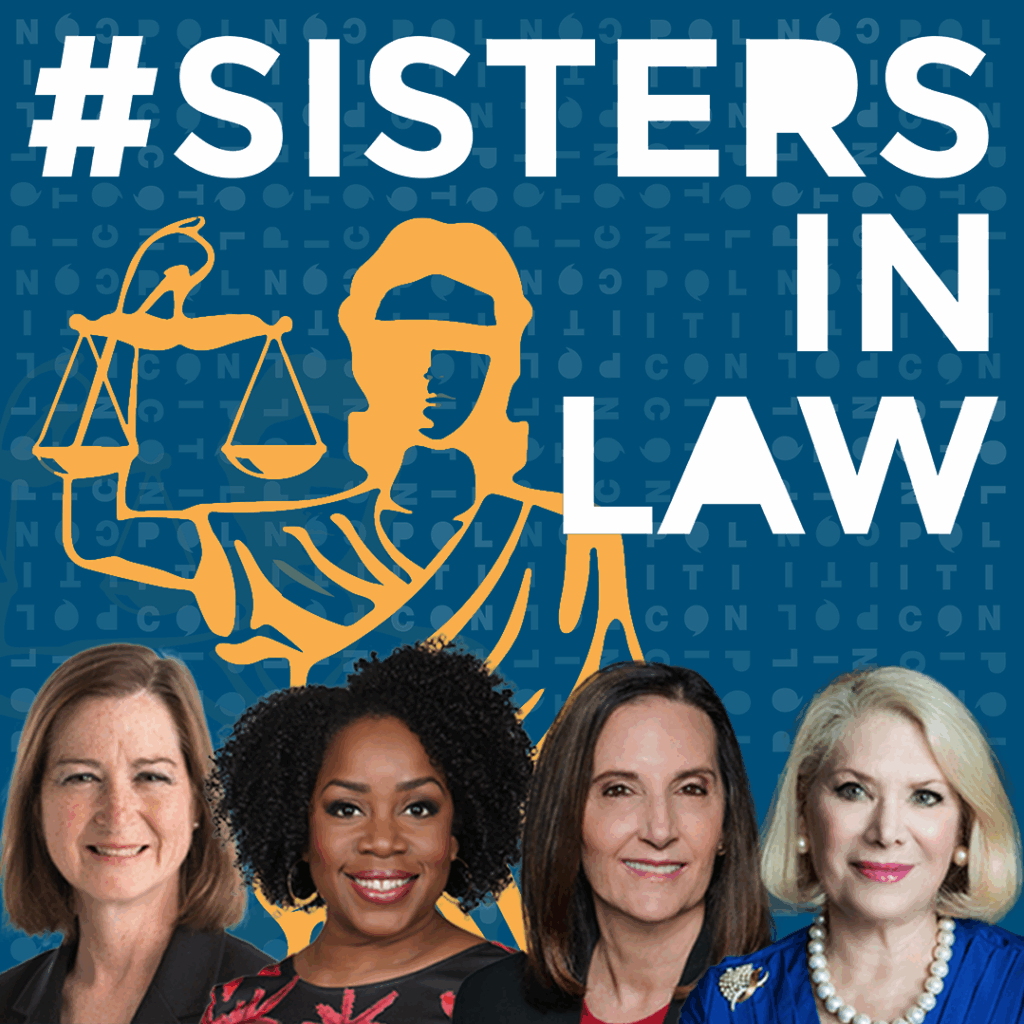
Joyce Vance hosts #SistersInLaw to discuss the ongoing murder investigations into the tragic killings of the Reiners, Australian beachgoers, and Brown University students, focusing on the role of prosecutors, the impact of media, and the dangers of anti-semitism and mental illness. Then, the #Sisters review Jack Smith’s recent testimony on Trump’s classified documents and election interference cases, the political motivations behind it, and if there will be accountability. They also examine Wisconsin Judge Hannah Dugan’s felony obstruction conviction for her actions during an attempted ICE arrest, looking at its merits, the potential for appeal, and what it means for judicial independence and immigration policy.
The holidays are here! Get the brand new ReSIStance T-Shirt, Mini Tote, and other #SistersInLaw gear at politicon.com/merch!
Additional #SistersInLaw Projects
Check out Jill’s Politicon YouTube Show: Just The Facts
Check out Kim’s Newsletter: The Gavel
Joyce’s new book, Giving Up Is Unforgivable, is now available! Not only that, for a limited time, you have the exclusive opportunity to order a signed copy here!
Pre-order Barb’s new book, The Fix. Her first book, Attack From Within, is now in paperback.
Add the #Sisters & your other favorite Politicon podcast hosts on Bluesky
Get your #SistersInLaw MERCH at politicon.com/merch
Email: SISTERSINLAW@POLITICON.COM or Thread to @sistersInLaw.podcast
Get text updates from #SistersInLaw and Politicon.
From the #Sisters
From Joyce’s Substack on The Brown University Shooter & The Conviction Of Judge Dugan
Support This Week’s Sponsors
Wild Grain:
Get $30 off and free croissants in every box when you start your subscription to delicious quick-bake artisanal pastries, pasta, and bread at wildgrain.com/sisters with promo code: SISTERS
Thrive Causemetics:
Effortlessly complete your perfect winter look. Go to thrivecausemetics.com/sisters for an exclusive offer of 20% off your first order.
Quince:
Upgrade your winter wardrobe and get free shipping on your order and 365-day returns when you go to quince.com/sisters. Now available in Canada!
Aura Frames:
Aura Frames is the perfect gift! Shop now with holiday savings and get an exclusive $35 off their Carver Mat frame at on.auraframes.com/SISTERS. Promo Code: SISTERS
Lola Blankets:
Get 40% off your entire order at Lolablankets.com by using code SISTERS at checkout.
Experience the world’s #1 blanket with Lola Blankets.
Get More From The #SistersInLaw
Joyce Vance: Bluesky | Twitter | University of Alabama Law | Civil Discourse Substack | MSNBC | Author of “Giving Up Is Unforgiveable”
Jill Wine-Banks: Bluesky | Twitter | Facebook | Website | Author of The Watergate Girl: My Fight For Truth & Justice Against A Criminal President | Just The Facts YouTube
Kimberly Atkins Stohr: Bluesky | Twitter | Boston Globe | WBUR | The Gavel Newsletter | Justice By Design Podcast
Barb McQuade: barbaramcquade.com | Bluesky | Twitter | University of Michigan Law | Just Security | MSNBC | Attack From Within: How Disinformation Is Sabotaging America
Joyce (00:10)
Welcome back to Hashtag Sisters-in-Law with Kimberly Atkins-Stor, Barb McQuade, Jill Winebanks, and me, Joyce Vance. A little quick news before we get on with the show. Hoodies and t-shirts are available at politicon.com slash merch. You can find the link in our show notes. You know you want a little bit of a Hashtag Sisters-in-Law wear. In today’s show, we’ve got three very serious topics to discuss.
First off, the murder investigations from Brown University, Boston, Hollywood, and Australia. Then there’s the story of Jack Smith’s trip to Capitol Hill to testify, behind closed doors because that’s how Republicans wanted it. And finally, late last night, Thursday night, we’re taping Friday afternoon, we learned about the conviction of Wisconsin Judge Hannah Dugan. You’ll notice we’re not talking about Jeffrey Epstein because at the time that we’re taping,
Nothing has been released. I know we’re all waiting to see what DOJ will release and I’m sure we’ll be discussing that next week. But before we get on with the show, you know, there’s something I think we need to take up with you and Barb, maybe you’ll start us off. There’s a little bit of a debate about fonts of all things.
Barb (01:30)
Oh yeah, did you see that this week? Secretary of State Marco Rubio said that the State Department was reverting to its traditional font of Times New Roman and all official communications and rejecting the change during the Biden administration to the Calibri. Is that how you say it? Calibri? don’t know how to it. Calibri, Calibra font. Because that font is too woke.
Joyce (01:49)
I think I say Calibri,
Barb (01:56)
⁓ That font is one that is helpful to people who are visually impaired. It is one without serifs. You know, those are the little lines, the little doodads. The tails, that’s a good way to put it, that make letters look a little more decorative. But decorative is pretty, but it’s difficult for people to read.
Kim (02:08)
Tails, ⁓
So
they don’t actually want people to be able to read these things. They think that is too woke. Just being able to read what they.
Barb (02:23)
against
our tradition and history and the formality and dignity of the State Department to allow people to actually read it.
Joyce (02:32)
If I understand this correctly, Marco Rubio doesn’t have enough to do. He’s now the font police in addition to his other functions.
Barb (02:40)
But it did get me thinking, do you have a favorite font? I kind of like the Times New Roman, but here at the law school, in an effort to accommodate people with disabilities, we have been encouraged and I have complied with a suggestion to use Sans-Sera fonts, Sans, French Kim. ⁓ How would you say it?
Kim (03:00)
SON
Joyce (03:01)
So, so, so if…
Barb (03:04)
If I use Calibri in slides and documents, it’s easy enough. You do highlight click and you can make it into ⁓ a song serif font. ⁓ It’s not that hard and I’m happy to do it if it means that students can read it. ⁓ Here’s to you Marco Rubio. May your name look lovely in calligraphy.
Joyce (03:27)
Yeah. Jill, do you have a favorite font?
Jill (03:30)
I do, I have always hated Times New Roman, and now I have a real reason to hate it, but I’ve always liked the Sans Serif ones. I personally prefer Ariel, but given what ⁓ Rubio said about Calibri, I might have to switch to that. But for now, at least, I’ve permanently changed my word doc to open every time in my Ariel font. That’s my favorite.
Joyce (03:58)
Well, who knew that choice of font could be an act of wokeness, but I’m all for it.
Kim (04:03)
I’m gonna do all of my correspondence from now on in a comic song. yeah. a joy to everyone.
Joyce (04:08)
Yes. Good one.
Hehehehe
Barb (04:13)
There you go.
Joyce (04:23)
This episode of Hashtag Sisters-in-Law is brought to you by Wild Grain. If you haven’t heard, Wild Grain is the first baked from frozen subscription box for artisanal breads, seasonal pastries, and fresh pastas. Plus, all items conveniently bake in 25 minutes or less. Unlike many store-bought options, Wild Grain uses simple ingredients you can pronounce and a slow fermentation process that can be easier on your belly.
and it’s richer in nutrients and antioxidants.
Jill (04:53)
We all love that Wild Grain’s boxes are fully customizable and that they are constantly adding seasonal and limited time products for you to enjoy. In addition to their classic box, they now feature a gluten-free box and a plant-based box. It’s amazing how fast Wild Grain goes from the box to our table. My husband and I enjoy the breads and the pastas and the pastries, and so do my guests.
They are impressed and then surprised when I say it’s baked from frozen, not homemade. They often end up subscribing since it’s perfect for delicious meals, snacks, or quick food prep.
Barb (05:30)
Yeah, I’m actually looking forward to heating up some of my wild grain pastries. All my kids are coming back into town for the holidays, and they’re a bunch I’ve been saving just for this opportunity. Having wild grain delivered is so convenient when life gets busy, and it’s great to watch the color and the flavor come alive when things like pumpkin cinnamon biscuits are heating up. The aroma coming from the oven is just incredible. And when the weather outside is cold,
⁓ You will be able to warm up with some of these delicious items like the cranberry pecan rolls, the parmesan biscuits, and the apple pie bites. Just make sure you’ve got enough to share. I have been accumulating mine so that I am ready for a feast next week. We promise you’ll never have to call everyone when the food’s ready. They will come running because they can smell the delicious aromas. When you want to treat your family, wild grain is perfect for the holiday season.
Kim (06:27)
For a limited time, Wild Grain is offering our listeners 30 bucks off your first box, plus free croissant in every box. When you go to wildgrain.com slash sisters to start your subscription, you heard me, free croissants in every box and 30 bucks off your first box when you go to wildgrain.com slash sisters. That’s wildgrain.com slash sisters, or you can use promo code sisters at checkout.
and the link is in the show notes.
Barb (06:58)
I’m really glad Kim’s here today to say that magic word. Can you say it one more time, Kim? Because you can say it like nobody else.
Kim (07:03)
Poisson.
Five years of French at work.
So it was a quite busy and traumatic week in terms of criminal investigations. And I know listeners must have a lot of questions, because I do too. And luckily, three of my favorite people are former prosecutors who can help us break this all down. I really want to start with the wild and horrific story of the man who went on a multi-state murder spree. First, opening fire on an economics class at Brown University, killing two students.
and then traveling to Brookline, Massachusetts, where he murdered an MIT professor. Now, I won’t say his name because he deserves no glory, but the victims do. They are Brown students Ella Cook and Muhammad Aziz Umurzikov, an MIT professor, Nuno Lurio. The shooter is a Portuguese national who had briefly attended Brown in the early aughts and was a former classmate of Lurio in the 1990s.
And of course, the discovery of the shooter’s body ended what was a wild four-day search, which included the nickname of an early person of interest who had been briefly detained. Wow. It was a lot. So, Barb, let me start with you and your thoughts. You know, one thing that I thought about was in a case like that, when there is an ongoing search for a suspect.
And we don’t know exactly who they are, and especially in a case like this where the investigators were led in one direction and then another. What are prosecutors doing during that time? We know investigators are trying to find who this person is, but what do prosecutors do? Do they wait back and wait until there is an arrest, or are they working in the meantime? I’m thinking of other high profile cases like this. I think of the Boston Marathon bombing, for ⁓ example, where there was a couple days before we knew.
who the Zarnaev brothers were and also the DC sniper. Remember that. There was a long time before we knew who they were. What do prosecutors do at that time?
Barb (09:14)
Actually, prosecutors are very actively involved in the investigation. They’re not just sitting back there working hand in hand with investigators from the FBI, oftentimes state police, and sometimes local and campus police in a case like this might be involved. One of the things that prosecutors can do is obtain court authorized authorization for search and seizure of phone records.
video and other kinds of things where legal process is necessary. But they are working together. I would imagine in a case like this, you it was a tricky case. They did have some limited video of the shooter, but they didn’t have anything else to go on. know, oftentimes you can figure out, you know, who your target might be and then look at social media phones and other kinds of things to try to track them down. Here, all we had was this limited
video, I imagine that much of what was happening was an effort to question everybody who might have been a witness to see what information they could find out about this person in an effort to identify them as they cross state lines coordinating with other offices. In this case, we had people from both Rhode Island and Massachusetts participating in some of this activity in New Hampshire. And so they are all working together and coordinating. ⁓
And working to develop evidence. The first order of business is to catch this guy and stop him so that he can’t hurt anybody else. That’s a matter of great urgency. But then the second one is making sure evidence is obtained so that there can be a prosecution if the shooter should be found alive, which of course is not the case in this matter.
Kim (11:00)
Wow. ⁓ know, Joyce, one of the many interesting factors about this case is that it was broken wide open by a tipster. ⁓ Tell us about that. who was this tipster and what information did he give? And how tough is it to rely on tipsters, tipster information in a case like this where I can only imagine there was a flood of information coming into investigators. There was a flood of information and misinformation.
online. ⁓ So how were they able to home in on this one tip that broke the case open?
Joyce (11:37)
Yeah, it’s a really great question. You know, I’ve been through this a couple of times, but most notably in the Birmingham abortion clinic bombing that was committed by Eric Rudolph. And ⁓ I’m going to say that within four hours of the bomb going off, we had stood up a federal, state, and local task force. And I think it’s important for our listeners to understand how good law enforcement is at doing this. We hear a lot about dysfunction.
Well, let me tell you, the feds, the state folks, the local folks get along really well. And we almost immediately took over an entire floor in the FBI office in Birmingham, dropped cables down. It was long enough ago that nothing was wireless and had probably 200 people in this large room representing every agency. FBI and ATF both have rapid response teams.
that they send in to do some of the preliminary investigation at scenes like this. So, you you saw, and I think some people made fun of, agents walking through the snow, sort of arms-length wingtip from each other and shuffling through the snow in their feets. And that’s actually a very important investigative technique that they use at the scene to make sure that anything that’s on the ground is uncovered, so they block off that field in a grid.
and go through it meticulously, pace by pace. But also increasingly, they do a lot of work online, and that’s how this tipster came to like him. The tipster was posting on Reddit saying that he had had an encounter with someone who matched the description of the shooter, and ultimately people on Reddit encouraged him to reach out to law enforcement, either he did or someone put them in touch with him. That’s not clear. And he provided the key tip.
that he had had an encounter with a man who just didn’t fit in, saw him repeatedly in the neighborhood, ultimately approaching a car. And there were a lot of red flags, the way he was dressed, the way he was conducting himself. So the point that you make, law enforcement gets a lot of tips in a situation like this. You know, we did after the Rudolph bombing, just literally thousands of tips. And so you have hundreds of agents who are combing through it. And very often you’ll get lucky.
We did, we had a young pre-med student who had actually followed Eric Rudolph as he walked away from the bombing. He noticed that as everybody else was running towards the scene of the crime, one man was walking away and he was smart enough to follow him. And that was the identification that let us ⁓ ultimately figure out who did that bombing. Very similar here in Rhode Island. We heard Peter Nirona, the attorney general, whose Barb’s and my former US attorney colleagues say this was the tip.
that cracked the case. So look, for folks out there, it really can be as important to see something say something.
Kim (14:37)
Wow, that’s really incredible. And know, speaking of that Olympic Park bombing case, Jill, this case reminded me of that too, in that there was a person of interest that was initially questioned but released, but not before his name leaked out and it was reported by news organizations and there were wild conspiracy theories being formed online about him.
But it turned out he had nothing to do with this case. And that reminds me of Richard Jewell, who was initially ⁓ thought to have been the suspect in that bombing case in Atlanta, who turned out to have been innocent. Now, he sued some news organizations. ⁓ After that, know in this case, once it was clear that that first person detained in the Brown shooting case, a friend of mine said, well, he better get a good lawyer and sue. But I’m like, I
So, Jill, do you think based on what we know from that Richard Jewell situation, might he have a case to sue news organizations and others who reported his name?
Jill (15:46)
So going back to the Atlanta case, ⁓ Jewell did sue and he suffered a lot as a result of having been identified this way. But news media, two of them, at least CNN and NBC, settled with him. So there was some value to him in having sued. But the main case he had was against the Atlanta Journal Constitution. And they refused to settle and the case dragged on for years.
It finally was dismissed after he died, after Jewel died. you know, when I wrote my book and the lawyers were reviewing it, the one thing I learned was that dead people do not have any rights for defamation, which I shocking. Well, there was one comment in it that they said, tell me if he’s alive. And I said, it’s true. And he’s a public figure. So I don’t care if he’s alive. And I have no idea. And they said,
Barb (16:31)
Defame all the dead people then?
Jill (16:45)
just check it’s a lot easier because he has no rights if he’s dead. And I said, that’s so unfair. Don’t you think that’s horrible that a dead person
Kim (16:53)
But
this case, he was defamed while he was alive. So it was his estate that was continuing this. that the defamation happened while he was, alleged defamation, happened while he was still alive. So his estate continued with this case, right?
Jill (17:08)
They did, but nothing came of that. And so whether or not the person who has been identified wrongly as a suspect has any rights will be sort of an open question. And it’s because other associations settled. actually in this case, the card ultimately ruled for the Constitution Journal saying that
It was substantially true when they published it. They believed it to be substantially true and therefore there was no cause of action. So really it is substantially true that the person whose name may have been leaked was a suspect at the time and they reported accurately. So I don’t think he’ll have much of a case and that’s probably not worth it. But then again, Donald Trump sues all the time and he has no case and people pay him off. So hey, what…
What can I say?
Kim (18:04)
Well, I really feel for this man whose life was upended in this way. But yeah, I agree with you, Jill. I’m not sure there will ultimately be any liability to be had unless there are people who are online, for example, who are being reckless ⁓ and negligent in what they said about him. Maybe there will be causes there. just for news organizations that just reported what happened, which is that this man was questioned, ⁓ I think that might be tough. So let’s now turn to the horrific terrorist attack
on Bondi Beach in Sydney, Australia. I know you guys aren’t barristers, ⁓ as they call lawyers in Australia, but there are some things that are unfortunately universal, like mass violence and anti-Semitism. I just want to check into you with all of you and get your takeaways about this awful incident. didn’t even, frankly, I didn’t even know how to form a question about this. It’s just so awful. feel free just to speak how it hits your heart. You go first, Jo.
Jill (19:04)
Okay, ⁓ well, of course, Joyce and I are both Jewish, and so it may have hit us more in a personal way. ⁓ I was planning to go to the Menorah lighting in Evanston, and I did not. And Evanston is a place where I would never expect any action of this sort. ⁓ We are a definite sanctuary city and an anti-gun city.
But it still, just made me feel like this is one more example of horrific anti-Semitism. I also was struck, of course, in Australia by the heroism of a fruit vendor who ran into the danger area and disarmed one of the shooters. And I mean, he’s a real hero. And then of course he had to put the gun down because he didn’t want other people thinking
He was the shooter. I mean, it’s a horrible situation. And the vision of these two shooters, father and son, standing on a bridge, shooting into an unarmed, harmless group of people and killing children and elderly, a Holocaust survivor was killed. It’s horrendous. And I don’t know what we do about why Jews are subject to this kind of violence and hatred.
⁓ And somehow we have to deal with it.
Kim (20:36)
Choice.
Joyce (20:39)
You know, I think Jill captured it perfectly. Look, it’s a tough moment. It’s the evening of the Hanukkah celebration. Families are gathered at the beach and they are targeted because they’re Jewish. And I’m not going to mince words here. I’m going to say that in many corners in our country, it’s become popular to view Jews as legitimate targets because of reprehensible policies followed by the Netanyahu government in Israel.
And I would really encourage people to think carefully before they equate those two, because these are people who lost their lives, kids who won’t grow up, kids who will grow up with horrific memories, targeted simply because of their religion. think, you know, I have many hopes for 2026. Among them is that we can all work together to fight back against hate.
Kim (21:32)
Barb, what were your thoughts about this?
Barb (21:35)
Yeah, I mean very similar the idea that people could be targeted out enjoying a holiday on a beach, know, I’m sure you saw those images of people You know dressed for like a beach party. Mm-hmm. And then suddenly have that come shattering. It’s just not something we should have to live with and I ⁓ You know, shooter is the person to blame the shooters And it was clearly ⁓
sophisticated plot. There have been reported ties to ISIS, so this does seem to be an international terrorist plot. But I just can’t help but think that some of the vitriolic rhetoric we see in our society today directed against Jewish people and other people that are deemed to be other and other than what I guess ⁓ white and Christian is ⁓
fueling some of this political violence that we see in the world. It’s an awful thing. It’s a human problem. It’s created by humans. ⁓ And it’s something that we shouldn’t have to live with. it’s just heartbreaking, especially coming on the heels of the Brown shooting. It’s easy to feel helpless in these moments. But I always take the advice of Mr. Rogers and look for the helpers, like the man who did disarm the gunman. ⁓ That’s inspiring.
try to focus on those positive things and the important work done by law enforcement to bring these offenders to justice.
Kim (23:09)
Yeah, this is hell heavy and then there’s more. Of course, there was the shocking murders of beloved Hollywood filmmaker Rob Reiner and his wife Michelle. Barb, we learned pretty quickly that their son was the prime suspect and very soon after he was charged, I was wondering actually if it would be first or second degree murder and he was charged with first degree murder. So tell us the difference and whether you were surprised by this decision and how might his report
mental struggles play into the charging decision here.
Barb (23:42)
Yeah, although this is the initial charge, it may not be the ultimate and final charge or if he’s convicted of the crime of which he is convicted. know, prosecutors typically will seek to charge the highest readily provable offense. ⁓ First degree murder under California law, like most states, requires murder with malice aforethought. That means this was planned premeditated.
I went in there with this idea that I’m going to kill these people. It doesn’t have to be something that’s plotted for days or even hours. It can be formed, the law says, in an instant, but it is different from other intentional killings. So it requires those words ⁓ premeditated and deliberation means I thought about it for some time in advance and I meant to do what I did. So that’s a legal requirement.
California law also allows this special circumstance enhancement for use of a dangerous weapon. So the knife in this case applies. But as I said, I don’t know that this is the end of the story as prosecutors learn more about this defendant. It is possible that they could seek a jury instruction for a lesser included offense of second degree murder, which is simply any intentional killing. And so they could, you know, ask the jury, we believe this is first degree murder and here’s what you need to find for this, you know, premeditation, et cetera.
But if you don’t find premeditation, you can still convict him of second degree murder if you find that this was an intentional killing alone. And it seems like the evidence is strong enough there. I imagine the defense will explore ⁓ getting him some sort of mental ⁓ health assessment, looking for an insanity defense, looking to show that perhaps he’s not competent, sit-in trial, or some sort of diminished capacity defense. It’s usually not a complete defense, but it can be… ⁓
a defense to the ability to form this mental state of premeditation and deliberation, or it can be used as sentencing to reduce a sentence if a person was unable to fully either control his impulses or appreciate the wrongfulness of his conduct.
Kim (25:50)
So Jill, everyone knows Rob Reiner or one of his works. ⁓ And the case has received so much publicity. ⁓ The son didn’t enter a plea. But if this goes to trial, is it possible for him to get an unbiased jury? And if he’s convicted, what might the sentence be?
Jill (26:08)
So there’s three things I want to answer to you. One is that it is ⁓ more unusual than not to not enter a plea. But the arraignment has been put off again till January. His lawyer said that there was still too much to discuss before it was appropriate to enter a plea. So that is still pending. ⁓ If it goes to trial,
Obviously there’s been a lot of coverage of his mental health issues, his addiction, and it will be hard to find a jury that hasn’t read about his involvement in this case and the night before being at Conan O’Brien’s and there being a dispute. ⁓ But that isn’t the same as saying you can’t get an unbiased jury. The test for whether the jury is fair is whether the jurors say
that they can put aside everything they’ve read and judge the case solely on the basis of the evidence in the courtroom. And jurors can do that, even though it’s a beloved figure and who didn’t love Rob Reiner from his days as Meathead to his days producing some of the best movies. mean, who doesn’t know the line from Harry and Sally, I’ll have what she’s having. I mean, he was phenomenal and
I just have to give kudos to our producer who has a show called Politicon, which was a ⁓ convention of ideas. And that was where I met Rob Reiner, who was the nicest, most lovely person. And then I met him again because he was an activist, not just a talent of enormous proportions, but he was a real activist and he was on what was then MSNBC. And I met him in the green room at
30 Rock with Michelle. And they were both so nice. And we started corresponding about political activism. And so I took it personally, not just as a we’ve lost a great talent. ⁓ In terms of what he could be sentenced to, right now there is the possibility of the death penalty in California, although it has not been used for many years. And the current governor Gavin Newsom has
rescinded the ability to ⁓ actually go for it. It is still on the book. he could in a first degree and he has been charged with aggravating circumstances. He murdered more than two people and used a dangerous weapon. So there is a legitimate enhancement that could lead to capital punishment, but that is not what’s going to happen. He is unlikely under the current rules to get that. ⁓
And as I think has already been said, his mental capacity will be questioned. ⁓ He certainly is eligible for 25 years to life without parole. And I would say we’re more in that category than capital punishment.
Kim (29:20)
So Joyce, ⁓ the son has retained Alan Jackson. And if that name sounds familiar, that’s because he’s represented people like Karen Reed up in Massachusetts, ⁓ Kevin Spacey, and Harvey Weinstein. And the son is reportedly paying for this with his parents’ money. Now, I thought when you are ⁓ accused of killing someone, you cannot ⁓ receive any part of their estate. So how is this possible?
Joyce (29:49)
Yeah, California is one of the states that prohibits ⁓ someone who commits a murder from benefiting from it, including through the estate. But there are other mechanisms that the son could be using to pay the lawyer. And frankly, I don’t think anyone knows the details of those payments. Typically, people don’t know that. There are a lot of options.
It’s possible that he has money of his own. It’s possible that the lawyer is taking on the case for free for the notoriety. But also it’s possible that because of Nick Reiner’s, ⁓ the publicly available information about his mental health and his drug use, his parents would have been likely to establish a protective trust fund for him before they died. And it’s possible that his siblings may have signed off on using some of
those funds to make sure he gets a defense and the care that he needs.
Kim (30:45)
Right, right. What a horrible thing for his family and especially as you said at the start of the holidays. So my heart goes out to all of them and may the memory of both of them be a blessing.
you
All right, the cold weather is upon us and that means it’s the perfect time to add more color to our lives. For some of us, that means bringing out artistic quilts. For me, it means getting dressed up in colorful clothing, but it could also mean putting up festive decorations or customizing all of our looks with a seasonal vibe with thrive cosmetics. After all, little rituals that celebrate the holidays, they feel good. And that includes updating your makeup look.
Joyce (31:37)
Whether you’re going with a simple, I just need to get out of the house routine or festive winter glam, Thrive Cosmetics is your go-to for completing any look. Every product is 100 % vegan, cruelty-free, and made with clean, skin-loving ingredients that work with your skin, not against it. And that means it’s always our go-to.
Jill (31:58)
I love all of Thrive’s products and I would hate to pick just one that’s my favorite, but if I did, it might have to be the Vegan Tubing Liquid Lash Extensions Mascara. It comes in six amazing shades that last all day without clumping, smudging, or flaking. There’s a reason it has over 40,000 five-star reviews. Your lashes will look extra long due to how it wraps around each lash from root to tip, and it is super easy to remove.
It slides right off with warm water without yanking out your natural lashes. Plus, its nourishing ingredients support longer, stronger, and healthier looking lashes over time. As soon as I found out about it, I started using it. It’s the perfect way to make a big impression.
Barb (32:45)
You know, with Thrive Cosmetics, I’m using the mascara and my eyelashes are so long, I have to braid them.
That’s so funny. We love that cause is in the name for a reason. I’ll stick to the script. Thrive not only defines luxury beauty with clean skin loving ingredients and uncompromising standards, but they give back to. Every time you use Thrive, you’re doing more than enhancing your glow. You’re helping others shine too. With more than $150 million in product and cash donations to 600 plus giving partners, your purchase directly fuels real impact.
Imagine making a difference in things like education, the fight against cancer, stopping domestic abuse, and more with every purchase. That’s beauty with purpose. So don’t wait to complete your winter look. Go to thrivecosmetics.com slash sisters for an exclusive offer of 20 % off your first order. That’s thrive cosmetics, C-A-U-S-E M-E-T-I-C-S dot com slash sisters. I feel like Lucille Ball and Vitamina Vegemin.
The link is in our show notes.
Kim (33:54)
Do you pop out of parties? Are you unpopular?
Jill (34:02)
you
When it comes to holiday gifting, we believe in giving people things they’ll really love, like beautiful, timeless pieces that will get worn for years to come. That’s why we’re going with quints. From Mongolian cashmere sweaters to Italian wool coats, everything is premium quality at a price that actually makes sense. When you have a lot of people to do your shopping for, not to mention the pieces you want to pick up for yourself.
Kim (34:34)
Now, this is not even rehearsed. Like literally as we started rehearsing, the mail carrier came and I got a little something for myself, which are these beautiful Quinn’s cashmere pants. These would be perfect for after. I’m thinking after Christmas dinner, when you’ve eaten a little too much and you need, you want something comfy to lounge in. That’s when I’m gonna put those on and those are from me to me.
know, coins has something for everyone, like soft Mongolian cashmere sweaters and pants. The pants are great. And the sweaters are just 50 bucks and they look and feel like designer pieces. They have stylish silk tops and skirts when you want to dress up. They have perfectly cut denim for everyday wear, durable outerwear that actually keeps you warm. And they’re Italian wool coats. They are gorgeous and they will stand out in a crowd.
The thing I really like about them is how beautifully tailored they are. You know, you always look put together when clothes fit you well and they’re made well. And you can really tell that they’re soft to the touch. And I have had so many pieces for years and years and years. And best of all, every piece that comes from Quint is made with premium materials from ethical, trusted factories and priced far below what other luxury brands would charge. The craftsmanship shows in every detail from the stitching to the fit.
to the drape. Their pieces are elevated timeless and made to wear on repeat.
Joyce (36:05)
So Kim, you’ve got the pants. I just got a t-shirt and a cardigan sweater. I got the Yak ribbed cardigan and it is on repeat. I haven’t even put it back in the dresser to be honest, because I’ve just been wearing it every day. And you know, as a knitter, I’m a little bit persnickety about store-bought knit items, about the quality of the yarn and the quality of the knitting. This yarn is so soft. It’s a Yak cashmere blend. It’s utterly fantastic.
And the knitting is really beautiful. It’s just well done, nicely finished machine knitting. You know, because when you choose Quince, you’re getting a wardrobe upgrade that feels smart, stylish, and effortless at prices you’ll love. So I don’t feel bad about ordering it in every color. The cashmere is cozy in the cold. It feels so good. And once you get inside the office or the classroom when the heater is running, everyone needs Quince’s washable stretch silk blouse, another one of my favorites.
The material feels great. The style is perfect for hanging out with friends or for being on a TV screen or even for wearing to a holiday party. There’s nothing better for looking your best. And if you’re prioritizing fitness as we head into the new year, some of the best workout motivation around new active wear from Quince.
Barb (37:25)
We have that washable silk, no wrinkle shirt also, Joyce. I bet we all have them. We should wear them all together. They’re really great.
Kim (37:33)
I
love traveling with them though. They’re so good traveling. great.
Barb (37:38)
Well, this year, I’m giving the gift of quints. ⁓ Boys, if you’re listening, turn down the sound right now. All my sons are getting quint sweaters. They make really nice sweaters for men, these Mongolian ⁓ cashmere sweaters. They’ve got them in ⁓ turtleneck, crew neck, quarter zip, and V-neck. so there’s a little… All of my boys with their various ⁓ sartorial preferences.
So you can find gifts so good, you will want to keep them with Quince. I already have a lot of my own, so now I’m expanding my Quince giving to family members. Go to quince.com slash sisters for free shipping on your order and 365 day returns. And we have some good news, Quince is now available in Canada too. That’s quince.com slash sisters to get free shipping and 365 day returns. Again, that’s
The link, as always, is in our show notes.
Joyce (38:39)
Y’all seriously, that Yak Cardigan I think is their unsung hero. You should go grab him. It’s just so perfect.
Kim (38:45)
Man.
All right. I’m not supposed to be shopping anymore, Joyce. Come on.
Joyce (38:50)
Sorry,
I’m sorry.
Barb (39:01)
Well this week, Special Counsel Jack Smith finally got to speak about his investigations into Donald Trump, but unfortunately it was behind closed doors. Kim, why was Jack Smith appearing on Capitol Hill and why behind closed doors?
Kim (39:18)
So he was appearing on Capitol Hill because the Republicans on the House Judiciary Committee wanted him to appear ⁓ as part of this investigation of the investigators and why he brought charges against now President Donald Trump when he did. And ⁓ the Republicans, ⁓ even though Jack Smith offered multiple times to testify in a public hearing,
The Republicans on the committee did not want that and they insisted that it be a closed door meeting. I don’t have a quote right in front of me from Eric Holder, but I read a quote from Eric Holder that basically says something to the effect that the Republicans were chicken because they knew if this was a publicly aired hearing that Jack Smith would eat them for lunch.
and that they didn’t want that. They wanted to do it privately so that they can cherry pick the answers and present this sort of narrative that would be in line with what they and their dear leader, President Trump, would want.
Barb (40:27)
Yeah. I think Jamie Raskin said afterwards that Jack Smith schooled the questioners on the committee, no doubt, and they certainly didn’t want that to be seen publicly. before this deposition began behind closed doors, Jack Smith issued an opening statement that had, I thought, a lot of important things in it about how, you know, he was not basing his decision on politics. He would have done the same if it was a Republican or Democrat. And one of the things he said is,
He had developed proof beyond a reasonable doubt to convict Trump of election interference and powerful evidence to convict him of unlawfully retaining national defense information. Should we read anything into that language and the different language used for those two different investigations? And were you surprised to see a prosecutor speak in such unequivocal terms about a person who still, at least arguably, has the presumption of innocence?
Joyce (41:23)
Yeah, I mean, it’s a really interesting question, right? I suspect that what Jack Smith was doing was reiterating the standard that federal prosecutors have to meet before they can indict a case from the federal principles of prosecution. You only indict a case if you believe you have sufficient evidence to convict a defendant at trial and get that conviction sustained on appeal. And so I think Smith was stating unequivocally
that not only could they meet the burden of proof necessary to get search warrants and indictment, but that he was confident that they would have obtained a conviction had the case gone to trial. You know, Barb, I saw something else that was interesting, and I’m wondering if it struck you the same way. Smith said, I’m responsible for this decision. You know, I’m the one who made it. And I thought that was important because also with the news that he was testifying came the news that Jim Jordan and his committee were interested
In subpoenaing, four of the people that had worked for Jack Smith were interested in subpoenaing. Our former colleague, Ken Pauley, who was the Assistant Attorney General for the Criminal Division, who would have worked with Jack and reviewed some of this material. And I heard Smith saying, you know, come at me, shoot at me if you must have a target, but keep your hands off of the people who worked for me. Keep your hands off of the career people who were just doing their jobs.
And I think that’s important. It’s unseemly for folks in Congress to try to burden, you know, hardworking career prosecutors who don’t exactly have the resources to fight back. And so I was proud of Smith for doing that.
Barb (43:03)
Yeah, I was promised Smith for doing it, but he’s also one of these people, right? I mean, he didn’t ask for this. They asked him if he would do it. And like out of a sense of duty, he’d come back from his job in the Netherlands and do this really hard politically fraught task. And then he himself gets attacked. I did see that in that language, Joyce, but I also saw something else. This is a line a lot of prosecutors use ⁓ when ⁓ defendants…
sort of put the government on trial, which is a common defense tactic. You you anticipate it and you’re ready for it when it happens at trial. But one of the things is, look, I didn’t choose to ⁓ go after Donald Trump. He made this choice by engaging in this criminal conduct. Like, I’m just here to investigate. So I thought ⁓ that was also part of that. You know, I didn’t choose these people or the people whose phones he looked at. I didn’t choose these people. You did by calling them.
So I think there’s a little of that going on too. Well, Jill, I want to ask you about something else that happened just before Jack Smith’s testimony. And that is on the day before, the Justice Department provided to Congress some email messages and memos in which FBI agents expressed doubt about whether they had probable cause back in 2022 to search Trump’s Mar-a-Lago home.
and there’s a far right news outlet that called the documents a bombshell. ⁓ What did you think about both the timing of the disclosure and the content of those documents?
Jill (44:38)
Well, first of all, bombshell is not a word that I would apply to any of these documents. And second of all, the timing was definitely not a coincidence that they were released the day before Jack Smith was to testify. The emails that they released do show that the FBI run by Trump appointee, Christopher Wray, was resisting and saying that they didn’t think there was probable cause.
but admitting that the Department of Justice did think so. So you had bait about the law. The Department of Justice said there is probable cause, which of course anyone in hindsight would say, yeah, they sure were right. The FBI was saying there are lesser ways, less invasive ways that we could go about this. We should talk to his lawyer. Well, of course we all know that his lawyer was not read in.
Barb (45:14)
a dep…
Jill (45:38)
and didn’t know this. We also know that documents were being moved around and hidden and that the longer it was delayed to get in there, ⁓ the more likelihood that things would be destroyed. So I don’t think there’s anything legitimate to alarm anyone saying that the FBI thought there wasn’t probable cause when it’s clear in retrospect that there was. The documents were found, they were there.
There was video evidence of them being moved from place to place to hide them. There was ⁓ correspondence with Trump and a lawyer saying, well, can’t we just not do this? I mean, it’s clear that there was a cover up going on. And so in my view, this was outrageous to release it now, but I’m glad they did and that we could have this discussion showing how ridiculous it is. ⁓ And the proof is that there was obviously probable cause because the documents were hidden there.
Barb (46:36)
Yeah, yeah, the judge found it. It was pretty overwhelming, frankly. It was like way more than probable. 18 months, like admitted he had him. He refused to give him back. Right, right. man. Well, Kim, Democrats ⁓ are demanding that a transcript of Jack Smith’s testimony on the Hill from this deposition be released to the public. What would it take for that to happen?
Kim (46:57)
All it would take would be for Jim Jordan to give the go at it.
Joyce (47:01)
Man.
Kim (47:04)
So if you don’t see it, I don’t know. Somebody seems a little chicken to me.
Barb (47:12)
Yeah, I mean, guess because Republicans have the majority, can continue to keep this secret if they want to.
Kim (47:17)
He can release it as soon as that transcript is available.
Barb (47:20)
Yeah. Well, ⁓ what do you think are the chances that we’ll see it?
Kim (47:25)
⁓ slim.
Barb (47:26)
Yeah, right. The better the cherry pit from, right? If the public can’t read the whole thing.
Kim (47:30)
⁓
Yeah, that would spoil the whole reason why they wanted it private, right? It’s really terrible. It just goes to show what theater this is.
Barb (47:41)
Yeah, that’s a good word for it. Joyce, one of the issues that was an area of inquiry was Smith’s obtaining phone records from members of Congress. What’s your sense of that controversy?
Joyce (47:55)
Yeah, I think this is a little bit of thou dost protest too much, right? Because members of Congress were outraged that DOJ would have collected their phone records. And from what we understand, ⁓ these were merely, ⁓ I’m struggling for a nice way to say this. This is something that you would do in any case. If you knew that your bad guys
And I’m just going to use that language loosely. But if you knew that your bad guys were talking to other people, trying to either enlist them in their scheme or talk to them about their scheme, you would want to know who all those people were so that you could identify potential witnesses, potential defendants, or potential victims. And so you collect toll records, you see if phone calls actually took place, and you might follow up with in-person interviews. And here the government had
every reason to want to collect phone records because there is a lot of publicly available information about Trump contacting people about the effort to prevent certification of the presidential vote. There were public stories, for instance, about I think it was Mike Lee, the Utah senator, getting a call from Trump who wanted to talk to Tommy Tuberville, the brand new senator from Alabama. so Lee actually takes his phone over to Tuberville.
course, you’re going to get phone records to confirm that so you can decide whether it has value to your investigation. What wasn’t collected, this was not a wiretap. So nobody was collecting the contents of the phone call. There wasn’t a transcript being made. No one was listening, and it was just records about whether calls took place ⁓ and what phone numbers they were between. That, think, is a legitimate investigative technique and not very much here for senators and members of Congress to whine about.
Barb (49:52)
I know we were spied upon. This is such a common investigative technique. I know when it’s used against members of Congress, it requires higher level of approval from DOJ to make sure that the executive is not interfering with the legislative branch, but he got that. He went through that formal process. He got all the approvals. It’s a really routine thing that’s done in any kind of conspiracy.
Joyce (50:13)
It’s just not that intrusive, right? So it’s, mean, it’s not like that big of a deal.
Barb (50:17)
Yeah, it’s toll records, not content. We’re not listening to the content of their calls. We’re just seeing who called whom and at what time, which is really important because Trump, the indictment says, was trying to exploit the chaos at the Capitol when the attack was going on to double down on his efforts to get members of Congress to block the certification. So it seems like a perfectly legitimate and essential investigative step to me. Well, Jill, Jack Smith’s final report in the election interference case was made public.
but not the volume on the documents case. ⁓ What’s the status of that? And do you think we’ll ever see that one become public?
Jill (50:55)
So the reason that volume two was withheld originally was that there was still a pending case, even though it was dismissed against Trump, his two co-defendants were still had cases, but that isn’t true anymore. So to me, there’s absolutely no reason except guess who the judge is? It’s Judge Cannon. ⁓ my. So with her having withheld any decision, the 11th circuit finally said,
You know what, if you don’t rule by January 2nd, we’re going to take action. So she only has till January 2nd to decide if she will allow the release of volume two. I, obviously I think she should. But she also just a few days ago granted Donald Trump leave to intervene in the case to argue that it shouldn’t be released for whatever reasons he will say. And
Of course, she will probably, she has granted him intervention. And now it’s a question of what he will say and whether the ⁓ court will agree that it should be continued to be withheld. And as long as it has a court order, FOIA won’t apply and so it won’t be released. But in any event, when the government appeals such a ruling, if that is what happens, it’s going to delay release for a long time. And so you got to ask,
How strong is that report? It’s got to be pretty powerful to use Jack Smith’s remarks and how he categorized it. And, I just want to add, I sort of was suspicious like you when I saw we had proof beyond a reasonable doubt on volume one, but on volume two, we had powerful evidence. I was a little troubled by that because ⁓ Jack Smith was speaking as if he was doing a closing argument for volume one.
⁓ that particular case of interference in the election, but was sort of pulling punches with saying powerful evidence. I was a little concerned about that, but I mean, I think there’s way more evidence in there or Trump wouldn’t still be fighting.
Barb (53:09)
And the indictment pan is so clear cut, Like the documents are at the house. that’s about as…
Jill (53:17)
And
he knows it, he ordered them to be moved. Do we have videos of them? I mean, yeah. I don’t know why you don’t have proof beyond a reasonable doubt, but yeah.
Barb (53:24)
Yeah. All right. Well, just last question, and anyone can chime in on this. So do you think that these criminal cases will ever be resuscitated? Both got dismissed without prejudice. And so if the Justice Department wanted to, they could pick up where they left off, right? Litigating the immunity in the super city indictment on the election interference and litigating the appeal about the legality of the special counsel regs.
It’ll be 2029 before this could be litigated again. Number one, can it? And number two, should it be relitigated?
Joyce (53:59)
You know, those are both interesting questions, right? There’s some technical legal aspects to the Can It question. ⁓ And they would turn on whether the time DOJ has to bring the cases is sort of unfairly interrupted by the presidency. Look, I think it’s more important to weigh in on the ⁓ should it be prosecuted. And I am reluctantly a yes on the question of should the cases be prosecuted.
I don’t think that they will be. think as a practical matter, the evidence will be old and moldy and there’ll be some legal issues and there’ll be a desire for a kumbaya moment. But more and more, I think Donald Trump has been permitted to romanticize what happened on January 6th. He’s sort of portraying it, and I write about this a little bit in my book. He’s sort of portraying these patriotic people who, you know, wanted to take back the Capitol.
And he just can’t leave it alone. mean, we’ve seen in the last week, right, he’s trying to re-litigate the myth that he won the election in 2020. And I think ultimately there needs to be accountability and someone needs to tell him, no, you got it wrong and what you tried to do to the country was criminal. so, know, Barb, we’ve talked about this before and I’ve suggested it wouldn’t be appropriate to prosecute, but Donald Trump has made a believer out of me.
He needs accountability.
Barb (55:24)
Yeah, I agree with you. think it absolutely should be. I agree, like there’s more to be litigated. It would take some time to work through the legal issues. ⁓ you know, it’s not time, what was what was Jill, the Gerald Ford phrase, our long national nightmare is over. Like it’s going to continue unless we hold people accountable. And I think it’s really important to do that.
Jill (55:43)
I couldn’t agree more, Barb. I just want to say I am a passionate, fervent believer that we must continue the case after he’s out of office. I think that had Richard Nixon not gotten pardoned and we had been able to indict him, we might have short-circuited some of what’s happening under Donald Trump. And that if we do not take action against the blatant and obvious criminality
of Donald Trump that we will suffer in the future and that there is no legitimate reason why these actions, which are definitely not within the immunity in my view that the Supreme Court has ridiculously granted to him, because they are not core functions to violate the law in this manner. He had no role in the election stuff that would have given him immunity.
and hiding the documents is clearly not one of his jobs. So I think it must be continued. I hope and pray that we will be able to do that.
Joyce (56:52)
Hear, hear.
Kim (56:56)
you
So hear me out. If you want to spread holiday cheer this season, give your loved ones a picture of you. No, I really mean it. You should get an aura frame and preload it with some pictures of you and them enjoying some of the best times and great memories together. I think that would make a phenomenal holiday gift. Or if you want to get one for yourself, it’s a great decoration for your own home.
And you know, when you get one, you have the perfect way to share and remember your favorite times with the people close to you. No matter who you’re shopping for, Aura Frames is always a winner.
Barb (57:42)
Yeah, I love the Oriframe. As I’ve said before, it’s a great gift for family members. And one of the great things is if you have family members who are not super tech savvy, you can preload all the pictures on it yourself, which I’ve done for my mother and father-in-law. And they just love this. I also have one in my home, and I change the photos every month ⁓ with pictures of family from that month, which is fun. So right now, we’ve got a lot of great Christmas photos of our kids when they’re little. And every time you walk in the room, you just double over with laughter and joy when you see these things.
So whether you’re getting one for your home or for a beloved friend or family member, one of the most exciting things about this gift is picking up the photos and the videos that go in it. Since it’s a digital picture frame, you can load as many memories as you want. Truly, there’s no limit. Better yet, it’s super easy to set up. You just download the Aura app, connect it to Wi-Fi, and from there, you just click on the pictures that you want to load. Plus, you can change what you display at any time. I create…
I’ve got little folders labeled by month. So when I want to change the month, I just click on the folder and boom, it goes from November to December.
Joyce (58:46)
that’s brilliant. That’s brilliant.
Barb (58:49)
Yeah, it really works well. So right now I’m seeing pictures of my kids playing in the snow when they’re little or, you know, eating too many Christmas cookies. It’s all a lot of fun. But best of all, you can keep sharing new photos straight from your phone all year long.
Joyce (59:04)
Sorry, I’m still thinking about the fact that you have files. That’s just such a great idea.
Barb (59:08)
You come in a folder by month and I don’t have to read you it every time. And I’ve now done it for more than a year so I can just go back.
Joyce (59:14)
Yeah, and you can keep adding. mean, Aura makes it convenient, powered by Barb McQuaid’s brilliance. looking back at our photos and videos from the past is a favorite holiday tradition in our family, and it’s so nice. We have it cycling in the kitchen. So luckily, our Aura frames make it easy to build those holiday memories. And especially if you’ve got relatives or kids living far away, it’s a great gift to keep everyone connected.
You can personalize your frame by adding a message or preloading photos for the recipient before it arrives. Or better yet, it comes packaged in a premium gift box at no extra cost. So you can save time on wrapping and have more time to enjoy the holidays. Just deciding on the ones we want to add quickly brings back our favorite memories. You know, right now I’ve got a sweet 10 month old German Shepherd puppy, Elsa, at my feet. And this will be her first Christmas with us.
And we’re going to have so many great pictures. Elsa trying to knock over the Christmas tree. Elsa eating the presents. Elsa getting into the holiday baking. It’s going to add a whole new dimension to our aura.
Jill (1:00:22)
You can’t wrap togetherness, but you can frame it for a limited time save on the perfect gift by visiting AuraFrames.com. You’ll get $35 off. Aura’s best-selling carver, Matt Frames. That’s been named number one by Wirecutter. Just use promo code sisters at checkout. That’s AuraFrames.com promo code sisters. This deal is exclusive.
to our listeners and frames sell out fast, so order yours now to get it in time for the holidays. Support the show by mentioning us at checkout, terms and conditions apply, and the link is in our show notes.
Late on Thursday, a federal jury convicted Milwaukee County, Wisconsin judge Hannah Dugan of felony obstruction, but acquitted her on a misdemeanor charge in connection with her response to ICE and FBI agents entering her courtroom without a judicial warrant to arrest a person who was a defendant in her courtroom, Eduardo Flores Ruiz, who was there on misdemeanor battery charges. He had been deported.
in 2013 and was back again without legal status. So, Barb, what did the prosecution allege she did factually to bring this case against her?
Barb (1:01:51)
Yeah, well, essentially they allege that she helped Mr. Ruiz escape when ICE agents appeared to arrest him. ⁓ Six ICE agents and FBI agents showed up at the courthouse where Mr. Ruiz was appearing on charges of battery in a domestic abuse case and ⁓ said they had a warrant for his arrest.
Judge Dugan went out in the hallway and talked with them. She brought another judge down the hall to talk with them to try to figure out what was going on and what this process would be. They asked whether it was a judicial warrant or an administrative warrant. And she asked her colleague to walk the agents down the hall to speak to the chief judge to figure out what the protocol ought to be in these kinds of cases. That all makes some sense to me. What they say is what she did next is after leading the agents down the hall, she goes back into her courtroom.
She adjourned Mr. Ruiz’s matter and then she suggested he leave through a side door. One of the things that’s interesting here, and I think an essential part of this case is whether she intended to obstruct their arrest of Mr. Ruiz or whether she was just showing him the way out the door. And what they allege is that she deliberately suggested a route that could evade their path. And so suggesting that Mr. Ruiz exit through a door,
And there was a recording in which her court reporter said to the judge, would you like me to go show him the proper way? Apparently once you leave this door, there are two routes. There’s a private stairwell, and then there’s another hallway that leads out to the public. And the judge said, no, I’ll do it. I’ll get the heat. And what the prosecutors argued that meant is, I will be the one who faces the consequences for assisting Mr. Ruiz. And as they argued,
assisting him in evading detection by the police. Now it turns out that Mr. Ruiz took the public path anyway, back into the hallway with the agents and he rode down an elevator with agents and then he fled and they chased him down on a foot chase and arrested him. But what they argue and what the jury found is that she did attempt to help Mr. Ruiz to evade arrest by these ICE agents.
Jill (1:04:13)
And Kim, so let’s take the other point of view. What did the defense argue? What was her ⁓ defense?
Kim (1:04:21)
So essentially, the defense was that she was trying to ⁓ run her courtroom in an orderly way. Keep in mind that it was not just Mr. Ruiz’s case that was being heard that day. There were lots of other defendants that were in that courtroom, other matters that needed to be heard, and that it was her responsibility as a judge in charge of that courtroom to ensure that there was order.
and that things were run in a way that did not cause unintended disruption. But the defense also argued that this was essentially a politicized prosecution, that it came from, quote, the top levels of government, and that she was meant to be used as an example ⁓ to sort of intimidate other judges who think they might want to help people who are undocumented try to evade ICE or other
⁓ authorities. She said she may have been stern and she may have been outspoken in her courtroom and within that, ⁓ I guess pertaining to that statement, I’ll take the heat, but that she has that authority as a judge in that position.
Jill (1:05:38)
And of course, the words that Barb quoted about, I’ll take the heat, I’ll lead him out, since he did go through the public hallway, that may be where she took him. And it seems to me that you can’t interpret that she said, yeah, take the secret stairway, it’ll get you out. He walked right past the agents. But Joyce, talk about the two laws the state alleged she violated and how she could be convicted of the felony, but not the misdemeanor.
And while we’re talking about misdemeanors, sort of a second level question is, he had this pending misdemeanor charge against him, not just illegal entry, but that he had actually done something in the country. And do you think that that changes things in terms of the law or the jury?
Joyce (1:06:26)
Well, let me start that argument first. So the individual that she was accused of helping was facing misdemeanor domestic violence charges, but that doesn’t really play into the charges against her. What she’s charged with ⁓ are essentially crimes that turn on her state of mind, her knowledge, her intention to help. So the first count in the indictment, and this is the misdemeanor, ⁓ requires that she knowingly conceal a person
from arrest and the government has to show beyond a reasonable doubt as the government always does in a criminal case that there is a federal warrant for the undocumented immigrant in the case, that the judge was aware of the warrant, that she actually harbored or concealed the fugitive and that she had the intent to prevent his discovery. know, juries don’t know, they’re unaware of what the…
punishment range on a charges when they’re considering whether a defendant is guilty or not. So it would not have been apparent to them that one of these was a misdemeanor and one was a felony and which was which. I suspect that what they struggled with here was the requirement that she actually harbor and that she had the intent to prevent discovery on these facts. That’s the count that they acquitted on.
In count two, though, she was charged with obstructing justice under one of the many obstruction statutes in the federal code 18 USC 1505. For that charge, the government had to prove, and they clearly established to the jury’s satisfaction, that she corruptly, that’s the state of mind, and it means acting with an improper purpose, like making a false or misleading statement or withholding information, so that she corruptly interfered with Flores Ruiz’s arrest.
so that he could be placed in immigration removal proceedings. And because the law here allows it to be an attempt to interfere, that’s likely ⁓ what caused them to sort of split the baby and vote to convict on this charge. There will be an argument on appeal undoubtedly that the verdicts are inconsistent. I’m really not sure that it’ll get anywhere. Whether we like this verdict or not, the job of juries in criminal cases is to decide what the facts
are. And this jury believed that the government’s proved the facts necessary for a conviction on count two. So there may be legal charges, but I think the jury is entitled to weigh in on the facts, whether I like how they came out or not.
Jill (1:08:59)
You know, it’s interesting because ⁓ she did not testify in her own defense and other judges testified for the prosecution. And there was also some jury questions that came out before the verdict. And they were asking questions about ⁓ does she have to have known the name and who the defendant was? And the answer from the judge and instructions to the jury in response
were yes as to the felony, but no as to the misdemeanor, or I’m sorry, vice versa. And that it may be that because of that answer, they felt that there wasn’t enough evidence for the misdemeanor, what turned out to be the misdemeanor, but there was for the ⁓ felony. anyway, ⁓ Barb, were you surprised by the result? Did you think that she was gonna be acquitted?
Barb (1:09:59)
I did only because there seemed to be enough ⁓ conflicting ⁓ facts that would give a jury room for reasonable doubt. know, intent is the hardest thing to prove, proving what’s in someone’s mind. And then, you all we have is this hallway thing. Apparently there were some other ⁓ words heard saying down the stairs that, you know, the jury could have inferred to believe that the judge was
planning to show him the route down the stairs. But I just thought, you know, the fact that he actually took the main hallway and all that. There were a couple of things though that I think were really harmful to her case. One is this ⁓ fellow judge that she had brought out, you know, during this confrontation initially with the agents. She said she felt abandoned by Judge Dugan when she asked ⁓ her name is Servala. When she asked Judge Servala to escort the agents down the hall to the chief judge’s office to ask questions. I think maybe she felt used, you know, that
I’m using them as a decoy to get these guys out of the way. You never know what kind of palace intrigue occurs between colleagues. And so I thought that was interesting. There was also another, ⁓ and that judge testified that Judge Dugan told her later that I am in the chief judge’s doghouse now because I helped that guy. So that was some damaging testimony. There was one other thing that I thought was damaging. The defense called as a character witness,
the former mayor of Milwaukee who said, she’s a great person. She’s very honest. But she also said this, which was a total unforced error. He said, I think she’s extremely honest and I think she will tell you exactly how she feels. What? mean, she has an absolute right not to testify, but you can’t really object when it’s your own witness. like, so once he said that, I assume it kind of created a little expectation.
by the jury, even if they’re not supposed to, even if they’re instructed not to, like, yeah, like, why doesn’t she just get up here and tell us what she intended or didn’t intend? She’s a judge, what is she afraid of? So I think those facts probably really hurt her from a fellow judge and from this former mayor of Milwaukee who apparently is her longtime friend.
Jill (1:12:16)
Yeah, I have to say that before the trial, I thought for sure this was a no-go that she’d be acquitted. But as I read the evidence and how the case went, I’m really not so surprised. ⁓ But Kim, a lot of people thought this would be a case of jury nullification because Milwaukee is a very liberal city and there’s been serious opposition to the aggressive nature of the government’s actions on immigration.
So did you think it would happen? What is jury nullification?
Kim (1:12:51)
So jury nullification is essentially ⁓ when a jury takes based on factors outside of the evidence presented in court, believes that the most just outcome is something different. So for example, even if in this case, a criminal case, if the prosecution may have proven their case, they think that it was politically motivated or brought from some other nefarious reason. And so they find not guilty anyway.
always think that that is something that is hyped up way ⁓ much bigger than it actually occurs in reality. I think when people are sworn in to be members of a jury, in my experience, I have not tried criminal cases, but I have been on trials for civil ones and I’ve served on criminal juries. That the jurors take their instructions seriously, they ask lots of questions, the jury in this case went back with lots of questions and they ⁓ adhere to the judge’s instructions. ⁓
In this case, as in most cases, I don’t give that a lot of credibility. So I think even if they do believe this was brought for political reasons, they believed that the prosecution made their case. And that’s why we got the verdict that we did.
Jill (1:14:03)
And Joyce, of course the verdict is going to be appealed and you are our appellate expert. Plus you wrote a really good sub stack on this yesterday that will be in our show notes. What are some of the grounds that will be used for an appeal of this verdict?
Joyce (1:14:18)
Well, I think we’ll see a number of grounds for appeal. For one thing, defendants almost always challenge the sufficiency of the evidence against them, which means that they’re challenging the conclusion that there was evidence to prove them guilty beyond a reasonable doubt. But I think the most important issue that the judge has to push here is the concept of judicial immunity, which is something that’s deeply seeded in our law and tradition. ⁓
common law privilege that goes back to 17th century England because we want judges to not be constantly looking over their shoulder worried about the idea that they might get sued by a dissatisfied litigant, which could interfere with their handling the case fairly and equitably and according to principles of law. So judges are typically granted this broad immunity from civil suit.
And the question that remains open is whether that immunity also applies in this very unusual situation where the federal government is prosecuting a state court judge. You the government has said that there’s a 2020 case out of the First Circuit, a Boston case, and the government has argued that that suggests that Judge Dugan doesn’t have any criminal immunity. But when you hear this case go up, I caution you to be very cynical about the government’s use of it.
Because the case does not say that on the merits there’s no immunity. It just says that judges aren’t entitled to appeal that issue to the Court of Appeals before they’ve had a trial. Well, Judge Dugan has now had her trial. She’s been convicted. We’ll see her lawyers argue on appeal that she should be immune because of principles ⁓ involving protection of the integrity of the courts. And that argument, I have to say, could well have a lot of force in this case.
Jill (1:16:09)
So we’ve already mentioned in discussing this that this could have a chilling effect. And I’m wondering what you all think about, is this a big win for Trump? Will it frighten anybody else inclined to help other undocumented immigrants from taking action to protect them? What do you think, Barb?
Barb (1:16:31)
Yeah, I think you probably will. And that’s probably the intent. You know, I am not a fan of anybody, judges, anybody trying to obstruct the work of law enforcement officials. I’m not a fan of people standing in the way of ICE vehicles and other kinds of things. There are ways to object, ⁓ but obstructing their efforts is not one of them. ⁓
You know, this is a case where I think most prosecutors would have declined to prosecute just because the facts were kind of messy, especially at the moment when they were first coming into a public courthouse and there were questions about how to best handle this for the interest of public safety, other visitors to the court, ⁓ the effect it would have on ⁓ people’s willingness to show up for court hearings. So I think this was a very aggressive charging decision, but I think that people will…
respond by saying, I don’t want to not just cross the line, but get even close to the line. And one of the downsides of not just aggressive enforcement, but what’s called sort of arbitrary enforcement and using discretion in a way that is very aggressive like this is it can show even lawful behavior. So it worries me that people might be afraid, I don’t know where the line is, so I’m gonna stay well back a bit because these people are crazy.
Jill (1:17:51)
Joyce.
Joyce (1:17:52)
Yeah, you know, ⁓ I agree with Barb. I think a very modest ⁓ approach is really the right one to take here. I’m concerned about this administration and its unusual attack on judges. I think it’s meant to intimidate people. After all, if you can intimidate judges, if you can prosecute them and put them in jail, who can’t you go after? So we have to be well aware of that and push back against that. But at the same time, I think we have to be careful.
⁓ about when, how, and why we protest and be very deliberate.
Kim (1:18:28)
Hear, hear.
Jill (1:18:33)
you
After a long work day in the Chicago cold, my favorite part of the night is finally winding down and getting cozy. Lately, I can’t end my day without my Lola blanket. I’m obsessed. The moment you feel one, you’ll understand why. And so will your pets and other family members. Not only does the ivory fawn style seem to match Rizvi perfectly, it sort of hides his white hairs that come off all over. ⁓
It’s very luxurious in addition to that. They’re incredibly soft and they make your space feel warmer and more put together. There’s no pilling or shedding, just pure comfort. We’ve all seen Lola online and exploding all over Instagram, but I actually discovered them right here on Sisters-in-Law, hashtag Sisters-in-Law, was the place I found them. Now I tell everyone about it.
Kim (1:19:33)
Yeah, Lola has really been a great addition to my household. ⁓ When my stepdaughter came home from grad school, I came in the house and found her on the couch with her laptop in front of her because she was doing a little bit of work on one of her projects and wrapped up in a Lola blanket. And I thought, my job here is done.
Like I have made the perfect cozy place for her to come home to for the holidays. And it’s no wonder they’re crafted with ultra soft luxury vegan faux fur and a signature four way stretch that somehow makes them both plush and light at the same time. But one thing that I like is if it’s cold and you get underneath it, I’ve been under a Lola blanket, gotten up, gone, made lunch or something and come back. And from my body heat from when I was in it before, it’s still warm. It holds that.
heat in in this really delightful way. And they’re machine washable, double hemmed for durability. And even after countless washes, they look brand new. Not only that, they make the ultimate present. I can’t wait to surprise family and friends with some of them for the holidays, especially knowing that they will last for years and years. Lola’s have a wow factor that really makes them special. And even if you’re shopping for that one carmugin that
You can’t get a good gift from, know, the hardest person to shop for on your list. I bet you Lola will hit the spot.
Barb (1:20:55)
That’s good. I just had ⁓ a brainstorm from that, Kim. Thanks for the inspiration. These blankets are great. There’s a reason they’re called the number one blanket in the world. Lolas are always a hit. It’s funny, I get feedback from friends about various products that we advertise and that they buy themselves and enjoy. And this one is really off the charts. Everybody who’s bought a Lola blanket loves it. They text me and say, thanks for the tip on the Lola blanket. It’s fantastic. They get used and loved right away.
With more than 10,000 five-star reviews, a Lola is a must in every home. The story behind it is what makes it even more special. Lola was founded by two brothers inspired by their mom who found comfort in her favorite blanket while living with breast cancer. And their mission is to bring life-changing softness to others. It’s woven into every stitch. Just make sure you get one for everyone in the family or they’ll get jealous.
Joyce (1:21:50)
You know, I really do love my Lola. I use it when I’m up with my daughter in Maine because it’s incredibly warm. But increasingly, I think it’s important to have one on the couch and in the bed and out on the sun porch because it’s just, there’s something about it that just says home to me. Lola is a great addition and I think you’ll love them as much as we do. So treat yourself or someone you love. Give the gift of incredible softness this holiday season with Lola blankets.
For a limited time, our listeners are getting a huge 40 % off their entire order. Ooh, does that apply to us too? I might do a little last minute Christmas shopping. That’s 40 % off your entire order at lolablankets.com. Use code SISTERS at checkout. Just head to lolablankets.com and use code SISTERS for 40 % off. After you complete your purchase, they’ll ask where you heard about them. Please support our podcast and tell them we sent you.
Look for the link in our show notes.
Now we’re at the favorite part of our show where we get to answer our listener questions. And this week, y’all did not disappoint. We’ve got some great questions for you. If you have a question for us, we’ll be here through the holidays. Please email us at sistersinlawatpoliticon.com or tag us on social media using hashtag Sisters In Law. If we don’t get your questions during the show,
Keep your eye on our feeds on social media during the week because often we’ll sneak in there and answer a few additional questions. This week, our first question comes from Kyle in Los Angeles. And Barb, this one really has your name on it. Kyle asks, do attorneys in US attorney’s offices have the right to not participate in proceedings if they object?
Barb (1:23:44)
This is a great question. I would say they do not have a legal right to say, I don’t want to participate in those proceedings if I object. I think, however, the best practice is what was done in my office. Joyce, I imagine you ran your office the same way. This was true when I was an assistant US attorney and when I was a US attorney. If anybody had a conscientious objection to, say, a death penalty case, ⁓ you didn’t want the person on that case, right? Because…
⁓ it would be difficult for them to be all in as they need to be in a case. And ⁓ why would you subject somebody to that? You know, I like to think that most of the cases that are assigned to us US attorneys, at least they were during our era of choice, ⁓ our cases with merit at AUSA typically has the ability to go to their supervisor and say, I don’t think we should bring this case. I would like to decline because it’s not in the best interest of justice or the evidence is insufficient.
or it’s a bad use of scarce federal resources. And that happens from time to time once a prosecutor digs into a case and they have that autonomy and discretion, which I think is what gives federal prosecutors so much job satisfaction. you know, just the subject matter. I don’t want to bring a case like this. I know there are people who just didn’t want to deal with child exploitation cases, which deal with, know, horrific facts and photos and images of, you know, video of children being ⁓ sexually abused. ⁓
We honored those preferences and we had the luxury of doing so because we had hundreds of prosecutors and there were other people who were willing to do some of this very unpleasant but important work. However, in the Garn administration, Pam Bondi has issued a memo requiring all federal, not just criminal prosecutors, but civil attorneys as well to zealously represent the interests of the federal government. And the phrase they frequently use is, ⁓
to implement the president’s agenda faithfully, which sounds pretty good because it comes close to the constitutional directive to the president to faithfully execute the laws. But notice it’s not about faithfully executing laws, it’s faithfully implementing the president’s agenda. And so here, if people were to decline to or want to opt out of pursuing cases that they conscientiously object to, I don’t think this DOJ is going to tolerate.
Joyce (1:26:09)
Yeah, I think that’s a fair assessment, know, unfortunate, but fair. Kim, I have a question for you from Jason. This is a fun one too. An entirely different topic, something I don’t think that we’ve really discussed. Jason asks, Trump’s $10 billion lawsuit against the BBC is a huge amount. No kidding. What determines how much a plaintiff can ask for? Kim, you are a civil law expert. Can plaintiffs just draw a number out of a hat or is there some rule?
Kim (1:26:40)
Yeah, by and large, yes. When you file a complaint, you can put anything that you want in it. ⁓ Generally speaking, in practice, I did not do that because I actually wanted to win my cases. And generally speaking, except for when there are specific amounts in a statute or when the evidence, the case you’re bringing has a clear economic damage. So if you’re accusing someone of
causing you to lose ⁓ a $5,000 contract, then you would ask for $5,000 in economic damages. There’s also non-economic damages, things like pain and suffering. I usually said in excess, damages in excess of, and I sort of set a floor in my complaint, both to ensure that I met any statutory requirement. But this isn’t, that’s not what this is about. This is to try to force a settlement or to make a big splash in the media. So they’re putting, I suspect,
In my opinion, they’re putting these huge dollar amounts on these complaints, knowing that they are not concerned about the judge getting really upset with them by not pleading specifically what this case is really about, and just to make some headlines. So I wouldn’t read too much in what’s in the complaint. Later on in action, ⁓ there is a actual calculator that you go through, and it’s very, it takes a lot of time to sort of put forward evidence of what your actual damages are.
And that’s really how, at the end, a judge or a jury decides what the damages are. But this is a lot of hot air, in my opinion, so don’t pay too much attention to that.
Joyce (1:28:10)
That’s super helpful. Jill, last question is for you from Chad. He asks, if the Supreme Court rules that the president can fire or replace the heads of departments without cause, even those that require Senate confirmation, couldn’t the president also remove Supreme Court members themselves? ⁓ How about it?
Jill (1:28:31)
That was such an interesting question. And when I first read it, I went, ⁓ I have to think about that. That’s an interesting theory. And then I went, ⁓ wait a second. Congress has its role and the executive branch has its role and the judicial branch has its role. And Congress can create ⁓ executive agencies that are part of the executive branch. And so when we’re arguing about slaughter, which is the last
case argued about whether he can fire people without any cause. ⁓ That was an agency that is part of the executive branch. But the Supreme Court was created by the Constitution and it’s the judicial branch and that isn’t in his control. So I would say the answer is no, it doesn’t mean that he can eliminate any SCOTUS members. ⁓ So the answer is separate branch and separate rules.
Joyce (1:29:32)
Well, thank you for listening to Hashtag Sisters-in-Law with Kimberly Atkins-Stor, Barb McQuade, Jill Winebanks, and me, Joyce Vance. Make sure you follow Hashtag Sisters-in-Law wherever you listen, and please give us a five-star review. It really helps others find the show. Don’t forget you still have time to get your Hashtag Sisters-in-Law holiday goodies at politicon.com slash merch. And please show some love to this week’s sponsors, Wild Grain,
Thrive Cosmetics, Quints, Aura Frames, and Lola Blankets. The links are in the show notes. Please support them. They really make the podcast possible. See you next week with another episode. Hashtag Sisters-in-Law.
Barb (1:30:19)
Hey, Kim, if you were the president and you could name something after yourself, what would you name? You know, there’s the Trump-Kennedy Senator now, but aim big. What would you choose?
Kim (1:30:31)
See, I wouldn’t put my name on anything. The Kennedy Center, would put Chuck Brown’s name on. He is the king of go-go, which is the DC’s ⁓ local music style.
Jill (1:30:42)
Well, disagree, Kim. I would not rename the Kennedy Center. It was named for a heroic president.
Barb (1:30:48)
that rule because I want to ⁓ name myself Jill Wine Banks.
Jill (1:30:54)
Okay, you can name yourself, but you can’t name something else. I’m sorry.
 Barbara McQuade
  Jill Wine-Banks
  Joyce Vance
  Kimberly Atkins Stohr
 Joyce (00:10)
Welcome back to Hashtag Sisters-in-Law with Kimberly Atkins-Stor, Barb McQuade, Jill Winebanks, and me, Joyce Vance. A little quick news before we get on with the show. Hoodies and t-shirts are available at politicon.com slash merch. You can find the link in our show notes. You know you want a little bit of a Hashtag Sisters-in-Law wear. In today’s show, we’ve got three very serious topics to discuss.
First off, the murder investigations from Brown University, Boston, Hollywood, and Australia. Then there’s the story of Jack Smith’s trip to Capitol Hill to testify, behind closed doors because that’s how Republicans wanted it. And finally, late last night, Thursday night, we’re taping Friday afternoon, we learned about the conviction of Wisconsin Judge Hannah Dugan. You’ll notice we’re not talking about Jeffrey Epstein because at the time that we’re taping,
Nothing has been released. I know we’re all waiting to see what DOJ will release and I’m sure we’ll be discussing that next week. But before we get on with the show, you know, there’s something I think we need to take up with you and Barb, maybe you’ll start us off. There’s a little bit of a debate about fonts of all things.
Barb (01:30)
Oh yeah, did you see that this week? Secretary of State Marco Rubio said that the State Department was reverting to its traditional font of Times New Roman and all official communications and rejecting the change during the Biden administration to the Calibri. Is that how you say it? Calibri? don’t know how to it. Calibri, Calibra font. Because that font is too woke.
Joyce (01:49)
I think I say Calibri,
Barb (01:56)
⁓ That font is one that is helpful to people who are visually impaired. It is one without serifs. You know, those are the little lines, the little doodads. The tails, that’s a good way to put it, that make letters look a little more decorative. But decorative is pretty, but it’s difficult for people to read.
Kim (02:08)
Tails, ⁓
So
they don’t actually want people to be able to read these things. They think that is too woke. Just being able to read what they.
Barb (02:23)
against
our tradition and history and the formality and dignity of the State Department to allow people to actually read it.
Joyce (02:32)
If I understand this correctly, Marco Rubio doesn’t have enough to do. He’s now the font police in addition to his other functions.
Barb (02:40)
But it did get me thinking, do you have a favorite font? I kind of like the Times New Roman, but here at the law school, in an effort to accommodate people with disabilities, we have been encouraged and I have complied with a suggestion to use Sans-Sera fonts, Sans, French Kim. ⁓ How would you say it?
Kim (03:00)
SON
Joyce (03:01)
So, so, so if…
Barb (03:04)
If I use Calibri in slides and documents, it’s easy enough. You do highlight click and you can make it into ⁓ a song serif font. ⁓ It’s not that hard and I’m happy to do it if it means that students can read it. ⁓ Here’s to you Marco Rubio. May your name look lovely in calligraphy.
Joyce (03:27)
Yeah. Jill, do you have a favorite font?
Jill (03:30)
I do, I have always hated Times New Roman, and now I have a real reason to hate it, but I’ve always liked the Sans Serif ones. I personally prefer Ariel, but given what ⁓ Rubio said about Calibri, I might have to switch to that. But for now, at least, I’ve permanently changed my word doc to open every time in my Ariel font. That’s my favorite.
Joyce (03:58)
Well, who knew that choice of font could be an act of wokeness, but I’m all for it.
Kim (04:03)
I’m gonna do all of my correspondence from now on in a comic song. yeah. a joy to everyone.
Joyce (04:08)
Yes. Good one.
Hehehehe
Barb (04:13)
There you go.
Joyce (04:23)
This episode of Hashtag Sisters-in-Law is brought to you by Wild Grain. If you haven’t heard, Wild Grain is the first baked from frozen subscription box for artisanal breads, seasonal pastries, and fresh pastas. Plus, all items conveniently bake in 25 minutes or less. Unlike many store-bought options, Wild Grain uses simple ingredients you can pronounce and a slow fermentation process that can be easier on your belly.
and it’s richer in nutrients and antioxidants.
Jill (04:53)
We all love that Wild Grain’s boxes are fully customizable and that they are constantly adding seasonal and limited time products for you to enjoy. In addition to their classic box, they now feature a gluten-free box and a plant-based box. It’s amazing how fast Wild Grain goes from the box to our table. My husband and I enjoy the breads and the pastas and the pastries, and so do my guests.
They are impressed and then surprised when I say it’s baked from frozen, not homemade. They often end up subscribing since it’s perfect for delicious meals, snacks, or quick food prep.
Barb (05:30)
Yeah, I’m actually looking forward to heating up some of my wild grain pastries. All my kids are coming back into town for the holidays, and they’re a bunch I’ve been saving just for this opportunity. Having wild grain delivered is so convenient when life gets busy, and it’s great to watch the color and the flavor come alive when things like pumpkin cinnamon biscuits are heating up. The aroma coming from the oven is just incredible. And when the weather outside is cold,
⁓ You will be able to warm up with some of these delicious items like the cranberry pecan rolls, the parmesan biscuits, and the apple pie bites. Just make sure you’ve got enough to share. I have been accumulating mine so that I am ready for a feast next week. We promise you’ll never have to call everyone when the food’s ready. They will come running because they can smell the delicious aromas. When you want to treat your family, wild grain is perfect for the holiday season.
Kim (06:27)
For a limited time, Wild Grain is offering our listeners 30 bucks off your first box, plus free croissant in every box. When you go to wildgrain.com slash sisters to start your subscription, you heard me, free croissants in every box and 30 bucks off your first box when you go to wildgrain.com slash sisters. That’s wildgrain.com slash sisters, or you can use promo code sisters at checkout.
and the link is in the show notes.
Barb (06:58)
I’m really glad Kim’s here today to say that magic word. Can you say it one more time, Kim? Because you can say it like nobody else.
Kim (07:03)
Poisson.
Five years of French at work.
So it was a quite busy and traumatic week in terms of criminal investigations. And I know listeners must have a lot of questions, because I do too. And luckily, three of my favorite people are former prosecutors who can help us break this all down. I really want to start with the wild and horrific story of the man who went on a multi-state murder spree. First, opening fire on an economics class at Brown University, killing two students.
and then traveling to Brookline, Massachusetts, where he murdered an MIT professor. Now, I won’t say his name because he deserves no glory, but the victims do. They are Brown students Ella Cook and Muhammad Aziz Umurzikov, an MIT professor, Nuno Lurio. The shooter is a Portuguese national who had briefly attended Brown in the early aughts and was a former classmate of Lurio in the 1990s.
And of course, the discovery of the shooter’s body ended what was a wild four-day search, which included the nickname of an early person of interest who had been briefly detained. Wow. It was a lot. So, Barb, let me start with you and your thoughts. You know, one thing that I thought about was in a case like that, when there is an ongoing search for a suspect.
And we don’t know exactly who they are, and especially in a case like this where the investigators were led in one direction and then another. What are prosecutors doing during that time? We know investigators are trying to find who this person is, but what do prosecutors do? Do they wait back and wait until there is an arrest, or are they working in the meantime? I’m thinking of other high profile cases like this. I think of the Boston Marathon bombing, for ⁓ example, where there was a couple days before we knew.
who the Zarnaev brothers were and also the DC sniper. Remember that. There was a long time before we knew who they were. What do prosecutors do at that time?
Barb (09:14)
Actually, prosecutors are very actively involved in the investigation. They’re not just sitting back there working hand in hand with investigators from the FBI, oftentimes state police, and sometimes local and campus police in a case like this might be involved. One of the things that prosecutors can do is obtain court authorized authorization for search and seizure of phone records.
video and other kinds of things where legal process is necessary. But they are working together. I would imagine in a case like this, you it was a tricky case. They did have some limited video of the shooter, but they didn’t have anything else to go on. know, oftentimes you can figure out, you know, who your target might be and then look at social media phones and other kinds of things to try to track them down. Here, all we had was this limited
video, I imagine that much of what was happening was an effort to question everybody who might have been a witness to see what information they could find out about this person in an effort to identify them as they cross state lines coordinating with other offices. In this case, we had people from both Rhode Island and Massachusetts participating in some of this activity in New Hampshire. And so they are all working together and coordinating. ⁓
And working to develop evidence. The first order of business is to catch this guy and stop him so that he can’t hurt anybody else. That’s a matter of great urgency. But then the second one is making sure evidence is obtained so that there can be a prosecution if the shooter should be found alive, which of course is not the case in this matter.
Kim (11:00)
Wow. ⁓ know, Joyce, one of the many interesting factors about this case is that it was broken wide open by a tipster. ⁓ Tell us about that. who was this tipster and what information did he give? And how tough is it to rely on tipsters, tipster information in a case like this where I can only imagine there was a flood of information coming into investigators. There was a flood of information and misinformation.
online. ⁓ So how were they able to home in on this one tip that broke the case open?
Joyce (11:37)
Yeah, it’s a really great question. You know, I’ve been through this a couple of times, but most notably in the Birmingham abortion clinic bombing that was committed by Eric Rudolph. And ⁓ I’m going to say that within four hours of the bomb going off, we had stood up a federal, state, and local task force. And I think it’s important for our listeners to understand how good law enforcement is at doing this. We hear a lot about dysfunction.
Well, let me tell you, the feds, the state folks, the local folks get along really well. And we almost immediately took over an entire floor in the FBI office in Birmingham, dropped cables down. It was long enough ago that nothing was wireless and had probably 200 people in this large room representing every agency. FBI and ATF both have rapid response teams.
that they send in to do some of the preliminary investigation at scenes like this. So, you you saw, and I think some people made fun of, agents walking through the snow, sort of arms-length wingtip from each other and shuffling through the snow in their feets. And that’s actually a very important investigative technique that they use at the scene to make sure that anything that’s on the ground is uncovered, so they block off that field in a grid.
and go through it meticulously, pace by pace. But also increasingly, they do a lot of work online, and that’s how this tipster came to like him. The tipster was posting on Reddit saying that he had had an encounter with someone who matched the description of the shooter, and ultimately people on Reddit encouraged him to reach out to law enforcement, either he did or someone put them in touch with him. That’s not clear. And he provided the key tip.
that he had had an encounter with a man who just didn’t fit in, saw him repeatedly in the neighborhood, ultimately approaching a car. And there were a lot of red flags, the way he was dressed, the way he was conducting himself. So the point that you make, law enforcement gets a lot of tips in a situation like this. You know, we did after the Rudolph bombing, just literally thousands of tips. And so you have hundreds of agents who are combing through it. And very often you’ll get lucky.
We did, we had a young pre-med student who had actually followed Eric Rudolph as he walked away from the bombing. He noticed that as everybody else was running towards the scene of the crime, one man was walking away and he was smart enough to follow him. And that was the identification that let us ⁓ ultimately figure out who did that bombing. Very similar here in Rhode Island. We heard Peter Nirona, the attorney general, whose Barb’s and my former US attorney colleagues say this was the tip.
that cracked the case. So look, for folks out there, it really can be as important to see something say something.
Kim (14:37)
Wow, that’s really incredible. And know, speaking of that Olympic Park bombing case, Jill, this case reminded me of that too, in that there was a person of interest that was initially questioned but released, but not before his name leaked out and it was reported by news organizations and there were wild conspiracy theories being formed online about him.
But it turned out he had nothing to do with this case. And that reminds me of Richard Jewell, who was initially ⁓ thought to have been the suspect in that bombing case in Atlanta, who turned out to have been innocent. Now, he sued some news organizations. ⁓ After that, know in this case, once it was clear that that first person detained in the Brown shooting case, a friend of mine said, well, he better get a good lawyer and sue. But I’m like, I
So, Jill, do you think based on what we know from that Richard Jewell situation, might he have a case to sue news organizations and others who reported his name?
Jill (15:46)
So going back to the Atlanta case, ⁓ Jewell did sue and he suffered a lot as a result of having been identified this way. But news media, two of them, at least CNN and NBC, settled with him. So there was some value to him in having sued. But the main case he had was against the Atlanta Journal Constitution. And they refused to settle and the case dragged on for years.
It finally was dismissed after he died, after Jewel died. you know, when I wrote my book and the lawyers were reviewing it, the one thing I learned was that dead people do not have any rights for defamation, which I shocking. Well, there was one comment in it that they said, tell me if he’s alive. And I said, it’s true. And he’s a public figure. So I don’t care if he’s alive. And I have no idea. And they said,
Barb (16:31)
Defame all the dead people then?
Jill (16:45)
just check it’s a lot easier because he has no rights if he’s dead. And I said, that’s so unfair. Don’t you think that’s horrible that a dead person
Kim (16:53)
But
this case, he was defamed while he was alive. So it was his estate that was continuing this. that the defamation happened while he was, alleged defamation, happened while he was still alive. So his estate continued with this case, right?
Jill (17:08)
They did, but nothing came of that. And so whether or not the person who has been identified wrongly as a suspect has any rights will be sort of an open question. And it’s because other associations settled. actually in this case, the card ultimately ruled for the Constitution Journal saying that
It was substantially true when they published it. They believed it to be substantially true and therefore there was no cause of action. So really it is substantially true that the person whose name may have been leaked was a suspect at the time and they reported accurately. So I don’t think he’ll have much of a case and that’s probably not worth it. But then again, Donald Trump sues all the time and he has no case and people pay him off. So hey, what…
What can I say?
Kim (18:04)
Well, I really feel for this man whose life was upended in this way. But yeah, I agree with you, Jill. I’m not sure there will ultimately be any liability to be had unless there are people who are online, for example, who are being reckless ⁓ and negligent in what they said about him. Maybe there will be causes there. just for news organizations that just reported what happened, which is that this man was questioned, ⁓ I think that might be tough. So let’s now turn to the horrific terrorist attack
on Bondi Beach in Sydney, Australia. I know you guys aren’t barristers, ⁓ as they call lawyers in Australia, but there are some things that are unfortunately universal, like mass violence and anti-Semitism. I just want to check into you with all of you and get your takeaways about this awful incident. didn’t even, frankly, I didn’t even know how to form a question about this. It’s just so awful. feel free just to speak how it hits your heart. You go first, Jo.
Jill (19:04)
Okay, ⁓ well, of course, Joyce and I are both Jewish, and so it may have hit us more in a personal way. ⁓ I was planning to go to the Menorah lighting in Evanston, and I did not. And Evanston is a place where I would never expect any action of this sort. ⁓ We are a definite sanctuary city and an anti-gun city.
But it still, just made me feel like this is one more example of horrific anti-Semitism. I also was struck, of course, in Australia by the heroism of a fruit vendor who ran into the danger area and disarmed one of the shooters. And I mean, he’s a real hero. And then of course he had to put the gun down because he didn’t want other people thinking
He was the shooter. I mean, it’s a horrible situation. And the vision of these two shooters, father and son, standing on a bridge, shooting into an unarmed, harmless group of people and killing children and elderly, a Holocaust survivor was killed. It’s horrendous. And I don’t know what we do about why Jews are subject to this kind of violence and hatred.
⁓ And somehow we have to deal with it.
Kim (20:36)
Choice.
Joyce (20:39)
You know, I think Jill captured it perfectly. Look, it’s a tough moment. It’s the evening of the Hanukkah celebration. Families are gathered at the beach and they are targeted because they’re Jewish. And I’m not going to mince words here. I’m going to say that in many corners in our country, it’s become popular to view Jews as legitimate targets because of reprehensible policies followed by the Netanyahu government in Israel.
And I would really encourage people to think carefully before they equate those two, because these are people who lost their lives, kids who won’t grow up, kids who will grow up with horrific memories, targeted simply because of their religion. think, you know, I have many hopes for 2026. Among them is that we can all work together to fight back against hate.
Kim (21:32)
Barb, what were your thoughts about this?
Barb (21:35)
Yeah, I mean very similar the idea that people could be targeted out enjoying a holiday on a beach, know, I’m sure you saw those images of people You know dressed for like a beach party. Mm-hmm. And then suddenly have that come shattering. It’s just not something we should have to live with and I ⁓ You know, shooter is the person to blame the shooters And it was clearly ⁓
sophisticated plot. There have been reported ties to ISIS, so this does seem to be an international terrorist plot. But I just can’t help but think that some of the vitriolic rhetoric we see in our society today directed against Jewish people and other people that are deemed to be other and other than what I guess ⁓ white and Christian is ⁓
fueling some of this political violence that we see in the world. It’s an awful thing. It’s a human problem. It’s created by humans. ⁓ And it’s something that we shouldn’t have to live with. it’s just heartbreaking, especially coming on the heels of the Brown shooting. It’s easy to feel helpless in these moments. But I always take the advice of Mr. Rogers and look for the helpers, like the man who did disarm the gunman. ⁓ That’s inspiring.
try to focus on those positive things and the important work done by law enforcement to bring these offenders to justice.
Kim (23:09)
Yeah, this is hell heavy and then there’s more. Of course, there was the shocking murders of beloved Hollywood filmmaker Rob Reiner and his wife Michelle. Barb, we learned pretty quickly that their son was the prime suspect and very soon after he was charged, I was wondering actually if it would be first or second degree murder and he was charged with first degree murder. So tell us the difference and whether you were surprised by this decision and how might his report
mental struggles play into the charging decision here.
Barb (23:42)
Yeah, although this is the initial charge, it may not be the ultimate and final charge or if he’s convicted of the crime of which he is convicted. know, prosecutors typically will seek to charge the highest readily provable offense. ⁓ First degree murder under California law, like most states, requires murder with malice aforethought. That means this was planned premeditated.
I went in there with this idea that I’m going to kill these people. It doesn’t have to be something that’s plotted for days or even hours. It can be formed, the law says, in an instant, but it is different from other intentional killings. So it requires those words ⁓ premeditated and deliberation means I thought about it for some time in advance and I meant to do what I did. So that’s a legal requirement.
California law also allows this special circumstance enhancement for use of a dangerous weapon. So the knife in this case applies. But as I said, I don’t know that this is the end of the story as prosecutors learn more about this defendant. It is possible that they could seek a jury instruction for a lesser included offense of second degree murder, which is simply any intentional killing. And so they could, you know, ask the jury, we believe this is first degree murder and here’s what you need to find for this, you know, premeditation, et cetera.
But if you don’t find premeditation, you can still convict him of second degree murder if you find that this was an intentional killing alone. And it seems like the evidence is strong enough there. I imagine the defense will explore ⁓ getting him some sort of mental ⁓ health assessment, looking for an insanity defense, looking to show that perhaps he’s not competent, sit-in trial, or some sort of diminished capacity defense. It’s usually not a complete defense, but it can be… ⁓
a defense to the ability to form this mental state of premeditation and deliberation, or it can be used as sentencing to reduce a sentence if a person was unable to fully either control his impulses or appreciate the wrongfulness of his conduct.
Kim (25:50)
So Jill, everyone knows Rob Reiner or one of his works. ⁓ And the case has received so much publicity. ⁓ The son didn’t enter a plea. But if this goes to trial, is it possible for him to get an unbiased jury? And if he’s convicted, what might the sentence be?
Jill (26:08)
So there’s three things I want to answer to you. One is that it is ⁓ more unusual than not to not enter a plea. But the arraignment has been put off again till January. His lawyer said that there was still too much to discuss before it was appropriate to enter a plea. So that is still pending. ⁓ If it goes to trial,
Obviously there’s been a lot of coverage of his mental health issues, his addiction, and it will be hard to find a jury that hasn’t read about his involvement in this case and the night before being at Conan O’Brien’s and there being a dispute. ⁓ But that isn’t the same as saying you can’t get an unbiased jury. The test for whether the jury is fair is whether the jurors say
that they can put aside everything they’ve read and judge the case solely on the basis of the evidence in the courtroom. And jurors can do that, even though it’s a beloved figure and who didn’t love Rob Reiner from his days as Meathead to his days producing some of the best movies. mean, who doesn’t know the line from Harry and Sally, I’ll have what she’s having. I mean, he was phenomenal and
I just have to give kudos to our producer who has a show called Politicon, which was a ⁓ convention of ideas. And that was where I met Rob Reiner, who was the nicest, most lovely person. And then I met him again because he was an activist, not just a talent of enormous proportions, but he was a real activist and he was on what was then MSNBC. And I met him in the green room at
30 Rock with Michelle. And they were both so nice. And we started corresponding about political activism. And so I took it personally, not just as a we’ve lost a great talent. ⁓ In terms of what he could be sentenced to, right now there is the possibility of the death penalty in California, although it has not been used for many years. And the current governor Gavin Newsom has
rescinded the ability to ⁓ actually go for it. It is still on the book. he could in a first degree and he has been charged with aggravating circumstances. He murdered more than two people and used a dangerous weapon. So there is a legitimate enhancement that could lead to capital punishment, but that is not what’s going to happen. He is unlikely under the current rules to get that. ⁓
And as I think has already been said, his mental capacity will be questioned. ⁓ He certainly is eligible for 25 years to life without parole. And I would say we’re more in that category than capital punishment.
Kim (29:20)
So Joyce, ⁓ the son has retained Alan Jackson. And if that name sounds familiar, that’s because he’s represented people like Karen Reed up in Massachusetts, ⁓ Kevin Spacey, and Harvey Weinstein. And the son is reportedly paying for this with his parents’ money. Now, I thought when you are ⁓ accused of killing someone, you cannot ⁓ receive any part of their estate. So how is this possible?
Joyce (29:49)
Yeah, California is one of the states that prohibits ⁓ someone who commits a murder from benefiting from it, including through the estate. But there are other mechanisms that the son could be using to pay the lawyer. And frankly, I don’t think anyone knows the details of those payments. Typically, people don’t know that. There are a lot of options.
It’s possible that he has money of his own. It’s possible that the lawyer is taking on the case for free for the notoriety. But also it’s possible that because of Nick Reiner’s, ⁓ the publicly available information about his mental health and his drug use, his parents would have been likely to establish a protective trust fund for him before they died. And it’s possible that his siblings may have signed off on using some of
those funds to make sure he gets a defense and the care that he needs.
Kim (30:45)
Right, right. What a horrible thing for his family and especially as you said at the start of the holidays. So my heart goes out to all of them and may the memory of both of them be a blessing.
you
All right, the cold weather is upon us and that means it’s the perfect time to add more color to our lives. For some of us, that means bringing out artistic quilts. For me, it means getting dressed up in colorful clothing, but it could also mean putting up festive decorations or customizing all of our looks with a seasonal vibe with thrive cosmetics. After all, little rituals that celebrate the holidays, they feel good. And that includes updating your makeup look.
Joyce (31:37)
Whether you’re going with a simple, I just need to get out of the house routine or festive winter glam, Thrive Cosmetics is your go-to for completing any look. Every product is 100 % vegan, cruelty-free, and made with clean, skin-loving ingredients that work with your skin, not against it. And that means it’s always our go-to.
Jill (31:58)
I love all of Thrive’s products and I would hate to pick just one that’s my favorite, but if I did, it might have to be the Vegan Tubing Liquid Lash Extensions Mascara. It comes in six amazing shades that last all day without clumping, smudging, or flaking. There’s a reason it has over 40,000 five-star reviews. Your lashes will look extra long due to how it wraps around each lash from root to tip, and it is super easy to remove.
It slides right off with warm water without yanking out your natural lashes. Plus, its nourishing ingredients support longer, stronger, and healthier looking lashes over time. As soon as I found out about it, I started using it. It’s the perfect way to make a big impression.
Barb (32:45)
You know, with Thrive Cosmetics, I’m using the mascara and my eyelashes are so long, I have to braid them.
That’s so funny. We love that cause is in the name for a reason. I’ll stick to the script. Thrive not only defines luxury beauty with clean skin loving ingredients and uncompromising standards, but they give back to. Every time you use Thrive, you’re doing more than enhancing your glow. You’re helping others shine too. With more than $150 million in product and cash donations to 600 plus giving partners, your purchase directly fuels real impact.
Imagine making a difference in things like education, the fight against cancer, stopping domestic abuse, and more with every purchase. That’s beauty with purpose. So don’t wait to complete your winter look. Go to thrivecosmetics.com slash sisters for an exclusive offer of 20 % off your first order. That’s thrive cosmetics, C-A-U-S-E M-E-T-I-C-S dot com slash sisters. I feel like Lucille Ball and Vitamina Vegemin.
The link is in our show notes.
Kim (33:54)
Do you pop out of parties? Are you unpopular?
Jill (34:02)
you
When it comes to holiday gifting, we believe in giving people things they’ll really love, like beautiful, timeless pieces that will get worn for years to come. That’s why we’re going with quints. From Mongolian cashmere sweaters to Italian wool coats, everything is premium quality at a price that actually makes sense. When you have a lot of people to do your shopping for, not to mention the pieces you want to pick up for yourself.
Kim (34:34)
Now, this is not even rehearsed. Like literally as we started rehearsing, the mail carrier came and I got a little something for myself, which are these beautiful Quinn’s cashmere pants. These would be perfect for after. I’m thinking after Christmas dinner, when you’ve eaten a little too much and you need, you want something comfy to lounge in. That’s when I’m gonna put those on and those are from me to me.
know, coins has something for everyone, like soft Mongolian cashmere sweaters and pants. The pants are great. And the sweaters are just 50 bucks and they look and feel like designer pieces. They have stylish silk tops and skirts when you want to dress up. They have perfectly cut denim for everyday wear, durable outerwear that actually keeps you warm. And they’re Italian wool coats. They are gorgeous and they will stand out in a crowd.
The thing I really like about them is how beautifully tailored they are. You know, you always look put together when clothes fit you well and they’re made well. And you can really tell that they’re soft to the touch. And I have had so many pieces for years and years and years. And best of all, every piece that comes from Quint is made with premium materials from ethical, trusted factories and priced far below what other luxury brands would charge. The craftsmanship shows in every detail from the stitching to the fit.
to the drape. Their pieces are elevated timeless and made to wear on repeat.
Joyce (36:05)
So Kim, you’ve got the pants. I just got a t-shirt and a cardigan sweater. I got the Yak ribbed cardigan and it is on repeat. I haven’t even put it back in the dresser to be honest, because I’ve just been wearing it every day. And you know, as a knitter, I’m a little bit persnickety about store-bought knit items, about the quality of the yarn and the quality of the knitting. This yarn is so soft. It’s a Yak cashmere blend. It’s utterly fantastic.
And the knitting is really beautiful. It’s just well done, nicely finished machine knitting. You know, because when you choose Quince, you’re getting a wardrobe upgrade that feels smart, stylish, and effortless at prices you’ll love. So I don’t feel bad about ordering it in every color. The cashmere is cozy in the cold. It feels so good. And once you get inside the office or the classroom when the heater is running, everyone needs Quince’s washable stretch silk blouse, another one of my favorites.
The material feels great. The style is perfect for hanging out with friends or for being on a TV screen or even for wearing to a holiday party. There’s nothing better for looking your best. And if you’re prioritizing fitness as we head into the new year, some of the best workout motivation around new active wear from Quince.
Barb (37:25)
We have that washable silk, no wrinkle shirt also, Joyce. I bet we all have them. We should wear them all together. They’re really great.
Kim (37:33)
I
love traveling with them though. They’re so good traveling. great.
Barb (37:38)
Well, this year, I’m giving the gift of quints. ⁓ Boys, if you’re listening, turn down the sound right now. All my sons are getting quint sweaters. They make really nice sweaters for men, these Mongolian ⁓ cashmere sweaters. They’ve got them in ⁓ turtleneck, crew neck, quarter zip, and V-neck. so there’s a little… All of my boys with their various ⁓ sartorial preferences.
So you can find gifts so good, you will want to keep them with Quince. I already have a lot of my own, so now I’m expanding my Quince giving to family members. Go to quince.com slash sisters for free shipping on your order and 365 day returns. And we have some good news, Quince is now available in Canada too. That’s quince.com slash sisters to get free shipping and 365 day returns. Again, that’s
The link, as always, is in our show notes.
Joyce (38:39)
Y’all seriously, that Yak Cardigan I think is their unsung hero. You should go grab him. It’s just so perfect.
Kim (38:45)
Man.
All right. I’m not supposed to be shopping anymore, Joyce. Come on.
Joyce (38:50)
Sorry,
I’m sorry.
Barb (39:01)
Well this week, Special Counsel Jack Smith finally got to speak about his investigations into Donald Trump, but unfortunately it was behind closed doors. Kim, why was Jack Smith appearing on Capitol Hill and why behind closed doors?
Kim (39:18)
So he was appearing on Capitol Hill because the Republicans on the House Judiciary Committee wanted him to appear ⁓ as part of this investigation of the investigators and why he brought charges against now President Donald Trump when he did. And ⁓ the Republicans, ⁓ even though Jack Smith offered multiple times to testify in a public hearing,
The Republicans on the committee did not want that and they insisted that it be a closed door meeting. I don’t have a quote right in front of me from Eric Holder, but I read a quote from Eric Holder that basically says something to the effect that the Republicans were chicken because they knew if this was a publicly aired hearing that Jack Smith would eat them for lunch.
and that they didn’t want that. They wanted to do it privately so that they can cherry pick the answers and present this sort of narrative that would be in line with what they and their dear leader, President Trump, would want.
Barb (40:27)
Yeah. I think Jamie Raskin said afterwards that Jack Smith schooled the questioners on the committee, no doubt, and they certainly didn’t want that to be seen publicly. before this deposition began behind closed doors, Jack Smith issued an opening statement that had, I thought, a lot of important things in it about how, you know, he was not basing his decision on politics. He would have done the same if it was a Republican or Democrat. And one of the things he said is,
He had developed proof beyond a reasonable doubt to convict Trump of election interference and powerful evidence to convict him of unlawfully retaining national defense information. Should we read anything into that language and the different language used for those two different investigations? And were you surprised to see a prosecutor speak in such unequivocal terms about a person who still, at least arguably, has the presumption of innocence?
Joyce (41:23)
Yeah, I mean, it’s a really interesting question, right? I suspect that what Jack Smith was doing was reiterating the standard that federal prosecutors have to meet before they can indict a case from the federal principles of prosecution. You only indict a case if you believe you have sufficient evidence to convict a defendant at trial and get that conviction sustained on appeal. And so I think Smith was stating unequivocally
that not only could they meet the burden of proof necessary to get search warrants and indictment, but that he was confident that they would have obtained a conviction had the case gone to trial. You know, Barb, I saw something else that was interesting, and I’m wondering if it struck you the same way. Smith said, I’m responsible for this decision. You know, I’m the one who made it. And I thought that was important because also with the news that he was testifying came the news that Jim Jordan and his committee were interested
In subpoenaing, four of the people that had worked for Jack Smith were interested in subpoenaing. Our former colleague, Ken Pauley, who was the Assistant Attorney General for the Criminal Division, who would have worked with Jack and reviewed some of this material. And I heard Smith saying, you know, come at me, shoot at me if you must have a target, but keep your hands off of the people who worked for me. Keep your hands off of the career people who were just doing their jobs.
And I think that’s important. It’s unseemly for folks in Congress to try to burden, you know, hardworking career prosecutors who don’t exactly have the resources to fight back. And so I was proud of Smith for doing that.
Barb (43:03)
Yeah, I was promised Smith for doing it, but he’s also one of these people, right? I mean, he didn’t ask for this. They asked him if he would do it. And like out of a sense of duty, he’d come back from his job in the Netherlands and do this really hard politically fraught task. And then he himself gets attacked. I did see that in that language, Joyce, but I also saw something else. This is a line a lot of prosecutors use ⁓ when ⁓ defendants…
sort of put the government on trial, which is a common defense tactic. You you anticipate it and you’re ready for it when it happens at trial. But one of the things is, look, I didn’t choose to ⁓ go after Donald Trump. He made this choice by engaging in this criminal conduct. Like, I’m just here to investigate. So I thought ⁓ that was also part of that. You know, I didn’t choose these people or the people whose phones he looked at. I didn’t choose these people. You did by calling them.
So I think there’s a little of that going on too. Well, Jill, I want to ask you about something else that happened just before Jack Smith’s testimony. And that is on the day before, the Justice Department provided to Congress some email messages and memos in which FBI agents expressed doubt about whether they had probable cause back in 2022 to search Trump’s Mar-a-Lago home.
and there’s a far right news outlet that called the documents a bombshell. ⁓ What did you think about both the timing of the disclosure and the content of those documents?
Jill (44:38)
Well, first of all, bombshell is not a word that I would apply to any of these documents. And second of all, the timing was definitely not a coincidence that they were released the day before Jack Smith was to testify. The emails that they released do show that the FBI run by Trump appointee, Christopher Wray, was resisting and saying that they didn’t think there was probable cause.
but admitting that the Department of Justice did think so. So you had bait about the law. The Department of Justice said there is probable cause, which of course anyone in hindsight would say, yeah, they sure were right. The FBI was saying there are lesser ways, less invasive ways that we could go about this. We should talk to his lawyer. Well, of course we all know that his lawyer was not read in.
Barb (45:14)
a dep…
Jill (45:38)
and didn’t know this. We also know that documents were being moved around and hidden and that the longer it was delayed to get in there, ⁓ the more likelihood that things would be destroyed. So I don’t think there’s anything legitimate to alarm anyone saying that the FBI thought there wasn’t probable cause when it’s clear in retrospect that there was. The documents were found, they were there.
There was video evidence of them being moved from place to place to hide them. There was ⁓ correspondence with Trump and a lawyer saying, well, can’t we just not do this? I mean, it’s clear that there was a cover up going on. And so in my view, this was outrageous to release it now, but I’m glad they did and that we could have this discussion showing how ridiculous it is. ⁓ And the proof is that there was obviously probable cause because the documents were hidden there.
Barb (46:36)
Yeah, yeah, the judge found it. It was pretty overwhelming, frankly. It was like way more than probable. 18 months, like admitted he had him. He refused to give him back. Right, right. man. Well, Kim, Democrats ⁓ are demanding that a transcript of Jack Smith’s testimony on the Hill from this deposition be released to the public. What would it take for that to happen?
Kim (46:57)
All it would take would be for Jim Jordan to give the go at it.
Joyce (47:01)
Man.
Kim (47:04)
So if you don’t see it, I don’t know. Somebody seems a little chicken to me.
Barb (47:12)
Yeah, I mean, guess because Republicans have the majority, can continue to keep this secret if they want to.
Kim (47:17)
He can release it as soon as that transcript is available.
Barb (47:20)
Yeah. Well, ⁓ what do you think are the chances that we’ll see it?
Kim (47:25)
⁓ slim.
Barb (47:26)
Yeah, right. The better the cherry pit from, right? If the public can’t read the whole thing.
Kim (47:30)
⁓
Yeah, that would spoil the whole reason why they wanted it private, right? It’s really terrible. It just goes to show what theater this is.
Barb (47:41)
Yeah, that’s a good word for it. Joyce, one of the issues that was an area of inquiry was Smith’s obtaining phone records from members of Congress. What’s your sense of that controversy?
Joyce (47:55)
Yeah, I think this is a little bit of thou dost protest too much, right? Because members of Congress were outraged that DOJ would have collected their phone records. And from what we understand, ⁓ these were merely, ⁓ I’m struggling for a nice way to say this. This is something that you would do in any case. If you knew that your bad guys
And I’m just going to use that language loosely. But if you knew that your bad guys were talking to other people, trying to either enlist them in their scheme or talk to them about their scheme, you would want to know who all those people were so that you could identify potential witnesses, potential defendants, or potential victims. And so you collect toll records, you see if phone calls actually took place, and you might follow up with in-person interviews. And here the government had
every reason to want to collect phone records because there is a lot of publicly available information about Trump contacting people about the effort to prevent certification of the presidential vote. There were public stories, for instance, about I think it was Mike Lee, the Utah senator, getting a call from Trump who wanted to talk to Tommy Tuberville, the brand new senator from Alabama. so Lee actually takes his phone over to Tuberville.
course, you’re going to get phone records to confirm that so you can decide whether it has value to your investigation. What wasn’t collected, this was not a wiretap. So nobody was collecting the contents of the phone call. There wasn’t a transcript being made. No one was listening, and it was just records about whether calls took place ⁓ and what phone numbers they were between. That, think, is a legitimate investigative technique and not very much here for senators and members of Congress to whine about.
Barb (49:52)
I know we were spied upon. This is such a common investigative technique. I know when it’s used against members of Congress, it requires higher level of approval from DOJ to make sure that the executive is not interfering with the legislative branch, but he got that. He went through that formal process. He got all the approvals. It’s a really routine thing that’s done in any kind of conspiracy.
Joyce (50:13)
It’s just not that intrusive, right? So it’s, mean, it’s not like that big of a deal.
Barb (50:17)
Yeah, it’s toll records, not content. We’re not listening to the content of their calls. We’re just seeing who called whom and at what time, which is really important because Trump, the indictment says, was trying to exploit the chaos at the Capitol when the attack was going on to double down on his efforts to get members of Congress to block the certification. So it seems like a perfectly legitimate and essential investigative step to me. Well, Jill, Jack Smith’s final report in the election interference case was made public.
but not the volume on the documents case. ⁓ What’s the status of that? And do you think we’ll ever see that one become public?
Jill (50:55)
So the reason that volume two was withheld originally was that there was still a pending case, even though it was dismissed against Trump, his two co-defendants were still had cases, but that isn’t true anymore. So to me, there’s absolutely no reason except guess who the judge is? It’s Judge Cannon. ⁓ my. So with her having withheld any decision, the 11th circuit finally said,
You know what, if you don’t rule by January 2nd, we’re going to take action. So she only has till January 2nd to decide if she will allow the release of volume two. I, obviously I think she should. But she also just a few days ago granted Donald Trump leave to intervene in the case to argue that it shouldn’t be released for whatever reasons he will say. And
Of course, she will probably, she has granted him intervention. And now it’s a question of what he will say and whether the ⁓ court will agree that it should be continued to be withheld. And as long as it has a court order, FOIA won’t apply and so it won’t be released. But in any event, when the government appeals such a ruling, if that is what happens, it’s going to delay release for a long time. And so you got to ask,
How strong is that report? It’s got to be pretty powerful to use Jack Smith’s remarks and how he categorized it. And, I just want to add, I sort of was suspicious like you when I saw we had proof beyond a reasonable doubt on volume one, but on volume two, we had powerful evidence. I was a little troubled by that because ⁓ Jack Smith was speaking as if he was doing a closing argument for volume one.
⁓ that particular case of interference in the election, but was sort of pulling punches with saying powerful evidence. I was a little concerned about that, but I mean, I think there’s way more evidence in there or Trump wouldn’t still be fighting.
Barb (53:09)
And the indictment pan is so clear cut, Like the documents are at the house. that’s about as…
Jill (53:17)
And
he knows it, he ordered them to be moved. Do we have videos of them? I mean, yeah. I don’t know why you don’t have proof beyond a reasonable doubt, but yeah.
Barb (53:24)
Yeah. All right. Well, just last question, and anyone can chime in on this. So do you think that these criminal cases will ever be resuscitated? Both got dismissed without prejudice. And so if the Justice Department wanted to, they could pick up where they left off, right? Litigating the immunity in the super city indictment on the election interference and litigating the appeal about the legality of the special counsel regs.
It’ll be 2029 before this could be litigated again. Number one, can it? And number two, should it be relitigated?
Joyce (53:59)
You know, those are both interesting questions, right? There’s some technical legal aspects to the Can It question. ⁓ And they would turn on whether the time DOJ has to bring the cases is sort of unfairly interrupted by the presidency. Look, I think it’s more important to weigh in on the ⁓ should it be prosecuted. And I am reluctantly a yes on the question of should the cases be prosecuted.
I don’t think that they will be. think as a practical matter, the evidence will be old and moldy and there’ll be some legal issues and there’ll be a desire for a kumbaya moment. But more and more, I think Donald Trump has been permitted to romanticize what happened on January 6th. He’s sort of portraying it, and I write about this a little bit in my book. He’s sort of portraying these patriotic people who, you know, wanted to take back the Capitol.
And he just can’t leave it alone. mean, we’ve seen in the last week, right, he’s trying to re-litigate the myth that he won the election in 2020. And I think ultimately there needs to be accountability and someone needs to tell him, no, you got it wrong and what you tried to do to the country was criminal. so, know, Barb, we’ve talked about this before and I’ve suggested it wouldn’t be appropriate to prosecute, but Donald Trump has made a believer out of me.
He needs accountability.
Barb (55:24)
Yeah, I agree with you. think it absolutely should be. I agree, like there’s more to be litigated. It would take some time to work through the legal issues. ⁓ you know, it’s not time, what was what was Jill, the Gerald Ford phrase, our long national nightmare is over. Like it’s going to continue unless we hold people accountable. And I think it’s really important to do that.
Jill (55:43)
I couldn’t agree more, Barb. I just want to say I am a passionate, fervent believer that we must continue the case after he’s out of office. I think that had Richard Nixon not gotten pardoned and we had been able to indict him, we might have short-circuited some of what’s happening under Donald Trump. And that if we do not take action against the blatant and obvious criminality
of Donald Trump that we will suffer in the future and that there is no legitimate reason why these actions, which are definitely not within the immunity in my view that the Supreme Court has ridiculously granted to him, because they are not core functions to violate the law in this manner. He had no role in the election stuff that would have given him immunity.
and hiding the documents is clearly not one of his jobs. So I think it must be continued. I hope and pray that we will be able to do that.
Joyce (56:52)
Hear, hear.
Kim (56:56)
you
So hear me out. If you want to spread holiday cheer this season, give your loved ones a picture of you. No, I really mean it. You should get an aura frame and preload it with some pictures of you and them enjoying some of the best times and great memories together. I think that would make a phenomenal holiday gift. Or if you want to get one for yourself, it’s a great decoration for your own home.
And you know, when you get one, you have the perfect way to share and remember your favorite times with the people close to you. No matter who you’re shopping for, Aura Frames is always a winner.
Barb (57:42)
Yeah, I love the Oriframe. As I’ve said before, it’s a great gift for family members. And one of the great things is if you have family members who are not super tech savvy, you can preload all the pictures on it yourself, which I’ve done for my mother and father-in-law. And they just love this. I also have one in my home, and I change the photos every month ⁓ with pictures of family from that month, which is fun. So right now, we’ve got a lot of great Christmas photos of our kids when they’re little. And every time you walk in the room, you just double over with laughter and joy when you see these things.
So whether you’re getting one for your home or for a beloved friend or family member, one of the most exciting things about this gift is picking up the photos and the videos that go in it. Since it’s a digital picture frame, you can load as many memories as you want. Truly, there’s no limit. Better yet, it’s super easy to set up. You just download the Aura app, connect it to Wi-Fi, and from there, you just click on the pictures that you want to load. Plus, you can change what you display at any time. I create…
I’ve got little folders labeled by month. So when I want to change the month, I just click on the folder and boom, it goes from November to December.
Joyce (58:46)
that’s brilliant. That’s brilliant.
Barb (58:49)
Yeah, it really works well. So right now I’m seeing pictures of my kids playing in the snow when they’re little or, you know, eating too many Christmas cookies. It’s all a lot of fun. But best of all, you can keep sharing new photos straight from your phone all year long.
Joyce (59:04)
Sorry, I’m still thinking about the fact that you have files. That’s just such a great idea.
Barb (59:08)
You come in a folder by month and I don’t have to read you it every time. And I’ve now done it for more than a year so I can just go back.
Joyce (59:14)
Yeah, and you can keep adding. mean, Aura makes it convenient, powered by Barb McQuaid’s brilliance. looking back at our photos and videos from the past is a favorite holiday tradition in our family, and it’s so nice. We have it cycling in the kitchen. So luckily, our Aura frames make it easy to build those holiday memories. And especially if you’ve got relatives or kids living far away, it’s a great gift to keep everyone connected.
You can personalize your frame by adding a message or preloading photos for the recipient before it arrives. Or better yet, it comes packaged in a premium gift box at no extra cost. So you can save time on wrapping and have more time to enjoy the holidays. Just deciding on the ones we want to add quickly brings back our favorite memories. You know, right now I’ve got a sweet 10 month old German Shepherd puppy, Elsa, at my feet. And this will be her first Christmas with us.
And we’re going to have so many great pictures. Elsa trying to knock over the Christmas tree. Elsa eating the presents. Elsa getting into the holiday baking. It’s going to add a whole new dimension to our aura.
Jill (1:00:22)
You can’t wrap togetherness, but you can frame it for a limited time save on the perfect gift by visiting AuraFrames.com. You’ll get $35 off. Aura’s best-selling carver, Matt Frames. That’s been named number one by Wirecutter. Just use promo code sisters at checkout. That’s AuraFrames.com promo code sisters. This deal is exclusive.
to our listeners and frames sell out fast, so order yours now to get it in time for the holidays. Support the show by mentioning us at checkout, terms and conditions apply, and the link is in our show notes.
Late on Thursday, a federal jury convicted Milwaukee County, Wisconsin judge Hannah Dugan of felony obstruction, but acquitted her on a misdemeanor charge in connection with her response to ICE and FBI agents entering her courtroom without a judicial warrant to arrest a person who was a defendant in her courtroom, Eduardo Flores Ruiz, who was there on misdemeanor battery charges. He had been deported.
in 2013 and was back again without legal status. So, Barb, what did the prosecution allege she did factually to bring this case against her?
Barb (1:01:51)
Yeah, well, essentially they allege that she helped Mr. Ruiz escape when ICE agents appeared to arrest him. ⁓ Six ICE agents and FBI agents showed up at the courthouse where Mr. Ruiz was appearing on charges of battery in a domestic abuse case and ⁓ said they had a warrant for his arrest.
Judge Dugan went out in the hallway and talked with them. She brought another judge down the hall to talk with them to try to figure out what was going on and what this process would be. They asked whether it was a judicial warrant or an administrative warrant. And she asked her colleague to walk the agents down the hall to speak to the chief judge to figure out what the protocol ought to be in these kinds of cases. That all makes some sense to me. What they say is what she did next is after leading the agents down the hall, she goes back into her courtroom.
She adjourned Mr. Ruiz’s matter and then she suggested he leave through a side door. One of the things that’s interesting here, and I think an essential part of this case is whether she intended to obstruct their arrest of Mr. Ruiz or whether she was just showing him the way out the door. And what they allege is that she deliberately suggested a route that could evade their path. And so suggesting that Mr. Ruiz exit through a door,
And there was a recording in which her court reporter said to the judge, would you like me to go show him the proper way? Apparently once you leave this door, there are two routes. There’s a private stairwell, and then there’s another hallway that leads out to the public. And the judge said, no, I’ll do it. I’ll get the heat. And what the prosecutors argued that meant is, I will be the one who faces the consequences for assisting Mr. Ruiz. And as they argued,
assisting him in evading detection by the police. Now it turns out that Mr. Ruiz took the public path anyway, back into the hallway with the agents and he rode down an elevator with agents and then he fled and they chased him down on a foot chase and arrested him. But what they argue and what the jury found is that she did attempt to help Mr. Ruiz to evade arrest by these ICE agents.
Jill (1:04:13)
And Kim, so let’s take the other point of view. What did the defense argue? What was her ⁓ defense?
Kim (1:04:21)
So essentially, the defense was that she was trying to ⁓ run her courtroom in an orderly way. Keep in mind that it was not just Mr. Ruiz’s case that was being heard that day. There were lots of other defendants that were in that courtroom, other matters that needed to be heard, and that it was her responsibility as a judge in charge of that courtroom to ensure that there was order.
and that things were run in a way that did not cause unintended disruption. But the defense also argued that this was essentially a politicized prosecution, that it came from, quote, the top levels of government, and that she was meant to be used as an example ⁓ to sort of intimidate other judges who think they might want to help people who are undocumented try to evade ICE or other
⁓ authorities. She said she may have been stern and she may have been outspoken in her courtroom and within that, ⁓ I guess pertaining to that statement, I’ll take the heat, but that she has that authority as a judge in that position.
Jill (1:05:38)
And of course, the words that Barb quoted about, I’ll take the heat, I’ll lead him out, since he did go through the public hallway, that may be where she took him. And it seems to me that you can’t interpret that she said, yeah, take the secret stairway, it’ll get you out. He walked right past the agents. But Joyce, talk about the two laws the state alleged she violated and how she could be convicted of the felony, but not the misdemeanor.
And while we’re talking about misdemeanors, sort of a second level question is, he had this pending misdemeanor charge against him, not just illegal entry, but that he had actually done something in the country. And do you think that that changes things in terms of the law or the jury?
Joyce (1:06:26)
Well, let me start that argument first. So the individual that she was accused of helping was facing misdemeanor domestic violence charges, but that doesn’t really play into the charges against her. What she’s charged with ⁓ are essentially crimes that turn on her state of mind, her knowledge, her intention to help. So the first count in the indictment, and this is the misdemeanor, ⁓ requires that she knowingly conceal a person
from arrest and the government has to show beyond a reasonable doubt as the government always does in a criminal case that there is a federal warrant for the undocumented immigrant in the case, that the judge was aware of the warrant, that she actually harbored or concealed the fugitive and that she had the intent to prevent his discovery. know, juries don’t know, they’re unaware of what the…
punishment range on a charges when they’re considering whether a defendant is guilty or not. So it would not have been apparent to them that one of these was a misdemeanor and one was a felony and which was which. I suspect that what they struggled with here was the requirement that she actually harbor and that she had the intent to prevent discovery on these facts. That’s the count that they acquitted on.
In count two, though, she was charged with obstructing justice under one of the many obstruction statutes in the federal code 18 USC 1505. For that charge, the government had to prove, and they clearly established to the jury’s satisfaction, that she corruptly, that’s the state of mind, and it means acting with an improper purpose, like making a false or misleading statement or withholding information, so that she corruptly interfered with Flores Ruiz’s arrest.
so that he could be placed in immigration removal proceedings. And because the law here allows it to be an attempt to interfere, that’s likely ⁓ what caused them to sort of split the baby and vote to convict on this charge. There will be an argument on appeal undoubtedly that the verdicts are inconsistent. I’m really not sure that it’ll get anywhere. Whether we like this verdict or not, the job of juries in criminal cases is to decide what the facts
are. And this jury believed that the government’s proved the facts necessary for a conviction on count two. So there may be legal charges, but I think the jury is entitled to weigh in on the facts, whether I like how they came out or not.
Jill (1:08:59)
You know, it’s interesting because ⁓ she did not testify in her own defense and other judges testified for the prosecution. And there was also some jury questions that came out before the verdict. And they were asking questions about ⁓ does she have to have known the name and who the defendant was? And the answer from the judge and instructions to the jury in response
were yes as to the felony, but no as to the misdemeanor, or I’m sorry, vice versa. And that it may be that because of that answer, they felt that there wasn’t enough evidence for the misdemeanor, what turned out to be the misdemeanor, but there was for the ⁓ felony. anyway, ⁓ Barb, were you surprised by the result? Did you think that she was gonna be acquitted?
Barb (1:09:59)
I did only because there seemed to be enough ⁓ conflicting ⁓ facts that would give a jury room for reasonable doubt. know, intent is the hardest thing to prove, proving what’s in someone’s mind. And then, you all we have is this hallway thing. Apparently there were some other ⁓ words heard saying down the stairs that, you know, the jury could have inferred to believe that the judge was
planning to show him the route down the stairs. But I just thought, you know, the fact that he actually took the main hallway and all that. There were a couple of things though that I think were really harmful to her case. One is this ⁓ fellow judge that she had brought out, you know, during this confrontation initially with the agents. She said she felt abandoned by Judge Dugan when she asked ⁓ her name is Servala. When she asked Judge Servala to escort the agents down the hall to the chief judge’s office to ask questions. I think maybe she felt used, you know, that
I’m using them as a decoy to get these guys out of the way. You never know what kind of palace intrigue occurs between colleagues. And so I thought that was interesting. There was also another, ⁓ and that judge testified that Judge Dugan told her later that I am in the chief judge’s doghouse now because I helped that guy. So that was some damaging testimony. There was one other thing that I thought was damaging. The defense called as a character witness,
the former mayor of Milwaukee who said, she’s a great person. She’s very honest. But she also said this, which was a total unforced error. He said, I think she’s extremely honest and I think she will tell you exactly how she feels. What? mean, she has an absolute right not to testify, but you can’t really object when it’s your own witness. like, so once he said that, I assume it kind of created a little expectation.
by the jury, even if they’re not supposed to, even if they’re instructed not to, like, yeah, like, why doesn’t she just get up here and tell us what she intended or didn’t intend? She’s a judge, what is she afraid of? So I think those facts probably really hurt her from a fellow judge and from this former mayor of Milwaukee who apparently is her longtime friend.
Jill (1:12:16)
Yeah, I have to say that before the trial, I thought for sure this was a no-go that she’d be acquitted. But as I read the evidence and how the case went, I’m really not so surprised. ⁓ But Kim, a lot of people thought this would be a case of jury nullification because Milwaukee is a very liberal city and there’s been serious opposition to the aggressive nature of the government’s actions on immigration.
So did you think it would happen? What is jury nullification?
Kim (1:12:51)
So jury nullification is essentially ⁓ when a jury takes based on factors outside of the evidence presented in court, believes that the most just outcome is something different. So for example, even if in this case, a criminal case, if the prosecution may have proven their case, they think that it was politically motivated or brought from some other nefarious reason. And so they find not guilty anyway.
always think that that is something that is hyped up way ⁓ much bigger than it actually occurs in reality. I think when people are sworn in to be members of a jury, in my experience, I have not tried criminal cases, but I have been on trials for civil ones and I’ve served on criminal juries. That the jurors take their instructions seriously, they ask lots of questions, the jury in this case went back with lots of questions and they ⁓ adhere to the judge’s instructions. ⁓
In this case, as in most cases, I don’t give that a lot of credibility. So I think even if they do believe this was brought for political reasons, they believed that the prosecution made their case. And that’s why we got the verdict that we did.
Jill (1:14:03)
And Joyce, of course the verdict is going to be appealed and you are our appellate expert. Plus you wrote a really good sub stack on this yesterday that will be in our show notes. What are some of the grounds that will be used for an appeal of this verdict?
Joyce (1:14:18)
Well, I think we’ll see a number of grounds for appeal. For one thing, defendants almost always challenge the sufficiency of the evidence against them, which means that they’re challenging the conclusion that there was evidence to prove them guilty beyond a reasonable doubt. But I think the most important issue that the judge has to push here is the concept of judicial immunity, which is something that’s deeply seeded in our law and tradition. ⁓
common law privilege that goes back to 17th century England because we want judges to not be constantly looking over their shoulder worried about the idea that they might get sued by a dissatisfied litigant, which could interfere with their handling the case fairly and equitably and according to principles of law. So judges are typically granted this broad immunity from civil suit.
And the question that remains open is whether that immunity also applies in this very unusual situation where the federal government is prosecuting a state court judge. You the government has said that there’s a 2020 case out of the First Circuit, a Boston case, and the government has argued that that suggests that Judge Dugan doesn’t have any criminal immunity. But when you hear this case go up, I caution you to be very cynical about the government’s use of it.
Because the case does not say that on the merits there’s no immunity. It just says that judges aren’t entitled to appeal that issue to the Court of Appeals before they’ve had a trial. Well, Judge Dugan has now had her trial. She’s been convicted. We’ll see her lawyers argue on appeal that she should be immune because of principles ⁓ involving protection of the integrity of the courts. And that argument, I have to say, could well have a lot of force in this case.
Jill (1:16:09)
So we’ve already mentioned in discussing this that this could have a chilling effect. And I’m wondering what you all think about, is this a big win for Trump? Will it frighten anybody else inclined to help other undocumented immigrants from taking action to protect them? What do you think, Barb?
Barb (1:16:31)
Yeah, I think you probably will. And that’s probably the intent. You know, I am not a fan of anybody, judges, anybody trying to obstruct the work of law enforcement officials. I’m not a fan of people standing in the way of ICE vehicles and other kinds of things. There are ways to object, ⁓ but obstructing their efforts is not one of them. ⁓
You know, this is a case where I think most prosecutors would have declined to prosecute just because the facts were kind of messy, especially at the moment when they were first coming into a public courthouse and there were questions about how to best handle this for the interest of public safety, other visitors to the court, ⁓ the effect it would have on ⁓ people’s willingness to show up for court hearings. So I think this was a very aggressive charging decision, but I think that people will…
respond by saying, I don’t want to not just cross the line, but get even close to the line. And one of the downsides of not just aggressive enforcement, but what’s called sort of arbitrary enforcement and using discretion in a way that is very aggressive like this is it can show even lawful behavior. So it worries me that people might be afraid, I don’t know where the line is, so I’m gonna stay well back a bit because these people are crazy.
Jill (1:17:51)
Joyce.
Joyce (1:17:52)
Yeah, you know, ⁓ I agree with Barb. I think a very modest ⁓ approach is really the right one to take here. I’m concerned about this administration and its unusual attack on judges. I think it’s meant to intimidate people. After all, if you can intimidate judges, if you can prosecute them and put them in jail, who can’t you go after? So we have to be well aware of that and push back against that. But at the same time, I think we have to be careful.
⁓ about when, how, and why we protest and be very deliberate.
Kim (1:18:28)
Hear, hear.
Jill (1:18:33)
you
After a long work day in the Chicago cold, my favorite part of the night is finally winding down and getting cozy. Lately, I can’t end my day without my Lola blanket. I’m obsessed. The moment you feel one, you’ll understand why. And so will your pets and other family members. Not only does the ivory fawn style seem to match Rizvi perfectly, it sort of hides his white hairs that come off all over. ⁓
It’s very luxurious in addition to that. They’re incredibly soft and they make your space feel warmer and more put together. There’s no pilling or shedding, just pure comfort. We’ve all seen Lola online and exploding all over Instagram, but I actually discovered them right here on Sisters-in-Law, hashtag Sisters-in-Law, was the place I found them. Now I tell everyone about it.
Kim (1:19:33)
Yeah, Lola has really been a great addition to my household. ⁓ When my stepdaughter came home from grad school, I came in the house and found her on the couch with her laptop in front of her because she was doing a little bit of work on one of her projects and wrapped up in a Lola blanket. And I thought, my job here is done.
Like I have made the perfect cozy place for her to come home to for the holidays. And it’s no wonder they’re crafted with ultra soft luxury vegan faux fur and a signature four way stretch that somehow makes them both plush and light at the same time. But one thing that I like is if it’s cold and you get underneath it, I’ve been under a Lola blanket, gotten up, gone, made lunch or something and come back. And from my body heat from when I was in it before, it’s still warm. It holds that.
heat in in this really delightful way. And they’re machine washable, double hemmed for durability. And even after countless washes, they look brand new. Not only that, they make the ultimate present. I can’t wait to surprise family and friends with some of them for the holidays, especially knowing that they will last for years and years. Lola’s have a wow factor that really makes them special. And even if you’re shopping for that one carmugin that
You can’t get a good gift from, know, the hardest person to shop for on your list. I bet you Lola will hit the spot.
Barb (1:20:55)
That’s good. I just had ⁓ a brainstorm from that, Kim. Thanks for the inspiration. These blankets are great. There’s a reason they’re called the number one blanket in the world. Lolas are always a hit. It’s funny, I get feedback from friends about various products that we advertise and that they buy themselves and enjoy. And this one is really off the charts. Everybody who’s bought a Lola blanket loves it. They text me and say, thanks for the tip on the Lola blanket. It’s fantastic. They get used and loved right away.
With more than 10,000 five-star reviews, a Lola is a must in every home. The story behind it is what makes it even more special. Lola was founded by two brothers inspired by their mom who found comfort in her favorite blanket while living with breast cancer. And their mission is to bring life-changing softness to others. It’s woven into every stitch. Just make sure you get one for everyone in the family or they’ll get jealous.
Joyce (1:21:50)
You know, I really do love my Lola. I use it when I’m up with my daughter in Maine because it’s incredibly warm. But increasingly, I think it’s important to have one on the couch and in the bed and out on the sun porch because it’s just, there’s something about it that just says home to me. Lola is a great addition and I think you’ll love them as much as we do. So treat yourself or someone you love. Give the gift of incredible softness this holiday season with Lola blankets.
For a limited time, our listeners are getting a huge 40 % off their entire order. Ooh, does that apply to us too? I might do a little last minute Christmas shopping. That’s 40 % off your entire order at lolablankets.com. Use code SISTERS at checkout. Just head to lolablankets.com and use code SISTERS for 40 % off. After you complete your purchase, they’ll ask where you heard about them. Please support our podcast and tell them we sent you.
Look for the link in our show notes.
Now we’re at the favorite part of our show where we get to answer our listener questions. And this week, y’all did not disappoint. We’ve got some great questions for you. If you have a question for us, we’ll be here through the holidays. Please email us at sistersinlawatpoliticon.com or tag us on social media using hashtag Sisters In Law. If we don’t get your questions during the show,
Keep your eye on our feeds on social media during the week because often we’ll sneak in there and answer a few additional questions. This week, our first question comes from Kyle in Los Angeles. And Barb, this one really has your name on it. Kyle asks, do attorneys in US attorney’s offices have the right to not participate in proceedings if they object?
Barb (1:23:44)
This is a great question. I would say they do not have a legal right to say, I don’t want to participate in those proceedings if I object. I think, however, the best practice is what was done in my office. Joyce, I imagine you ran your office the same way. This was true when I was an assistant US attorney and when I was a US attorney. If anybody had a conscientious objection to, say, a death penalty case, ⁓ you didn’t want the person on that case, right? Because…
⁓ it would be difficult for them to be all in as they need to be in a case. And ⁓ why would you subject somebody to that? You know, I like to think that most of the cases that are assigned to us US attorneys, at least they were during our era of choice, ⁓ our cases with merit at AUSA typically has the ability to go to their supervisor and say, I don’t think we should bring this case. I would like to decline because it’s not in the best interest of justice or the evidence is insufficient.
or it’s a bad use of scarce federal resources. And that happens from time to time once a prosecutor digs into a case and they have that autonomy and discretion, which I think is what gives federal prosecutors so much job satisfaction. you know, just the subject matter. I don’t want to bring a case like this. I know there are people who just didn’t want to deal with child exploitation cases, which deal with, know, horrific facts and photos and images of, you know, video of children being ⁓ sexually abused. ⁓
We honored those preferences and we had the luxury of doing so because we had hundreds of prosecutors and there were other people who were willing to do some of this very unpleasant but important work. However, in the Garn administration, Pam Bondi has issued a memo requiring all federal, not just criminal prosecutors, but civil attorneys as well to zealously represent the interests of the federal government. And the phrase they frequently use is, ⁓
to implement the president’s agenda faithfully, which sounds pretty good because it comes close to the constitutional directive to the president to faithfully execute the laws. But notice it’s not about faithfully executing laws, it’s faithfully implementing the president’s agenda. And so here, if people were to decline to or want to opt out of pursuing cases that they conscientiously object to, I don’t think this DOJ is going to tolerate.
Joyce (1:26:09)
Yeah, I think that’s a fair assessment, know, unfortunate, but fair. Kim, I have a question for you from Jason. This is a fun one too. An entirely different topic, something I don’t think that we’ve really discussed. Jason asks, Trump’s $10 billion lawsuit against the BBC is a huge amount. No kidding. What determines how much a plaintiff can ask for? Kim, you are a civil law expert. Can plaintiffs just draw a number out of a hat or is there some rule?
Kim (1:26:40)
Yeah, by and large, yes. When you file a complaint, you can put anything that you want in it. ⁓ Generally speaking, in practice, I did not do that because I actually wanted to win my cases. And generally speaking, except for when there are specific amounts in a statute or when the evidence, the case you’re bringing has a clear economic damage. So if you’re accusing someone of
causing you to lose ⁓ a $5,000 contract, then you would ask for $5,000 in economic damages. There’s also non-economic damages, things like pain and suffering. I usually said in excess, damages in excess of, and I sort of set a floor in my complaint, both to ensure that I met any statutory requirement. But this isn’t, that’s not what this is about. This is to try to force a settlement or to make a big splash in the media. So they’re putting, I suspect,
In my opinion, they’re putting these huge dollar amounts on these complaints, knowing that they are not concerned about the judge getting really upset with them by not pleading specifically what this case is really about, and just to make some headlines. So I wouldn’t read too much in what’s in the complaint. Later on in action, ⁓ there is a actual calculator that you go through, and it’s very, it takes a lot of time to sort of put forward evidence of what your actual damages are.
And that’s really how, at the end, a judge or a jury decides what the damages are. But this is a lot of hot air, in my opinion, so don’t pay too much attention to that.
Joyce (1:28:10)
That’s super helpful. Jill, last question is for you from Chad. He asks, if the Supreme Court rules that the president can fire or replace the heads of departments without cause, even those that require Senate confirmation, couldn’t the president also remove Supreme Court members themselves? ⁓ How about it?
Jill (1:28:31)
That was such an interesting question. And when I first read it, I went, ⁓ I have to think about that. That’s an interesting theory. And then I went, ⁓ wait a second. Congress has its role and the executive branch has its role and the judicial branch has its role. And Congress can create ⁓ executive agencies that are part of the executive branch. And so when we’re arguing about slaughter, which is the last
case argued about whether he can fire people without any cause. ⁓ That was an agency that is part of the executive branch. But the Supreme Court was created by the Constitution and it’s the judicial branch and that isn’t in his control. So I would say the answer is no, it doesn’t mean that he can eliminate any SCOTUS members. ⁓ So the answer is separate branch and separate rules.
Joyce (1:29:32)
Well, thank you for listening to Hashtag Sisters-in-Law with Kimberly Atkins-Stor, Barb McQuade, Jill Winebanks, and me, Joyce Vance. Make sure you follow Hashtag Sisters-in-Law wherever you listen, and please give us a five-star review. It really helps others find the show. Don’t forget you still have time to get your Hashtag Sisters-in-Law holiday goodies at politicon.com slash merch. And please show some love to this week’s sponsors, Wild Grain,
Thrive Cosmetics, Quints, Aura Frames, and Lola Blankets. The links are in the show notes. Please support them. They really make the podcast possible. See you next week with another episode. Hashtag Sisters-in-Law.
Barb (1:30:19)
Hey, Kim, if you were the president and you could name something after yourself, what would you name? You know, there’s the Trump-Kennedy Senator now, but aim big. What would you choose?
Kim (1:30:31)
See, I wouldn’t put my name on anything. The Kennedy Center, would put Chuck Brown’s name on. He is the king of go-go, which is the DC’s ⁓ local music style.
Jill (1:30:42)
Well, disagree, Kim. I would not rename the Kennedy Center. It was named for a heroic president.
Barb (1:30:48)
that rule because I want to ⁓ name myself Jill Wine Banks.
Jill (1:30:54)
Okay, you can name yourself, but you can’t name something else. I’m sorry.