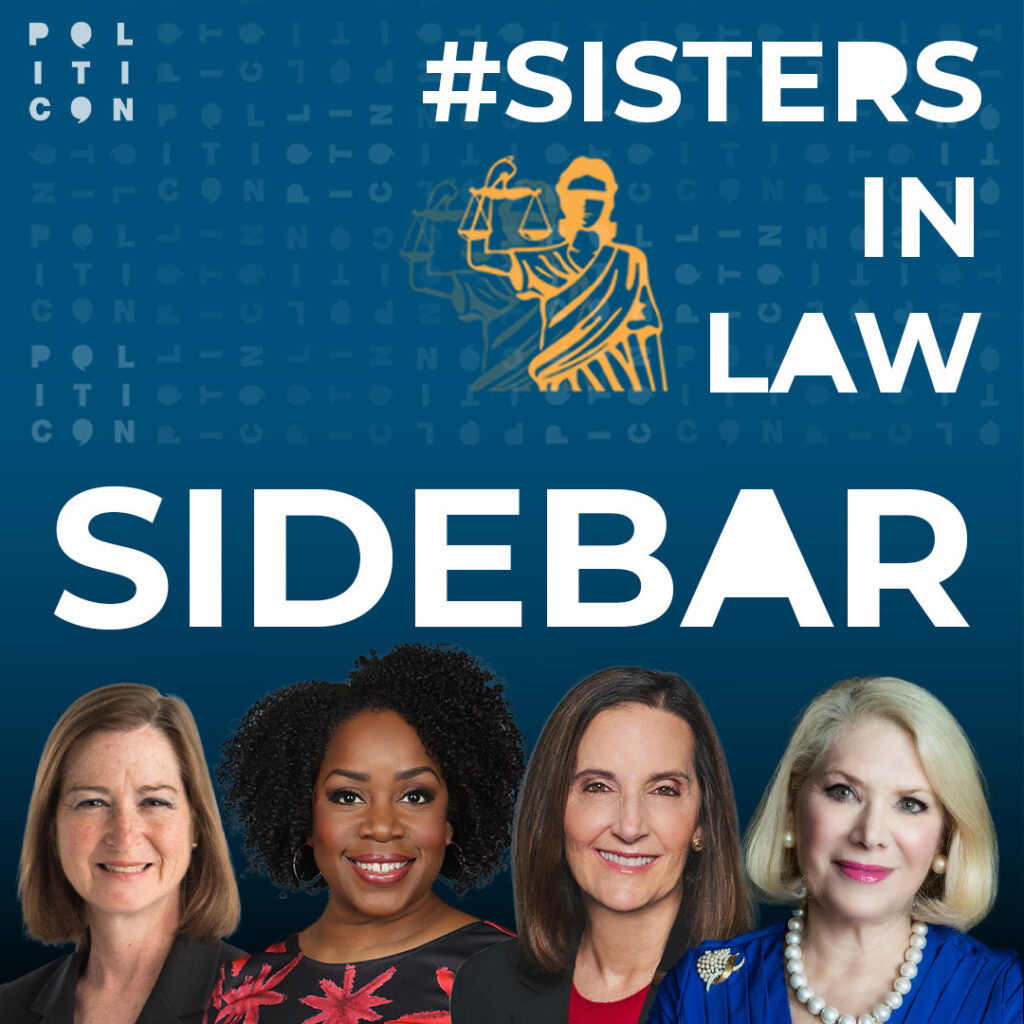
Barb McQuade and Kimberly Atkins Stohr answer listener questions on everything from privacy protections to Latin legal terms. They discuss the EU’s GDPR as a model for treating personal data as belonging to individuals, whether media outlets face liability for declining to air presidential speeches live, how to respond when people treat “socialism” as a curse word, why Trump’s impeachments cannot be nullified or expunged, the difference between lies, misinformation, and disinformation, and their favorite Latin legal phrases, like res ipsa loquitur and quantum meruit.
Freshen up your spring wardrobe! Get the ReSIStance T-Shirt, Mini Tote, and other #SistersInLaw gear at politicon.com/merch!
Additional #SistersInLaw Projects
Jill’s Politicon YouTube Show: Just The Facts
Kim’s Newsletter: The Gavel
Joyce’s new book, Giving Up Is Unforgivable, is now available, and for a limited time, you have the exclusive opportunity to order a signed copy here.
Order Barb’s new book, The Fix, or her first book, Attack From Within, now in paperback.
Add the #Sisters & your other favorite Politicon podcast hosts on Bluesky
Get your #SistersInLaw MERCH at politicon.com/merch
Email: SISTERSINLAW@POLITICON.COM or Thread to @sistersInLaw.podcast
Get text updates from #SistersInLaw and Politicon.
Mentioned By The #Sisters
Order Barb’s new book, The Fix, and get tickets for her book tour!
Support This Week’s Sponsor
Smalls:
For a limited time, get 60% off your first order, plus free shipping and treats for life when you head to Smalls.com/SISTERS
Get More From The #SistersInLaw
Joyce Vance: Bluesky | Twitter | University of Alabama Law | Civil Discourse Substack | MSNBC | Author of “Giving Up Is Unforgiveable”
Jill Wine-Banks: Bluesky | Twitter | Facebook | Website | Author of The Watergate Girl: My Fight For Truth & Justice Against A Criminal President | Just The Facts YouTube
Kimberly Atkins Stohr: Bluesky | Twitter | Boston Globe | WBUR | The Gavel Newsletter | Justice By Design Podcast
Barb McQuade: barbaramcquade.com | Bluesky | Twitter | University of Michigan Law | Just Security | MSNBC | Attack From Within: How Disinformation Is Sabotaging America
Kim (00:06)
Welcome to this episode of Sisters Sidebar with Barbara McQuade and me, Kimberly Atkins Stohr If you have a question for us, you know what to do, but just in case you don’t, you can either use hashtag SistersInLaw on your socials or you can email your questions at sistersinlaw at politicon.com. But don’t just write your questions. No, no, no. Send us a voice note with your phone.
Asking the question in your own voice, and guess what? You just may hear yourself on an upcoming episode of Sisters Sidebar. We love hearing your voice, so definitely give that a try. We have a lot of really good questions ⁓ this week to get to. So let’s get started. Our first question is from Julia, and it’s for you, Barb. This is Julia from California. Please opine on and
Barb (01:00)
Any aspects of the legal or political systems you’re aware of in foreign countries that you think would be beneficial for us here in the US? Well, Julia, that’s a really interesting question. And there’s an awful lot of stuff around the world that we could look to. But I think the one that I think is such a smart way of looking at the world is something the EU passed in, I think it was 2018, called the general
Kim (01:08)
Official f to adopt here
Barb (01:29)
Data protection regulation. It’s a privacy law. You know, here in the United States, it’s been so difficult to get privacy laws passed when it comes to the online world. I think the tech billionaires in our country have so much lobbying power that it’s impossible to do that. But, you know, they have things like the right to be left alone. So you can ask to have your data taken down. And I think one of the things that’s so ⁓ interesting about this law in the EU.
is that they treat your data as belonging to you and that third parties who take it are can only take it and use it with your permission. And so, you know, that’s what introduced all these cookie settings and things that we now get here, because if you’re operating around the world you have to comply with EU laws, so, you know, accept or reject, you know, all of the cookies and other kinds of things. But I think reimagining
business records about us as belonging to us, not just being their records, but our data, is a really good way to think about information. And I think if we could pass some law like that, it would really help protect us and our children online. All right, Kim, here’s one for you. It comes from Rick, who asks, I’ve heard rumors that the impeachment from Trump’s first team could be nullified or struck from the record. Is that possible and how would it work?
Kim (02:54)
Well, Rick, no. It’s not possible. So there’s no way that it can work. Once an impeachment takes place, it has taken place. The same way that, you know, I once got a parking ticket. I can’t say that I never got that ticket. It happened, you know. I maybe I fought it and it was taken away, but it the ticket still was issued. This is an effort by Donald Trump to
in his own world, wipe away the fact that he is the only president to have been impeached twice. but they can’t. Now, what the legislature might do while Republicans still are in control, is pass some sort of resolution which has absolutely no impact, ⁓ you know, no weight at all, that says, we hereby expunge Don I I mean, I’m laughing because it’s really it it’s hard it doesn’t even pass the giggle test.
Barb (03:49)
Mm.
Kim (03:49)
We hereby expunge the impeachment of Donald Trump and maybe give him some sort of, you know, certificate of expungement or some other nonsense. It means nothing. It would be a waste of your taxpayer dollars because it will have zero effect. Donald Trump was impeached twice. He was also acquitted twice in the Senate, and that is just fact, and he can’t change fact. We have a question from Stuart from Palm Springs, California, who asks.
Why are we not using the term lie instead of misinformation or disinformation? If one of our children said things that the MAGA followers do, it would be called out as a lie. What gives before I turn this over the barb to answer, I will say like I used a euphemism earlier in this podcast saying that the president has a different difficult relationship with the truth. But I am, for one, a journalist and I have always been a journalist, even when I was
on the news side and not the opinion side, that was not afraid to say when Donald Trump told a lie, if it was provable that he did. So why do so few people do that?
Barb (04:50)
Yeah, so interesting, isn’t it? ⁓ I think that there is a reluctance, at least in the media, to call out lies. I think that they’ll say Trump said X and then they’ll fill in the f the truth and you know, so that the reader can make their own decision about it. But but I I think, Stuart, this is a very good point that lies should be called lies. I I also want to say, however, that misinformation and disinformation
are terms of art that are not necessarily lies. I wrote a book on disinformation and it comes from the world of intelligence and propaganda and influence campaigns. And so disinformation is information warfare. It might be something that’s literally true, but it’s used in such a way to be misleading or to evoke strong emotions, you know, to say things that attack ⁓ individual groups based on stereotypes, for example.
⁓ it it it excites people and gets people angry or aroused or excited or something else. It is the Sorry?
Kim (05:51)
They’re eating the pets.
The they’re eating the pets.
Barb (05:55)
Beating
the p perfect example. Now that was a lie. ⁓ but it’s it’s a really Yeah yeah, it’s a really charged lie designed to get people up in arms, you know, to evoke an emotional response. Misinformation is slightly different. That is when people are exposed to disinformation or lies or whatever it is, and and truly believe it to be true, and then they spread it. So they’re misinformed and they share that in misinformation. And in fact, people who engage in information warfare
Kim (05:59)
It was also misinformation.
Barb (06:25)
Count on the fact that their message is going to be amplified by people who hear it and are excited and thereby spread this misinformation. So that’s how propaganda can spread when people start talking about it. So you you’re absolutely right though, Stuart. I think that a a lie when it is a ⁓ a black and white matter should be called a lie.
Kim (06:55)
We love cats, and cat owners can’t say enough great things about smalls. Like a lot of you, for the longest time we thought that the cat kibble they had in the grocery store was fine. It’s right next to all the food we buy for our family, so it has to be good, right? ⁓ wrong. Once we found out that it was mostly filler, corn, and ingredients you can barely pronounce, we knew cats everywhere deserve better. After making the switch to smalls, Joyce’s cats have so much more.
Energy and their fur seems softer and more luxurious, too. If you’re a cat parent, there’s no better time to try smalls than right now.
Barb (07:34)
Smalls Fresh Cat Food is protein-packed recipes made with preservative-free, 100% human-grade ingredients you’d find in your fridge. And it gets conveniently delivered right to your door. In addition to Joyce’s review, they have so many other outstanding reviews. Emmy L said that Smalls changed my cat’s life, and I know she would no longer be here if it weren’t for finding you. She’ll be 20 in April. Within two months of starting Smalls,
She was like a kitten again.
Kim (08:07)
I’m not surprised. Cats use protein as their main energy source, and more protein means more fuel and sustained energy. Small’s fresh, gently cooked, preservative free cat food gives them high protein and improved hydration for strong bones and toned muscles. Plus, a balanced diet leads to less shedding, fewer hairballs, you know, nobody likes those, and more silky shine. Even better, lots of nutrients in Small’s food are digestible, so less junk.
comes out the other end, if you know what I mean. That means less cat related odors, and that’s something we can all appreciate.
Barb (08:42)
The team at Smalls is so confident that your cat will love their product that you can try it risk-free. That means they will refund you if your cat won’t eat their food. So stop serving your little carnivore, a bowl of processed shortcuts, for a limited time because you are a sisters sidebar listener. Get 60% off your first order, plus free shipping and free treats for life when you head to smalls.com/slash sisters.
One last time that’s 60% off your first order, plus free shipping and free treats for life when you head to smalls.com slash sisters. The link is in our show notes.
Well Kim, here’s one for you. This one comes from Caesar. Hello, sisters. I in relation to Trump’s speech on Thursday. And news organizations have a real dilemma.
Kim (09:37)
Question.
By definition, anything
Barb (09:48)
that the president says or does is newsworthy, but Trump spouts myriad lies. And so if the organizations don’t want to disseminate lies in the inter
Kim (10:01)
interest
of public integrity.
Barb (10:05)
Which they also want to pursue. It wouldn’t ⁓
Kim (10:07)
And they wouldn’t
Operate with
Barb (10:12)
with this endeavor. So what I was thinking is could they on a time delay have a team of
Kim (10:16)
Put the speech
And
Barb (10:29)
Maybe put a statement saying lacking context where
Kim (10:33)
The speech is you know
Barb (10:36)
lack nuance
or or clarity, but is not an outright lie. And
Kim (10:42)
And
do you think that would open them to
Barb (10:45)
to
⁓ a legal proceedings say the Trump admit did that.
Kim (10:49)
by the administration if they do.
Thank you. that’s a really good question, Caesar. So the answer is no, it shouldn’t open media companies up to liability. if you listened to this week’s sister sisters in law podcast, which dropped on Saturday, you would have heard us discuss the fact that the DOJ ⁓ tried to subpoena
New York Times reporters just for doing their jobs and how a judge, ⁓ at least for now, ⁓ has put a stop to that, causing the DOJ to withdraw. So we’ve seen this administration go after journalists many times. The president calls us the enemy of the people. But the question you asked is a really good one. I think actually what you are proposing is just good journalism. There is no requirement that broadcast news organization carry the president live.
That h is and has always been a courtesy. It goes back to the time where presidents really reserved speaking to the public to ⁓ important issues. You remember I remember growing up, and if the president was speaking in prime time, you know something big was happening, right? It was either because ⁓ the, you know, the war in Afghanistan began or or the
⁓ you know, the first Gulf War happened and when George Bush spoke to the nation or or when there was some sort of ⁓ tragedy like the Challenger explosion when President Reagan spoke to a nation. And people would listen and the networks would carry that live because it was an important policy or social reason to do so. But that even that, that was within the network’s own judgment to do that. The
White House can ask them to do it, but they’re not required to do it. And certainly in this age of streaming news organizations or cable news organizations, when the president gives a speech, they don’t have to carry it. I personally think it’s good journalism to follow it, to see what newsworthy is said, and to contextualize it, especially when you have, as is the case with this president, a president who often
Has a difficult relationship with the truth. I think that it’s more important than ever for journalists to be very careful and not just mainline whatever he is saying directly onto their airwaves. I think it’s irresponsible to do that. But is it illegal for them to do that? No, in no way. Does it mean that they won’t get in trouble, unfortunately, with this administration? No, it does not mean that either. All right, we have a question from Dr. Jane, ⁓ and it’s for Barb.
The question is, Hi dear sisters. The last week I’ve been talking to my brothers and both of them asked me what I thought about socialism as if it was a curse word. My question is, how do you respond to people who put a negative connotation to that term? I’m grateful for you and your work. Barb, what do you think?
Barb (13:56)
I love this question, ⁓ Dr. Jane, because we are hearing this from so many quarters. And in fact, what you’re actually hearing from ⁓ Donald Trump and some others is ⁓ going even further than ⁓ socialism and accusing some candidates of being communist. You know, the the Democratic Party has gone communist, which is sort of a the new red scare. But let’s break down what these systems really mean.
So America is mostly a capitalist society, right? Privately owned, free markets. We let markets do their thing. We compete in private business with the idea that the best products will rise to the top and with the lowest prices, and we have competition. And competition is good because it fosters innovation and investment and all those kinds of things. And that that’s you know, and that’s I I think s something most Americans believe in and can get around.
Socialism in its purest form is when the government actually takes control of some of the public goods. So things like education and health care and public services. And the idea there is to redistribute some of that wealth, to have a social safety net. It can be done in extreme forms or in ⁓ more discrete terms. And I think what we’re seeing is a term called democratic socialism, which is an effort to redistribute wealth.
You know, we are experiencing a growing wealth gap in society today. In my view, we are right back to where we were during the Gilded Age when we’ve got you know, one percent of the population controlling some huge percentage of the wealth in this country, while the lower and middle classes are relatively poorer because their wages have not come kept up with inflation. And so some of these democratic socialists are in favor of promoting ⁓ a a closure of that wealth gap.
By you know, higher corporate taxes. Since the Reagan administration, we have cut, cut, cut taxes for CEOs, corporations, and the wealthiest Americans, leaving some of the lower and middle classes left behind. And what we see in our society is rather than acknowledge that wealth distribution, what we see by candidates like you know, d Donald Trump, leaders like Donald Trump is they divide and conquer the lower middle class by blaming others for people’s
economic woes, right? The reason you are not as well off as your parents were, and you’re really not, is not because of the tax cuts we’ve given to the wealthy, ⁓ and the way we’ve allowed ⁓ businesses to grow exponentially and create more market share. ⁓ it’s because of others, right? It’s because of immigrants, it’s because of mi minorities, it’s because of DEI, it’s because of the LGBTQ community, it’s because of ⁓
secular globalism, you know, all of these kinds of things, I think, are really just efforts to distract from what’s really causing this, and that’s wealth disparity. So socialism, or at least democratic socialism, as it’s practiced in this country, or is things like the Social Security Program, right? We we that today that would be called socialism. Or public libraries, public schools, the postal service, you know, all of these services that we the taxpayers subsidize so that everyone gets the benefits of it.
Public ⁓ funds being used for tax collection or road repair. This privatization of, you know, prisons and trash collection and all these other kinds of things is a capitalistic movement. But the problem is that the wealthiest get to enjoy the velvet rope economy and the concierge service and the rest of us are left with the scraps. Just look at the airline industry to see how we’re seeing that stratification, right? Unless you’re platinum gold elite.
Yeah, you know, you got a piece of rope to tie you in for for your seatbelt. ⁓ and then finally, let you Kim. Finally, let me say what it’s not, and that is communism. So communism is a classless society. The idea is every one of us is equal, every one of us gets equal amount of money, every one of us does ⁓ find some work that we can do to contribute to the collective. It’s an idealistic kind of an idea.
that you know everybody is living in this utopian society and we’re all doing the same thing and we’re all getting our fair share. ⁓ I think the problem with that is ⁓ we have seen in some societies authoritarian regimes utilize this idea of of communism where they’re actually engaging in kleptocracy, where they’re taking all the wealth out of society and leaving the scraps for ⁓ others. I’m also i someone who believes in in capitalism by and large. I think that competition is good.
It causes people to innovate because there’s a a reward at the end of the day, right? You can get rich if you come up with a new process or a new invention or a new idea that can make society better. So all of these things I think are more complicated than labels. And so ask yourself, what is it that they so fear about socialism? ⁓ and ask them. Why, why, why? I’d be surprised if they could answer it.
Kim (19:00)
Yeah, that’s actually exactly what I was gonna say. It’s a w it’s a way to open up the conversation.
Barb (19:04)
Okay, Kim, here’s one last question for you. It comes from Kevin who asks, after hearing your explanation for de facto and de jure, I was wondering if there are any other cool Latin legal terms we should know. ⁓ that’s a fun question. What do you think?
Kim (19:19)
I want you to jump in too, Barb. Like I do love her. I do love legal. So one of my favorite one is my favorite one, I think, is Ris Ipsoloquiter. Like the way that says. And it means the thing speaks for itself. And it’s used in ⁓ legal terminology to say, listen, if if ⁓ if something happens that almost can never happen but for some sort of negligence.
You say resips a loquitter, basically that thing speaks for itself as evidence that negligence occurs, right? So that’s what it means. But I also like it because it’s one of the terms that have been used, like when I was in law school or, you know, in law offices when there are like road races or something. And then you we’d be tea when I was in law school, our our charity race was ⁓ race judicata, which is another legal.
Barb (20:12)
You should say that. I was gonna raise the same thing. I think every bar association in America has a race judicat, like the five K Run, fun run is the race judicating.
Kim (20:21)
Or the race of siloquitter or something like that. With, you know, it’s race and s R A C E instead of R E S, which is the Latin word. But I don’t know. I really like that one. I also liked ⁓ as a civil attorney, I liked quantum marrowit. And quantum marrow it meant if you were harmed in some way, if someone committed a tort against you, which means that they did something that was negligent or something and caused you some sort of harm, you deserved to be paid the value of that harm. Or if someone
had a ⁓ agreement with you that wasn’t a formal contract, but who did a service for you, they deserve to be paid for that service. And the amount of that was called quantum marwit, what that was ⁓ paid for. I just like saying that too. Quantum marrow. It sounds so official when it just means, you know, in the words of Rihanna, pay me what you owe me. But what about you, Barb?
Barb (21:13)
There’s some great ones. You know, there’s quid pro quo, which we hear about in bribery cases, right? This for that. You you did this p you know public act in exchange for money. ⁓ caveat emptor, let the buyer beware. If you ever sell anybody anything, you just say caveat emptor and you’re free if you know like like as is
Kim (21:31)
Pay you say quantum marrow it.
Barb (21:35)
On your ⁓ your line about race ⁓ ipsoloquiter, we have you know a whole bunch of different ⁓ student organizations at our law school. And one of my all-time favorite names is the name for a group of ⁓ the the law organization for women of color. It’s called race sistaloquitter. Isn’t that the best?
Kim (21:59)
Yes
That’s the winner. Racist loquiter. I just wanna come out there to Ann Arbor just to meet them. That’s all
Barb (22:03)
Isn’t that the best?
Great. And my all-time favorite is a story that occurred. ⁓ a colleague came back from the grand jury and he’d had a rough day with witnesses on the stand, you know, who were clearly lying or giving him a hard time. And at the end of it, one of the grand jurors wrote up on the whiteboard ⁓ illegitimi non carburundum. And he said, Here’s a legal term for you. And my colleague said, I I I don’t know what that means. What does that mean?
I think it’s actually mock Latin. I’m not sure it’s really Latin. But instead, what it means is don’t let the bastards grind you down. Ooh.
Kim (22:45)
That needs to be on a t-shirt.
Barb (22:48)
Yeah.
Kim (22:52)
Well, thank you for joining us this week for Sister Sidebar. Keep those questions coming. ⁓ we love getting them. You can either use hashtag Sisters in Law on your socials or send us your questions at sistersinlaw at politicon.com. please support our sponsor this week, Smalls. It’s so important. And the link is in our show notes because without our sponsors, we could not be here doing what we do for you.
Don’t forget to also, wherever you listen or watch, to follow us, subscribe, like, give us a good review, pass it along to your friends to make sure this podcast continues to grow and grow, and we can continue what we do. Of course, don’t forget to buy merch at our merch store politicon.com slash merch. We have a lot of goodies there, ⁓ and we are rotating things seasonally, so make sure that you check it out to make sure.
You can get some of the latest swag from us. And see you on Saturday with the next episode of hashtag SistersIn-Law and then next Wednesday with the next Sister Cycle.
Ray sister look with her though. Ray sister look with the black woman speaks for herself. I I w I’m I wanna buy a T shirt. Yeah.
Barb (24:17)
Yeah, isn’t that so great?
Isn’t it such a great a great line?
Kim (24:25)
I’m gonna use that when I’m in the next argument with my husband. Racist eloquitor. Top that.
Barb (24:29)
Ha ha.
 Joyce Vance
  Barbara McQuade
  Kimberly Atkins Stohr
  Jill Wine-Banks