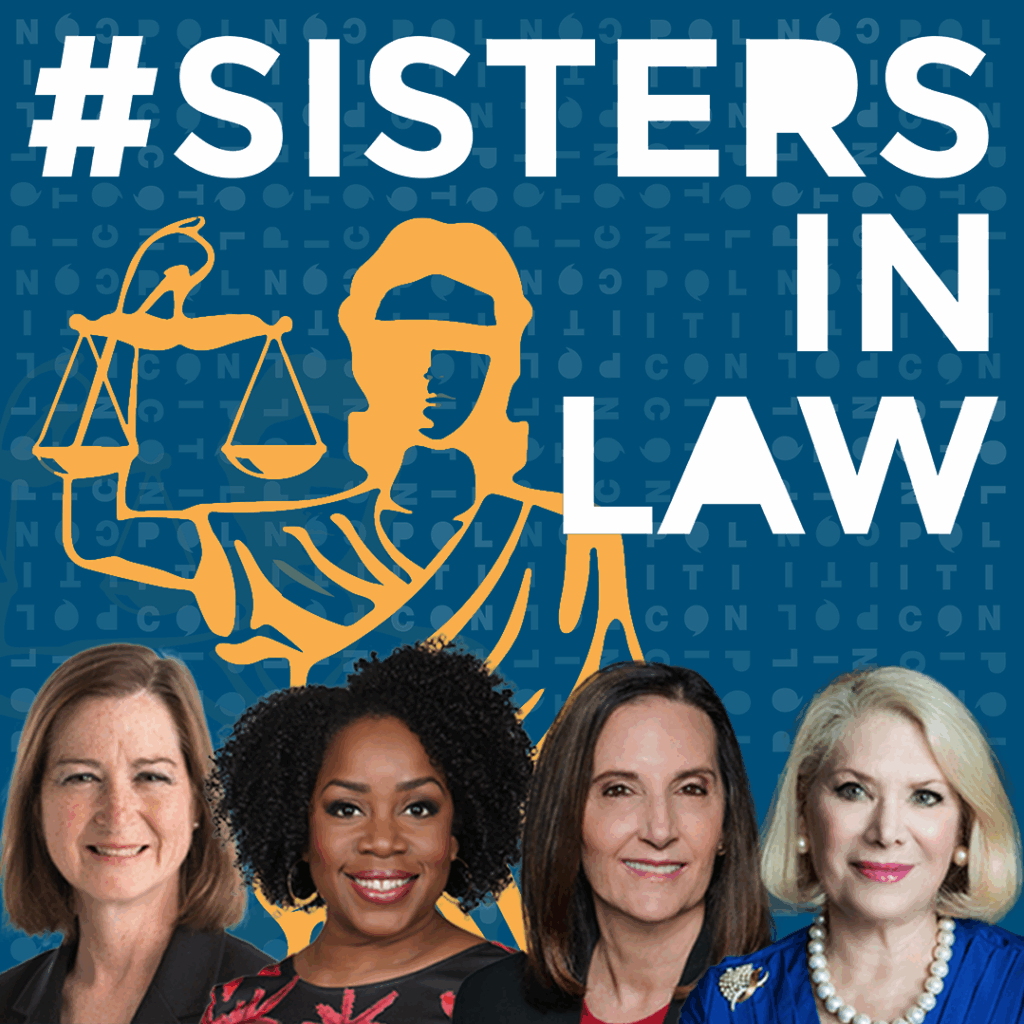
Jill Wine-Banks hosts #SistersInLaw to explain the D.C. Circuit arguments over Trump’s 2025 executive order punishing elite law firms for representing clients and causes he dislikes, the firms’ lower court wins, the government’s failed arguments, and the court’s skepticism. Then, the #Sisters examine the DOJ subpoena to the Wall Street Journal issued as part of a leak investigation, and discuss its threat to press freedom. They also review Jamie Raskin’s anti-corruption bills that strengthen emoluments rules, ban pardon payments, and further other good-government reforms.
Remember to send in audio questions to SistersInLaw@politicon.com for the #Sisters to answer on their new companion podcast, SistersInLaw Sidebar! It airs Wednesdays wherever you normally get your podcasts!
Get the brand new ReSIStance T-Shirt, Mini Tote, and other #SistersInLaw gear at politicon.com/merch!
Additional #SistersInLaw Projects
Check out Jill’s Politicon YouTube Show: Just The Facts
Check out Kim’s Newsletter: The Gavel
Joyce’s new book, Giving Up Is Unforgivable, is now available, and for a limited time, you have the exclusive opportunity to order a signed copy here.
Barb is going on a book tour! You can also pre-order Barb’s new book, The Fix. Her first book, Attack From Within, is now in paperback.
Add the #Sisters & your other favorite Politicon podcast hosts on Bluesky
Get your #SistersInLaw MERCH at politicon.com/merch
Email: SISTERSINLAW@POLITICON.COM or Thread to @sistersInLaw.podcast
Get text updates from #SistersInLaw and Politicon.
Mentioned By The #Sisters
Pre-order Barb’s new book, The Fix, and get tickets for her upcoming book tour!
From Barb: Patel’s Exploits Are A Serious Risk To The FBI
From Barb: Jack Smith’s Latent Honesty Is Valuable — But New Challenges Require New Rules
Support This Week’s Sponsors
HexClad:
Find your forever cookware @hexclad and get 10% off at hexclad.com/SISTERS! #hexcladpartner
Blueland:
Get 15% off your order of green cleaning products at blueland.com/sisters
Mill:
Try Mill risk-free for 90 days and get $75 off at mill.com/SISTERS and use code SISTERS at checkout.
HoneyLove:
Save 20% Off Honeylove by going to honeylove.com/SISTERS! #honeylovepod
Wild Grain:
Get $30 off your first box and free croissants for life when you start your subscription to delicious quick-bake artisanal pastries, pasta, and bread at wildgrain.com/sisters with promo code: SISTERS
Get More From The #SistersInLaw
Joyce Vance: Bluesky | Twitter | University of Alabama Law | Civil Discourse Substack | MSNBC | Author of “Giving Up Is Unforgiveable”
Jill Wine-Banks: Bluesky | Twitter | Facebook | Website | Author of The Watergate Girl: My Fight For Truth & Justice Against A Criminal President | Just The Facts YouTube
Kimberly Atkins Stohr: Bluesky | Twitter | Boston Globe | WBUR | The Gavel Newsletter | Justice By Design Podcast
Barb McQuade: barbaramcquade.com | Bluesky | Twitter | University of Michigan Law | Just Security | MSNBC | Attack From Within: How Disinformation Is Sabotaging America
Jill (00:00)
Welcome back to Hashtag Sisters-in-Law with Barb McQuade and me, Jill Wine-Banks Joyce and Kim will be back next week. We missed them, but they’ll be here next week. In today’s show, we have some really heavy duty topics and one that maybe will make us a little happier. We’re gonna discuss the oral arguments in the law firm extortion. I guess it’s called an executive order case, but it is sort of like extortion. ⁓ And then we’re gonna talk about one of the many DOJ wrongs of the week. We’re going to talk about their subpoena to the Wall Street Journal. And on a better side, we’re talking about some proposed legislation that could make a difference to our democracy. And that is the anti-corruption, anti-grift legislation that’s being proposed by ⁓ Jamie Raskin and several other members of Congress and also Schumer in the Senate.
So before we get to those topics though. Barb, I want to talk about your book because it’s almost out and you’re almost ready to start your book tour. And I understand you have an event. The first of your book tour is at the 92nd Street Y, which is really a prestigious place to appear. When is that and how do people get tickets for it?
Barb (01:29)
Thanks a lot, Jill. Yeah, my new book, it comes out June 2nd. It’s called The Fix, Saving America from the Corruption of a Mob-Style Government. It uses some of the lessons I learned as a prosecutor in combating crime and comparing some of the tactics of the Trump administration, but mostly offering solutions. Hence the name, The Fix. ⁓ But the first event to launch the book tour, most of them are in June. I’m going to be traveling around the country to talk about it. Maybe we can put the… ⁓
tour schedule in the show notes. But on May 31st, as you said, I’ll be at the 92nd Street Y with Preet Bharara. And we are going to be live recording an episode of his podcast, Stay Tuned with Preet, and talking about the show there. So I’m really excited. You and I had a chance to be at the 92nd Street Y a couple of years ago. It’s a wonderful venue. anybody in the New York vicinity, I hope you come out and see us on May 31st. It’s a Sunday evening. And I’ll post a link in the show notes. But thanks, Jill.
You know what it’s like to launch a book, right? There’s a little bit of you that’s very self-conscious that you’re putting out into the world, but I hope I have some ideas that I really want to share with people and I look forward to talking about.
Jill (02:38)
And I have to mention that you’re coming to Chicago and I get to interview you. I believe it’s the Union League Club on June 8th. And I hope that everyone who’s listening who’s in Chicago will come and see us. I know many of my friends are saving the date. So I look forward to seeing all of you listeners in Chicago. That’ll be great. And again, it’s called The Fixed.
Barb (03:01)
Kim is going to interview me at Politics and Pros in DC on June 4th as well. ⁓ We don’t have ⁓ a trip yet scheduled for the Deep South for Joyce, but we’ll look into it. Last time around, I went down to Birmingham. We had a lot of fun. So we’ll see what we can put together.
Jill (03:15)
It’s a great book. I’ve had a chance to read a pre-publication version. And I love that it’s not focused on the problem, but on the solution, because we’ll be talking about a lot of the problems today in our show, and I like to think about solutions.
Barb (03:32)
Thanks, Joe.
Jill (03:42)
Spring is a time of renewal where the old gives way to the new and there’s no better place to start than resetting your kitchen. Don’t just clean out the cabinets. Get rid of your scratched up, difficult to clean pots and pans and make an upgrade that will take your cookware and your meals to the next level. If you’ve been hanging on to old ones far too long, do what I just did. Give them to Goodwill and get hex clad because you deserve the best.
Plus, having shiny new tools that liven up your kitchen makes the effort you put in much more enjoyable and more delicious and easier to clean.
Barb (04:21)
These pans are absolutely magic. That’s why we want to tell you about Hexclad. Hexclad’s beautiful design combines the performance of stainless steel with the convenience of nonstick. So you get the best of both worlds without the drawbacks. We all know how fast nonstick pans get scratched up and worn out and stainless steel does great until it’s time to clean up. Then it’s a disaster. That’s why you’ll love how Hexclad’s revolutionary features
deliver on both performance and convenience. Not only are they oven safe to 900 degrees with stay cool handles, the heat control is unmatched. The sears are spectacular and cleanup is easy every time. Instead of scrubbing stuck on burnt on food, all it takes is a quick wipe down and a move to the dishwasher. Now you can actually relax and enjoy your culinary creations.
Jill (05:14)
Hexclad completely changed the way I cook. Once you make the switch, confidence in the kitchen comes naturally. And once you’ve gotten a taste of them, your whole family and everyone who comes to have a meal at your house is gonna wanna sit. It’s easy to see why Gordon Ramsay cooks with Hexclad at home and in his restaurants. And he’s the toughest critic on the planet. Thanks to Hexclad’s lifetime warranty, this is truly the last set of pans you’ll need.
It’s no surprise Hexclad has over 1 million customers and over 50,000 five-star reviews, including every Sister-in-Law’s. Now that the secret is out, don’t wait. Spring is the perfect time to upgrade your kitchen with cookware that actually works as hard as you do. For a limited time, our listeners get 10 % off with our exclusive link. Just head to hexclad.com slash sisters. Support our show and check them out at
H-E-X-C-L-A-D dot com slash sisters. Make sure to let them know we sent you. Let’s cook smarter this spring with Hexclad’s revolutionary cookware. The link is in our show notes.
This week on Thursday, the US Court of Appeals for the DC Circuit heard arguments regarding President Trump’s 2025 executive order that punished major law firms, very elite firms, including my former firm. So I’m announcing that I have an interest in this case particularly. ⁓ One of the firms was Jenner & Block, where I was a partner. Others include Perkins & Coe and Sussman Godfrey, Wilmer Hale. ⁓
They were punished for their past representation of clients that Donald Trump doesn’t like. For some of it was pro bono work they did for causes that Donald Trump doesn’t like, like diversity, equity, and inclusion. It’s a problem for firms that have represented whistleblowers. There was one lawyer who was punished individually by name for having represented whistleblowers. This is really contrary to our system of justice. And it’s really a bad thing.
⁓ Many firms caved, not these four. They fought and they have won at the lower courts. The firms that caved have lost customers. They lost clients because people thought, if you can’t defend yourself, how can you defend me? ⁓ So now the federal trial courts that ruled in favor of the law firms, they said it was unconstitutional and ⁓ now it’s gotten up.
to the Court of Appeals and the arguments were this week. And so I think it’s time for us to look at the arguments that were made there about the first, fifth and sixth amendment violations that these executive orders might have ⁓ counted. So Barbara, I want to start just to refresh our audience, because we have discussed this before. Talk about the history of the order when it was passed in 2025 ⁓ and how it got to the lower court and what’s going on now.
Barb (08:35)
So about a year ago, I think they started in maybe March of 2025, but in the spring, first hundred days of Trump’s presidency, he issued these executive orders and they targeted the law firms that you mentioned. And in each instance, there was some element of retribution. They had ⁓ employed Robert Mueller, Andrew Weissman, Mark Pomerant, some of the lawyers who had
⁓ worked on prosecutions against Donald Trump. ⁓ Mark Elias was another who had once represented the Hillary Clinton campaign. ⁓ And these people were singled out by name. And the effects of the executive order were to bar them from ⁓ engaging in contracts with the federal government, to prohibit them from entering federal buildings, including federal courthouses, ⁓ to refuse to hire lawyers who worked in, came from those firms.
And I think perhaps most egregiously or what might have been most acute for some of these firms is ⁓ stripping security clearances for lawyers who had them in those firms. Private lawyers can get security clearances if they go through a background check so that they can represent clients in cases that have national security classified information involved. ⁓ Those four immediately filed lawsuits. There were, as you mentioned, eight or nine other law firms
that negotiated with the Trump administration and agreed to pay in the form of pro bono legal services to make Trump go away, ⁓ which was the exact kind of ⁓ what Timothy Snyder refers to as obedience in advance, entering into these deals. But these four, ⁓ I thought, showed great courage. And also, there were law firms who represented these four in their legal challenges.
They filed lawsuits in the District of Columbia, all four of them won, in my opinion, not a surprise in the least. ⁓ And their arguments ⁓ address a number of constitutional violations ⁓ due process. They were stripped without any opportunity to be heard. ⁓ A Sixth Amendment violation for making it difficult for clients to hire counsel of their choice. If you’re working with a lawyer on a classified case,
and that lawyer loses his security clearance, you’ve got to find a new lawyer. But also, the ability to have a lawyer who can go to a courthouse. If your lawyer can’t go to court, they can’t represent you anymore. And then, of course, First Amendment issues. So ⁓ to punish people for expressing views and opinions that the president didn’t like or for the First Amendment right, it’s actually the right to free assembly, which has been interpreted to mean the right to free association. And so if law firms want to hire people that
Trump doesn’t like, like Robert Mueller and Andrew Weisman and other people, Mark Elias or others, it’s none of his business. He can’t just simply say, I don’t like that guy in your firm, therefore ⁓ any place you touch the federal government is off. And so in each of those four cases, the district courts decided in favor of the law firms ⁓ and the justice department filed an appeal on behalf of the administration. And what’s interesting about it is on the day the briefs were due, maybe the day before,
The government said, we’re not going to proceed. don’t, we, you know, essentially waving the white flag as it seemed appropriate to do, right? That there’s, they’ve got no arguments. They have no legal basis to defend. They’re indefensible. And then the next day, mysteriously, without any explanation, they said, you know what? We’ve changed our mind and we are going to file that appeal brief. And here it is. Can’t you just imagine, Jill, that somewhere at the White House, like Trump read the clip or was briefed and told, yeah, the Department of Justice has decided to withdraw because there’s no arguments. You’re like, they what?
Get in court. You tell them to fight this thing to the end. I don’t want to surrender this. We’ll blame some woke judge for this. And so finally on Thursday, ⁓ it was time for the Court of Appeals to hear the oral argument in this case. And we heard Paul Clement. He was the Solicitor General during the administration of George W. Bush. So this is certainly not a political argument. This is a rule of law argument. And he made these
you basically the same arguments that we had seen before that these violate the First Amendment, that there is the risk of having a chilling effect on free speech, that you can’t retaliate against people for exercising constitutional rights, ⁓ that in our adversarial legal system, we count on lawyers to represent even unpopular causes, right? John Adams famously represented the ⁓
British soldiers involved in the Boston massacre, even though nobody liked them. Charles Manson gets a lawyer, everybody gets a lawyer. And that is an important part of being a lawyer is to take on unpopular causes. And so that was the argument that was made yesterday. And the court took the case under advisement and I thought showed appropriate skepticism.
Jill (13:47)
Yeah, well, let’s talk more about that. But first, I want to just say that I think one of the most outrageous things is that they said the ugly, crazy part out loud. I mean, there was no attempt to conceal this as anything other than punishment for firms that Donald Trump didn’t like. And there was no attempt to conceal that this was a real threat to our system of advocacy and of representation. So it was a horrible order.
and the court was skeptical. ⁓ Let’s talk about some of the arguments the government made in defense of this was that the president has unlimited national security powers. And of course, you’re our national security expert, so I’m going to have you weigh in on this, they argued that he has an unreviewable power to revoke security clearances. Sort of like he says, I’m the commander in chief, I get to make these decisions, and no court can
review them in the same way that they can’t review my grants of pardons, even if there’s evidence that I took money for the pardon. So talk about the national security aspect of this because ⁓ that argument was maybe one of the strongest that they made.
Barb (15:03)
Yeah, this is really interesting. I don’t think it equates to a pardon. A pardon is specified in the Constitution and gives that power to the president. And so I think that is unique in terms of its unreviewability. ⁓ But of course, this administration and this court has taken up this idea of the unitary executive and that anything that has anything to do with executive power is the president’s and the president’s alone to decide. But where I think this argument fails, Jill, is that even if
the government can make discretionary decisions about who gets a background clearance, a security clearance. I don’t think they can exercise it in a way that’s at odds with the Constitution. And at one point they even asked, I think this is the part where he’s in the quiet part out loud, where they say, do you mean to tell me that if the president said, I’m not going to grant security clearances to any black people, just because, wouldn’t that fall?
a foul of the 14th Amendment and the Equal Protection Clause. And the lawyer’s response was, ⁓ you can’t look at it. It doesn’t matter because the president gets to do whatever he wants to do. No judge could make that decision. ⁓ It doesn’t matter. And I think it does because I think it is retaliation in violation of those rights. If they were to exercise their discretion in such a way ⁓ as to decide, know, Jill Weinbanks had this problem in her past and I don’t think she should get a clearance, these people already had them.
it was clear that the whole reason they were revoked was as punishment for the names described in that executive order. even the firms that negotiated relief, there was no part of the remedy that had anything to do with national security. It was all about give me enough pro bono hours and I’ll give it all back to you. And so I think that really belies that there’s just no substance to this.
And it really is based on an effort to punish in violation of the Constitution. I mean, what do you think about that? I think that I worry that this unitary executive theory, if taken to its nth degree, means that there’s no check on executive power.
Jill (17:09)
That is exactly correct. Let me just also add the firms that caved agreed to give over a billion dollars worth of pro bono services to causes that appealed to Donald Trump, which is despicable. But yes, this unitary executive is a theory that came out of nowhere and that has no validity in my mind. This is a real threat because it would mean
You know, we’d be going back to Marbury versus Madison and nothing could be reviewed. Whatever the president does, you couldn’t say it was unconstitutional because no court would have the authority to review it. And that would be the end of any kind of checks and balances. So it’s much more threatening than anything else we have seen or certainly as much as anything else we’ve seen. It’s really… ⁓
Very scary. And I’m glad you drew the distinction with pardons because again, I think the court needs to recognize that it isn’t the same as pardons. And I think later in the show, we’re going to be talking about whether pardons can be reined in under this new anti-corruption bill. And let’s talk a little bit more about the skepticism that I think you and I both saw in how the court reacted to the arguments. ⁓
What do you think? Were they skeptical enough? Do you think this is going to be a clear cut, ⁓ affirming of the lower courts?
Barb (18:45)
I think that at the circuit court level, I think we will see a decision similar to what we saw in four different courts ⁓ in the district court ⁓ level, four different judges. ⁓ I suppose there’s a question of whether this goes to the Supreme Court. ⁓ I don’t know whether it does. mean, it may be, of course, the Supreme Court only takes up cases it wants to take up. It doesn’t have to take up every case. can leave lower court decisions intact, and that’s the end of it.
This one strikes me as so clear cut that it’s difficult to imagine. But again, as we said, there is this appetite to really shape the law to entrench this idea of a unitary executive. And so, you know, I can see Chief Justice Roberts and Brett Kavanaugh, along with Alito and Thomas, being very eager to take this up. And it only takes four justices to grant Sir Sherari. So maybe it does go that far. And then if it gets that far, is there a fifth vote to say,
Yeah, the president can do all this stuff and even if we think it’s wrong, it’s not our place to review it. Gosh, I sure hope not, but ⁓ it does seem sometimes that we’re trending in that direction. What do you think about?
Jill (19:55)
that. I think it will definitely be appealed to the Supreme Court. Whoever loses is going to ask them to review it despite the risk. But if you’ve lost, you may as well try because there’s at least a chance that the Supreme Court will recognize it. think, you know, I’ve had questions from on social media, people saying, has the Supreme Court ever reversed a case that it just announced? And it’s this one where, you know, and
I don’t know. It’s so hard to say, but all we can hope for is a new Supreme Court because it’s terrifying to me, this executive theory, unitary executive theory, and that they would give power to not just this president who has shown a propensity to abuse any power that he has, but no president is intended to have this kind of power. Our founders saw we needed three branches co-equal with
abilities of checks and balances all the way around. And if he can just ignore legislation, if he can just ignore the constitution and it can’t be reviewed, we aren’t a democracy anymore. So let’s hope that the Court of Appeals rules to uphold the lower court orders and that the Supreme Court agrees with you that it’s just not worth reviewing because it’s so obviously ⁓ what the courts have said.
And they’ve used pretty harsh language in evaluating this executive order. ⁓
Barb (21:27)
It’s been a chance to write those sweeping opinions about democracy and the role of lawyers and Shakespeare and all that sort of stuff. you know, why not? This is the time to sing it from the rooftops, Your Honor.
Jill (21:41)
They are saying it and speaking of rooftops, that’s not the Cubs rooftops, is it? No, because that’s another whole issue that maybe someday we’ll talk about,
Barb (22:01)
We hear a lot about microplastics in the oceans and in our food, but they can also come from products we use every day at home, including the ones we use to clean. It’s not good for us, our pets, or the environment. That’s why we want to tell you about BlueLand.
Jill (22:18)
BlueLand makes dish, laundry, and every other household cleaning product that you could ever need, and they’re all designed to reduce single-use plastic, and all of their cleaning tablets are 100 % plastic-free and microplastic-free. They’re independently tested to perform alongside major brands, and the formulas are made without dyes, parabens, or harsh chemicals. BlueLand is also a great way to stop repeatedly buying plastic bottles
which just end up getting tossed out and replace it with Blue Land. You just use tablets, making it super easy to cut down on waste at home and the transportation costs because you’re not shipping water. You’re just shipping a tablet. You add the water and shake it up and you have a great cleaning product.
Barb (23:04)
I love not having to choose between the safe option and what actually gets my house clean, and you will too. Like us, they believe that hardworking, clean products can be the norm, not the exception, so that you can do better for your family and the planet at the same time. It feels great knowing that I’m incorporating sustainable practices into essential everyday activities. I’m always amazed by how well their dishwasher tablets work. They’re proven to perform no matter how intense the baked on,
or burnt-on stains can get. It’s a lifesaver when the dishes start to pile up and when it’s time to cook and eat. You won’t be worried about residual plastic getting into your food. You don’t even need a rinse aid.
Jill (23:46)
Best of all, BlueLand is a certified B Corp and leaping bunny cruelty-free certified. Their formulas are EPA Safer Choice certified and many products have also earned Cradle to Cradle’s Gold Material Health Certificate. Put it all together and it’s easy to see why their products are trusted in over one million homes, including ours. Make this switch today. Get
That’s 15 % off your first order by going to blueland.com slash sisters. That’s 15 % off your first order at blueland.com slash sisters. Once again, blueland.com slash sisters, and you can find the link in our show notes.
Getting your kitchen right is always one of the most important things to do when making the place you live into a beloved home. You need the right space, the right energy, and the right equipment to bring it all together. We always felt like there was something that could take ours to the next level. And eventually we found Mill. We weren’t sure what to expect, but after a few months, you’ll be amazed at how peaceful and clean it makes your space.
Barb (25:05)
Mill handles your food cleanup and puts every scrap to better use by making free garden-ready fertilizer. We couldn’t wait to get them for our homes and form habits that were better for our families, our yards, and the planet. To fill you in, Mill is the odorless, effortless, fully automated food recycler that can handle almost anything. We love how it looks, but the one thing that continually amazes people is how quiet it is while it works.
Forget about loud grinding disposals that strain your plumbing. Just throw everything from potato peels to avocado pits, chicken bones, or even dairy into your mill. And while you sleep, mill quietly transforms your food scraps into nutrient-rich shelf-stable grounds.
Jill (25:50)
It sounds unbelievable. And we were shocked when we discovered it really can process up to 10 pounds overnight. And it takes weeks before you have to empty it. Best of all, once you have a mill, there’s no more messes, smells or fruit flies. Everything gets so much easier. It means fewer trips out to the trash cans and the kitchen is filled with a delicious smell of freshly cooked food instead of whatever was wafting out of that garbage can. Without a mill,
We all create more food waste than we should. Now, milk can handle things while you get well-deserved rest. Then you can use the grounds in your garden, add them to your curbside compost, or milk can even pick them up and get them to a small farm for you. Afterwards, your plants will look great and you can feel good knowing you’ve done something good for the planet.
Barb (26:42)
Mill turns a huge climate problem into a simple daily habit. And it’s fun to use the Mill app to see how much food you’re keeping out of landfills. So far, Mill customers have put more than 15 million pounds of food to good use. Plus, they offer a 90-day risk-free trial. So if you don’t absolutely love it, you can just send it back. Try Mill risk-free for 90 days and get $75 off at mill.com slash sisters and use code sisters.
That’s $75 off at mil.com slash sisters and use code sisters. The link is in our show notes.
Well, this week, DOJ served a subpoena on the Wall Street Journal in a leak investigation, part of its growing trend to investigate the media, to learn about sources, about things that it doesn’t like. So Jill, in this instance, can you just share with our listeners what DOJ is investigating now and why it’s concerning that DOJ is seeking records from members of the press?
Jill (27:56)
So this is a change in policy ⁓ to allow broad investigation of the media who publishes anything that Donald Trump thinks is a leak. This particular leak involves some information about warnings that Donald Trump got before going to war with Iran about the risks of that war. And that’s pretty important because
He obviously ignored those warnings. So it’s good information for people who care about this to have. It’s important. It’s the role of the press to inform us. And this is important information. It’s not highly classified information. It’s the kind of thing that is the press’s role. In the past, you couldn’t just subpoena or get a search warrant to get press information.
⁓ You had to really go through the attorney general. Let me just say, in the past, you had to get, before you could subpoena the press, the attorney general had to weigh in on it, not just ⁓ a line prosecutor. I don’t know that that matters in this administration. Who cares? Todd Blanchard will grant anything. In fact, he’ll encourage anything.
Barb (29:18)
That’s a good point.
Jill (29:20)
Sort
of, you know, the highest level. Yeah, I mean, it doesn’t, I don’t think that that’s a protection anymore. The only protection we have is if you have to go to a court and the court wants, no, there’s no probable cause here for you to ask for this. And you should go back to the policy that says, there alternate ways to get this information that you don’t have to ask the press for their sources? So I just, it’s sort of like section two of the Voting Rights Act.
You know, the preclearance used to mean something. It doesn’t mean, again, preclearance, yeah, they’ll preclear any change you make because they don’t care about voting rights. I’m not sure that those laws which were based on integrity of the administration matter anymore.
Barb (30:09)
That’s a really interesting perspective. Of course, during the Biden administration, they had some rules in place to make it really quite difficult to go directly to a reporter to use a subpoena or a search warrant. You had to show that it was the only way you could get the information, that it was necessary to your investigation. It was an important investigation because President Biden himself said he thought it was wrong to subpoena reporters. think about the reasons for that.
I want to find out who’s leaking at the Pentagon. And so instead of investigating people at the Pentagon, what I do is I reverse engineer it by serving a subpoena on the reporter. And then I get the reporters to come in and testify, or if I get a search warrant, I get the reporter’s phone and I can look at all the chats, even on encrypted applications and see all the people she’s talking about or talking to. And not just in this investigation, but in all of
the stories that she’s pursuing. So she may be talking to people, you know, at the Defense Department and the Justice Department and other places. And you could see how it could have a chilling effect on sources who will say, you know, no, thanks, I’m not going to talk to any reporters because there’s a chance that the reporter might have her phone taken by law enforcement. And then my name and information will be revealed. I suppose Jill, some… ⁓
People might say, well, that’s good, right? Because we want to protect classified information. We don’t want the world to know our playbook. And it’s a crime to ⁓ leak and publish classified information. So what’s the big deal? Why is this a problem?
Jill (31:53)
It’s a problem because of the role of the press in a free democracy. It’s a problem because of the First Amendment and the very significant role of information ⁓ that the press can give us as voters so that we know how to make proper decisions. And this would be a chilling effect on sources, but also on ⁓ newspapers, magazines, blogs. If you don’t want to end up in an expensive litigation,
you may hesitate to publish even important things. There is another case pending right now, which was a search that there was, and I have to say the Justice Department is in trouble because it did not even talk about some of the Privacy Protection Act, which would have maybe made a difference and maybe the magistrate should have known about that law on his own, but
He’s certainly mad that the Department of Justice didn’t even try to mention it and rebut it. They just ignored its existence. And that’s Hannah Natanson from the Washington Post whose phone, computer, everything was taken and there’s now an issue of whether they have to give it back or at least for now they can’t use it. They can’t review it. But they haven’t had to give it back. Imagine having your phone and your computer taken.
And the government says, just buy a new one. ⁓ isn’t that simple? That is like, it’s a joke. It’s not a joke because that makes it sound funny. It’s not funny. It’s a very serious threat ⁓ to how our government has functioned, how our democracy works, how the First Amendment is intended to work.
Barb (33:39)
Yeah, and just to amplify your point about the Privacy Protection Act of 1980, what that says is if the government needs information from a media outlet, instead of using a search warrant, it should first pursue the information by using a subpoena because that gives the recipient an opportunity to go to court and challenge the subpoena and try to move to quash it. And so a search is in contrast, allows them to show up and just take.
the evidence. And so the idea is that ⁓ Congress passed this statute. We want to be respectful of news gathering activity. It’s not like a privilege the way there’s certain attorney client privilege sacrosanct. can’t ask about things that occur there. Reporters don’t have that same kind of privilege under federal law. Some states have given them a qualified privilege, but under federal law, like if you get a subpoena for the grand jury,
You have to show up if you’re a reporter. You could be held in contempt. You could be jailed. And that’s happened from time to time if a reporter fails to give up information. But there’s also this recognition that ⁓ in a free society, we want to respect the role of the free press. And I think that comes down to this idea, Jill, of can the government do something versus should the government do something? And you see Todd Blanch frequently
defending the government’s conduct by saying, read Article II or read this law. And he’ll look at the blank ⁓ words of it. And that’s all true. But there’s 250 years of Supreme Court doctrine that goes along with it, including the Pentagon Papers case. Now, that was a case about a prior restraint. So it’s a little different from using a subpoena or search warrant to obtain newspaper records.
Boy, that case really talks about how important it is to a free society to have a free press. We can’t vote in a meaningful way unless we know what our leaders are up to. Certainly it recognizes that some information is so sensitive that it should not be shared. And they talk about things like the movement of troops, the dates and locations where troops might be located during a war. Of course, that is something that should be protected. But they talk about other things. In that case itself, the Pentagon Papers,
was about decisions made regarding the Vietnam War ⁓ that should have been part of the public discourse. We should be able to talk about these things and know what our government is up to. I think when it comes to the war in Iran, you know, I mean, maybe it harms our negotiating position to know that there are people on the inside of the Trump administration who say, the love of God, don’t do this. ⁓ But it’s important for the public to understand that as well. you know, these are sensitive issues, ⁓ but a robust press
⁓ It’s why it’s not an absolute rule that you can ask for this information, but it should be done with people with respect for the First Amendment and some exercises of discretion because just because you can doesn’t mean you should.
Jill (36:43)
Right. And there is an analogy here ⁓ to Watergate where the Supreme Court said that the justice system is entitled to the evidence from every person, every potential witness, including the president. So there’s an argument being made that that means that even the press has to cooperate with criminal investigations. In the Watergate case, was an argument that ⁓
Confidential conversations, executive privilege applied, and therefore the president shouldn’t have to turn over the tapes. And the court said, no, you do, the interests in criminal prosecution outweigh this in this case. I think this is a different situation where there are so many alternative ways of getting the evidence that you don’t need to prosecute the person who may have leaked this. ⁓ And I’m not sure that the information
was that ⁓ critical. It was policy discussion about whether or not there was a risk to starting this war of choice. And so I think that even though the court said the president has to turn over the tapes, it’s not going to say that the reporter has to cooperate with this investigation.
Barb (38:14)
It’s always a good time for a closet makeover. So this spring, add in stylish and comfortable shapewear that works with your body and fits perfectly in all the right places. For that, you need to start with our favorite independent female founded brand called Honeylove. Their founder, Betsy, leads a team of women who bring their talent and experience to design every product with your body and needs in mind. And the results are amazing.
Jill (38:43)
As the weather gets nicer, we’re all more active. That means you want clothes that look stylish, wear comfortably, and get the job done. Unfortunately, so many sports bras and other shapewear we’ve tried in the past just didn’t cut it. You either feel trapped and suffocated or are constantly rearranging it instead of it seamlessly moving with your body. That’s why you need to try Honeyloves Crossflex Activity
with its easy hook and eye back. Add in its cloud-fuse bonding, and there’s no digging, poking, or pressure points. With all the support and coverage of a sports model in a design made for day wear, whether you’re exercising or not, when I’m taking a fitness class, out on a walk, or just looking for a compliment to my favorite outfits, it’s my new ultra wearable go-to.
Barb (39:38)
You know, Jill, I’m contractually exempted from discussing undergarments, but I would say that if I were to talk about such things, I would talk about the cross flex because of the way it works if you happen to have narrow shoulders, which some of us might have. It is a winner. It works every time. It’s comfortable. And there is no strap slipping down your shoulders. So even if you’re a long time Honeyloaf fan like us,
They are always releasing exciting new pieces that you’ll want to add to your collection. And recently they launched their new crossover contour undergarment, AKA bra, which features their best- I said AKA and I said it in parentheses, which features their best-selling wireless crossover design with built-in molded light foam pads for extra support and a beautiful contoured shape. If you like how that sounds, Honeylove is now offering
Jill (40:18)
I’m so proud of
Barb (40:36)
a crossover triple undergarment bundle. So if you want a big wardrobe upgrade, you can get huge savings by buying three at one time.
Jill (40:46)
And it’s worth it because the comfort is amazing. But Honeylove has so many other things to offer. They’ve built a full line of tanks, body suits, and foundational wear featuring supportive structure, smoothing fabrics, and premium finishes made for any occasion. You need to check them out. Treat yourself to the most advanced bras and shapewear on the market. Use our exclusive link to save 20 % off Honeylove at honeylove.com slash sisters.
That’s honeylove.com slash sisters. After you check out, they’ll ask you how you heard about them. Please support our show and tell them we sent you. Experience the new standard and comfort and support with Honeylo. The link is also in our show notes.
Barb (41:40)
Well, so often the legal topics in the news are alarming and disturbing, but there was a development this week that I love and it gives me hope. In fact, Jill, it’s very consistent with some of the things I talk about in my book. And that is a package of anti-corruption bills introduced by Congressman Jamie Raskin. Now, I suppose it’s unlikely to be passed by this Congress until we get a new Congress and a new president are elected.
I think you’d like to think that people care about good government no matter who they are, because these are not targeted at any particular president and they won’t take effect until ⁓ in many instances we have a new president, but they’re designed just for good government. Jill, can you just share with us, actually, I don’t know, a dozen or more provisions in this package of bills, but can you share with our listeners a few of the highlights of what’s in these bills? Because I think they’re really exciting.
Jill (42:37)
There are some that I think are extremely important, but I want to say first of all that while it gives hope, it also is extremely depressing because these are things- on a high note there. Okay, we’re going to move back to a high note when I talk about the specific things that are in it, but let’s face it. These are things that our founders never thought were necessary to codify. And the reason was they assumed integrity of the president.
Barb (42:47)
Come on,
Jill (43:06)
and members of Congress, et cetera. And so they didn’t think that you needed to implement laws that would stop you from doing things that are clearly immoral and wrong. But it turns out that isn’t always the case. And so there are several things in this bill that I think are incredibly important. One of them is putting teeth into the emoluments clause. You have an emoluments clause.
And Donald Trump has clearly violated the Emoluments Clause. He took a plane from Qatar. has foreign governments staying at his hotels. ⁓ He has the Secret Service staying at his hotels ⁓ and charges them for it while they’re protecting him. ⁓ But there’s nothing that can be done because there’s no punishment for violating the Emoluments Clause. So this would put some teeth into it. think that-
Barb (43:59)
They thought that when the jail, how naive, when the president swore to support and defend the Constitution, that meant he would comply with all of its terms. Turned out they forgot to put a penalty in there, but this fixes that, right? Yes.
Jill (44:12)
Yes, yes. And this also includes you can’t take payments for a pardon.
Barb (44:19)
Wait, is that frown-a-fun?
Jill (44:21)
Don’t you think that’s ridiculous? It also would protect regulatory agency by limiting the tenure of agency heads who are acting to 120 days, which is actually sort of already part of our rules, but being ignored, but it makes it clear. It would suspend the statute of limitations for presidential crimes as long as the person is in office.
Well, you wouldn’t think that’s necessary, but when you have a president committing crimes and the statute runs, because the rules are you can’t prosecute an act, which don’t get me started on whether you can or can’t and shouldn’t indict a president, because I think you can and should, but that’s a different issue right now. The rule is you can’t indict a sitting president and the cases against him that took too long to get to verdict have been dismissed. This would say, statute of limitations is told.
doesn’t run during the time of the presidency. ⁓ It also would require candidates to submit their tax returns. Everyone does that except Donald Trump. And so it’s particularly aimed at him, but it’s a good rule. It’s something that people should know in order to have ⁓ some concept of what the president’s conflicts might be.
And I guess I’m just sorry that we need an anti-Grift law, but there are so many examples of the GRIF that is going on that ⁓ if we have time, we can talk about some of the things that are really, really horrible ⁓ that are clear benefits of billions of dollars worth to the president and his family.
Barb (46:04)
Yeah. yeah, so many. mean, how about ⁓ getting the IRS to settle his $10 billion claim against the IRS for, you know, asking to audit his taxes? ⁓
Jill (46:20)
and 1.6 billion for the January 6th defendants to get paid back. And how about all the Qatar plane, we’ve talked about ⁓ his son-in-law taking, raising money while he’s negotiating in the Middle East. I mean, there’s just, the list goes on and on.
Barb (46:40)
Clear, clear conflicts of interest. Well, Jill, let me ask you this. It actually reminds me of some of the reforms we saw right after Watergate, right? That was a time of, you know, people were pretty shocked at what had happened in Watergate and Congress said, what can we do to prevent this from happening again? And there was a real appetite for good government. And what were some of the provisions passed at that time? You know, some of these are pretty well known today, maybe some less so, but, you know, in the 1970s, mid to late 1970s,
a whole bunch of statutes were passed that have become part of the law today. What were some of those?
Jill (47:15)
Well, one that’s in the news right now that’s definitely worth talking about is the Presidential Records Act. Because ⁓ Richard Nixon had refused to turn over presidential records. planned to take them and sell them or use them for his own financial benefit. And the government said, no, you created those as president. They’re the people’s. They belong to the people. ⁓ Now, of course, you have Donald Trump taking confidential information and proloining it and keeping it.
in an unsecure place in Mar-a-Lago. ⁓ But you also have him now saying that he’s going to ignore the Presidential Records Act, that it’s an infringement on his prerogatives. ⁓ So that’s in the news right now. And the importance of that is not to be ⁓ ignored. You can’t know history if you don’t have the actual records. And it’s important for us to grow as a country by knowing
what happened in an administration and only the original documents. Remember, he was in first administration shredding documents and- Didn’t he even flush them down the toilet? He flushed them down the toilet. Yes, he did all of those things. And so we need to have these ⁓ new rules put in place in order to protect democracy. And this Presidential Records Act was right after Watergate to protect against
Barb (48:26)
some of the reports.
Jill (48:44)
that there were government and ethics rules. Actually, even the ABA passed new ethics rules because so many lawyers were involved in the Watergate scandal that the legal profession said, need to pass some rules that will protect ⁓ us and make clear. Now you have the Department of Justice saying, you can’t even disbar a lawyer who works for the Department of Justice. Only the Department of Justice can look at that. And they’re trying to undo some of the
disbarments that have happened. Jeffrey Clark, think, I know for sure it was Clark, but maybe there are others as well that they’re trying to.
Barb (49:21)
They filed a lawsuit against the DC bar for disciplining Jeffery Clark. Yeah, but you know, back then, as you mentioned, Presidential Records Act, Ethics and Government Act, Freedom of Information Act, think about that. The Federal Election Campaign Act, the Foreign Intelligence Surveillance Act, these were huge. And, you know, I wasn’t a lawyer then, and so I don’t remember the reception to them, but like presidents signed these into law, right? Like Gerald Ford must have signed most of these or Jimmy Carter must have signed most of these.
Jill (49:31)
Like
Barb (49:50)
And they were embraced bipartisanly, you know, like. And now we have, as we discussed earlier, a time when our Supreme Court is buying into this unitary executive theory, this idea that the Constitution vests all executive power in the president, and therefore Congress can’t tell him how to run the executive branch. And so, you know, they’re taking shots now. It’s like the Federal Election Campaign Act is the one
Jill (49:53)
So mostly
Barb (50:19)
that got challenged ⁓ in Buckley v. Valeo, which is the predecessor to Citizens United. As you said, the Presidential Records Act is being challenged. I can only imagine what’s happening to FISA, the Foreign Intelligence Surveillance Act. Would we even know if they are just operating outside of that? Maybe not. And so in light of that history and the current makeup of the court, what do you think is the likelihood that if this package of bills manages to pass,
say in 2029, right, with a brand new Congress and a president of either party who just cares about good government. Do you think, one, will we get challenges to their constitutionality? Probably. What does this court do with those? Does it accept these as good government or does it rely on the unitary executive theory to say, Congress, can’t tell the executive what to do?
Jill (51:13)
Well, we’re going to know more about that with decisions that are pending at the Supreme Court or that may get to the Supreme Court in this term. I think it could pass in 2026 at the congressional level, but will be vetoed by President Trump.
Barb (51:29)
You would need a veto-proof majority.
Jill (51:33)
I think that’s, you know, I mean, in my fantasy maybe, but if I was being realistic, I don’t think that, while I do think the Democrats are going to win both the House and the Senate, I do not think it will be veto proof. So he will veto them and we’ll have to wait till after the inauguration.
Barb (51:53)
It’s
okay, right? It gets people thinking about these ideas and how important they are going forward.
Jill (51:59)
I think it could affect the election because I think these are such sensible solutions as in your book, The Fix, such sensible solutions that people will go like, why are they vetoing this? Why are they voting no to pass these laws? Because they are important to individual people. think they are things that ordinary citizens are going to realize are important to them and benefit them.
Barb (52:28)
Yeah, I think it’s also a moment when we’re seeing prices for consumer prices off the charts, gas prices off the charts, and other kinds of things. And meanwhile, we see politicians getting wealthy off the public dole. And so these anti-corruption measures just say, we thank you for your service, but you shouldn’t get rich off the backs of your service by accepting money in exchange for just doing your job.
This episode of Hashtag Sisters-in-Law is brought to you by Wild Grain. If you haven’t heard, Wild Grain is the first bake from frozen subscription box for sourdough breads, artisanal pastries, and fresh pastas. Plus, all items conveniently bake in 25 minutes or less with no thawing required. This is made for me. Unlike many store-bought options, Wild Grain uses simple ingredients you can pronounce.
and a slow fermentation process that can be easier on your belly and richer in nutrients and antioxidants.
Jill (53:40)
And one of the best things is that wild grain boxes are fully customizable. And that means that like in a week like this where I just felt a craving for chocolate, I was able to supplement my normal order with extra amazing chocolate croissants. And of course, I can’t say it the way Kim does, but you’ll have to take my pronunciation. Not bad. Okay. You’ve learned. I try to mimic her, but.
In addition to their variety box, they have a gluten-free box, a vegan box, and a new protein box. And I did try, I just ordered some of the protein ones. So I’ll tell you how they are as soon as I get my cheese sandwich and one other. No matter what you choose, it’s amazing how fast wild grain goes from the box to your table. And it’s always a treat. My husband and I enjoy the breads, the pastas, and the pastries. And so do my guests.
They are impressed and surprised when I say it’s baked from frozen, not homemade. And they often end up subscribing because it’s perfect for delicious meals, snacks, or quick food prep.
Barb (54:47)
Having wild grain delivered is so convenient when life gets busy. And I love watching the color and flavor come alive when those maple Belgian waffles are heating up. If you had those,
Jill (54:58)
Yeah, it’s one of my husband’s favorites.
Barb (55:01)
And you know what they go well with is that slow churn French truffle butter. That’s the thing. I’ll order a whole box just for that butter. But when it’s been a long day, the raspberry white chocolate cheesecake is the perfect treat. The aroma coming from the oven on all of these items is just incredible. And the whole house has a warmer vibe. Just make sure you get enough to share because you’ll want to be able to treat your loved ones when they come running.
Jill (55:27)
You know, I agree on the cheesecake, but I have to say even better is the chocolate lava cake. That is amazing. Imagine having fresh bakery quality bread, pastries, and pasta at home. And the pastas, you will never go back to the dried pasta if you try their pasta. You never have to make a trip to the store. Don’t just take our word for it. Try it. They have over 40,000 five-star reviews and have been voted the best food subscription box by USA Today for
three years in a row. And for a limited time, Wild Grain is offering our listeners $30 off your first box, plus free croissants for life when you go to wildgrain.com slash sisters. To start your subscription today, that’s $30 off your first box and free croissants for life when you visit wildgrain.com slash sisters, or you can use our promo code sisters at checkout. The link is in our show notes.
Now it’s time for our favorite part of the show, your questions. We love your questions. They challenge us and they educate us. Please keep sending them to us. You write to sistersinlawatpoliticon.com or tag us on social media anywhere using hashtag sistersinlaw. Let’s look at the questions today. And our first one comes from Mark in Tucson, Arizona.
And it’s for you, Barb. He wants to know, because you’re our national security expert, what is a national security presidential memorandum and why does it have any force at all? I’m worried. Can it be used to declare the 2026 election rigged once it is underway and halt the election?
Barb (57:25)
Ooh, Mark, a very valid fear. So what is a National Security Presidential Memorandum? It is essentially an executive order that pertains to national security. And of course, executive orders can only tell other parts of the executive branch what to do. It can’t create new laws, can’t create new causes of action, it can’t supplant a statute, it can’t change the constitution.
That’s why President Trump’s executive order redefining birthright citizenship has been met with challenges because it seems to rewrite a provision of the 14th Amendment. And so that’s why it’s been challenged. so ⁓ he could issue a national security presidential memorandum ⁓ directing parts of the executive branch to do things. suppose in the same way we have seen him issue executive orders that have been challenged for the legality.
⁓ I don’t think it would be legal, but again, we haven’t seen that always stop President Trump. If he were to direct members of the executive branch of the federal government to go out and halt an election because he has claimed it is rigged, I think there would be an immediate lawsuit. And I like to think that some of the real brave and ⁓ experienced election law lawyers are ready for this kind of thing. ⁓
Mark Elias at his own law firm who brings a lot of ⁓ voting rights cases, democracy defenders who have brought a lot of challenging these executive orders are going to be ready to go on this one because we’ve had such warnings about it. But the Constitution gives the power to the states to conduct elections. The Constitution itself says that states get to control the time, place, and manner of running elections. It’s their show. Congress does get to overlay by passing statutes
that apply to everybody. So that gives us the Help America Vote Act, which gives the rights to have military members have their ballots counted. Or the Motor Voter Act, which says you can register to vote at the same time you renew or apply for a driver’s license. There are those things. But there’s no role for the federal executive branch to get involved in elections, really whatsoever. The Justice Department, after the fact,
can investigate and prosecute cases of voter fraud, but is really supposed to be very hands-off when it comes to administering elections. So I think that if he were to issue a national security presidential memorandum on this topic, it would immediately be challenged in courts. And if all goes the way it should, it should be defeated so that the president cannot stop the election from occurring.
Jill (1:00:11)
You know, there’s another question, Barb, that I want to answer. It’s from Nancy in New Kent, Virginia. And it’s actually addressed to me. says, Jill, did you ever work with Representative Barbara Jordan? And what, if anything, in her address gives you hope in today’s context? To all the sisters, do her words give us direction for a way forward today? So you can answer that part of the question along with me. And the answer is, I…
When you say work with, no, I mean, she was a member of Congress and I was a prosecutor. Did I follow very closely the impeachment hearings, which she was on the judiciary committee? Of course I did, because we were providing them with a briefcase of information so that they could proceed with impeachment. And we followed it very closely. She was one of the most remarkable and gifted speakers that has ever been a member of Congress.
you were riveted by her voice. I found some YouTube ⁓ videos of her speaking, and I recommend you go on the internet and find a YouTube of Barbara Jordan speaking and enunciate it in a way that no one else could have done. And I also was at, one of the things I found was a very short remarks that she made at the
1976 Democratic Convention in New York City. I was there. I was consul to the chairman, Lindy Boggs. And so I was on the platform when she was speaking. And if you think she’s riveting watching a YouTube, let me tell you, the electricity in the room being there when she was speaking was just amazing. And I just thought I would turn to some of
the language that she used, ⁓ I’m going to just, because I want to quote it in this speech that was like part of proceeding with impeachment. She talked about the history saying, we the people in the preamble to the constitution, it’s a very eloquent beginning. But when that document was completed on the 17th of September in 1787, I was not included in that we the people.
I felt somehow for many years that George Washington and Alexander Hamilton just left me out by mistake, but through the process of amendment, interpretation, and court decision, I have finally been included in We the People. And she goes on, today I am an inquisitor and hyperbole would not be fictional and would not overstate the solemnness that I feel right now. My faith in the constitution is whole. It is complete. It is total.
and I am not going to sit here and be an idle spectator to the diminution, the subversion, the destruction of the Constitution.” And she goes on to explain then why impeachment is the right vote. ⁓ And please don’t take my reading of that. You have to listen to her saying it because she was amazing. So I’m glad you asked that question because it brought back happy memories that do give me hope that we could once again have a Congress that did its job.
and that didn’t say not guilty at the end of an impeachment trial when in fact guilt was obvious. What about you, Barb?
Barb (1:03:40)
about Barbara Jordan?
Jill (1:03:41)
Yes, because the question said, what do the other sisters think about whether there’s hope for the future based in her remarks?
Barb (1:03:48)
Yeah, ⁓ know, women of her era are so inspiring to me and Jill, you’re one of them. I think about some of the leaders during that time. Bella Abzug was a great one. Thank you. ⁓
Jill (1:04:02)
Yeah, absolutely.
Let’s not forget Liz Holtzman was on the impeachment committee.
Barb (1:04:10)
⁓ yeah, but others as well who were just vocal around that time like Shirley Chisholm and ⁓ Gloria Steinem. I love women of that era and to me, I put them up on a pedestal because they were the women who broke down the barriers that allowed women like me to walk through them without nearly as much…
challenge as you had. And so I’m really grateful for the battles that they fought and ⁓ including you. It is inspiring to think because the world was just so different then. And it’s hard to explain. It was even different, you know, for me in my childhood. And I think about ⁓ how far we’ve come and it’s difficult to explain to young people. I think sometimes young people are unaware of or have forgotten just how recent all of these issues were.
⁓ when it comes to sexism. And ⁓ it’s important that people tell their stories, you know, aside from, you know, who was on the impeachment committee, but about the women who were in leadership during those times when it was so difficult to do that. And so I really admire the work they’ve done. And I think I’m really glad we’re amplifying some of their stories today.
Jill (1:05:32)
You know, it’s not just sexism, it was sexist laws. I couldn’t get a credit card in my own name when I was in law school because only a man could do it. So, I mean, we’ve come a long way, but we aren’t there yet. We don’t have the Equal Rights Amendment. And until we do, we will not be fully included in the Constitution.
Thank you for listening to Hashtag Sisters in Law with Barb McQuade and me. And next week we’ll have Joyce and Kim back. Don’t forget to pick up Sisters in Law merch and other goodies at politicon.com slash merch and make sure you check out our new companion podcast, Sisters Sidebar, where we answer only your questions. Please send us questions for that show and please show some love to today’s sponsors.
Hexclad, Blue Land, Mill, Honey Love, and Wild Grain. The links are in our show notes, and please support them because they make this show possible. See you next week with another episode of Hashtag Sisters-in-Law. Everything and the results are incredible. The face and eyes go on my face.
warehouse with this.
Barb (1:06:54)
I hope so.
Jill (1:06:58)
Okay. Okay.
 Joyce Vance
  Barbara McQuade
  Kimberly Atkins Stohr
  Jill Wine-Banks