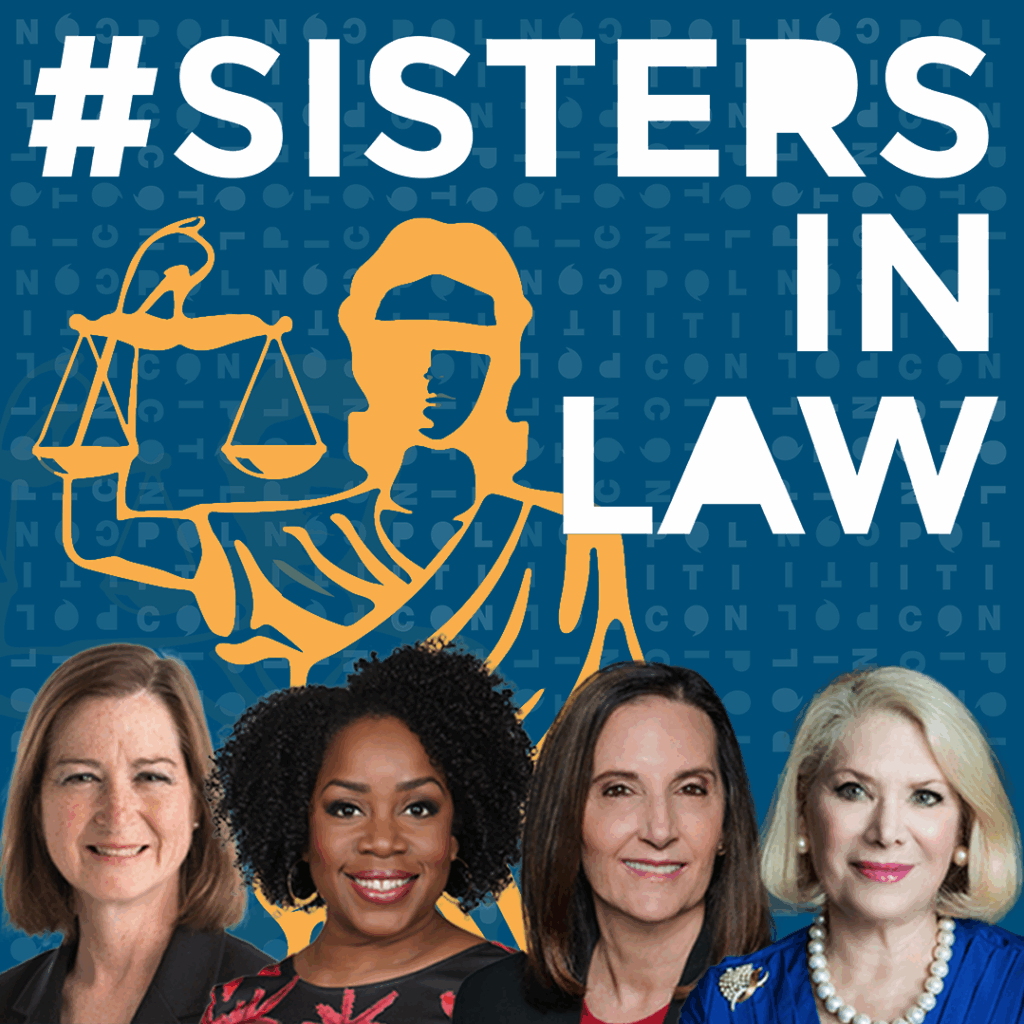
Kimberly Atkins Stohr hosts #SistersInLaw to mourn the killing of Renée Good by an ICE agent, weigh its legal implications, explain the jurisdictional challenges playing out between the state of Minnesota and the federal government, and share the ways they find hope amid tragedy. Then, the #Sisters discuss the legality of the Trump administration’s takeover of Venezuela and kidnapping of its President, looking at the future of their oil industry, charges against Maduro in NY, and what it all means for international law and foreign relations. They also review the legal arguments in the upcoming SCOTUS case centered on transgender athletes and the decision’s implications.
Start 2026 with style! Get the brand new ReSIStance T-Shirt, Mini Tote, and other #SistersInLaw gear at politicon.com/merch!
Additional #SistersInLaw Projects
Check out Jill’s Politicon YouTube Show: Just The Facts
Check out Kim’s Newsletter: The Gavel
Joyce’s new book, Giving Up Is Unforgivable, is now available, and for a limited time, you have the exclusive opportunity to order a signed copy here.
Pre-order Barb’s new book, The Fix. Her first book, Attack From Within, is now in paperback.
Add the #Sisters & your other favorite Politicon podcast hosts on Bluesky
Get your #SistersInLaw MERCH at politicon.com/merch
Email: SISTERSINLAW@POLITICON.COM or Thread to @sistersInLaw.podcast
Get text updates from #SistersInLaw and Politicon.
From the #Sisters
From Joyce’s Substack: Jack Smith’s Video Testimony & Transcript | Chief Justice Roberts’ Year-End Report
Support This Week’s Sponsors
Quince:
Upgrade your winter wardrobe and get free shipping on your order and 365-day returns when you go to quince.com/sisters. Now available in Canada!
Factor Meals:
Enjoy quick and delicious meals from FactorMeals.com/sil50off and use code sil50off to get 50% off your first box, plus free breakfast for 1 Year.
Osea Malibu:
Get 10% off your first order of clean beauty products from OSEA Malibu when you go to oseamalibu.com and use promo code: SISTERS10
Blueland:
For 15% off your order of green cleaning products, go to blueland.com/sisters
Helix:
Find your perfect mattress with Helix’s incredible Best of Web New Year Sale, exclusive to listeners of the show! Get 27% off sitewide at helixsleep.com/sisters!
Get More From The #SistersInLaw
Joyce Vance: Bluesky | Twitter | University of Alabama Law | Civil Discourse Substack | MSNBC | Author of “Giving Up Is Unforgiveable”
Jill Wine-Banks: Bluesky | Twitter | Facebook | Website | Author of The Watergate Girl: My Fight For Truth & Justice Against A Criminal President | Just The Facts YouTube
Kimberly Atkins Stohr: Bluesky | Twitter | Boston Globe | WBUR | The Gavel Newsletter | Justice By Design Podcast
Barb McQuade: barbaramcquade.com | Bluesky | Twitter | University of Michigan Law | Just Security | MSNBC | Attack From Within: How Disinformation Is Sabotaging America
Kim (00:00)
Welcome back to Hashtag Sisters-in-Law with Barb McQuaid, Jill Winebanks, Joyce Vance, and me, Kimberly Atkins-Stor. It’s cold out. And one thing that I’ve been wearing a lot is the Hashtag Sisters-in-Law hoodie. ⁓ featuring The Resistance. I highly recommend it if you’re looking for something to layer up with. And you can find it at politicon.com slash merch, politicon.com slash merch. And as always, the link is in our show notes too. ⁓ what a week this has been. And we’re gonna do our best to break it down. We’re gonna talk, of course, about the horrific killing of Renee Good in Minneapolis by an ICE agent, and what will and maybe won’t come next after that. We’ll also talk about the apparent US military takeover of Venezuela after the arrest of Nicolas Maduro. And we’re also going to preview next week’s Supreme Court arguments in the challenge to state laws that bar transgender athletes from sports. Man, that’s a lot. This week has been a lot and it was easy to feel hopeless this week, but
It’s during weeks like this that we most need to find hope more than ever. And so I was just wondering from you guys where you have been finding hope ⁓ this week and maybe it can help give our listeners some inspiration. How about you, Barb?
Barb (01:41)
You know, sometimes when the news gets overwhelming, and this week was really a lot, there’s a real heaviness to the news this week that was really bringing me down. But you know what I always find that brings me back? ⁓ There three things that are always good relief for me. Nature, exercise, but the other is just looking for human kindness. And you know, if you can give it all the better, ⁓ but sometimes just watching it. You know, my husband has been
volunteering at our church’s homeless shelter this week. Like what a beautiful act of kindness. I’m really proud of them and ⁓ it’s great. I’ve done it before. It’s wonderful to see the humanity of wonderful people who are enduring challenges in their lives. And so I think, you know, it’s like Mr. Rogers, said, look for the helpers, but just seeing individual kindness at a human level, I think can restore your hope for humanity.
Kim (02:37)
I think that’s great. Jill, how about you?
Jill (02:40)
Well, as Barb said, this is a tough week and it’s been a struggle. It’s always a struggle lately. But I do something that I recommend, which is I actively look for something positive in the news. And if you do that, you can find something to give you hope. It may be just a little thing, and it may be that my optimistic Pollyanna self says that these little things are foretelling bigger changes. But here’s an example.
Today, the Republican majority in the House has whittled away to almost nothing. It’s basically effectively won. That happened because Marjorie Taylor Greene resigned and there was an unexpected death of a California representative, Lamalpha, and the status of Massey as a Trump enemy makes him sort of not a reliable Republican. So that gives me hope and the election outcomes recently give me hope.
I’m looking for hope and I hope you all will too.
Kim (03:43)
That’s great, Jill. How about you, Joyce?
Joyce (03:46)
You know, like Barb, I’ve been looking for kindness around me and I had to fly the day after Renee Good was killed. And it was, I mean, that was a tough day. all felt that it hit incredibly close to home. And I was stunned. I almost began to wonder by the end of the day flying if people weren’t going just a little bit further to try to make the people around them ⁓ feel loved and considered.
So I I’ve screwed up one of my hands and I was trying to put my suitcases up on the conveyor belt in the airport to go through security. The TSA guy saw that I was struggling and he says, don’t do that, you I’ll come around and help you. And he like, when do they ever do that? Right? He walks around and helps me. A woman that I walked through security with was funny and helpful and we sort of shared a good laugh together.
And I noticed that the whole day. So maybe I just had an extraordinarily fortunate day, but the people around me really lifted my spirits and it made me think that I need to be more intentional about injecting those moments of kindness and thoughtfulness into the day, just for total strangers.
Kim (04:53)
love that so much. think it is the acts of kindness that get us through. I have to say, I’ve found a lot of hope from our listeners, people who listen to the podcast, whether it’s the comments that they make on social media or in emails that I’ve gotten asking questions that show that they are astute about the legal issues that a lot of the stuff we’re going to talk about today raises and that they’re aware and they’re looking to.
to try to figure out ways to bring about justice in different ways, or ⁓ when it comes to people wanting to volunteer to sign, make sure that people are registered to vote, to combat efforts to suppress voting around the midterm. I’ve just heard from a lot of people who listen to what we break down every week, and it just goes to show that there are people just beyond us four. Sometimes it sort of feels like us around the coffee table,
a threading at the end of a week, but that there are a lot of people who listen and who are really engaged and who really want to ⁓ do what’s right for our nation and our democracy. So I take a tremendous amount of hope from that. And I really, really appreciate all of you who listen with us every week.
Jill (06:15)
you
If you’re planning to kick off 2026 with a fashion refresh, Quince has you covered with luxe essentials that look polished and feel effortless. They’re perfect for layering, mixing, and building a wardrobe that lasts. Their versatile styles make it easy to reach for them day after day. No matter your style, Quince has all the staples covered from soft Mongolian cashmere sweaters that feel like designer pieces without the markup to 100 % silk
tops and skirts for easy dressing up and perfectly cut denim for everyday wear. Their wardrobe essentials are crafted to last.
Kim (06:59)
I started 2026 in a pair of Mongolian Kashmir ⁓ pants by Quince and
That was the best part of the year so far, I gotta tell you. It’s gone downhill from there. You know, I really am in love with Quince’s Italian wool coats too. I have a gray wool coat by Quince and I get compliments on it all the time. They stand out thanks to their beautiful tailoring, which is soft to the touch and built to carry you through years of wear. The quality shows in every detail from the stitching to the fit and the fabrics. And every piece,
is thoughtfully designed to be your new wardrobe essential. Plus, everything from Quince is made with premium materials in ethical, trusted factories and priced far below what other luxury brands charge.
Joyce (07:51)
When you choose quints, you’re getting a wardrobe upgrade that feels smart, stylish, and effortless at prices you’ll love. The cashmere is so cozy in the cold and look, I’m a knitter. I’m pretty discerning about cashmere and about yarn that’s used in sweaters. And I love this stuff. It feels fabulous. Once you get inside, everyone needs Quints’ washable stretch silk blouse. Perfect for indoor wear in winter. The material feels amazing and the style is perfect for seeing friends.
lounging at home or taking care of business. There’s nothing better for looking your best. And if fitness is one of your 2026 resolutions, I have to tell you, I’ve started lifting weights again. The best workout motivation has been new active wear from Quince.
Barb (08:37)
I’ve lifted weights with Joy’s fans. She doesn’t mess around. You know, this year at holiday time, I got Quince sweaters for all of my boys, my adult young sons, and they love them. They’ve got a crew neck, a V-neck, a quarter zip. They’re fantastic. And so they’re all looking smart in their Quince sweaters. You too, dear listener, can refresh your wardrobe with Quince. Don’t wait. Go to quince.com slash sisters.
Kim (08:40)
You
Barb (09:06)
for free shipping on your order and a 365 day return. And we have some good news. Quince is now available in Canada too. That’s quince.com slash sisters to get free shipping and 365 day returns. Again, quince.com slash sisters. The link is in our show notes.
Jill (09:33)
you
The facts of the killing by an ICE agent in Minnesota have not been determined conclusively. But I think Governor Walz was on target, quoting George Orwell’s 1984 about denying reality. That quote is, the party told you to reject the evidence of your eyes and ears. It was their final, most essential command. You’ve seen the videos and slow motion analysis.
So you can decide if you were a juror whether you would vote that Ice Agent Ross was in reasonable fear and that the 37-year-old mother of three, an American citizen, Renee Nicole Good, was a domestic terrorist, as the Republicans are alleging, or whether she was murdered during her best to obey Ice Agent’s orders. While we wait for a conclusive determination, and there has been a new video released that ⁓
The White House shows for sure that she was trying to kill someone. ⁓ I haven’t seen the video. I have read what the video supposedly says. It does not answer my questions. whatever the final factual determination is, there are some very important legal questions we can talk about today. And it’s important to do that because this isn’t the first killing. And sadly, I don’t think it’s going to be the last. In fact,
On Thursday, the day after Renee Good was killed, ICE agents shot two people in Portland. ⁓ And so I think we need to talk about some of these tough legal questions. Let’s start, with who has jurisdiction to investigate the facts and determine whether to bring charges for homicide or any other crime, including civil rights violations, or whether to drop the case as being legitimate self-defense.
as federal officials are saying. Is there any legal grounds for self-defense or for this shooting being within DHS policy?
Joyce (11:43)
Well, let me start with the jurisdiction question that you asked first, because I think that that’s a very interesting question. And we’ve seen this before, right? I think by now folks understand that there’s actually dual jurisdiction with the feds and the state in cases where police officers use excessive force. The twist here is that this was a federal agent who would be the defendant if there was a criminal prosecution, not a state officer.
as we saw, for instance, in the murder of George Floyd and in other cases. But there’s a state statute, presumably a murder statute. There may be laws that could potentially apply to other agents who were there. For instance, there’s a report that they would not permit a physician to treat her after she was shot, and that could potentially give rise to other charges. So those would be brought by the state.
The federal government also would have jurisdiction under a number of statutes if they could establish a civil rights violation, which I think frankly would be difficult here. They could prosecute a civil rights crime. But there’s also a statute, 18 U.S. Code 242, which criminalizes a person who’s acting under color of law. That means a police officer, an agent who’s doing their job, who willfully deprives someone of their constitutional rights. And here, of course, that would be the right to life.
So it’s possible that either system or both could prosecute. Now, historically, in cases that involve state agents, unless the state asks the feds to go first, usually the state is permitted to do the first prosecution. And then if there are interests that haven’t been fully vindicated, for instance, ⁓ in a civil rights case, the federal government might prosecute as well. The double convictions provide additional certainty
that there will be accountability in case there’s a technical legal error that leads to reversal on appeal. So not infrequently in these cases, you see both prosecutions happen. But Jill, to the point of the second part of your question about self-defense, what you don’t see is somebody jumping out before there’s been an investigation. You don’t see somebody within an hour of shooting asserting that it was self-defense. It takes time.
to develop the facts in these cases. I’ve done a large number of these. I’ve reviewed a number of shoots to determine whether they had prosecutive merit. And something that you learn is that you have to painstakingly gather all of the available video and photographic footage. You want to see as many different angles as possible. You also want different perspectives. Sometimes being further away allows you to see things that being closer in doesn’t.
Sometimes those closer in shots are very important. It takes time. Often video has to be enhanced and carefully reviewed to make a determination about what happened along with ballistic evidence. Here it sounded to me in the videotape like there were three shots. I’ve heard other people say one or two. I think that there were three. I would want to take a look at the ballistics and see if all of the shots had the same entry point into the vehicle. And of course there’s eyewitness testimony.
You can’t make a determination about self-defense until the investigative groundwork is laid. It’s irresponsible to suggest otherwise.
Jill (15:09)
Not only you’re responsible, it can damage the case by prejudicing a potential jury. But there also are DHS guidelines that are clear about how you deal with someone in a vehicle. Officers are barred from firing warning shots at someone in a car, even if it is to just disable the vehicle. And officers are largely prohibited from discharging firearms at the operator of a moving vehicle for obvious reasons, because it endangers
everyone around the car will lose control, other things like that. ⁓ So there are some real policy problems in saying that this was within policy and that it was self-defense. So Barb Joyce has sort of referred to that normally the FBI and the state and local law enforcement work together, as they did in the George Floyd murder, which happened very near where this killing happened. But here the FBI is taking total control.
They originally were working with the Minnesota ⁓ proper officials and now they’ve ousted them. Governor Walz denounced the FBI’s decision to exclude the state. why, Barb, sorry, why did the FBI, I got you. I’m confusing the two of you heard you. Sorry. either one of you can answer because you’re all the same. Go ahead. Sorry, Barb. Anyway.
Barb (16:32)
That’s pretty reasonable.
Jill (16:37)
Why did the DOJ and FBI do this? And what are the consequences for a state prosecution if there aren’t state murder charges, but the state has denied access to the evidence? Is a prosecution possible?
Barb (16:52)
Yeah, this is really ⁓ unusual and disturbing. In most law enforcement operations, the local police department has primary jurisdiction. They are the first responders. They are the chief law enforcement ⁓ agency on the ground. And they’re supposed to work collaboratively. mean, this is a crime scene ⁓ based on
Comma T, not comity, there’s nothing funny about this, but comity with a T, the allocation of power between state and federal government. ⁓ Typically, the state is given a preferential treatment to go first. Most often what happens is a parallel investigation where all the law enforcement agencies understand we’re working together. I think about when I was looking at cases like this, I would reach out to the county prosecutor or they would reach out to me and we would talk about
you know, what potential charges do you see here? What potential charges do you have? ⁓ You know, why don’t we work together and see what we can come up with? And, you the practice in our district was typically to defer to the state to see if they wanted to go first. ⁓ If they declined for some reason, we might go in. ⁓ But we were gathering evidence together at the same time because, of course, evidence can go stale if you don’t get it in the first instance. And because state and federal prosecutions
are working on different statutes that have different elements, it’s important that the investigators both have access to the physical evidence and to the witnesses because you might need to ask slightly different questions to establish violation of your laws. So the idea that the state is being squeezed out here is highly irregular. I hope that ⁓ state investigators will try to assert themselves here.
⁓ and make some hay about this because this is highly irregular. And then, you know, what’s going to happen if the federal authorities say, yeah, we looked at it and there’s nothing here. We don’t see anything. I think there’s going to be a lot of public distrust about that. ⁓ But, you know, the state does have an uphill battle when it’s a federal agent. As Joyce mentioned, federal agents do have a certain kind of immunity from state prosecution. It is not
absolute as JD Vance has said, it is a qualified immunity and courts will first look at a case to see if the federal official was doing something ⁓ that he’s authorized to do under federal law and I suppose, know, if they’re involved in an enforcement action on the streets, I suppose there may be authority for that. But the other thing they have to look at, this is a very factual determination, is whether the particular official’s actions were necessary and proper
in fulfilling their federal duties. And that’s a very fact-based question, right? mean, ⁓ if you have to shoot because your life is in danger, that’s one thing. If you gratuitously shoot at somebody because you feel like it or you’re going to teach somebody a lesson, that’s another matter. So I think that ⁓ there are some significant questions here about whether this was a valid use of force by this officer. And I think that the state courts are in a, or least state prosecutors ⁓ have
a stake in deciding whether that’s the case.
Jill (20:13)
Yeah, it is unusual and suspicious, I would say. I mean, they can’t even get access to the car and to the ballistics of the bullets and the point of entry. So I think it is suspicious. But Kim, is a prosecution possible at the state or even if we got over this problem of gathering the evidence?
Will the case be removed to federal court and then dismissed by Trump’s DOJ?
Kim (20:44)
So I will start with the second part of that question ⁓ first. There is a possibility, given that this, as you guys mentioned, involves a federal agent, ⁓ that the ⁓ DOJ may seek to have the case removed to federal court. What that means is it would change the venue from state court, where a trial will happen, like in the Derek Chauvin case, which we saw in the George Floyd case, that was done in state court. They would instead ⁓
do it in a federal court. Even if that happens, it would still be tried under state law, if it’s a state prosecution, and tried by state prosecutors based on state law. It would not be tried by the DOJ in that case. So they couldn’t seek to dismiss it. The only difference would be it would take place in a federal court before a federal judge. the rationale behind doing that is that sometimes ⁓ it is the idea that
a federal official will get a fairer shot before a federal judge, as opposed to being tried in a state where ⁓ emotions may be running high and the people on the state court may be elected or you never know, they may have ⁓ some sort of bias toward this case against a federal agent. They want to ensure the fairest prosecution possible. And I wouldn’t see any problem if there was a state prosecution that’s moved to federal court. think that federal judges, by and large, make
good decisions ⁓ and still it would still be a state prosecution. But let me back up for a minute about the investigation and whether we even get to a state prosecution, which I’m infuriated by even the idea that the federal government is blocking state officials from trying to prosecute this. ⁓ It isn’t just not allowing them to get to evidence. We have seen people at the top of the DOJ, at the top of the executive branch, we’ve seen the
President state publicly facts that are clearly false Based on what we have seen on video evidence. You’re right Jill. This is not that this we don’t have all the Evidence we don’t have all the facts as to what happened, but we do know this was not a case of a Someone
a federal official trying to dig out their car from the snow and somebody intentionally plowed into them, like Secretary Kristi Noem said, this was not a case of some sort of coordinated and trained use in the weaponization of automobiles, as Noem said. This was not somebody who was savishly and viciously and intentionally run down, as the president said. It did not leave the officer.
send the officer into the hospital with serious injuries like the president. You have these people that are publicly stating falsehoods about this at the same time federal officials are blocking state officials from access. I can’t emphasize enough how dangerous and outrageous that is. And that says to me that any federal investigation now cannot be trusted. And so you have local and state officials are the only games in town.
I personally was really disappointed in Governor Walz for backing up the assertion that was made by the head of the Bureau of Criminal Apprehension in Minnesota that, well, if they’re not going to show us the stuff, there’s nothing we could do. But I can’t say what I want to say, because Barb is here. But you’ve got to be kidding me. And one thing that I, the first thing I thought of is I wanted to know what the attorney general, Keith Ellison, had to say about it. And it was very different. And I’m glad about that. He said that they are
⁓ He said, quote, every moment in these cases is precious. If you have any information bearing on the outcome of this matter, please share it. There has set up a portal for people to submit photos, videos, evidence, testimony, if they were there, for what they saw, because they are investigating to the best that they can. It does not matter what the feds are doing. They are doing it. I was very disappointed in the ⁓ head of the BCA, but apparently the BCA is now cooperating with the attorney general’s office.
in helping people to gather evidence so that they can do whatever investigation they can. We saw the videos. There is evidence to be had, and the people need to see an investigation taking place that they can trust. Whether or not it leads to a trial or not, they can make their own determinations if it does not lead to a prosecution, and if the feds block that. But the state cannot just throw up its hands and walk away. That would be outrageous.
Jill (25:26)
Right. And Joyce, to further talk about what Kim is saying, it’s horrible that we have to even talk about this, but can we trust the DOJ and the FBI to pursue this after President Trump and Vice President Vance and Secretary Noem and others have announced their conclusion, without all the evidence in, that Agent Ross acted in self-defense and in compliance with the
policies of the Bureau of Homeland Security, Department of Homeland Security, which seems to me clearly not the case. ⁓ Or is Governor Walz correct? Although Kim is right about one thing he said, he did say that any probe that doesn’t include state law enforcement can’t be trusted. What do you think?
Joyce (26:14)
So I think I would answer it like this. This to me goes to the real core problem of what this administration has done. They have damaged public confidence in our institutions to such a great extent that now in a really important criminal case, a case that very much has overtones of Kent State, which really rocked the nation, there is no investigative authority that everyone in the public.
will have confidence in in this situation. You know, I know and have worked with a lot of the guys at the FBI who will probably be called upon to be involved in this. They’re great agents. They’re hardworking agents. All they care about is the facts. And that’s what they chase when they’re looking at a situation like this. But we’ve seen far too many instances where this administration has tried to put its thumb on the scales of justice as they did early on. You know, literally within
hours, if not minutes, of this shooting taking place for us to have blind confidence in the federal government. You know, it used to be when there was a situation like this where a community was in upheaval, that the Justice Department would bring in its community relations service. They were called the peacekeepers. They went into communities and provided accurate information and helped communities understand what was going on. But Donald Trump cut that office out of the Justice Department’s budget.
fired all of the people who’d been doing that work for decades. They don’t exist anymore. The Justice Department really has no way to go into this community and restore confidence. And so I think we’re in a tough position. Maybe the best case right now is trust but verify. I’m certainly not willing to engage in blind trust, even though I believe that the agents will do their jobs. I have concerns about their higher ups.
It would be wise in a situation like this ⁓ for the federal government to walk it back, to agree that there would be a joint investigation, because let me tell you, no good deed goes unpunished if you run two separate criminal investigations. It’ll make any possibility of prosecution that much more difficult. And quite frankly, that’s probably one of this administration’s goals in interfering with the investigation. It’s tough to read it in any other way.
The Justice Department knows how to do this in a case where there’s dual jurisdiction. We work seamlessly with state and local partners in these kind of cases every day all across the country. So there’s literally no excuse for conducting it in this fashion.
Jill (28:54)
Yeah, that is so true. we’ve heard reference already today ⁓ to possible immunity for the federal agents. So, Barb, let’s dig a little deeper into that. Do federal agents have immunity from criminal prosecution so that even if it isn’t remotely self-defense, but is deemed murder or reckless endangerment, can there be a prosecution? I mean, Derek Chauvin, ⁓
who killed George Floyd was convicted of second degree murder, unintentional murder, third degree murder, and second degree manslaughter and pleaded guilty to federal civil rights charges in addition to those state charges and was sentenced to over 20 years for the state crimes and is now in jail. So what happens with a federal agent?
Barb (29:45)
Yeah, you know, as we said, JD Vance has been out there publicly stating that federal agents have absolute immunity from state court prosecution. And that’s not right. ⁓ They have a qualified immunity. And the idea is ⁓ law enforcement officers have jobs that are easy to second guess, but we want to empower them to do their jobs, which sometimes require there’s a jury instruction that talks about the need to make snap judgments
⁓ matters of life and death in quickly evolving situations. And so there is a recognition of that in the law. But the immunity is something that is a common law immunity. And it’s based on the fact that we have a supremacy clause and that we don’t want states going around prosecuting federal agents and federal officers just over policy disagreements. That there is a legitimate role for federal agents
to exercise in court. you know, this is something that I think
Joyce (30:49)
both.
Barb (30:50)
People ⁓ who are on the progressive side of politics want and people on the more ⁓ conservative side of politics want, right? I mean, in the deep south at one time, we had federal agents who were acting to protect people ⁓ who were ⁓ being lynched or harassed for voting or harmed for voting. And so ⁓ there is some immunity recognized for federal agents.
But as I said, it’s only qualified. The Supreme Court has articulated a two-part test that it applies when it is deciding whether a person is immune from federal prosecute or from state prosecution. One is you have to show that the federal official was doing something authorized by federal law. So if, for example, he is just ⁓ recklessly driving, that would not count, right? It has to be, I’m on the job and I’m doing my job.
And the other has to be, and this is this fact-based inquiry, that the officials’ actions were necessary and proper in fulfilling those federal duties. if they are outside the scope of their federal duties, killing somebody in an unreasonable manner, that is going to be outside of that scope. And so that’s why I think in this case, there will have to be a factual determination made. But also, Jill is so, I think, often
⁓ disconcerting to the public is so often we’ve seen these videos where people say, my gosh, the officer didn’t have to shoot that person. I can’t believe they shot them. They panicked. They exercised poor judgment. They made snap decisions. They made racist decisions. Typically, those things alone are not enough. You have to show that the person didn’t just ⁓ make a bad decision, didn’t even just ⁓
forget their training that they deliberately engaged in, you know, essentially an assassination. So we may have that here. I think that we’re going to, as Joy said earlier, we got to look at all the video. You got to talk to all the eyewitnesses. You have to look at the ballistics about what happened here to make a decision. But it is what makes it so very difficult to obtain convictions against officers who are acting in ways that people would consider unreasonable, but because it’s criminal.
It’s just not that they acted unreasonably, but that they acted criminally, that this was a murder.
Jill (33:20)
So we’re talking about criminal prosecution. Kim, you’re our civil litigation expert. And so I want to ask you about what kind of civil liability might there be for Agent Ross or for ICE or someone else in the federal government? One of our listeners, Robert in Canada, asked about that. And I want to ask you to talk about that.
Kim (33:42)
Yeah, that’s a great question, Robert. And sadly, the answer is it’s possible, but it would be quite an uphill battle. So generally, and we’ve talked about this before, under 42 USC, section 1983, people who have their constitutional rights violated by official who is acting under color of law can sue. But
that statute expressly excludes federal officials. So that only applies to local police, maybe state police, things like that. It doesn’t apply to federal officials. The Supreme Court has ruled that the remedy when it comes to a federal official is done under a doctrine known as Bivens. Now we’ve talked about Bivens in cases where there has been, for example, an illegal search. Say someone shows up at the wrong house.
when they’re executing a search warrant, recklessly goes into the wrong house, ⁓ damages property or harms someone, they can be sued in a Bivens action. But the Supreme Court has really reigned in the circumstances outside of the Fourth Amendment, a Fourth Amendment search and seizure situations in which Bivens actions can take place. The reasoning is that 1983, there’s nothing in the text of it or the history that shows that Congress had that expansive view.
of the use of 1983 or anything like that. So there has been a push over the years by Congress to pass a law that would apply in cases like this. I believe the most recent bill that was filed was in December, just a couple of weeks before this event happened, but it has not been able to cross the finish line. It’s been a lot of opposition from the
law enforcement lobby against that. But yeah, it’s very unlikely, unfortunately, ⁓ for this family. This incident has left ⁓ a widow. ⁓ It has left ⁓ children who don’t have a mother. It’s really devastating. ⁓ know, she had, ⁓ Goodhead just dropped her kid off at school. You know, you could see I was heartbroken by the fact that.
You could see her stuffed animals and schoolwork in the car. And there’s going to be very little ⁓ remedy, if any, for those left behind.
Barb (36:26)
It’s a new year and we all have big goals, but it can be hard to find time to cook and still eat well. Luckily, Factor makes it easy with fully prepared meals designed by dieticians and crafted by chefs so you can eat well without the shopping or the cooking. This was designed for me. Each meal is filled with quality functional ingredients, including lean proteins, colorful veggies, whole food ingredients, and healthy fats.
And there are no refined sugars, artificial sweeteners, or refined seed oils. So you know you’re getting the good stuff. Plus, each and every factor meal is made to fit your goals and schedule and delivers healthier eating, calorie management, and more protein.
Jill (37:11)
Wow, you’ve made a good choice for this. And it’s only is that. Yeah, no, it’s true though because they taste really good and the variety and convenience is just amazing. They have 100 rotating weekly meals, so you’ll never get bored. They have so many options, including high protein, calorie smart, Mediterranean diet, GLP-1 support.
Barb (37:12)
Vincent K.
Jill (37:36)
ready-to-eat salads, and a new Muscle Pro collection that supports strength and recovery. So if one of your New Year’s resolutions was to watch your diet, this is part of the answer. Everything is ready in about two minutes. Yep, just two minutes, and it’s always fresh and never frozen. There’s no prep and no stress. You and your family will have more time to spend together and get things done because you aren’t going to be spending it on preparing and cooking meals.
Kim (38:06)
And do you like snacks? I love snacks and they have snacks. They have very easy snacks and smoothies and other things that are more go-to whenever your hunger strikes. In fact, I’m planning on enjoying garlic herb chicken with vegetable risotto and green beans after the show. And I don’t have to cook it, because guess what? It’s all ready to go. But if the winter is starting to get to you, nothing is better than factors white.
bean chicken chili on a cold day. And we’ve had a lot of those this winter. No matter what you choose, you’ll be amazed by how much time and money you save.
Joyce (38:44)
Did you say snacks, Snacks, man, it’s all about the snacks. Head to factormeals.com slash SIL 50 off and use code SIL 50 off to get 50 % off your first FactorBox plus free breakfast for one year. Offer only valid for new Factor customers with the code and a qualifying auto renewing subscription purchase. Make healthier eating easy with Factor and look for the link in our show notes.
Kim (38:45)
I love snacks.
Whether you’re freezing out in the wind or baking under the heater, winter can be really rough on our skin. Add in the start of the year stress. And it’s easy to wish that I could relax on a nice warm tropical beach, but maybe not in the Caribbean. Anyway, but even if I’m not there, I have the next best thing. I have Osea Malibu. It makes me feel like I’m…
They’re on the beach every time I use it as part of my regimen. And right now I’m in love with their dream collection. It’s an amazing combo for unwinding for the day ahead. You need to try it.
Jill (40:00)
And you know what, Kim? I have, I just got it. It’s fabulous. Osea’s Dream Night Serum and Dream Night Cream are clinically tested formulas that are powered by bioretinal and designed to reduce the visible effects of stress on skin while you sleep. I like putting on the Dream Bioretinal Body Serum first. It’s a brand new full body restorative treatment that visibly de-stresses the skin.
Kim (40:03)
And in a good
Jill (40:27)
with a holistic blend of bioretinol, red seaweed, magnesium, and lavender. After savoring the scent, I follow it up with night cream. Both products are so nurturing, and now I wake up with firmer, more moisturized skin that glows whenever I apply it. It’s not only visibly firming my skin, it improves skin elasticity. It also smooths lines and wrinkles with less potential for irritation than the traditional retinol of other brands.
I just have to make sure I hide it from my husband. Actually, I’m not hiding it. He’s really liking it and he’s never even tried any other product I’ve ever had. But there was something about the fragrance he liked and he tried it and now we’re sharing it.
Joyce (41:12)
That’s impressive. You’re very generous. I am not sharing with Bob, but let me tell you what I’m using every night before bedtime. I use the Dream Collection. It makes it really easy to give your skin a rest and say good night to dryness, dullness, wrinkles, and lack of firmness. It’s the perfect relaxing ritual and it works overnight. By the time you wake up, your skin is softer, smoother, and more radiant, and it really takes very little time before you go to bed, which I appreciate.
Both of the products that work together are essential. It’s so efficient and it leads to a real transformation in your body and in your wellbeing.
Barb (41:52)
There really is nothing better for promoting a restful night while visibly firming and improving skin elasticity. We also love that everything is vegan, cruelty-free, and comes in sustainable packaging. So don’t wait. Give your skin a rest with clean, clinically tested skincare from Osea. And right now we have a special discount just for our listeners. Get 10 % off your first order site-wide with code SISTERS10 at oseamalibu.com. That’s O-S-E-A.
Malibu.com code Sisters10. The link is in our show notes.
Well, by now everyone knows about the shocking military operation that occurred in Venezuela on Saturday, in which the United States arrested that nation’s president, Nicolas Maduro. We had previously discussed the boat strikes. We thought those were a big deal. Those killed more than 100 people, alleged drug smugglers, but without any apparent legal authority. Now we’ve got this operation going into Venezuela to arrest the president. And I want to focus just on the legal aspects.
of this case or whatever it is we’re calling it. ⁓ First, Secretary of Marco Rubio said that this was a law enforcement operation and that the military was there only in aid of that operation. Now, reports indicate that anywhere from 75 to 100 people were killed in this law enforcement operation. Jill, you’re our former general counsel of the Army. Make it make sense.
From a military perspective, is it lawful for the United States to go into a sovereign nation with guns blazing to arrest a defendant who has been charged with a crime?
Jill (43:46)
such a great question and so impossible to make it make sense, whether as a citizen or a lawyer or former general counsel of the army. But before I even answer the question, I want to point out that Rubio’s claim that this was a law enforcement action was contradicted by Trump and others almost immediately saying that we’re now running Venezuela, that we would control its oil, that they’re going to give us billions of dollars worth of oil and
that the vice president, now the president, is doing whatever we tell her to do. That does not sound like a law enforcement action. But to your question, ⁓ let’s get to that because it’s important and the answer is clear. It is not lawful for the U.S. to go into a sovereign nation, bomb it. And by the way, we were concerned about the nearly 100 people killed in the boats for supposedly carrying drugs. The same number of people were killed in one action and many of them were
innocent civilians who had nothing to do with anything even remotely colorably illegal. They just happened to be in the wrong place at the wrong time. But no, you can’t go into a sovereign nation, bomb it, arrest a person, whether it’s the president of that nation or any other citizen, to remove them to stand trial in the US. Here’s why. It violates the UN Charter to attack unprovoked and Congress ratified in 1945.
The Constitution says treaties are supreme law of the land and only Congress can declare war. The US claims we are in an armed conflict because Venezuela is sending drugs into our country and that’s causing overdoses. But that isn’t the same thing as any justification for this action. ⁓ So no, it’s not legal, period.
Barb (45:37)
Yeah, pretty disturbing. Kim, here’s another piece of this whole saga that is ⁓ very difficult to put your head around. The Trump administration has said that one of the reasons we went into Venezuela is because they stole our oil. What do they mean by that? How is it that our oil is in the ground in Venezuela?
Kim (45:57)
Again, this is not a part of the charges against Maduro. has nothing to do with that, but again, this one of those instances. So Venezuela, as we know, has some of the richest oil resources ⁓ in the world. And for a time, a lot of big companies, including Exxon Mobil, were ⁓ there pumping oil under their agreements with the country.
point in a couple decades ago, Venezuela nationalized its oil production, which essentially meant, we control all of the oil production and we control who can stay there and do it. And they kicked out two ⁓ American oil companies from being able to do that. ⁓
didn’t, you know, they kept all of their equipment, all of their infrastructure and all of that. So these oil companies were just like, wait a minute, we had invested in this and we had ⁓ oil. An international court ruled that Venezuela had to pay these companies back for what ⁓ they kept from their extraction of the oil and Venezuela never did. So on this basis, Donald Trump is saying, well, it’s our oil. First of all, was never their oil. It was companies that
We had an agreement at some point to extract this oil from Venezuela. It’s Venezuelan oil, but ⁓ using this as a justification, well, we have to keep this oil and now the oil companies need to go in and essentially grift this oil now. ⁓ I can’t even wrap my head around how the legalities of this just because it’s so bonkers.
Barb (47:39)
Yeah, you know, I get it that there’s a civil award, right? That a ⁓ court has ordered Venezuela to pay back these oil companies for their money. the idea that we’re just going to repel in and go get it and go extract it from the earth.
Kim (47:52)
Payment!
And to be fair, to be fair, some of these oil, it’s not as if the oil companies are lining up and rubbing their hands together to go in there and get it. They’re like, wait a minute, wait a minute, we did this before and we got jacked. Like, I don’t know what you want us to go in and spend all of this money setting up more infrastructure. What’s going to happen? We’re just going to get kicked out again and we’re going to get, you know, get our stuff. So in the oil companies, I want to praise oil companies, but at least they are showing some common sense here.
Jill (48:24)
⁓ Plus, I have to say, having talked to a number of oil executives, that the oil companies at this point say it’s not even profitable. The billions we’d have to invest will not get paid back at the current price of oil. We don’t want to go back, aside from the fact that it’s not a stable environment, to put it mildly. Even if we could count on it being stable, it’s economically stupid. So this is a ridiculous claim.
Joyce (48:54)
I really like economically stupid. I’m gonna start using that phrase.
Kim (48:59)
be our next t-shirt.
Barb (49:02)
Oh man. Well, Joyce, I have heard some people compare Maduro’s arrest to that of Manuel Noriega, who was arrested in Panama in 1989 and convicted at trial of drug trafficking. By the way, I happened to be in Miami in, I don’t know, 1991 or thereabouts, and I actually went to the courthouse and watched some of this trial. wow. I’m a big court watcher. I love to watch court wherever I am.
And it was fascinating. remember watching a day of court proceedings. nonetheless, what do you make of that comparison? Does that mean, ⁓ I forgot about Noriega. Yeah, we’re good.
Joyce (49:42)
No, I think it’s a really interesting comparison. know, this happened in my circuit, the 11th Circuit. The case was prosecuted in federal district court in Miami. Noriega gets convicted on major drug trafficking charges. He gets a 40-year sentence. That ultimately gets reduced on appeal. But the situations aren’t the same. The Panamanian Assembly had already said that we were at war. An American Marine had been shot and killed.
And so the context in which we went in and got Noriega, who if memory serves, was holed up in the Vatican’s embassy and they had to lure him out by blasting him with offensively loud music. ⁓ I mean, it was a little bit of a show. It wasn’t a surgical military strike, but the situation is somewhat different given that predication. And at the same time, it was widely condemned. There was the belief at the time that the United
or rather that the United States had violated international law. You know, there’s an interesting twist when you’re prosecuted in US courts and that case firmly established that you can’t challenge your prosecution even if your arrest violated international law. So Noriega tried that and failed. But where he did ultimately succeed was he asked the court for prisoner of war status. He wanted to be treated as a POW. And the court ultimately afforded him that
privilege for what it was worth, ⁓ well, after he was already in custody, it’ll be interesting to see how that plays out here, quite frankly.
Barb (51:20)
Yeah, know, sisters, for a future chit chat, I would love to hear your choices for what music it would be that would be played that was so bad it would drive you out and into the arms of awaiting law enforcement officers waiting to arrest you.
Joyce (51:36)
We a We need to do that down the road.
Jill (51:38)
I have to tell you that they were playing heavy metal and I believe Bolero by Ravel, which is one of those repetitive, repetitive things. And the general in charge was one of my best friends when I was in the Pentagon, Max Thurman. And ⁓ Noriega was someone that I had to deal with because when I was general counsel, I was also the general counsel of the Panama Canal Corporation. And that’s another distinguishing feature here where we had
thousands of troops already in Panama because we controlled the canal at the time. So it’s a completely different situation than the Maduro ⁓ repelling in and arrest. Totally different.
Barb (52:20)
How much do I love Jill Winebanks that she knows the music that was played because she was on the
Joyce (52:24)
So great. I love it.
Jill (52:26)
No, he was actually arrested after I was long gone. He was in the 90s. I left in 80s. I didn’t, but I just…
Barb (52:32)
I love
the music though, I love it. love it. Well, ⁓ now, of course, Maduro faces charges in ⁓ the Southern District of New York on a criminal indictment. Jill, what do we know about these charges against Maduro and his wife, by the way? Do you see this as a legitimate indictment or is it more akin to the kind of indictments we saw against Letitia James and James Comey?
Jill (52:58)
You know, that depends on the facts, obviously. And this is a superseding indictment. The original indictment was in 2020 and did not include his wife. There are other co-conspirators included. You know, based on reading the indictment, it looks a lot more legitimate than others. And we do have a history of drug charges against leaders of other countries. The president of Honduras, for one. The president of ⁓
Panama for another, and they were legitimately tried and convicted. So there’s no reason to suspect that this is one of those like, he’s an enemy, we’re going to go after him, even though it’s obvious that Trump didn’t like Maduro and was going after him. It doesn’t mean he didn’t have legitimate basis for these charges. And as Joyce has mentioned, even though the arrest is suspicious, if not totally illegal, ⁓ it doesn’t
eliminate the charges.
Barb (53:59)
Yeah, and in fact, you know, ⁓ there was a general from Venezuela. ⁓ He was the head of the military intelligence agency who entered a guilty plea to very similar charges this summer, which makes me think they may have a very valuable cooperator prepared to testify. So it may very well be a strong case. We don’t know. As you say, the facts will matter. Kim, here’s a great question that I think our listeners might be interested in knowing.
Why on earth is this case being tried in the Southern District of New York? Right? Like you think maybe Southern Florida, maybe Washington, D.C., the nation’s capital. Why Southern District of New York?
Kim (54:39)
Well, I suspect ⁓ it’s in part because according to the indictment itself, some of the drug trafficking that is being linked to Maduro happened in the state of New York, happened in Manhattan, and therefore that they have jurisdiction to bring this case here. It was also alleged that some happened in Miami too.
They could have brought it there, but the prosecutors, the career prosecutors, assuming that there are still career prosecutors in the Southern District of New York, they have a lot of experience with drug trafficking cases, with RICO cases. ⁓ They’ve prosecuted mobsters and they have long experience with these kinds of cases. Not to say that they don’t in Miami too, I would suspect, but my guess is that they wanted to prosecute it in the place.
not only where they have jurisdiction, also where there’s the expertise on the part of the prosecutors to bring this case and make it stick.
Barb (55:33)
Yeah. I also noticed that it was, ⁓ there’s this rule that says a person, venue is proper in the first place, a foreign person is brought. So they kind of were able to engineer venue by bringing him to Brooklyn.
Kim (55:49)
⁓ that’s interesting. ⁓
Joyce (55:51)
In fact, Barb, both LaGuardia and JFK are in the Eastern District of New York, which is why they bypassed them and flew into a small airport that’s south of York.
Kim (56:02)
That’s in
Jill (56:07)
But they also are skipping the fact that he actually was landed in Guantanamo base. And they certainly don’t want any trial there. they’re ignoring that as the first place he landed.
Joyce (56:20)
That’s
not mainland US though. Does it qualify Jill because of Guantanamo’s status? I mean, that could be an interesting argument they could make.
Jill (56:28)
I think it’s certainly one the defense is going to raise.
Joyce (56:33)
I heard it here first.
Barb (56:35)
Well, here’s an argument, Joyce, ⁓ and we’ve hinted at this and some people have talked about this. Will Maduro have a valid legal argument to dismiss his case on the grounds that he was arrested illegally?
Joyce (56:49)
Right, and we sort of wade partway into this. There’s a well-established legal doctrine called the Kerr-Frisbee doctrine. And it says very definitively that you cannot use this sort of an illegal arrest to avoid prosecution. You know, the argument that defendants try to make is that the arrest violated their Fourth Amendment rights, and the courts have just ⁓ universally rejected that position.
Barb (57:14)
Yeah, I always find this a little, I teach this in my national security class and I always find this a little odd because of course we have the fruit of the poisonous tree doctrine when it comes to fourth amendment search and seizure. That is, know, if I obtained evidence in violation of fourth amendment rights against unreasonable searches, that evidence is to be suppressed as is any other evidence that derived from that evidence, you know, a further link in the chain. And yet when it comes to
the body, we do not suppress the body. So it essentially blesses the government, the military law enforcement to go kidnap people in other countries. And as long as you’re here, we’re going to try the case. Now they may have other remedies like civil damages or something like that, but this Kerr-Frisbee doctrine, K-E-Z,
Jill (58:02)
That’s
frisbee, not brisbee.
Barb (58:04)
Frisbee like the Wham-O toy, Frisbee. So I think that’s a super interesting doctrine. Well, Jill, what about ⁓ Donald Trump’s favorite defense immunity, right? ⁓ He’s immune from criminal prosecution. Does Maduro as the president of Venezuela have sovereign immunity to prevent him from criminal prosecution in another country? And if not, what would prevent Donald Trump from being charged by a foreign country and abducted and put on trial there?
Jill (58:34)
That’s a great question and it’s one that a listener named Teresa also asked. So she’s going to be happy that you asked it too. ⁓ The answer of course is complicated. If the question relates to Trump’s SCOTUS manufactured absolute immunity from US prosecutions, both state and federal, for conduct that’s part of his core duties like commanding the armed forces and presumptive but rebuttable immunity for other actions, ⁓ but not for undefined
personal contact, that doesn’t apply to foreign leaders. That’s something SCOTUS created just for Donald Trump. But there is immunity for Trump and for Maduro under international law and common law. But even that immunity may not help here. It didn’t help Noriega from Panama or Hernandez from Honduras, who were prosecuted and convicted in the U.S. despite arguing that they had immunity from foreign
criminal and foreign civil jurisdiction during their time in office. And during the time in office is a key because that’s one of the issues is whether you are the legitimately recognized head of state and whether you are currently in office. ⁓ And that’s based on international law. It’s reinforced by treaties like the Vienna Conventions. And it’s the intent, much like what I think our Supreme Court was saying, is to ensure that a president can perform his duties
freely and it covers official acts. And it’s not absolute though, because it doesn’t apply once you’re out of power, once you’re out of office. So we were able to arrest Maduro and we were able to arrest Noriega and Hernandez. And I don’t think that the immunity argument is going to go anywhere.
Barb (1:00:24)
Yeah. I think you’re probably right about that. Well, ⁓ meanwhile, back in Venezuela, Kim, the United States has essentially installed Maduro’s vice president, Delci Rodriguez, to lead the country. Now, if one argument that the United States has made about Maduro is that his reelection was not legitimate and that he lost in a landslide to his opponent, Eduardo Gonzalez, why then is the United States placing his vice president
in power instead of the person they believe to be the rightful president.
Kim (1:00:59)
Well, clearly this is meant to be some sort of leverage that Trump is doing as part of his Don Roe doctrine nonsense, which is not real, ⁓ to try to assert his imperial authority in the Western hemisphere. I also think he has some ⁓ machado envy. ⁓ The opposition leader there who won the Nobel Peace Prize, something that Donald Trump is dying for, there’s ⁓ some animus there.
It’s important to remember the US shouldn’t be installing anybody. This is for the Venezuelan people to decide, especially if the US claims this was a criminal action, a criminal prosecutorial action and not regime change, nation building. US has no business, no authority. Let’s remember that.
Barb (1:01:45)
Yeah, the inconsistency is pretty breathtaking. Joyce, last question. ⁓ Donald Trump is now talking about invading Greenland, which is currently, of course, a territory of Denmark. In fact, right after the Venezuela attack, Katie Miller, who is the wife of the Deputy Chief of Staff, Stephen Miller, posted online, I if you saw this, a map of Greenland, and it was colored with the American flag and the word
Is Trump serious about like invading Greenland and is there any legal basis for him to do that?
Joyce (1:02:22)
Well, you know, I actually wrote a column in my newsletter, Civil Discourse, about this Thursday night. I was very taken with Katie Miller’s post. She apparently has impressive chat GPT skills, and she asked chat GPT to turn a very outsized version of Greenland into a country covered by the map of the United States. so Stephen Miller, who is in many ways, do you remember they used to call Karl Rove Trump’s, or rather Bush’s brain?
Miller has sort of emerged in a similar role. You know, if you want to know what Trump is going to do next, listen to what Stephen Miller is saying on TV shows. so Miller gets a little bit offended when Tapper asks him about his wife’s tweet. And he acts like everybody was supposed to already know this. And he says, the formal position of the administration was that Greenland should be part of the United States.
Which of course is not an answer to the question Tapper asked, right? Are you going to take military action against Greenland? ⁓ And Miller responds in this sort of unctuous way. And so Tapper tries to push him and Miller says, well, the real question is by what right does Denmark assert control over Greenland? And he makes the point, he suggests that if there was military action, it wouldn’t be against Greenland.
it would be against Denmark. ⁓ this is stunning, right? This is a NATO ally, one of our most important NATO allies. And Miller is just suggesting, well, that this needs to go by the wayside because Greenland should be part of the United States. I think the part, quite frankly, that we should pay attention to following Venezuela, where it was very clear that the United States, that this president,
Barb (1:03:52)
ally.
Joyce (1:04:17)
had no interest in following international norms or international law, right? That’s not a barrier if Trump wants to do something. And so that’s pretty much what Miller ends up saying. He says, nobody’s going to fight the United States militarily over the future of Greenland. And then he makes a number of other comments talking about, we’re a superpower. It’s absurd that we would let other nations into our own backyard. So when
Kim points out that the new ⁓ Don Roe ⁓ doctrine, a supposed take on the Monroe Doctrine, which was the 1800s version of US expansionism just in what’s now our own ⁓ continental territory, but that now that Donald Trump is asserting that throughout the hemisphere, I think she’s right. It’s not a thing, but Donald Trump seems to want to make it a thing.
Barb (1:05:13)
Yeah, this idea that we’re superpowers. Basically, we have the power to do whatever we want. he said something also, too, about we’re not worried about legal niceties of international law. This is the iron law of the world, power.
Joyce (1:05:27)
It
sounds very, very, you know, pre Hitler, or not pre Hitler, but pre pre war Germany under Hitler.
We’re all for self-reflection, self-improvement, and thinking about how we can make an impact this year. Those resolutions can be deeply personal, but they can also be about the everyday things, like tidying up or living a cleaner and more sustainable lifestyle by reducing single-use plastics. That’s why we’ve made the switch to BlueLand across all the cleaning products in our homes, especially going into the new year when we’re thinking routines and trying to build more sustainable habits at home.
Certified by Cradle to Cradle, BlueLand products meet the highest standards of clean. They’re effective yet gentle on people and on the planet.
Jill (1:06:24)
From cleaning sprays and toilet bowl cleaners to dishwasher and laundry detergent, tablets, Lulands 100 % microplastic free, EPA safer, choice certified formulas are safe to use around family and our pets. I love not having to choose between the safe option and what actually gets my house clean. And we know that you will too.
Barb (1:06:49)
Thanks, Jill. I’m so glad you’re here because, you know, I am contractually prohibited from saying the word toilet on air. BlueLand is on a mission to make it easy for everyone to make sustainable choices. Like us, they believe that hardworking, clean products can be the norm, not the exception, so that you can do better for your family and the planet at the same time. It feels great knowing that I’m incorporating sustainable practices into essential everyday activities.
I’m always amazed by how well their dishwasher tablets work. For example, Jill, they’re proven to perform no matter how intense the baked on or burnt on stains get. You won’t even need a rinse aid. And after all the holiday cooking, they definitely became the MVP in our house.
Kim (1:07:32)
Their products are trusted in over one million homes, including ours. And Blueland has a special offer just for our listeners. Right now, get 15 % off your first order by going to blueland.com slash sisters. You won’t want to miss this. Blueland.com slash sisters for 15 % off. That’s blueland.com slash sisters to get 15 % off. The link is in our show notes.
Joyce (1:08:11)
Well, just a little heads up before we go on what we can expect from the Supreme Court next week, because on Tuesday, the court takes up a pair of cases involving transgender Americans. ⁓ Let’s start right there. Jill, we’ve got this pair of cases that the court will hear oral argument in Tuesday morning. They involve the rights of transgender Americans. What’s the specific issue that the court is taking a look at?
Jill (1:08:36)
These are really going to be fascinating arguments. One involves a West Virginia law and a very appealing plaintiff. And the other is an Idaho law. And they both are looking at the rights of LGBTQ trans sports participants ⁓ to participate in the sport of the gender which they identify with.
And so these are both trans girls who want to participate in sports. And that’s the issue is can the state bar someone who is not biologically born into a particular sex or gender, depending on which word you want to use, to participate. And in the case from West Virginia, the girl who wants to participate was
changing her identified gender from the time she was in third grade. So she never had the benefit of testosterone or other things that would have given her a physical advantage, ⁓ at least scientifically. So it’s going to be a very interesting case to see how the court deals with this. I mean, we’re looking at this in the ⁓ aspect of past rulings. We had a case out of Tennessee, Scrumetti, that banned
puberty blockers and hormones for transgender youth ruling that it was constitutional to bar that. They would review it under a rational basis review, not under intermediate review. And that’ll be part of the issue here is what is the standard for review and what are the rights of transgender youth to participate in sports.
Joyce (1:10:25)
So, Barb, I have sort of a two-part question for you, and I don’t mean to be too cute by halves, but I’m curious how you expect that the case will come out. But I’d also like to know, how do you hope it’ll come out? What do you think is the right result here based on the facts and the law?
Barb (1:10:43)
I think it is likely, as Jill sort of hinted, that ⁓ the court rules in favor of the states that have put these laws in place blocking transgender kids from participating in sports that don’t align with their biological birth. And I base that on their holding in that Skirmetty case. ⁓ Before that case, there was some hope, I think.
because the court had decided that case called Bostic, where they had recognized some gay rights when it comes to employment, that they did understand that this issue ⁓ is based on sex and that it could be seen as a violation of equal protection or Title IX. But I think the Skirmetty decision about gender-affirming care, where the court showed its hostility and its willingness to use this ⁓ rational basis test,
probably means it’s going to uphold the state laws. And I also say that on the fact that you can sometimes read the tea leaves because the lower courts ruled in favor of the students. And so they could have just left the cases alone and the students would win. And so the reason to take it up is usually to change what the court below has done. So that’s what I think is going to happen. What do I hope will happen? What I would hope would happen is that trans kids would stop being a political football.
And so often, as Kim wrote a very nice piece about this in her gavel newsletter this week, you the number of kids who are transgender participating in sports is like, you in Michigan it’s like two. You know, in one of the states, I think they’ve got 10. It’s a really small number of kids, and they’re using it as a way, I think, to delegitimize kids who are transgender and to keep them out.
you know, all of this phobia about who’s going to be using locker rooms and all of those kinds of things. I think it’s a complicated issue. And I think what is done at the very young children age, tweens, teens, is perhaps very different from what should be done at very elite levels of competition. And the governing bodies of various sports are looking into ways to try to figure out a fair way to address this.
I fairness is important and so is inclusion, but also preventing these kids from being ostracized and hated. They just want to throw a ball around with their friends. Do we really have to make a Supreme Court case out of it?
Joyce (1:13:09)
You know, I love that. think that you’ve explained that better than ⁓ really anybody. It’s such a very human sort of issue about kids. It’s not easy. The solution won’t be perfect. Not everybody will be happy. But if we ground the solution in just the notion that kids are kids and should be permitted to be kids and people who love sports should be permitted to play them, it seems like reasonable people should be able to reach a good result. But you know, Kim, I turn to you here as our Supreme Court expert.
because there is an issue here that has plagued me through this entire line of cases, even before Skirmetti, which Jill referenced. Transgender people make up a small percentage of the population, but they’ve become sort of an outsized target for conservatives and for MAGA in particular. My question, though, is why does the court indulge them in this? I mean, let’s…
bring their little lawsuits, they only get heard when the Supreme Court agrees to. Why do they keep accepting cases? How does this fit into the Roberts Court’s agenda?
Kim (1:14:15)
That’s such a good question because yes, ⁓ the anti-trans sentiment has been used as a political wedge issue because the people who push that have found that it works. People do get all ⁓ frenzied at this idea that ⁓ cisgender kids might be heard or there’s some unfair advantage if there are trans people playing on their teams or if they’re in their schools or there’s some sort of threat when…
The facts indicate absolutely not, if anything, these situations present the most threat and peril to the trans kids who have higher rates of depression and even suicidal ideology if they are not able to participate, just like their peers, in activities like sports. It’s really this, they’ve twisted this idea. But the reason that these cases keep getting to the Supreme Court and they’re taking up
It’s important to know in these two cases, it is actually the transgender students who are bringing the challenges to these state laws. But the reason these state laws keep getting passed, and as I suspect here will get sustained, upheld in this case, is because the Supreme Court has this weird idea of fairness that is completely removed from the way America actually works. In this case, as Jill pointed out, they’ll have to decide the level of scrutiny.
And what that means is the state has to put up an interest. They have to express an interest that they’re protecting. And they have to show that it is tailored properly. The law is tailored properly to advancing this interest. So the interest that the state is advancing is fairness. it’s unfair for somebody who is a trans person to participate on a team with cisgender people because of, again, we are talking about, we’re talking about school. Like this is not.
elite play. We’re talking about schools and we’re talking about a tiny percentage of people, a handful of people total. Why is that so unfair to anyone? But if the Supreme Court lowers the bar low enough, the states can still get over it because they have this idea is like, whoa, you got to be fair and fairness sounds good to us. The same with affirmative action. Well, you got to be fair to the white people. And this voting rights case we’re waiting for, will you be fair to the white voters when none of these things are
directed toward that. So it’s a real twisting of how these civil rights laws are meant to work in the real world. ⁓ And it’s really tragic and I’m worried about how this case will come out.
Joyce (1:16:48)
You know, we started this show by talking about how we cope during the bad weeks and what gives us comfort. I’ve got to say, these cases are very troubling to me. I am so grateful for my sisters, too, people who help me make sense of a complicated, sometimes messy world. And we will ⁓ all wait for this oral argument and hope that the Supreme Court will be its best self, not its worst self.
In the winter, everyone wants to curl up in a warm comfy bed. So having the perfect mattress for your sleep habits is a must. After all, great sleep is critical to success. And there’s nothing better for sleep than a Helix mattress. I first heard about Helix when they asked to sponsor our show, but we are very selective here on hashtag sisters-in-law. We wanted to check them out for ourselves. I took the quiz to tailor my mattress to my sleep style.
and got matched with the Helix Midnight Mattress. And I must have aced that quiz because I’ve been getting the best sleep of my life ever since it arrived. Tossing and turning is a thing of the past. And now my whole family has them. And they all love finding their ultimate bedroom fits.
Barb (1:18:07)
Joyce isn’t the only one. A recent study showed that 82 % of people saw an increase in their deep sleep cycle when using a Helix. And they are the most awarded mattress brand by reviewers like Forbes and Wired. There are so many options, and you’ll love how they combine memory foam and individually wrapped steel coils for the optimal blend of softness and support. There are even enhanced cooling features to keep you from getting too warm when the heater is blasted.
Kim (1:18:36)
I’m amazed that Helix has been a part of my sister’s sleep habits for over two years. Making the switch is such an upgrade. Since then, we’ve heard so many stories from people seeing amazing improvements in the quality of their sleep on their wearable devices, thanks to their Helix mattresses. Add that to free US shipping that comes direct to your door, a quick and easy setup, and no fuss trial policy, and Helix is an easy choice.
Jill (1:19:04)
The Happy with Helix Guarantee offers a risk-free customer-first experience with 120-night sleep trial and a limited lifetime warranty to ensure you’re completely satisfied with your new mattress for years to come. Don’t wait. Snuggle up on an incredible mattress this winter and beyond. Take advantage of their incredible best-of-web deal to kick off 2026. Go to helixsleep.com slash sisters
for 27 % off site wide, exclusive for listeners of Hashtag Sisters-in-Law. That’s helixsleep.com slash sisters for 27 % off site wide, exclusive for listeners of Sisters-in-Law. Make sure you enter our show name after checkout so they know we sent you. Again, it’s helixsleep.com slash sisters. And the link is in our show notes in case you didn’t hear me all three times.
Kim (1:20:12)
We’ve now reached the point of our show, which is indeed our favorite. It is when we answer your questions. If you have a question for us, you know what to do. You can send us an email at sistersinlawatpoliticon.com. You can tag us on social media using hashtag sistersinlaw. You can send a smoke signal, however you want to do it. We will keep an eye out for your questions throughout the week. Sometimes we’ll answer them ⁓ in our social media feeds.
if we have the opportunity and if we don’t get to them here. So our first question comes from Emily who asks, if Maduro was found not guilty, what happens to him? Joyce, you’re our prosecutorial expert here, what happens?
Joyce (1:20:55)
I mean, it’s such an interesting question. Honestly, this had not occurred to me, right? Because ⁓ although we live with a very unusual Justice Department these days, not your mama’s Justice Department, certainly not mine, ⁓ when a case of this magnitude is indicted by serious prosecutors in the Southern District of New York, it would be shocking if they indicted this case without sufficient evidence to convict.
But things happen. It’s possible that this case, like others that we’ve seen, ⁓ was indicted for reasons other than because they had sufficient evidence. And even in cases that seem strong when they’re indicted, there can always be complexities. For instance, a court of appeals or even the district court could dismiss the prosecution for legal reasons if it finds something improper. And of course, as the question asks, ⁓ Maduro could be acquitted.
And look, the answer is pretty straightforward and simple. When you are acquitted, you are released from prison and you are free to go home. Now, if some other court, some other entity has an indictment and they’ve filed the paperwork to detain you on that separate and additional case, then you can be taken back into custody or release can be denied and you can go straight into the custody of the other entity.
We don’t really know what the administration would do in a situation like this. But these cases don’t go to trial quickly, which is another interesting dimension here. There will be discovery. I would expect that there will be some sort of a defense of immunity, head of state immunity, that will be attempted. It’s possible that there could be an appeal on that issue in advance of trial.
And so we could be talking about trial many years down the road with a different administration in charge when there is the theoretical acquittal in this case happens. And it’s a very interesting question. But the bottom line is this, when you’re acquitted, you walk.
Kim (1:22:59)
All right. Our next question is from Nemo in North Carolina who asks, are the sentencing limitations for a person convicted under impeachment? Is losing your job the only penalty? Jill, what do you say?
Jill (1:23:15)
Well, again, this is a great question, so thank you, Nemo. And the Constitution, ⁓ after you are convicted, by two-thirds vote of the Senate, the penalty is removal from office. ⁓ There is an additional possibility, which people don’t talk much about, which is the Senate can also disqualify any impeached official from holding public office in the future. There is no appeal and
This is not a pardonable offense. ⁓ And maybe that was a double entendre, but the president or the subsequent president after removal cannot pardon an impeached person. So the only thing that might also happen is if the conduct was really a criminal violation, there might possibly be a prosecution post presidency. That’s something that was never decided after Nixon because ⁓
He was pardoned and then he couldn’t be prosecuted. ⁓ So if there isn’t a pardon, then it’s possible that there could be a criminal case in addition to being barred from future office and being removed from current office.
Kim (1:24:31)
Yeah, we got a couple. I got a couple of questions too about that. think conflated criminal cases and impeachment, which are totally different things. One is done by the executive branch. One is done by the ⁓ by the by Congress. And our last question comes from Ross, who asks, watching Jack Smith’s testimony before Congress, I was fascinated by his counsel’s facial expressions. Have you had similar courtroom experiences?
that you can share. I’m going to leave that one for ⁓ prosecutor McQuaid.
Barb (1:25:05)
This is such a great question, Ross. You know, I watched ⁓ these video clips and I saw Jack Smith’s lawyer. I actually thought he did a pretty good job of keeping a poker face. He was pretty stoic as he sat there, which is not easy to do. You know, I remember as a prosecutor being trained and told, you know, don’t forget the jury is watching you all the time. You may feel like
you know, nobody’s looking at me, they’re all looking at the judge or they’re looking at the witness or whatever it is, but somebody’s always looking at you. So it’s really important to maintain a poker face. And sometimes ridiculous things happen and you want to laugh, or sometimes people are, you know, say something ridiculous and you want to roll your eyes or something like that, but really important to, um, I think keep a poker face. My first job out of law school was as a law clerk. And when you’re a law clerk, you kind of sit
off to the side of the judge so you can pass some notes and stuff. And so you’re a little bit ⁓ blending in. But I could watch the lawyers very near me and in front of me. And I was surprised at how often lawyers did make faces. It’s kind of like, you guys remember ⁓ that old Carol Burnett sketch, one of my favorite of all time, where she’s a court reporter. So she’s not a lawyer, but she’s the person typing and taking it all down. And as the witness is describing what’s happening,
it gets progressively more absurd, of course, as the sketch goes on. But first she kind of like rolls her eyes and then she’s like, yeah, right. And then after a while it’s like, oh, come on. Are you kidding me? You expect these people to believe this? So I always thought that was funny. So Ross, very important to keep a good poker face. And I thought Jackson Slaughter did a pretty good job.
Kim (1:26:50)
Thank you for listening to another episode of Hashtag Sisters-in-Law with Barb McQuade, Jill Winebanks, Joyce Vance, and me, Kim Atkins-Stor. Follow Hashtag Sisters-in-Law wherever you get your pods. Give us five stars so that other people can find our show. Don’t forget to buy some ⁓ New Year’s Sisters-in-Law swag at politicon.com slash merch and show some love for our sponsors. This week, they are Quince Factor, Osea Malibu.
BlueLand and Helix. All of their links are in the show notes and support them because they support us. See you next week with another episode. Hashtag Sisters-in-Law.
Barb (1:27:32)
So I have progressive contact lenses, which means I compromise a little bit on distance and reading, but I can do both pretty well. But where I don’t want to compromise is driving at night. my eye doctor gave me distance glasses to wear over contact. So it’s the opposite of reading glasses. It enhances my distance vision. I keep them in the car and I only put them on when I’m driving at night. It’s a pretty modest change. You know, I just aim at the light and it usually works out.
 Barbara McQuade
  Jill Wine-Banks
  Joyce Vance
  Kimberly Atkins Stohr
 Kim (00:00)
Welcome back to Hashtag Sisters-in-Law with Barb McQuaid, Jill Winebanks, Joyce Vance, and me, Kimberly Atkins-Stor. It’s cold out. And one thing that I’ve been wearing a lot is the Hashtag Sisters-in-Law hoodie. ⁓ featuring The Resistance. I highly recommend it if you’re looking for something to layer up with. And you can find it at politicon.com slash merch, politicon.com slash merch. And as always, the link is in our show notes too. ⁓ what a week this has been. And we’re gonna do our best to break it down. We’re gonna talk, of course, about the horrific killing of Renee Good in Minneapolis by an ICE agent, and what will and maybe won’t come next after that. We’ll also talk about the apparent US military takeover of Venezuela after the arrest of Nicolas Maduro. And we’re also going to preview next week’s Supreme Court arguments in the challenge to state laws that bar transgender athletes from sports. Man, that’s a lot. This week has been a lot and it was easy to feel hopeless this week, but
It’s during weeks like this that we most need to find hope more than ever. And so I was just wondering from you guys where you have been finding hope ⁓ this week and maybe it can help give our listeners some inspiration. How about you, Barb?
Barb (01:41)
You know, sometimes when the news gets overwhelming, and this week was really a lot, there’s a real heaviness to the news this week that was really bringing me down. But you know what I always find that brings me back? ⁓ There three things that are always good relief for me. Nature, exercise, but the other is just looking for human kindness. And you know, if you can give it all the better, ⁓ but sometimes just watching it. You know, my husband has been
volunteering at our church’s homeless shelter this week. Like what a beautiful act of kindness. I’m really proud of them and ⁓ it’s great. I’ve done it before. It’s wonderful to see the humanity of wonderful people who are enduring challenges in their lives. And so I think, you know, it’s like Mr. Rogers, said, look for the helpers, but just seeing individual kindness at a human level, I think can restore your hope for humanity.
Kim (02:37)
I think that’s great. Jill, how about you?
Jill (02:40)
Well, as Barb said, this is a tough week and it’s been a struggle. It’s always a struggle lately. But I do something that I recommend, which is I actively look for something positive in the news. And if you do that, you can find something to give you hope. It may be just a little thing, and it may be that my optimistic Pollyanna self says that these little things are foretelling bigger changes. But here’s an example.
Today, the Republican majority in the House has whittled away to almost nothing. It’s basically effectively won. That happened because Marjorie Taylor Greene resigned and there was an unexpected death of a California representative, Lamalpha, and the status of Massey as a Trump enemy makes him sort of not a reliable Republican. So that gives me hope and the election outcomes recently give me hope.
I’m looking for hope and I hope you all will too.
Kim (03:43)
That’s great, Jill. How about you, Joyce?
Joyce (03:46)
You know, like Barb, I’ve been looking for kindness around me and I had to fly the day after Renee Good was killed. And it was, I mean, that was a tough day. all felt that it hit incredibly close to home. And I was stunned. I almost began to wonder by the end of the day flying if people weren’t going just a little bit further to try to make the people around them ⁓ feel loved and considered.
So I I’ve screwed up one of my hands and I was trying to put my suitcases up on the conveyor belt in the airport to go through security. The TSA guy saw that I was struggling and he says, don’t do that, you I’ll come around and help you. And he like, when do they ever do that? Right? He walks around and helps me. A woman that I walked through security with was funny and helpful and we sort of shared a good laugh together.
And I noticed that the whole day. So maybe I just had an extraordinarily fortunate day, but the people around me really lifted my spirits and it made me think that I need to be more intentional about injecting those moments of kindness and thoughtfulness into the day, just for total strangers.
Kim (04:53)
love that so much. think it is the acts of kindness that get us through. I have to say, I’ve found a lot of hope from our listeners, people who listen to the podcast, whether it’s the comments that they make on social media or in emails that I’ve gotten asking questions that show that they are astute about the legal issues that a lot of the stuff we’re going to talk about today raises and that they’re aware and they’re looking to.
to try to figure out ways to bring about justice in different ways, or ⁓ when it comes to people wanting to volunteer to sign, make sure that people are registered to vote, to combat efforts to suppress voting around the midterm. I’ve just heard from a lot of people who listen to what we break down every week, and it just goes to show that there are people just beyond us four. Sometimes it sort of feels like us around the coffee table,
a threading at the end of a week, but that there are a lot of people who listen and who are really engaged and who really want to ⁓ do what’s right for our nation and our democracy. So I take a tremendous amount of hope from that. And I really, really appreciate all of you who listen with us every week.
Jill (06:15)
you
If you’re planning to kick off 2026 with a fashion refresh, Quince has you covered with luxe essentials that look polished and feel effortless. They’re perfect for layering, mixing, and building a wardrobe that lasts. Their versatile styles make it easy to reach for them day after day. No matter your style, Quince has all the staples covered from soft Mongolian cashmere sweaters that feel like designer pieces without the markup to 100 % silk
tops and skirts for easy dressing up and perfectly cut denim for everyday wear. Their wardrobe essentials are crafted to last.
Kim (06:59)
I started 2026 in a pair of Mongolian Kashmir ⁓ pants by Quince and
That was the best part of the year so far, I gotta tell you. It’s gone downhill from there. You know, I really am in love with Quince’s Italian wool coats too. I have a gray wool coat by Quince and I get compliments on it all the time. They stand out thanks to their beautiful tailoring, which is soft to the touch and built to carry you through years of wear. The quality shows in every detail from the stitching to the fit and the fabrics. And every piece,
is thoughtfully designed to be your new wardrobe essential. Plus, everything from Quince is made with premium materials in ethical, trusted factories and priced far below what other luxury brands charge.
Joyce (07:51)
When you choose quints, you’re getting a wardrobe upgrade that feels smart, stylish, and effortless at prices you’ll love. The cashmere is so cozy in the cold and look, I’m a knitter. I’m pretty discerning about cashmere and about yarn that’s used in sweaters. And I love this stuff. It feels fabulous. Once you get inside, everyone needs Quints’ washable stretch silk blouse. Perfect for indoor wear in winter. The material feels amazing and the style is perfect for seeing friends.
lounging at home or taking care of business. There’s nothing better for looking your best. And if fitness is one of your 2026 resolutions, I have to tell you, I’ve started lifting weights again. The best workout motivation has been new active wear from Quince.
Barb (08:37)
I’ve lifted weights with Joy’s fans. She doesn’t mess around. You know, this year at holiday time, I got Quince sweaters for all of my boys, my adult young sons, and they love them. They’ve got a crew neck, a V-neck, a quarter zip. They’re fantastic. And so they’re all looking smart in their Quince sweaters. You too, dear listener, can refresh your wardrobe with Quince. Don’t wait. Go to quince.com slash sisters.
Kim (08:40)
You
Barb (09:06)
for free shipping on your order and a 365 day return. And we have some good news. Quince is now available in Canada too. That’s quince.com slash sisters to get free shipping and 365 day returns. Again, quince.com slash sisters. The link is in our show notes.
Jill (09:33)
you
The facts of the killing by an ICE agent in Minnesota have not been determined conclusively. But I think Governor Walz was on target, quoting George Orwell’s 1984 about denying reality. That quote is, the party told you to reject the evidence of your eyes and ears. It was their final, most essential command. You’ve seen the videos and slow motion analysis.
So you can decide if you were a juror whether you would vote that Ice Agent Ross was in reasonable fear and that the 37-year-old mother of three, an American citizen, Renee Nicole Good, was a domestic terrorist, as the Republicans are alleging, or whether she was murdered during her best to obey Ice Agent’s orders. While we wait for a conclusive determination, and there has been a new video released that ⁓
The White House shows for sure that she was trying to kill someone. ⁓ I haven’t seen the video. I have read what the video supposedly says. It does not answer my questions. whatever the final factual determination is, there are some very important legal questions we can talk about today. And it’s important to do that because this isn’t the first killing. And sadly, I don’t think it’s going to be the last. In fact,
On Thursday, the day after Renee Good was killed, ICE agents shot two people in Portland. ⁓ And so I think we need to talk about some of these tough legal questions. Let’s start, with who has jurisdiction to investigate the facts and determine whether to bring charges for homicide or any other crime, including civil rights violations, or whether to drop the case as being legitimate self-defense.
as federal officials are saying. Is there any legal grounds for self-defense or for this shooting being within DHS policy?
Joyce (11:43)
Well, let me start with the jurisdiction question that you asked first, because I think that that’s a very interesting question. And we’ve seen this before, right? I think by now folks understand that there’s actually dual jurisdiction with the feds and the state in cases where police officers use excessive force. The twist here is that this was a federal agent who would be the defendant if there was a criminal prosecution, not a state officer.
as we saw, for instance, in the murder of George Floyd and in other cases. But there’s a state statute, presumably a murder statute. There may be laws that could potentially apply to other agents who were there. For instance, there’s a report that they would not permit a physician to treat her after she was shot, and that could potentially give rise to other charges. So those would be brought by the state.
The federal government also would have jurisdiction under a number of statutes if they could establish a civil rights violation, which I think frankly would be difficult here. They could prosecute a civil rights crime. But there’s also a statute, 18 U.S. Code 242, which criminalizes a person who’s acting under color of law. That means a police officer, an agent who’s doing their job, who willfully deprives someone of their constitutional rights. And here, of course, that would be the right to life.
So it’s possible that either system or both could prosecute. Now, historically, in cases that involve state agents, unless the state asks the feds to go first, usually the state is permitted to do the first prosecution. And then if there are interests that haven’t been fully vindicated, for instance, ⁓ in a civil rights case, the federal government might prosecute as well. The double convictions provide additional certainty
that there will be accountability in case there’s a technical legal error that leads to reversal on appeal. So not infrequently in these cases, you see both prosecutions happen. But Jill, to the point of the second part of your question about self-defense, what you don’t see is somebody jumping out before there’s been an investigation. You don’t see somebody within an hour of shooting asserting that it was self-defense. It takes time.
to develop the facts in these cases. I’ve done a large number of these. I’ve reviewed a number of shoots to determine whether they had prosecutive merit. And something that you learn is that you have to painstakingly gather all of the available video and photographic footage. You want to see as many different angles as possible. You also want different perspectives. Sometimes being further away allows you to see things that being closer in doesn’t.
Sometimes those closer in shots are very important. It takes time. Often video has to be enhanced and carefully reviewed to make a determination about what happened along with ballistic evidence. Here it sounded to me in the videotape like there were three shots. I’ve heard other people say one or two. I think that there were three. I would want to take a look at the ballistics and see if all of the shots had the same entry point into the vehicle. And of course there’s eyewitness testimony.
You can’t make a determination about self-defense until the investigative groundwork is laid. It’s irresponsible to suggest otherwise.
Jill (15:09)
Not only you’re responsible, it can damage the case by prejudicing a potential jury. But there also are DHS guidelines that are clear about how you deal with someone in a vehicle. Officers are barred from firing warning shots at someone in a car, even if it is to just disable the vehicle. And officers are largely prohibited from discharging firearms at the operator of a moving vehicle for obvious reasons, because it endangers
everyone around the car will lose control, other things like that. ⁓ So there are some real policy problems in saying that this was within policy and that it was self-defense. So Barb Joyce has sort of referred to that normally the FBI and the state and local law enforcement work together, as they did in the George Floyd murder, which happened very near where this killing happened. But here the FBI is taking total control.
They originally were working with the Minnesota ⁓ proper officials and now they’ve ousted them. Governor Walz denounced the FBI’s decision to exclude the state. why, Barb, sorry, why did the FBI, I got you. I’m confusing the two of you heard you. Sorry. either one of you can answer because you’re all the same. Go ahead. Sorry, Barb. Anyway.
Barb (16:32)
That’s pretty reasonable.
Jill (16:37)
Why did the DOJ and FBI do this? And what are the consequences for a state prosecution if there aren’t state murder charges, but the state has denied access to the evidence? Is a prosecution possible?
Barb (16:52)
Yeah, this is really ⁓ unusual and disturbing. In most law enforcement operations, the local police department has primary jurisdiction. They are the first responders. They are the chief law enforcement ⁓ agency on the ground. And they’re supposed to work collaboratively. mean, this is a crime scene ⁓ based on
Comma T, not comity, there’s nothing funny about this, but comity with a T, the allocation of power between state and federal government. ⁓ Typically, the state is given a preferential treatment to go first. Most often what happens is a parallel investigation where all the law enforcement agencies understand we’re working together. I think about when I was looking at cases like this, I would reach out to the county prosecutor or they would reach out to me and we would talk about
you know, what potential charges do you see here? What potential charges do you have? ⁓ You know, why don’t we work together and see what we can come up with? And, you the practice in our district was typically to defer to the state to see if they wanted to go first. ⁓ If they declined for some reason, we might go in. ⁓ But we were gathering evidence together at the same time because, of course, evidence can go stale if you don’t get it in the first instance. And because state and federal prosecutions
are working on different statutes that have different elements, it’s important that the investigators both have access to the physical evidence and to the witnesses because you might need to ask slightly different questions to establish violation of your laws. So the idea that the state is being squeezed out here is highly irregular. I hope that ⁓ state investigators will try to assert themselves here.
⁓ and make some hay about this because this is highly irregular. And then, you know, what’s going to happen if the federal authorities say, yeah, we looked at it and there’s nothing here. We don’t see anything. I think there’s going to be a lot of public distrust about that. ⁓ But, you know, the state does have an uphill battle when it’s a federal agent. As Joyce mentioned, federal agents do have a certain kind of immunity from state prosecution. It is not
absolute as JD Vance has said, it is a qualified immunity and courts will first look at a case to see if the federal official was doing something ⁓ that he’s authorized to do under federal law and I suppose, know, if they’re involved in an enforcement action on the streets, I suppose there may be authority for that. But the other thing they have to look at, this is a very factual determination, is whether the particular official’s actions were necessary and proper
in fulfilling their federal duties. And that’s a very fact-based question, right? mean, ⁓ if you have to shoot because your life is in danger, that’s one thing. If you gratuitously shoot at somebody because you feel like it or you’re going to teach somebody a lesson, that’s another matter. So I think that ⁓ there are some significant questions here about whether this was a valid use of force by this officer. And I think that the state courts are in a, or least state prosecutors ⁓ have
a stake in deciding whether that’s the case.
Jill (20:13)
Yeah, it is unusual and suspicious, I would say. I mean, they can’t even get access to the car and to the ballistics of the bullets and the point of entry. So I think it is suspicious. But Kim, is a prosecution possible at the state or even if we got over this problem of gathering the evidence?
Will the case be removed to federal court and then dismissed by Trump’s DOJ?
Kim (20:44)
So I will start with the second part of that question ⁓ first. There is a possibility, given that this, as you guys mentioned, involves a federal agent, ⁓ that the ⁓ DOJ may seek to have the case removed to federal court. What that means is it would change the venue from state court, where a trial will happen, like in the Derek Chauvin case, which we saw in the George Floyd case, that was done in state court. They would instead ⁓
do it in a federal court. Even if that happens, it would still be tried under state law, if it’s a state prosecution, and tried by state prosecutors based on state law. It would not be tried by the DOJ in that case. So they couldn’t seek to dismiss it. The only difference would be it would take place in a federal court before a federal judge. the rationale behind doing that is that sometimes ⁓ it is the idea that
a federal official will get a fairer shot before a federal judge, as opposed to being tried in a state where ⁓ emotions may be running high and the people on the state court may be elected or you never know, they may have ⁓ some sort of bias toward this case against a federal agent. They want to ensure the fairest prosecution possible. And I wouldn’t see any problem if there was a state prosecution that’s moved to federal court. think that federal judges, by and large, make
good decisions ⁓ and still it would still be a state prosecution. But let me back up for a minute about the investigation and whether we even get to a state prosecution, which I’m infuriated by even the idea that the federal government is blocking state officials from trying to prosecute this. ⁓ It isn’t just not allowing them to get to evidence. We have seen people at the top of the DOJ, at the top of the executive branch, we’ve seen the
President state publicly facts that are clearly false Based on what we have seen on video evidence. You’re right Jill. This is not that this we don’t have all the Evidence we don’t have all the facts as to what happened, but we do know this was not a case of a Someone
a federal official trying to dig out their car from the snow and somebody intentionally plowed into them, like Secretary Kristi Noem said, this was not a case of some sort of coordinated and trained use in the weaponization of automobiles, as Noem said. This was not somebody who was savishly and viciously and intentionally run down, as the president said. It did not leave the officer.
send the officer into the hospital with serious injuries like the president. You have these people that are publicly stating falsehoods about this at the same time federal officials are blocking state officials from access. I can’t emphasize enough how dangerous and outrageous that is. And that says to me that any federal investigation now cannot be trusted. And so you have local and state officials are the only games in town.
I personally was really disappointed in Governor Walz for backing up the assertion that was made by the head of the Bureau of Criminal Apprehension in Minnesota that, well, if they’re not going to show us the stuff, there’s nothing we could do. But I can’t say what I want to say, because Barb is here. But you’ve got to be kidding me. And one thing that I, the first thing I thought of is I wanted to know what the attorney general, Keith Ellison, had to say about it. And it was very different. And I’m glad about that. He said that they are
⁓ He said, quote, every moment in these cases is precious. If you have any information bearing on the outcome of this matter, please share it. There has set up a portal for people to submit photos, videos, evidence, testimony, if they were there, for what they saw, because they are investigating to the best that they can. It does not matter what the feds are doing. They are doing it. I was very disappointed in the ⁓ head of the BCA, but apparently the BCA is now cooperating with the attorney general’s office.
in helping people to gather evidence so that they can do whatever investigation they can. We saw the videos. There is evidence to be had, and the people need to see an investigation taking place that they can trust. Whether or not it leads to a trial or not, they can make their own determinations if it does not lead to a prosecution, and if the feds block that. But the state cannot just throw up its hands and walk away. That would be outrageous.
Jill (25:26)
Right. And Joyce, to further talk about what Kim is saying, it’s horrible that we have to even talk about this, but can we trust the DOJ and the FBI to pursue this after President Trump and Vice President Vance and Secretary Noem and others have announced their conclusion, without all the evidence in, that Agent Ross acted in self-defense and in compliance with the
policies of the Bureau of Homeland Security, Department of Homeland Security, which seems to me clearly not the case. ⁓ Or is Governor Walz correct? Although Kim is right about one thing he said, he did say that any probe that doesn’t include state law enforcement can’t be trusted. What do you think?
Joyce (26:14)
So I think I would answer it like this. This to me goes to the real core problem of what this administration has done. They have damaged public confidence in our institutions to such a great extent that now in a really important criminal case, a case that very much has overtones of Kent State, which really rocked the nation, there is no investigative authority that everyone in the public.
will have confidence in in this situation. You know, I know and have worked with a lot of the guys at the FBI who will probably be called upon to be involved in this. They’re great agents. They’re hardworking agents. All they care about is the facts. And that’s what they chase when they’re looking at a situation like this. But we’ve seen far too many instances where this administration has tried to put its thumb on the scales of justice as they did early on. You know, literally within
hours, if not minutes, of this shooting taking place for us to have blind confidence in the federal government. You know, it used to be when there was a situation like this where a community was in upheaval, that the Justice Department would bring in its community relations service. They were called the peacekeepers. They went into communities and provided accurate information and helped communities understand what was going on. But Donald Trump cut that office out of the Justice Department’s budget.
fired all of the people who’d been doing that work for decades. They don’t exist anymore. The Justice Department really has no way to go into this community and restore confidence. And so I think we’re in a tough position. Maybe the best case right now is trust but verify. I’m certainly not willing to engage in blind trust, even though I believe that the agents will do their jobs. I have concerns about their higher ups.
It would be wise in a situation like this ⁓ for the federal government to walk it back, to agree that there would be a joint investigation, because let me tell you, no good deed goes unpunished if you run two separate criminal investigations. It’ll make any possibility of prosecution that much more difficult. And quite frankly, that’s probably one of this administration’s goals in interfering with the investigation. It’s tough to read it in any other way.
The Justice Department knows how to do this in a case where there’s dual jurisdiction. We work seamlessly with state and local partners in these kind of cases every day all across the country. So there’s literally no excuse for conducting it in this fashion.
Jill (28:54)
Yeah, that is so true. we’ve heard reference already today ⁓ to possible immunity for the federal agents. So, Barb, let’s dig a little deeper into that. Do federal agents have immunity from criminal prosecution so that even if it isn’t remotely self-defense, but is deemed murder or reckless endangerment, can there be a prosecution? I mean, Derek Chauvin, ⁓
who killed George Floyd was convicted of second degree murder, unintentional murder, third degree murder, and second degree manslaughter and pleaded guilty to federal civil rights charges in addition to those state charges and was sentenced to over 20 years for the state crimes and is now in jail. So what happens with a federal agent?
Barb (29:45)
Yeah, you know, as we said, JD Vance has been out there publicly stating that federal agents have absolute immunity from state court prosecution. And that’s not right. ⁓ They have a qualified immunity. And the idea is ⁓ law enforcement officers have jobs that are easy to second guess, but we want to empower them to do their jobs, which sometimes require there’s a jury instruction that talks about the need to make snap judgments
⁓ matters of life and death in quickly evolving situations. And so there is a recognition of that in the law. But the immunity is something that is a common law immunity. And it’s based on the fact that we have a supremacy clause and that we don’t want states going around prosecuting federal agents and federal officers just over policy disagreements. That there is a legitimate role for federal agents
to exercise in court. you know, this is something that I think
Joyce (30:49)
both.
Barb (30:50)
People ⁓ who are on the progressive side of politics want and people on the more ⁓ conservative side of politics want, right? I mean, in the deep south at one time, we had federal agents who were acting to protect people ⁓ who were ⁓ being lynched or harassed for voting or harmed for voting. And so ⁓ there is some immunity recognized for federal agents.
But as I said, it’s only qualified. The Supreme Court has articulated a two-part test that it applies when it is deciding whether a person is immune from federal prosecute or from state prosecution. One is you have to show that the federal official was doing something authorized by federal law. So if, for example, he is just ⁓ recklessly driving, that would not count, right? It has to be, I’m on the job and I’m doing my job.
And the other has to be, and this is this fact-based inquiry, that the officials’ actions were necessary and proper in fulfilling those federal duties. if they are outside the scope of their federal duties, killing somebody in an unreasonable manner, that is going to be outside of that scope. And so that’s why I think in this case, there will have to be a factual determination made. But also, Jill is so, I think, often
⁓ disconcerting to the public is so often we’ve seen these videos where people say, my gosh, the officer didn’t have to shoot that person. I can’t believe they shot them. They panicked. They exercised poor judgment. They made snap decisions. They made racist decisions. Typically, those things alone are not enough. You have to show that the person didn’t just ⁓ make a bad decision, didn’t even just ⁓
forget their training that they deliberately engaged in, you know, essentially an assassination. So we may have that here. I think that we’re going to, as Joy said earlier, we got to look at all the video. You got to talk to all the eyewitnesses. You have to look at the ballistics about what happened here to make a decision. But it is what makes it so very difficult to obtain convictions against officers who are acting in ways that people would consider unreasonable, but because it’s criminal.
It’s just not that they acted unreasonably, but that they acted criminally, that this was a murder.
Jill (33:20)
So we’re talking about criminal prosecution. Kim, you’re our civil litigation expert. And so I want to ask you about what kind of civil liability might there be for Agent Ross or for ICE or someone else in the federal government? One of our listeners, Robert in Canada, asked about that. And I want to ask you to talk about that.
Kim (33:42)
Yeah, that’s a great question, Robert. And sadly, the answer is it’s possible, but it would be quite an uphill battle. So generally, and we’ve talked about this before, under 42 USC, section 1983, people who have their constitutional rights violated by official who is acting under color of law can sue. But
that statute expressly excludes federal officials. So that only applies to local police, maybe state police, things like that. It doesn’t apply to federal officials. The Supreme Court has ruled that the remedy when it comes to a federal official is done under a doctrine known as Bivens. Now we’ve talked about Bivens in cases where there has been, for example, an illegal search. Say someone shows up at the wrong house.
when they’re executing a search warrant, recklessly goes into the wrong house, ⁓ damages property or harms someone, they can be sued in a Bivens action. But the Supreme Court has really reigned in the circumstances outside of the Fourth Amendment, a Fourth Amendment search and seizure situations in which Bivens actions can take place. The reasoning is that 1983, there’s nothing in the text of it or the history that shows that Congress had that expansive view.
of the use of 1983 or anything like that. So there has been a push over the years by Congress to pass a law that would apply in cases like this. I believe the most recent bill that was filed was in December, just a couple of weeks before this event happened, but it has not been able to cross the finish line. It’s been a lot of opposition from the
law enforcement lobby against that. But yeah, it’s very unlikely, unfortunately, ⁓ for this family. This incident has left ⁓ a widow. ⁓ It has left ⁓ children who don’t have a mother. It’s really devastating. ⁓ know, she had, ⁓ Goodhead just dropped her kid off at school. You know, you could see I was heartbroken by the fact that.
You could see her stuffed animals and schoolwork in the car. And there’s going to be very little ⁓ remedy, if any, for those left behind.
Barb (36:26)
It’s a new year and we all have big goals, but it can be hard to find time to cook and still eat well. Luckily, Factor makes it easy with fully prepared meals designed by dieticians and crafted by chefs so you can eat well without the shopping or the cooking. This was designed for me. Each meal is filled with quality functional ingredients, including lean proteins, colorful veggies, whole food ingredients, and healthy fats.
And there are no refined sugars, artificial sweeteners, or refined seed oils. So you know you’re getting the good stuff. Plus, each and every factor meal is made to fit your goals and schedule and delivers healthier eating, calorie management, and more protein.
Jill (37:11)
Wow, you’ve made a good choice for this. And it’s only is that. Yeah, no, it’s true though because they taste really good and the variety and convenience is just amazing. They have 100 rotating weekly meals, so you’ll never get bored. They have so many options, including high protein, calorie smart, Mediterranean diet, GLP-1 support.
Barb (37:12)
Vincent K.
Jill (37:36)
ready-to-eat salads, and a new Muscle Pro collection that supports strength and recovery. So if one of your New Year’s resolutions was to watch your diet, this is part of the answer. Everything is ready in about two minutes. Yep, just two minutes, and it’s always fresh and never frozen. There’s no prep and no stress. You and your family will have more time to spend together and get things done because you aren’t going to be spending it on preparing and cooking meals.
Kim (38:06)
And do you like snacks? I love snacks and they have snacks. They have very easy snacks and smoothies and other things that are more go-to whenever your hunger strikes. In fact, I’m planning on enjoying garlic herb chicken with vegetable risotto and green beans after the show. And I don’t have to cook it, because guess what? It’s all ready to go. But if the winter is starting to get to you, nothing is better than factors white.
bean chicken chili on a cold day. And we’ve had a lot of those this winter. No matter what you choose, you’ll be amazed by how much time and money you save.
Joyce (38:44)
Did you say snacks, Snacks, man, it’s all about the snacks. Head to factormeals.com slash SIL 50 off and use code SIL 50 off to get 50 % off your first FactorBox plus free breakfast for one year. Offer only valid for new Factor customers with the code and a qualifying auto renewing subscription purchase. Make healthier eating easy with Factor and look for the link in our show notes.
Kim (38:45)
I love snacks.
Whether you’re freezing out in the wind or baking under the heater, winter can be really rough on our skin. Add in the start of the year stress. And it’s easy to wish that I could relax on a nice warm tropical beach, but maybe not in the Caribbean. Anyway, but even if I’m not there, I have the next best thing. I have Osea Malibu. It makes me feel like I’m…
They’re on the beach every time I use it as part of my regimen. And right now I’m in love with their dream collection. It’s an amazing combo for unwinding for the day ahead. You need to try it.
Jill (40:00)
And you know what, Kim? I have, I just got it. It’s fabulous. Osea’s Dream Night Serum and Dream Night Cream are clinically tested formulas that are powered by bioretinal and designed to reduce the visible effects of stress on skin while you sleep. I like putting on the Dream Bioretinal Body Serum first. It’s a brand new full body restorative treatment that visibly de-stresses the skin.
Kim (40:03)
And in a good
Jill (40:27)
with a holistic blend of bioretinol, red seaweed, magnesium, and lavender. After savoring the scent, I follow it up with night cream. Both products are so nurturing, and now I wake up with firmer, more moisturized skin that glows whenever I apply it. It’s not only visibly firming my skin, it improves skin elasticity. It also smooths lines and wrinkles with less potential for irritation than the traditional retinol of other brands.
I just have to make sure I hide it from my husband. Actually, I’m not hiding it. He’s really liking it and he’s never even tried any other product I’ve ever had. But there was something about the fragrance he liked and he tried it and now we’re sharing it.
Joyce (41:12)
That’s impressive. You’re very generous. I am not sharing with Bob, but let me tell you what I’m using every night before bedtime. I use the Dream Collection. It makes it really easy to give your skin a rest and say good night to dryness, dullness, wrinkles, and lack of firmness. It’s the perfect relaxing ritual and it works overnight. By the time you wake up, your skin is softer, smoother, and more radiant, and it really takes very little time before you go to bed, which I appreciate.
Both of the products that work together are essential. It’s so efficient and it leads to a real transformation in your body and in your wellbeing.
Barb (41:52)
There really is nothing better for promoting a restful night while visibly firming and improving skin elasticity. We also love that everything is vegan, cruelty-free, and comes in sustainable packaging. So don’t wait. Give your skin a rest with clean, clinically tested skincare from Osea. And right now we have a special discount just for our listeners. Get 10 % off your first order site-wide with code SISTERS10 at oseamalibu.com. That’s O-S-E-A.
Malibu.com code Sisters10. The link is in our show notes.
Well, by now everyone knows about the shocking military operation that occurred in Venezuela on Saturday, in which the United States arrested that nation’s president, Nicolas Maduro. We had previously discussed the boat strikes. We thought those were a big deal. Those killed more than 100 people, alleged drug smugglers, but without any apparent legal authority. Now we’ve got this operation going into Venezuela to arrest the president. And I want to focus just on the legal aspects.
of this case or whatever it is we’re calling it. ⁓ First, Secretary of Marco Rubio said that this was a law enforcement operation and that the military was there only in aid of that operation. Now, reports indicate that anywhere from 75 to 100 people were killed in this law enforcement operation. Jill, you’re our former general counsel of the Army. Make it make sense.
From a military perspective, is it lawful for the United States to go into a sovereign nation with guns blazing to arrest a defendant who has been charged with a crime?
Jill (43:46)
such a great question and so impossible to make it make sense, whether as a citizen or a lawyer or former general counsel of the army. But before I even answer the question, I want to point out that Rubio’s claim that this was a law enforcement action was contradicted by Trump and others almost immediately saying that we’re now running Venezuela, that we would control its oil, that they’re going to give us billions of dollars worth of oil and
that the vice president, now the president, is doing whatever we tell her to do. That does not sound like a law enforcement action. But to your question, ⁓ let’s get to that because it’s important and the answer is clear. It is not lawful for the U.S. to go into a sovereign nation, bomb it. And by the way, we were concerned about the nearly 100 people killed in the boats for supposedly carrying drugs. The same number of people were killed in one action and many of them were
innocent civilians who had nothing to do with anything even remotely colorably illegal. They just happened to be in the wrong place at the wrong time. But no, you can’t go into a sovereign nation, bomb it, arrest a person, whether it’s the president of that nation or any other citizen, to remove them to stand trial in the US. Here’s why. It violates the UN Charter to attack unprovoked and Congress ratified in 1945.
The Constitution says treaties are supreme law of the land and only Congress can declare war. The US claims we are in an armed conflict because Venezuela is sending drugs into our country and that’s causing overdoses. But that isn’t the same thing as any justification for this action. ⁓ So no, it’s not legal, period.
Barb (45:37)
Yeah, pretty disturbing. Kim, here’s another piece of this whole saga that is ⁓ very difficult to put your head around. The Trump administration has said that one of the reasons we went into Venezuela is because they stole our oil. What do they mean by that? How is it that our oil is in the ground in Venezuela?
Kim (45:57)
Again, this is not a part of the charges against Maduro. has nothing to do with that, but again, this one of those instances. So Venezuela, as we know, has some of the richest oil resources ⁓ in the world. And for a time, a lot of big companies, including Exxon Mobil, were ⁓ there pumping oil under their agreements with the country.
point in a couple decades ago, Venezuela nationalized its oil production, which essentially meant, we control all of the oil production and we control who can stay there and do it. And they kicked out two ⁓ American oil companies from being able to do that. ⁓
didn’t, you know, they kept all of their equipment, all of their infrastructure and all of that. So these oil companies were just like, wait a minute, we had invested in this and we had ⁓ oil. An international court ruled that Venezuela had to pay these companies back for what ⁓ they kept from their extraction of the oil and Venezuela never did. So on this basis, Donald Trump is saying, well, it’s our oil. First of all, was never their oil. It was companies that
We had an agreement at some point to extract this oil from Venezuela. It’s Venezuelan oil, but ⁓ using this as a justification, well, we have to keep this oil and now the oil companies need to go in and essentially grift this oil now. ⁓ I can’t even wrap my head around how the legalities of this just because it’s so bonkers.
Barb (47:39)
Yeah, you know, I get it that there’s a civil award, right? That a ⁓ court has ordered Venezuela to pay back these oil companies for their money. the idea that we’re just going to repel in and go get it and go extract it from the earth.
Kim (47:52)
Payment!
And to be fair, to be fair, some of these oil, it’s not as if the oil companies are lining up and rubbing their hands together to go in there and get it. They’re like, wait a minute, wait a minute, we did this before and we got jacked. Like, I don’t know what you want us to go in and spend all of this money setting up more infrastructure. What’s going to happen? We’re just going to get kicked out again and we’re going to get, you know, get our stuff. So in the oil companies, I want to praise oil companies, but at least they are showing some common sense here.
Jill (48:24)
⁓ Plus, I have to say, having talked to a number of oil executives, that the oil companies at this point say it’s not even profitable. The billions we’d have to invest will not get paid back at the current price of oil. We don’t want to go back, aside from the fact that it’s not a stable environment, to put it mildly. Even if we could count on it being stable, it’s economically stupid. So this is a ridiculous claim.
Joyce (48:54)
I really like economically stupid. I’m gonna start using that phrase.
Kim (48:59)
be our next t-shirt.
Barb (49:02)
Oh man. Well, Joyce, I have heard some people compare Maduro’s arrest to that of Manuel Noriega, who was arrested in Panama in 1989 and convicted at trial of drug trafficking. By the way, I happened to be in Miami in, I don’t know, 1991 or thereabouts, and I actually went to the courthouse and watched some of this trial. wow. I’m a big court watcher. I love to watch court wherever I am.
And it was fascinating. remember watching a day of court proceedings. nonetheless, what do you make of that comparison? Does that mean, ⁓ I forgot about Noriega. Yeah, we’re good.
Joyce (49:42)
No, I think it’s a really interesting comparison. know, this happened in my circuit, the 11th Circuit. The case was prosecuted in federal district court in Miami. Noriega gets convicted on major drug trafficking charges. He gets a 40-year sentence. That ultimately gets reduced on appeal. But the situations aren’t the same. The Panamanian Assembly had already said that we were at war. An American Marine had been shot and killed.
And so the context in which we went in and got Noriega, who if memory serves, was holed up in the Vatican’s embassy and they had to lure him out by blasting him with offensively loud music. ⁓ I mean, it was a little bit of a show. It wasn’t a surgical military strike, but the situation is somewhat different given that predication. And at the same time, it was widely condemned. There was the belief at the time that the United
or rather that the United States had violated international law. You know, there’s an interesting twist when you’re prosecuted in US courts and that case firmly established that you can’t challenge your prosecution even if your arrest violated international law. So Noriega tried that and failed. But where he did ultimately succeed was he asked the court for prisoner of war status. He wanted to be treated as a POW. And the court ultimately afforded him that
privilege for what it was worth, ⁓ well, after he was already in custody, it’ll be interesting to see how that plays out here, quite frankly.
Barb (51:20)
Yeah, know, sisters, for a future chit chat, I would love to hear your choices for what music it would be that would be played that was so bad it would drive you out and into the arms of awaiting law enforcement officers waiting to arrest you.
Joyce (51:36)
We a We need to do that down the road.
Jill (51:38)
I have to tell you that they were playing heavy metal and I believe Bolero by Ravel, which is one of those repetitive, repetitive things. And the general in charge was one of my best friends when I was in the Pentagon, Max Thurman. And ⁓ Noriega was someone that I had to deal with because when I was general counsel, I was also the general counsel of the Panama Canal Corporation. And that’s another distinguishing feature here where we had
thousands of troops already in Panama because we controlled the canal at the time. So it’s a completely different situation than the Maduro ⁓ repelling in and arrest. Totally different.
Barb (52:20)
How much do I love Jill Winebanks that she knows the music that was played because she was on the
Joyce (52:24)
So great. I love it.
Jill (52:26)
No, he was actually arrested after I was long gone. He was in the 90s. I left in 80s. I didn’t, but I just…
Barb (52:32)
I love
the music though, I love it. love it. Well, ⁓ now, of course, Maduro faces charges in ⁓ the Southern District of New York on a criminal indictment. Jill, what do we know about these charges against Maduro and his wife, by the way? Do you see this as a legitimate indictment or is it more akin to the kind of indictments we saw against Letitia James and James Comey?
Jill (52:58)
You know, that depends on the facts, obviously. And this is a superseding indictment. The original indictment was in 2020 and did not include his wife. There are other co-conspirators included. You know, based on reading the indictment, it looks a lot more legitimate than others. And we do have a history of drug charges against leaders of other countries. The president of Honduras, for one. The president of ⁓
Panama for another, and they were legitimately tried and convicted. So there’s no reason to suspect that this is one of those like, he’s an enemy, we’re going to go after him, even though it’s obvious that Trump didn’t like Maduro and was going after him. It doesn’t mean he didn’t have legitimate basis for these charges. And as Joyce has mentioned, even though the arrest is suspicious, if not totally illegal, ⁓ it doesn’t
eliminate the charges.
Barb (53:59)
Yeah, and in fact, you know, ⁓ there was a general from Venezuela. ⁓ He was the head of the military intelligence agency who entered a guilty plea to very similar charges this summer, which makes me think they may have a very valuable cooperator prepared to testify. So it may very well be a strong case. We don’t know. As you say, the facts will matter. Kim, here’s a great question that I think our listeners might be interested in knowing.
Why on earth is this case being tried in the Southern District of New York? Right? Like you think maybe Southern Florida, maybe Washington, D.C., the nation’s capital. Why Southern District of New York?
Kim (54:39)
Well, I suspect ⁓ it’s in part because according to the indictment itself, some of the drug trafficking that is being linked to Maduro happened in the state of New York, happened in Manhattan, and therefore that they have jurisdiction to bring this case here. It was also alleged that some happened in Miami too.
They could have brought it there, but the prosecutors, the career prosecutors, assuming that there are still career prosecutors in the Southern District of New York, they have a lot of experience with drug trafficking cases, with RICO cases. ⁓ They’ve prosecuted mobsters and they have long experience with these kinds of cases. Not to say that they don’t in Miami too, I would suspect, but my guess is that they wanted to prosecute it in the place.
not only where they have jurisdiction, also where there’s the expertise on the part of the prosecutors to bring this case and make it stick.
Barb (55:33)
Yeah. I also noticed that it was, ⁓ there’s this rule that says a person, venue is proper in the first place, a foreign person is brought. So they kind of were able to engineer venue by bringing him to Brooklyn.
Kim (55:49)
⁓ that’s interesting. ⁓
Joyce (55:51)
In fact, Barb, both LaGuardia and JFK are in the Eastern District of New York, which is why they bypassed them and flew into a small airport that’s south of York.
Kim (56:02)
That’s in
Jill (56:07)
But they also are skipping the fact that he actually was landed in Guantanamo base. And they certainly don’t want any trial there. they’re ignoring that as the first place he landed.
Joyce (56:20)
That’s
not mainland US though. Does it qualify Jill because of Guantanamo’s status? I mean, that could be an interesting argument they could make.
Jill (56:28)
I think it’s certainly one the defense is going to raise.
Joyce (56:33)
I heard it here first.
Barb (56:35)
Well, here’s an argument, Joyce, ⁓ and we’ve hinted at this and some people have talked about this. Will Maduro have a valid legal argument to dismiss his case on the grounds that he was arrested illegally?
Joyce (56:49)
Right, and we sort of wade partway into this. There’s a well-established legal doctrine called the Kerr-Frisbee doctrine. And it says very definitively that you cannot use this sort of an illegal arrest to avoid prosecution. You know, the argument that defendants try to make is that the arrest violated their Fourth Amendment rights, and the courts have just ⁓ universally rejected that position.
Barb (57:14)
Yeah, I always find this a little, I teach this in my national security class and I always find this a little odd because of course we have the fruit of the poisonous tree doctrine when it comes to fourth amendment search and seizure. That is, know, if I obtained evidence in violation of fourth amendment rights against unreasonable searches, that evidence is to be suppressed as is any other evidence that derived from that evidence, you know, a further link in the chain. And yet when it comes to
the body, we do not suppress the body. So it essentially blesses the government, the military law enforcement to go kidnap people in other countries. And as long as you’re here, we’re going to try the case. Now they may have other remedies like civil damages or something like that, but this Kerr-Frisbee doctrine, K-E-Z,
Jill (58:02)
That’s
frisbee, not brisbee.
Barb (58:04)
Frisbee like the Wham-O toy, Frisbee. So I think that’s a super interesting doctrine. Well, Jill, what about ⁓ Donald Trump’s favorite defense immunity, right? ⁓ He’s immune from criminal prosecution. Does Maduro as the president of Venezuela have sovereign immunity to prevent him from criminal prosecution in another country? And if not, what would prevent Donald Trump from being charged by a foreign country and abducted and put on trial there?
Jill (58:34)
That’s a great question and it’s one that a listener named Teresa also asked. So she’s going to be happy that you asked it too. ⁓ The answer of course is complicated. If the question relates to Trump’s SCOTUS manufactured absolute immunity from US prosecutions, both state and federal, for conduct that’s part of his core duties like commanding the armed forces and presumptive but rebuttable immunity for other actions, ⁓ but not for undefined
personal contact, that doesn’t apply to foreign leaders. That’s something SCOTUS created just for Donald Trump. But there is immunity for Trump and for Maduro under international law and common law. But even that immunity may not help here. It didn’t help Noriega from Panama or Hernandez from Honduras, who were prosecuted and convicted in the U.S. despite arguing that they had immunity from foreign
criminal and foreign civil jurisdiction during their time in office. And during the time in office is a key because that’s one of the issues is whether you are the legitimately recognized head of state and whether you are currently in office. ⁓ And that’s based on international law. It’s reinforced by treaties like the Vienna Conventions. And it’s the intent, much like what I think our Supreme Court was saying, is to ensure that a president can perform his duties
freely and it covers official acts. And it’s not absolute though, because it doesn’t apply once you’re out of power, once you’re out of office. So we were able to arrest Maduro and we were able to arrest Noriega and Hernandez. And I don’t think that the immunity argument is going to go anywhere.
Barb (1:00:24)
Yeah. I think you’re probably right about that. Well, ⁓ meanwhile, back in Venezuela, Kim, the United States has essentially installed Maduro’s vice president, Delci Rodriguez, to lead the country. Now, if one argument that the United States has made about Maduro is that his reelection was not legitimate and that he lost in a landslide to his opponent, Eduardo Gonzalez, why then is the United States placing his vice president
in power instead of the person they believe to be the rightful president.
Kim (1:00:59)
Well, clearly this is meant to be some sort of leverage that Trump is doing as part of his Don Roe doctrine nonsense, which is not real, ⁓ to try to assert his imperial authority in the Western hemisphere. I also think he has some ⁓ machado envy. ⁓ The opposition leader there who won the Nobel Peace Prize, something that Donald Trump is dying for, there’s ⁓ some animus there.
It’s important to remember the US shouldn’t be installing anybody. This is for the Venezuelan people to decide, especially if the US claims this was a criminal action, a criminal prosecutorial action and not regime change, nation building. US has no business, no authority. Let’s remember that.
Barb (1:01:45)
Yeah, the inconsistency is pretty breathtaking. Joyce, last question. ⁓ Donald Trump is now talking about invading Greenland, which is currently, of course, a territory of Denmark. In fact, right after the Venezuela attack, Katie Miller, who is the wife of the Deputy Chief of Staff, Stephen Miller, posted online, I if you saw this, a map of Greenland, and it was colored with the American flag and the word
Is Trump serious about like invading Greenland and is there any legal basis for him to do that?
Joyce (1:02:22)
Well, you know, I actually wrote a column in my newsletter, Civil Discourse, about this Thursday night. I was very taken with Katie Miller’s post. She apparently has impressive chat GPT skills, and she asked chat GPT to turn a very outsized version of Greenland into a country covered by the map of the United States. so Stephen Miller, who is in many ways, do you remember they used to call Karl Rove Trump’s, or rather Bush’s brain?
Miller has sort of emerged in a similar role. You know, if you want to know what Trump is going to do next, listen to what Stephen Miller is saying on TV shows. so Miller gets a little bit offended when Tapper asks him about his wife’s tweet. And he acts like everybody was supposed to already know this. And he says, the formal position of the administration was that Greenland should be part of the United States.
Which of course is not an answer to the question Tapper asked, right? Are you going to take military action against Greenland? ⁓ And Miller responds in this sort of unctuous way. And so Tapper tries to push him and Miller says, well, the real question is by what right does Denmark assert control over Greenland? And he makes the point, he suggests that if there was military action, it wouldn’t be against Greenland.
it would be against Denmark. ⁓ this is stunning, right? This is a NATO ally, one of our most important NATO allies. And Miller is just suggesting, well, that this needs to go by the wayside because Greenland should be part of the United States. I think the part, quite frankly, that we should pay attention to following Venezuela, where it was very clear that the United States, that this president,
Barb (1:03:52)
ally.
Joyce (1:04:17)
had no interest in following international norms or international law, right? That’s not a barrier if Trump wants to do something. And so that’s pretty much what Miller ends up saying. He says, nobody’s going to fight the United States militarily over the future of Greenland. And then he makes a number of other comments talking about, we’re a superpower. It’s absurd that we would let other nations into our own backyard. So when
Kim points out that the new ⁓ Don Roe ⁓ doctrine, a supposed take on the Monroe Doctrine, which was the 1800s version of US expansionism just in what’s now our own ⁓ continental territory, but that now that Donald Trump is asserting that throughout the hemisphere, I think she’s right. It’s not a thing, but Donald Trump seems to want to make it a thing.
Barb (1:05:13)
Yeah, this idea that we’re superpowers. Basically, we have the power to do whatever we want. he said something also, too, about we’re not worried about legal niceties of international law. This is the iron law of the world, power.
Joyce (1:05:27)
It
sounds very, very, you know, pre Hitler, or not pre Hitler, but pre pre war Germany under Hitler.
We’re all for self-reflection, self-improvement, and thinking about how we can make an impact this year. Those resolutions can be deeply personal, but they can also be about the everyday things, like tidying up or living a cleaner and more sustainable lifestyle by reducing single-use plastics. That’s why we’ve made the switch to BlueLand across all the cleaning products in our homes, especially going into the new year when we’re thinking routines and trying to build more sustainable habits at home.
Certified by Cradle to Cradle, BlueLand products meet the highest standards of clean. They’re effective yet gentle on people and on the planet.
Jill (1:06:24)
From cleaning sprays and toilet bowl cleaners to dishwasher and laundry detergent, tablets, Lulands 100 % microplastic free, EPA safer, choice certified formulas are safe to use around family and our pets. I love not having to choose between the safe option and what actually gets my house clean. And we know that you will too.
Barb (1:06:49)
Thanks, Jill. I’m so glad you’re here because, you know, I am contractually prohibited from saying the word toilet on air. BlueLand is on a mission to make it easy for everyone to make sustainable choices. Like us, they believe that hardworking, clean products can be the norm, not the exception, so that you can do better for your family and the planet at the same time. It feels great knowing that I’m incorporating sustainable practices into essential everyday activities.
I’m always amazed by how well their dishwasher tablets work. For example, Jill, they’re proven to perform no matter how intense the baked on or burnt on stains get. You won’t even need a rinse aid. And after all the holiday cooking, they definitely became the MVP in our house.
Kim (1:07:32)
Their products are trusted in over one million homes, including ours. And Blueland has a special offer just for our listeners. Right now, get 15 % off your first order by going to blueland.com slash sisters. You won’t want to miss this. Blueland.com slash sisters for 15 % off. That’s blueland.com slash sisters to get 15 % off. The link is in our show notes.
Joyce (1:08:11)
Well, just a little heads up before we go on what we can expect from the Supreme Court next week, because on Tuesday, the court takes up a pair of cases involving transgender Americans. ⁓ Let’s start right there. Jill, we’ve got this pair of cases that the court will hear oral argument in Tuesday morning. They involve the rights of transgender Americans. What’s the specific issue that the court is taking a look at?
Jill (1:08:36)
These are really going to be fascinating arguments. One involves a West Virginia law and a very appealing plaintiff. And the other is an Idaho law. And they both are looking at the rights of LGBTQ trans sports participants ⁓ to participate in the sport of the gender which they identify with.
And so these are both trans girls who want to participate in sports. And that’s the issue is can the state bar someone who is not biologically born into a particular sex or gender, depending on which word you want to use, to participate. And in the case from West Virginia, the girl who wants to participate was
changing her identified gender from the time she was in third grade. So she never had the benefit of testosterone or other things that would have given her a physical advantage, ⁓ at least scientifically. So it’s going to be a very interesting case to see how the court deals with this. I mean, we’re looking at this in the ⁓ aspect of past rulings. We had a case out of Tennessee, Scrumetti, that banned
puberty blockers and hormones for transgender youth ruling that it was constitutional to bar that. They would review it under a rational basis review, not under intermediate review. And that’ll be part of the issue here is what is the standard for review and what are the rights of transgender youth to participate in sports.
Joyce (1:10:25)
So, Barb, I have sort of a two-part question for you, and I don’t mean to be too cute by halves, but I’m curious how you expect that the case will come out. But I’d also like to know, how do you hope it’ll come out? What do you think is the right result here based on the facts and the law?
Barb (1:10:43)
I think it is likely, as Jill sort of hinted, that ⁓ the court rules in favor of the states that have put these laws in place blocking transgender kids from participating in sports that don’t align with their biological birth. And I base that on their holding in that Skirmetty case. ⁓ Before that case, there was some hope, I think.
because the court had decided that case called Bostic, where they had recognized some gay rights when it comes to employment, that they did understand that this issue ⁓ is based on sex and that it could be seen as a violation of equal protection or Title IX. But I think the Skirmetty decision about gender-affirming care, where the court showed its hostility and its willingness to use this ⁓ rational basis test,
probably means it’s going to uphold the state laws. And I also say that on the fact that you can sometimes read the tea leaves because the lower courts ruled in favor of the students. And so they could have just left the cases alone and the students would win. And so the reason to take it up is usually to change what the court below has done. So that’s what I think is going to happen. What do I hope will happen? What I would hope would happen is that trans kids would stop being a political football.
And so often, as Kim wrote a very nice piece about this in her gavel newsletter this week, you the number of kids who are transgender participating in sports is like, you in Michigan it’s like two. You know, in one of the states, I think they’ve got 10. It’s a really small number of kids, and they’re using it as a way, I think, to delegitimize kids who are transgender and to keep them out.
you know, all of this phobia about who’s going to be using locker rooms and all of those kinds of things. I think it’s a complicated issue. And I think what is done at the very young children age, tweens, teens, is perhaps very different from what should be done at very elite levels of competition. And the governing bodies of various sports are looking into ways to try to figure out a fair way to address this.
I fairness is important and so is inclusion, but also preventing these kids from being ostracized and hated. They just want to throw a ball around with their friends. Do we really have to make a Supreme Court case out of it?
Joyce (1:13:09)
You know, I love that. think that you’ve explained that better than ⁓ really anybody. It’s such a very human sort of issue about kids. It’s not easy. The solution won’t be perfect. Not everybody will be happy. But if we ground the solution in just the notion that kids are kids and should be permitted to be kids and people who love sports should be permitted to play them, it seems like reasonable people should be able to reach a good result. But you know, Kim, I turn to you here as our Supreme Court expert.
because there is an issue here that has plagued me through this entire line of cases, even before Skirmetti, which Jill referenced. Transgender people make up a small percentage of the population, but they’ve become sort of an outsized target for conservatives and for MAGA in particular. My question, though, is why does the court indulge them in this? I mean, let’s…
bring their little lawsuits, they only get heard when the Supreme Court agrees to. Why do they keep accepting cases? How does this fit into the Roberts Court’s agenda?
Kim (1:14:15)
That’s such a good question because yes, ⁓ the anti-trans sentiment has been used as a political wedge issue because the people who push that have found that it works. People do get all ⁓ frenzied at this idea that ⁓ cisgender kids might be heard or there’s some unfair advantage if there are trans people playing on their teams or if they’re in their schools or there’s some sort of threat when…
The facts indicate absolutely not, if anything, these situations present the most threat and peril to the trans kids who have higher rates of depression and even suicidal ideology if they are not able to participate, just like their peers, in activities like sports. It’s really this, they’ve twisted this idea. But the reason that these cases keep getting to the Supreme Court and they’re taking up
It’s important to know in these two cases, it is actually the transgender students who are bringing the challenges to these state laws. But the reason these state laws keep getting passed, and as I suspect here will get sustained, upheld in this case, is because the Supreme Court has this weird idea of fairness that is completely removed from the way America actually works. In this case, as Jill pointed out, they’ll have to decide the level of scrutiny.
And what that means is the state has to put up an interest. They have to express an interest that they’re protecting. And they have to show that it is tailored properly. The law is tailored properly to advancing this interest. So the interest that the state is advancing is fairness. it’s unfair for somebody who is a trans person to participate on a team with cisgender people because of, again, we are talking about, we’re talking about school. Like this is not.
elite play. We’re talking about schools and we’re talking about a tiny percentage of people, a handful of people total. Why is that so unfair to anyone? But if the Supreme Court lowers the bar low enough, the states can still get over it because they have this idea is like, whoa, you got to be fair and fairness sounds good to us. The same with affirmative action. Well, you got to be fair to the white people. And this voting rights case we’re waiting for, will you be fair to the white voters when none of these things are
directed toward that. So it’s a real twisting of how these civil rights laws are meant to work in the real world. ⁓ And it’s really tragic and I’m worried about how this case will come out.
Joyce (1:16:48)
You know, we started this show by talking about how we cope during the bad weeks and what gives us comfort. I’ve got to say, these cases are very troubling to me. I am so grateful for my sisters, too, people who help me make sense of a complicated, sometimes messy world. And we will ⁓ all wait for this oral argument and hope that the Supreme Court will be its best self, not its worst self.
In the winter, everyone wants to curl up in a warm comfy bed. So having the perfect mattress for your sleep habits is a must. After all, great sleep is critical to success. And there’s nothing better for sleep than a Helix mattress. I first heard about Helix when they asked to sponsor our show, but we are very selective here on hashtag sisters-in-law. We wanted to check them out for ourselves. I took the quiz to tailor my mattress to my sleep style.
and got matched with the Helix Midnight Mattress. And I must have aced that quiz because I’ve been getting the best sleep of my life ever since it arrived. Tossing and turning is a thing of the past. And now my whole family has them. And they all love finding their ultimate bedroom fits.
Barb (1:18:07)
Joyce isn’t the only one. A recent study showed that 82 % of people saw an increase in their deep sleep cycle when using a Helix. And they are the most awarded mattress brand by reviewers like Forbes and Wired. There are so many options, and you’ll love how they combine memory foam and individually wrapped steel coils for the optimal blend of softness and support. There are even enhanced cooling features to keep you from getting too warm when the heater is blasted.
Kim (1:18:36)
I’m amazed that Helix has been a part of my sister’s sleep habits for over two years. Making the switch is such an upgrade. Since then, we’ve heard so many stories from people seeing amazing improvements in the quality of their sleep on their wearable devices, thanks to their Helix mattresses. Add that to free US shipping that comes direct to your door, a quick and easy setup, and no fuss trial policy, and Helix is an easy choice.
Jill (1:19:04)
The Happy with Helix Guarantee offers a risk-free customer-first experience with 120-night sleep trial and a limited lifetime warranty to ensure you’re completely satisfied with your new mattress for years to come. Don’t wait. Snuggle up on an incredible mattress this winter and beyond. Take advantage of their incredible best-of-web deal to kick off 2026. Go to helixsleep.com slash sisters
for 27 % off site wide, exclusive for listeners of Hashtag Sisters-in-Law. That’s helixsleep.com slash sisters for 27 % off site wide, exclusive for listeners of Sisters-in-Law. Make sure you enter our show name after checkout so they know we sent you. Again, it’s helixsleep.com slash sisters. And the link is in our show notes in case you didn’t hear me all three times.
Kim (1:20:12)
We’ve now reached the point of our show, which is indeed our favorite. It is when we answer your questions. If you have a question for us, you know what to do. You can send us an email at sistersinlawatpoliticon.com. You can tag us on social media using hashtag sistersinlaw. You can send a smoke signal, however you want to do it. We will keep an eye out for your questions throughout the week. Sometimes we’ll answer them ⁓ in our social media feeds.
if we have the opportunity and if we don’t get to them here. So our first question comes from Emily who asks, if Maduro was found not guilty, what happens to him? Joyce, you’re our prosecutorial expert here, what happens?
Joyce (1:20:55)
I mean, it’s such an interesting question. Honestly, this had not occurred to me, right? Because ⁓ although we live with a very unusual Justice Department these days, not your mama’s Justice Department, certainly not mine, ⁓ when a case of this magnitude is indicted by serious prosecutors in the Southern District of New York, it would be shocking if they indicted this case without sufficient evidence to convict.
But things happen. It’s possible that this case, like others that we’ve seen, ⁓ was indicted for reasons other than because they had sufficient evidence. And even in cases that seem strong when they’re indicted, there can always be complexities. For instance, a court of appeals or even the district court could dismiss the prosecution for legal reasons if it finds something improper. And of course, as the question asks, ⁓ Maduro could be acquitted.
And look, the answer is pretty straightforward and simple. When you are acquitted, you are released from prison and you are free to go home. Now, if some other court, some other entity has an indictment and they’ve filed the paperwork to detain you on that separate and additional case, then you can be taken back into custody or release can be denied and you can go straight into the custody of the other entity.
We don’t really know what the administration would do in a situation like this. But these cases don’t go to trial quickly, which is another interesting dimension here. There will be discovery. I would expect that there will be some sort of a defense of immunity, head of state immunity, that will be attempted. It’s possible that there could be an appeal on that issue in advance of trial.
And so we could be talking about trial many years down the road with a different administration in charge when there is the theoretical acquittal in this case happens. And it’s a very interesting question. But the bottom line is this, when you’re acquitted, you walk.
Kim (1:22:59)
All right. Our next question is from Nemo in North Carolina who asks, are the sentencing limitations for a person convicted under impeachment? Is losing your job the only penalty? Jill, what do you say?
Jill (1:23:15)
Well, again, this is a great question, so thank you, Nemo. And the Constitution, ⁓ after you are convicted, by two-thirds vote of the Senate, the penalty is removal from office. ⁓ There is an additional possibility, which people don’t talk much about, which is the Senate can also disqualify any impeached official from holding public office in the future. There is no appeal and
This is not a pardonable offense. ⁓ And maybe that was a double entendre, but the president or the subsequent president after removal cannot pardon an impeached person. So the only thing that might also happen is if the conduct was really a criminal violation, there might possibly be a prosecution post presidency. That’s something that was never decided after Nixon because ⁓
He was pardoned and then he couldn’t be prosecuted. ⁓ So if there isn’t a pardon, then it’s possible that there could be a criminal case in addition to being barred from future office and being removed from current office.
Kim (1:24:31)
Yeah, we got a couple. I got a couple of questions too about that. think conflated criminal cases and impeachment, which are totally different things. One is done by the executive branch. One is done by the ⁓ by the by Congress. And our last question comes from Ross, who asks, watching Jack Smith’s testimony before Congress, I was fascinated by his counsel’s facial expressions. Have you had similar courtroom experiences?
that you can share. I’m going to leave that one for ⁓ prosecutor McQuaid.
Barb (1:25:05)
This is such a great question, Ross. You know, I watched ⁓ these video clips and I saw Jack Smith’s lawyer. I actually thought he did a pretty good job of keeping a poker face. He was pretty stoic as he sat there, which is not easy to do. You know, I remember as a prosecutor being trained and told, you know, don’t forget the jury is watching you all the time. You may feel like
you know, nobody’s looking at me, they’re all looking at the judge or they’re looking at the witness or whatever it is, but somebody’s always looking at you. So it’s really important to maintain a poker face. And sometimes ridiculous things happen and you want to laugh, or sometimes people are, you know, say something ridiculous and you want to roll your eyes or something like that, but really important to, um, I think keep a poker face. My first job out of law school was as a law clerk. And when you’re a law clerk, you kind of sit
off to the side of the judge so you can pass some notes and stuff. And so you’re a little bit ⁓ blending in. But I could watch the lawyers very near me and in front of me. And I was surprised at how often lawyers did make faces. It’s kind of like, you guys remember ⁓ that old Carol Burnett sketch, one of my favorite of all time, where she’s a court reporter. So she’s not a lawyer, but she’s the person typing and taking it all down. And as the witness is describing what’s happening,
it gets progressively more absurd, of course, as the sketch goes on. But first she kind of like rolls her eyes and then she’s like, yeah, right. And then after a while it’s like, oh, come on. Are you kidding me? You expect these people to believe this? So I always thought that was funny. So Ross, very important to keep a good poker face. And I thought Jackson Slaughter did a pretty good job.
Kim (1:26:50)
Thank you for listening to another episode of Hashtag Sisters-in-Law with Barb McQuade, Jill Winebanks, Joyce Vance, and me, Kim Atkins-Stor. Follow Hashtag Sisters-in-Law wherever you get your pods. Give us five stars so that other people can find our show. Don’t forget to buy some ⁓ New Year’s Sisters-in-Law swag at politicon.com slash merch and show some love for our sponsors. This week, they are Quince Factor, Osea Malibu.
BlueLand and Helix. All of their links are in the show notes and support them because they support us. See you next week with another episode. Hashtag Sisters-in-Law.
Barb (1:27:32)
So I have progressive contact lenses, which means I compromise a little bit on distance and reading, but I can do both pretty well. But where I don’t want to compromise is driving at night. my eye doctor gave me distance glasses to wear over contact. So it’s the opposite of reading glasses. It enhances my distance vision. I keep them in the car and I only put them on when I’m driving at night. It’s a pretty modest change. You know, I just aim at the light and it usually works out.