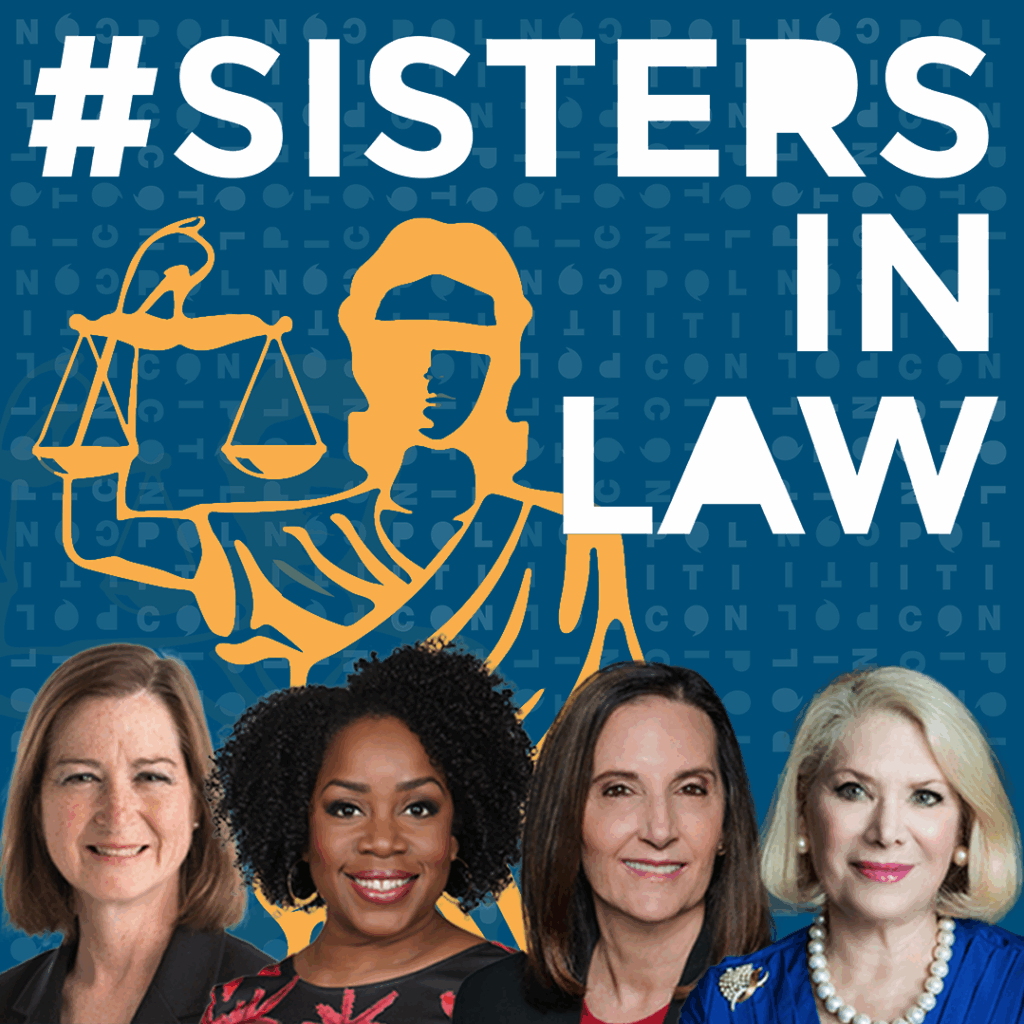
Kimberly Atkins Stohr hosts #SistersinLaw to discuss the Trump administration’s revenge prosecution of E. Jean Carroll, examining the motivations behind the investigation, the allegations against her, and the role of financial backers in her civil suit against the President. Then, they expose the DOJ’s prosecutorial misconduct in the Broadview Six case, review the vindictive prosecution of Kilmar Abrego Garcia, and highlight the dangers of politicizing DOJ appointments. They also explain the recent SCOTUS decision overturning the murder conviction of Terry Pitchford due to racial discrimination in the jury selection process, and the implications of Justice Kavanaugh’s opinion on future cases.
Remember to send in audio questions to SistersInLaw@politicon.com for the #Sisters to answer on their new companion podcast, SistersInLaw Sidebar! It airs Wednesdays wherever you normally get your podcasts!
Get the brand new ReSIStance T-Shirt, Mini Tote, and other #SistersInLaw gear at politicon.com/merch!
Additional #SistersInLaw Projects
Check out Jill’s Politicon YouTube Show: Just The Facts
Check out Kim’s Newsletter: The Gavel
Joyce’s new book, Giving Up Is Unforgivable, is now available, and for a limited time, you have the exclusive opportunity to order a signed copy here.
Barb is going on a book tour! You can also pre-order Barb’s new book, The Fix. Her first book, Attack From Within, is now in paperback.
Add the #Sisters & your other favorite Politicon podcast hosts on Bluesky
Get your #SistersInLaw MERCH at politicon.com/merch
Email: SISTERSINLAW@POLITICON.COM or Thread to @sistersInLaw.podcast
Get text updates from #SistersInLaw and Politicon.
Mentioned By The #Sisters
Pre-order Barb’s new book, The Fix, and get tickets for her upcoming book tour!
From Kim – At the Supreme Court, a small victory against racial discrimination
From Joyce – E. Jean Carroll- Is DOJ investigating her, or not?
Support This Week’s Sponsors
Ridge Wallet:
Upgrade your wallet today! Get up to 40% off @Ridge during their Father’s Day Sale when you go to https://www.Ridge.com/SISTERS #Ridgepod
ASPCA:
You can get a $25 Amazon Gift Card when you enroll in an ASPCA Pet Health Insurance Plan using the link https://www.aspcapetinsurance.com/SISTERS. Note: The ASPCA® is not an insurer and is not engaged in the business of insurance.
Mint Mobile:
Get premium wireless for just $15 per month at mintmobile.com/sisters
Pocket Hose:
Text LAW to 64000 for your 2 free gifts with the purchase of any Pocket Hose Ballistic hose. By texting 64000, you agree to receive recurring automated marketing messages from Pocket Hose. Message frequency varies, and data rates may apply. Text STOP at any time to opt out. Text HELP for additional Information. No purchase required. Terms apply, available at http://PocketHose.com/terms
Flamingo:
Our listeners get the Flamingo Starter Set for just $7 at https://www.shopflamingo.com/SISTERS
Get More From The #SistersInLaw
Joyce Vance: Bluesky | Twitter | University of Alabama Law | Civil Discourse Substack | MSNBC | Author of “Giving Up Is Unforgiveable”
Jill Wine-Banks: Bluesky | Twitter | Facebook | Website | Author of The Watergate Girl: My Fight For Truth & Justice Against A Criminal President | Just The Facts YouTube
Kimberly Atkins Stohr: Bluesky | Twitter | Boston Globe | WBUR | The Gavel Newsletter | Justice By Design Podcast
Barb McQuade: barbaramcquade.com | Bluesky | Twitter | University of Michigan Law | Just Security | MSNBC | Attack From Within: How Disinformation Is Sabotaging America
Kim (00:00)
Welcome back to hashtag Sisters in Law with Jill Wine-Banks, Barb McQuaid, Joyce Vance, and me, Kimberly Atkins Stohr. It was a very jam-packed week this week, and most of it, most of the news involved the DOJ. So today we’re gonna break down ⁓ the E. Jean Carroll possible criminal investigation into her or maybe not, we’ll figure all that out. Then we’ll go on to talk about even more DOJ mishaps. And then finally we will wrap it up by talking about a Supreme Court case where the majority actually found that race matters and that government actors can’t just give pretextual reasons for doing racist stuff. Yeah, the Supreme Court still does that every now and again.
But before we dive into all of these really big topics this week, you know, I I’ve been thinking a lot about the things that we need that we rely on to ⁓ give us silly diversions in this time of endless bad news. And I’m just wondering what each of you guys do. ⁓ for example, for me, ⁓ mine, and I’ve spoken about this before, I like some reality television shows, but
There was one show that I didn’t even watch. It’s been on TV for a long time. And I didn’t even start watching it until a couple months ago when my friends were in a chokehold over the drama over it. And it’s called Summer House. And they had their reunion episode this week. The listeners, if you know, you know. I’m not gonna go through the whole storyline, but I’m team Sierra. I’m Team Sierra through and through like much of the world. I think even the Pope is. But ⁓ it was just this joyous, silly
way I’m you know, I’m like live texting my friends, you know, we’re chatting live about it. And it was just this little bit of fun. ⁓ that was just silly. And it just made me, I didn’t think about the DOJ a single time for that entire hour and 15 minutes that the show lasted. So what’s the thing that you guys are doing? Like just that little thing. It doesn’t have to make that much sense, but that just give you a little bit of joy in these crazy times. What about you, Jill?
Jill (02:24)
Well, first of all, tonight I am going to see one of the opening games of the Chicago Snowballs. It’s a team like the Savannah Bananas. I won the lottery and I got a ticket. And Michael and I are going. So I am it’s it’s for people who don’t know the Savannah Bananas or the Chicago Snowballs, you will know it soon. Go on YouTube and watch some games where the pitcher will pitch and do a somersault while he’s pitching.
And then they break out into choreographic dances that are fabulous. So I’m really looking forward to that. But I also have to say I engage in really silly TV. But I have now found something really compelling that I want to recommend to all of our listeners and to all of you. It’s called 61st Street. And it’s filmed on the south side of Chicago, 61st Street. ⁓ and it’s about law versus justice. It’s about a public defender and a wrongfully accused defendant, of course.
And it’s really so well acted and so well filmed and there are so many compelling arguments. I I really I’m obsessed with it. And I just finished season one and starting season two.
Kim (03:37)
All right. Well how about you, Barb?
Barb (03:40)
Well, you know, sports is always my diversion. And in the summer it’s baseball. Although the Tigers are really letting me down, Kim. The Tigers are not not the team they were cracked up to be. But I I’m in New York for a wedding. We went to a Mets game the other night. The Mets are also ha suffering from a tough season, but they won. That’s why I’ve got the the Mets cap. I like to pick up the cap whenever I visit. And you know, I’m going on this book tour later this summer and ⁓ I’m hoping to hit a couple of games when I’m in town. Philly’s in Philadelphia, Padres in San Diego are on my
calendar. So it’s always fun. You know, as I often say, even the worst teams in baseball win a third of their games. And so on any given night your team might win. So it’s fun. I like to pay attention to what’s going on in sports and baseball is ⁓ especially my ⁓ my right I am I’m most fond.
Jill (04:26)
I hope that the Cubs will improve before you get here for your book tour because they have gone from here to the very bottom in like a snowball.
Barb (04:35)
That
would ⁓ be
Jill (04:37)
Okay.
Joyce (04:39)
If I play up, can I go two?
Barb (04:42)
Yeah, of course.
Kim (04:44)
Well, what’s your diversion, Joyce?
Joyce (04:46)
You know, mine involve animals right now. I’ve two of them. One is ⁓ Bob and I have two very poorly trained German shepherds. And so I’ve been taking on a little training project. and you know, Instagram is full of these videos and it makes it look super easy, right? All you do is you take the little treat and circle it around and teach your job, your dog to go underneath your legs into a ready protective position. But those videos don’t think about the fact
That I’m short and Bella is tall. And so the first time I tried to get her to go underneath my legs, it was a disaster. ⁓ but you know, we’re working on it, and she can sit. we’re working on our favorite command right now is no bark. ⁓ I think it’s gonna be slow progress, but I’m trying. And then the second obsession involves my chickens. I’m working on a little project that I don’t think I can talk about just yet, but soon.
and I’ve been collecting some some chicken art and some pictures of our chickens. So I’m obsessed with trying to get pictures of them in their most characteristic pose because this will be a shock to people who don’t have chickens. But they really do have big personalities. They’re very distinct. They’re just like people. And so I’m trying to get something that captures each one of them. And that has been sort of
Hilarious. Some are shyer than others, but they’re all very food motivated. So I’m working on croissants and popcorn.
Kim (06:17)
All right. Well, you know, I you had me at Coissants, Joyce.
Barb (06:24)
We just wanted a chance to say it. We love it.
You know how I feel about pockets. And now that summer’s here, our clothes don’t have as much storage space as they should. We’ve all seen people walking around with a giant wallet deforming a pair of shorts. Well, I’m gonna invoke the fifth as to whether I might be one of them. And ⁓ some of us may have been guilty of that too. That’s why the ridge is the perfect wallet. It’s sleek, smooth, and stylish, and it fulfills its purpose with ergonomic excellence.
It means you can finally sit comfortably and you don’t want an overflowing wallet giving your dads or spouses a crooked spine because they use it like a backpack.
Joyce (07:15)
There’s no excuse to keep the overstuffed, cracking, faux leather one with half the stuff falling out. You wanna look on point and when it comes time to pay, it’s embarrassing when you pull that old wall out. We don’t wear clothes with holes and rips in them, so why is a wallet any different? The Ridge wallet is the perfect upgrade, and with Father’s Day coming up, it makes a perfect gift. Let me tell y’all, my husband has actually had his since last Father’s Day and
Barb (07:28)
Fall it out.
Joyce (07:45)
And it really does make a difference. So, unlike a lot of stuff out there, your ridge wallet will get used every day and it comes with a lifetime warranty. It lasts forever.
Jill (07:57)
Ridgewalls have a unique, slim, and modern design that holds up to twelve cards plus cash, and it’s made with premium materials like aluminum, titanium, and carbon fiber. So it looks cool and always holds its shape. And with over fifty colors and styles to choose from, there’s a perfect fit for any personality. It’s no surprise they have over 100,000 five-star reviews, and you can feel confident that
that this is a gift that’ll actually get used and people will be proud to show off.
Kim (08:31)
Ridge isn’t just about wallets. They make premium everyday essentials like key cases, suitcases, and rings, all with that same sleek, durable design. And for a limited time, Ridge is running their huge Father’s Day sale where you can get up to 40% off their best gear. Just head to Ridge.com slash sisters and don’t miss out on one of their biggest discounts of the year. That’s Ridge.com slash sisters for up to 40% off.
After you purchase, they’ll ask you where you heard about them. Please support our show and tell them that we sent you. The link is in our show notes.
Joyce (09:16)
So we start today with my friend Eegene Carroll. I always like to disclose when we talk about her and her various legal cases that we’re friends, so that you’re under no impression that I’m unbiased about this delightful woman. ⁓ Eegene Carroll, new reporting this week suggests that she is under criminal investigation by the Justice Department. And my reaction when I first saw that was to think, is it a
Crime now to successfully sue the president of the United States or the ex-president as one might have it for defamation. Because I couldn’t figure out what crime sweet Eugene Carroll could have committed. So Kim, what was the first level of reporting about that? I mean, it’s been a confusing week, but let’s start with what we first heard.
Kim (10:05)
Yeah, it was really gobsmack. I know I use that word a lot, but ⁓ just the idea that someone who ⁓ a jury has ⁓ determined was sexually abused by someone and then being the subject of a criminal investigation themselves is ⁓ blaming the victim in a way that ⁓ I I just found really repugnant.
But as you said, CNN reported that the Justice Department had opened a criminal investigation into Eugene Carroll. As you know, she is a former columnist. I used to read her religiously. ⁓ was always a very big fan. ⁓ and multiple sources told CNN reporters that the investigation was focused on whether she committed perjury tied to her two civil cases.
against Donald Trump. Again, the idea, ⁓ and we’ve talked a lot about weaponization before. That’s what hit that’s what this hit me as ⁓ Donald Trump basically turning, you know, I asked the question, is Donald Trump turning his Justice Department against people he dislikes? Cause this isn’t even about like political enemies or perceived political just somebody who he doesn’t like and he has a problem with personally.
⁓ and it looked very much like the Justice Department was being weaponized to to to help him out there.
Joyce (11:30)
Yeah, I I think that’s absolutely the case. There was some reporting about the specifics, and it came down to a question about how she was paying for the defamation cases. And she responded that her lawyer had taken them on a contingency basis. She paid nothing up front, but the lawyer would get a certain percentage of of any recovery. And then it turns out her lawyer tells her, I think in 2022, but don’t hold me to the year.
That some that a you know, a sort of a donor had come from outside and was covering some of the lawyer’s expenses. When you file a lawsuit, you have to pay a filing fee and stuff like that. So it doesn’t alter her arrangement with her lawyer, but there is this source of funding. The lawyers say it gets mentioned to her once in passing. She’s asked about it a couple years later in a deposition, and she forgets about it. So that’s supposedly the source of the perjury.
But then, Barb, something really interesting happens. The US attorney in Chicago walks back or tries to walk back that recording. Can you explain his statement and and what you made of it? Did you end up thinking that there was an investigation into Carol or isn’t there? And also, ⁓ something I just have to ask is did you think it was odd that it was the US attorney in Chicago who popped up when she testified in Manhattan for her deposition?
Barb (12:55)
Yes. In in fact I think there’s a real tell here. So you have a nice piece on this in your civil discourse newsletter that gets into all the nitty-gritty, including one of the things I love, Joyce, about your newsletter is you often include screenshots of legal documents and you also included a screenshot of the social media post from the US attorney’s office in the Northern District of Illinois and Chicago. So Andrew Boutros, who’s the US attorney there, said
In light of the widespread reporting and intense media and public interest into the E. Gene Carroll matter in New York, the Chicago US Attorney’s Office can confirm that it has not opened and has never opened a criminal investigation into E. Jean Carroll. Any claim to the contrary is categorically false. So one of the things ⁓ all all of us have been trained ⁓ to look at when there’s a statement that’s false, remember that
If any one part of it is false, the whole thing is false. So when you talk to your friend and there’s half of it’s accurate and half of it’s not accurate, you say, well, that’s partly true. And let me correct you and, you know, send you on the right way. When when people are issuing public statements or testifying, sometimes they’re very careful to say something that is literally true. But if you throw enough qualifiers in there, ⁓ you can make it literally true without really revealing
what’s going on. So I thought a couple things were interesting here. ⁓ one is the idea that the Chicago U.S. Attorney’s Office has not opened a case. Well, okay, I don’t think the initial reporting was that it was Chicago. It was just the DOJ had. Okay, so maybe some other part of the Justice Department, I mean this deposition occurred in New York. Maybe the New York US Attorney’s Office or maybe DOJ in Washington has. So the word Chicago in there is doing a lot of work. It also says
It has not opened nor or ever a criminal investigation into E. Jean Carroll. That doesn’t mean they aren’t investigating her as part of a larger investigation. And as you note in your piece, Joyce, that later in the day it was reported that Chicago, ⁓ where ⁓ Reed Hoffman’s nonprofit is located, who who paid for the these legal expenses for E. Jean Carroll.
is based in Chicago. And so if you read between the lines, it seems quite likely that the Chicago U.S. Attorney’s Office may be interviewing Reed Hoffman or his ⁓ his nonprofit, and that maybe as part of this, ⁓ Egene Carroll is being, you know, swept up in it as a minor player. Maybe they try to charge her, try to flip her to get to use her against Reed Hoffman. So
I just think we should all be aware of that statement that each piece of that is doing some work there, making it ⁓ sort of a non-denial denial.
Joyce (15:52)
Yeah, I I think that’s really true here. And Jill, that’s a new name that cropped up yesterday in this context, Reed Hoffman. The reporting suggests that he might be the subject of the investigation. And of course, as we know when DOJ opens a case, usually it it might be like United States versus Carroll or United States versus Hoffman. And so it’s a neat trick for claiming you have not opened an investigation into E. Jean Carroll.
if your case is sub das US versus Hoffman. ⁓ so so tell us about Reed Hoffman. He’s got some ties to Chicago, as as do you. ⁓ who is he?
Jill (16:30)
So actually the only thing you need to know about Reed Hoffman as it pertains to this particular ⁓ item is that he is connected to Eugene Carroll and that he has donated to a lot of Democrats, candidates and Democratic ⁓ causes, I would say. ⁓ he is a billionaire. He is the one of the founders of PayPal and the founder of LinkedIn.
so a very successful entrepreneur and venture capitalist. ⁓ he has no links to Chicago except for one that I know of. He is a Californian, lives there, his companies are there, but he has a not-for-profit here in Chicago. And it was through that not-for-profit that he supported the E. Gene Carroll case by giving ⁓ money for expenses to Robbie Kaplan, E. Gene Carroll’s lawyer. And so
That’s what has led to his being a target, I would say. I’m guessing at this, but seems to me that anybody who funded a case that was successful to the tune of combined almost 88 million dollars in damages owed by Donald Trump. ⁓ and by the way, the only way Robbie Kaplan will get her percentage is after he actually pays the damages, which he’s doing his very best to avoid.
He’s he is a person in his own right, quite successful, but as I say, the only reason, ⁓ it’s a question of, you know, was he investigated because he funded ⁓ Eegene Carroll, or is E. Jean Carroll subsumed in an investigation into him for other reasons, but just because he funded her. So that’s who he is and it’s his not for profit in Chicago that gave venue in Chicago.
Joyce (18:24)
So Kim, can we drill down on that a little bit? You’re the civil lawyer in the room. ⁓ first off, you know, is there anything wrong with providing financial support for someone who’s conducting a civil lawsuit? A and what else do you think could have led to Hoffman becoming the subject of a possible criminal investigation?
Kim (18:43)
Yeah, no, it is not ⁓ there is nothing wrong with ⁓ funding ⁓ helping someone pay for a criminal lawsuit. I I would add one thing to this ⁓ desire, like why to the question about why Trump might be going ⁓ after him, is that one tactic that Donald Trump has always used, both in business and there’s no reason for him to change now, is to try to, as to your point, Joyce.
delay and throw obstacles in litigation or flood people with litigation to the point that they are it you know, filing a lawsuit is really expensive and it’s hard. And you sort of grind them down and they back down just because they have run out of money or resources or time or just, you know, they’re exhausted of it and they would ultimately back down. So I I would imagine that Trump wouldn’t love it, that there is a billionaire that is backing Eugene Carroll and that will thwart that very ⁓
Attempt to just keep appealing and appealing and appealing this case. He’s appealed this ⁓ one of the verdicts all the way up to the US Supreme Court, which weirdly, and this is a little bit of a tangent, but they keep re-listing it before deciding whether they take it up or not, which actually worries me a bit because usually I thought that this was ridiculous. I mean, there’s no reason for that award to be disturbed that was given by a jury. ⁓ but usually that would take one.
conference at the Supreme Court to say y no and kick that aside. It’s been relisted twelve times. Actually I don’t know what that’s about. Do you think
Joyce (20:11)
Yeah, I mean I was
Find that they might take it on a peel or do you think that they’re j they just have bigger fish to fry first?
Kim (20:21)
N well if they had bigger fish to fry they would have denied it already. Yeah. It doesn’t
Joyce (20:26)
Maybe we won’t find out until the long conference at the end of the term.
Kim (20:30)
Maybe, but I don’t yeah, I don’t know why. I don’t and I don’t wanna read in. It doesn’t necessarily mean that they will take it up. It’s just weird. It’s so just put a pin in that. Yeah, I was
Joyce (20:39)
We’ll put a pin in that we promise y’all, our our dear listeners, that we will come back and and close the loop on this.
Kim (20:46)
Yes, but no, there’s nothing wrong with funding ⁓ civil litigation. And I agree with everybody else. I think he’s going after him because he doesn’t like him. He thinks he’s a liberal. He’s helping somebody, Eugene Carroll, someone who Trump clearly has a problem with. And and it’s also interesting too, like you’re talking about deep pocketed people funding litigation. Remember that Hulk Hogan civil lawsuit, the defamation lawsuit that closed down the website Gawker because he claimed that they invaded his privacy? Well, that was funded
By Peter Thiel, which is one of Trump’s biggest backers. And nobody I didn’t see the DOJ investigating him in that case. And that was aimed at silencing journalists. So yeah, there there’s a lot going on with this case, and none of it’s good.
Joyce (21:26)
That’s a really great example. I had not thought about that until you just raised it. ⁓ Barb, let’s just pretend for a moment Carol’s a subsidiary target of the investigation, and let’s just leave aside concerns that she couldn’t be charged in Chicago. Would there be good substantive reasons to investigate her conduct based on what we know about these perjury allegations? I mean
You’re the US attorney who’s asked to open this investigation. Would you do it and take a look?
Barb (21:57)
Boy, n not not not in a minute. I can imagine a case, you know, someone presenting this to you, and you’d have to say, first, this occurred in twenty twenty two in a deposition in a civil case. I can’t remember a single time we ever brought criminal charges against a witness at a civil deposition ever. ⁓ i i aside from those you know, venue issues that you raise. But I think
The what what is really significant to me is this chronology. So she’s asked this question, ⁓ are you personally responsible for paying your legal fees? ⁓ answer, no, I’m I they’re getting I’m my f my lawyers will get paid on a contingency basis, which means if you win, they get a portion of it. Before the trial begins, her lawyers disclose to the court that in fact that wasn’t quite right, that in addition to the contingency fee,
Reed Hoffman and his i I guess it was actually his his nonprofit was going to cover some of the costs. There’s a difference between fees and costs. The judge considered this and said, This is completely irrelevant to this case. I am not going to let you bring this up in the trial because it will be irrelevant and unfairly prejudicial. The jury will be confused. No, it’s not coming in. So then this issue got raised on appeal. After she won her verdict, it went to the Second Circuit Court of Appeals.
And one of the things the court there said is the court was right to exclude all of this because even though her case was indeed taken on a contingency fee basis, there is, I’m quoting from the Second Circuit Court of Appeals, no evidence to suggest that Ms. Carroll was personally involved in securing the funding, interacted with the funder, received an invoice showing the arrangement before or after her counsel received the outside funding.
Or had discussed the arrangement w with anyone between learning of it in September of 2020 and being deposed in September in October 2022. Therefore, none of this is relevant or important. The reason that matters so much is that to bring a case of false statements, it’s it’s very difficult because you must prove what was in someone’s mind at the time, that they then and there knew they were making a false statement. So in light of the difference between fees and costs, anyone else paying your legal fees? It’s actually literally true.
What she said, no. ⁓ but the costs were so you we talked about earlier. i i it’s not a literally a false statement. This is what witnesses are trained to do in testifying. they didn’t ask her about costs. And so costs were something different. So it is number one, I don’t think they’re gonna be able to prove that this was a false statement. But the other thing about this is you have to prove that the matter was material to
The question under consideration. That means that it was important or dispositive or would have made a difference in the case. This was a case about defamation, that Donald Trump had defamed Eugene Carroll by calling her a liar and saying she made up all this stuff about sexual abuse. ⁓ who paid her legal fees is completely irrelevant to that issue. That’s why the judge excluded evidence of it at trial. That’s why it was affirmed at the Second Circuit Court of Appeals. That’s why it will fail to meet the materiality statement. So
I don’t see any legitimate prosecutor taking this case. I don’t see any grand jury indicting it. And I certainly don’t see any jury convicting ⁓ beyond a reasonable doubt.
Joyce (25:26)
Yeah, I I agree with you a hundred percent on that. I mean usually if ye I mean, leaving aside the the really great analysis you offered earlier about, you know, DOJ just doesn’t really investigate perjury and civil depositions that don’t have any connection to important national interests, but leaving all of that aside, here it’s just clear from the outside that a Court of Appeals has in essence said
Even if she made a false statement, it wasn’t material, there was no intent, I mean, this is just riddled with problems. So Jill, let’s just take into account the unlikely event that there’s an indictment of Carol that suddenly shows up. What kind of motions would you expect the defense to file? And do you think that they would be successful in getting the case dismissed if it was indicted?
Jill (26:13)
Yes, I expect them to be successful. I just I have to mention one of my favorite cases before I answer your question in full, which is Bronson. And I’m sure you all know what that is, which is basically to Barbara’s point, when something is misleading, but literally true, it is not perjury. So even if she misled and and remember they notified the court. So it was corrected before this could have had any impact. So there’s no way that this is perjury. So let’s, you know, let’s just acknowledge that.
⁓ but I would expect successful selective and vindictive prosecution motions to be made for sure. And while those are all hard to succeed on, I think that this is one of those cases where it would be successful. So in addition to it not being perjury, it’s selective, it’s vindictive. ⁓ I I also think that it will be ⁓ there’ll be a motion for change of venue because why is it in Chicago?
⁓ there’s no reason it and it’s not linked to whether or not the investigation of Reed Hoffman has anything to do with this at all. It doesn’t. he’s being investigated apparently for allegations of money laundering and of possible obstruction of justice. So there’s no reason why venue should lie in Chicago. And as we will discuss later in the show.
The US attorney’s office in Chicago is in plenty of big trouble for misconduct already, so I don’t think they want to take this on.
Joyce (27:47)
Well, maybe Trump can convince his party in Congress to pass him a statute that makes it a crime to successfully sue him for defamation. But until that happens, I think we’re all agreed. This is just another part of the revenge tour that DOJ is undertaking on Trump’s behalf, and it’s I I think it just underscores what an utterly insane place we’re in. As Kim would say, I’m gobsmacked by the whole thing.
You know, Barb, there was just a a raid on a house in Birmingham and they’ve got like seventy two pets that went to a shelter. So now’s the time if you’re thinking, I’ll go look at all the pups for you and send you pictures.
Barb (28:38)
Just
what I need, all seventy two in my house. I can see it in
Joyce (28:43)
We have a quick message from today’s sponsor, the ASPCA Pet Health Insurance Program. If you’ve ever owned a pet, you know that like my friend’s dog, they do things their way. Jump first, think later, and never ask questions. It’s part of what makes them so lovable, but it leads to surprise vet visits you didn’t see coming. Fortunately, ASPCA Pet Health Insurance helps cover eligible vet expenses, so when those moments happen,
You can focus on getting them the care they need without overthinking the cost or second guessing your decision.
Kim (29:20)
And we have some good news. There’s a special perk for signing up. When you enroll in an ASPCA Pet Health Insurance Plan, you could get a $25 Amazon gift card. It’s a little treat for you while you’re doing something great for your pet. The program offers customizable accident and illness plans, making it easier to get your pet the care they may need.
Jill (29:44)
You can tailor your plan to fit your budget, your lifestyle, and your pet’s particular quirks. To explore coverage, visit ASPCA petinsurance.com slash sisters. That’s ASPCA petinsurance.com slash sisters. Eligibility restrictions apply. Visit ASPCA petinsurance dot com slash Amazon Terms for more information. The link is in our show notes.
Barb (30:14)
Okay, here goes you guys, you ready? This is a paid advertisement. Insurance is underwritten by either Independence American Insurance Company or United States Fire Insurance Company and produced by PTZ Insurance Agency Limited. The ASPCA is not an insurer and is not engaged in the business of insurance.
Kim (30:39)
All right, I bet you like to know what’s happening to your money and keep as much of it as you can. Unfortunately, traditional big wireless carriers seem to like keeping your money too. But if you’re finally fed up with the crazy high wireless bills, bogus fees, and quote unquote free perks that actually cost more in the long run, then making the switch to mint mobile is a no-brainer for you. Every month you wait is money that could be in your pocket.
And we’ve seen how quick the savings add up when you take back control of your cell service.
Barb (31:13)
Stop overpaying for wireless just because that’s how it’s always been. Mint exists purely to fix that. We all deserve affordability, and Mint Mobile is here to rescue you with the premium wireless plans starting at 15 bucks a month. All plans come with high-speed data and unlimited talk and text delivered on the nation’s largest 5G network. Getting started is easy. Bring your own phone and number, activate with eSIM in minutes.
And start saving immediately. There are no long term contracts and no hassle.
Jill (31:48)
You can ditch overpriced wireless and get three months of premium wireless service from Mint Mobile for fifteen bucks. Fifteen bucks a month, it’s hard to believe. With service and a price like that, we strongly recommend you make the switch. Mint Mobile makes it super easy. The website is incredibly simple to navigate and you can get down to the business in no time. Get your kids and your family members using it too. Like you,
They have more important things to spend their money on.
Joyce (32:18)
If you like your money, Mint Mobile is for you. Shop plans at mintmobile.com slash sisters. That’s mintmobile.com slash sisters. You’ll also find the link in our show notes.
Kim (32:31)
Upfront payment of forty-five dollars for a three-month five-gigabyte plan required, equivalent to fifteen dollars per month. New customer offer for first three months only, then full price plan options available. Taxes and fees extra. See Mint Mobile for details.
Barb (32:58)
Well, we saw two cases during the past week that ended up in favor of defendants with findings by judges of such serious abuse by DOJ lawyers that the cases were dismissed. On the one hand, this is good news for justice, but on the other, it’s really painful to see the Department of Justice abuse and damaged in this way. And it makes me wonder what we don’t know that’s going on behind the scenes in other cases and what this could mean for the future of the Department of Justice.
So first, we learned about the case of the so called Broadview Six in Chicago, as Jill mentioned earlier. Joyce, can you please tell us who they are and what that case was about?
Joyce (33:40)
Yeah, you know, this is the case that happened in suburban Chicago, where six individuals, and some of them had ties to local democratic politics, were charged by federal prosecutors after this protest you may have seen in the news last October, an immigration protest. So they get arrested after a larger crowd surrounds an ICE agent’s SUV outside of the Operation Midway Blitz Processing Center.
And there are allegations that they banged on the vehicle, they pushed, they scratched, they caused some damage to it. But what happens next is sort of interesting. Only six individuals get charged out of that larger crowd. That led to concerns about selective prosecution. I guess that’s going to be the theme for today’s show because of who got charged and who didn’t. And then after the government dismissed felony counts and proceeded on misdemeanors, I think you’ll probably get.
into that with Kim, but things fell apart when the judge reviewed grand jury transcripts.
Barb (34:43)
Yeah, thanks. And you know, I I I’m not here to condone intimidating, blocking, obstructing federal officers in engaged in work, even if you disagree with the the work that they’re doing. But you have to follow the rules when you’re going to try to bring a prosecution. And so Kim, let me ask you about that. The judge dismissed the case on the grounds of prosecutorial misconduct before the grand jury. Wha what was it that the judge found that was so offensive?
Kim (35:11)
Yeah, it was pretty ⁓ wild. So US District Judge April Perry ⁓ said that she quote had never seen the types of
prosecutorial behavior before a grand jury that I saw in those transcripts. And it wasn’t just what she saw in the transcripts, it’s what she didn’t see in the transcripts. So she identified basically three things that this US attorney and and again, this is the office of US Attorney Andrew Boutros. He’s having a bad week, y’all. This is not
Joyce (35:41)
It’s
God, I love that movie so much. I’m such an airplane fan.
Kim (35:53)
So ⁓ it was three things that ⁓ she she said that the prosecutors in that office did. One was have improper contact with grand jurors outside of the courtroom. I don’t think I have to explain why that is a big, big no-no. Another one was try to ⁓ dismiss jurors from the grand jury who seem to indicate that they may not agree with the prosecutors.
Barb (36:22)
Like why you’re asking hard questions. You know what, why don’t you just leave? We don’t watch this grand series. ⁓ my god.
Kim (36:28)
I mean,
basically trying to rig a grand jury. And keep in mind, a grand jury, all they have to do is come back and and decide whether the prosecution has enough goods to bring forward a a a complaint, an indictment. They’re not deciding who wins, but they’re even rigging that grand jury, which is really outrageous. And it and she also Judge Perry also found that the prosecution was engaging in vouching. Now that means when a
Prosecutor in presenting the case sort of tries to put the thumb on the scale by saying, Hey, I know this expert and this expert never lies, or, you know, bolstering the credibility of experts or the strength of evidence and other things by saying, you know, basically saying, trust me, this stuff is good, you know, rather than just actually presenting what they have. And all of those things really angered the judge. She seemed pretty steamed. And she said,
on top of the kicker is that these evidence of this was not in the transcripts that she received. So it sounds also like they perhaps tried to cover it up. It it’s really, it’s really outrageous stuff.
Barb (37:41)
Yeah, I I agree. And you know, Jill, let me ask you, you spent a lot of time before grand juries. How how how do those things that Kim just described compared to your training and experience as a prosecutor, are these things that you ever would have even considered doing?
Joyce (37:55)
Is that a rhetoric?
Barb (37:58)
Yeah, I think I think the answer’s obvious. But I explain to our listeners why these things are so egregious. Yeah.
Jill (38:00)
It’s just so obvious.
Well, first of all, let me just expand on one of the things Kim said, which is the only thing that gets put before the grand jury is what the prosecution wants them to hear. So it’s not like there’s a defense in the room. The defendant doesn’t come in and say, Wait, wait, that’s not true. Here’s the other side of the story. No, it’s only prosecution evidence. So it’s like ridiculous to then expand it to I can’t even imagine calling a grand juror out and talking to them outside the grand jury.
I can’t imagine saying, you goodbye, you’re gone. You you’re you’re just not buying my case. ⁓ the the conduct was egregious. There’s no question about it. And so I I I can’t even imagine anyone who has even the most minimal training, even if it’s only in law school. I I just and of course the department does provide training and you don’t normally it maybe Lindsay Halligan, but normally your first
time in a grand jury, you aren’t alone. You’re second sharing. You’re watching someone experienced and learning from them. So all of that was ignored here. And there’s grand jury secrecy and the grand jury is ⁓ set up in a way under our Constitution to provide the secrecy to protect possible defendants who won’t get indicted. They get in you know, there’s something
alleged and and a grand jury investigates, but it never goes anywhere. You don’t want to sully someone’s name. So, you know, you keep it secret. So there’s really i in this case, it it’s outrageous.
Barb (39:42)
Yes, Joyce, as Jill said, I mean, I know I had training. I think I went for like a week-long training at the National Advocacy Center in South Carolina, right? The NAC. ⁓ I I shadowed AUSAs before I was allowed to do my own case. When I was US Attorney, we required our AUSAs to shadow ⁓ more experienced prosecutors to see how it’s done. And it’s all transcribed, right? So to get the case ⁓ presented, you try to do it in a way you know that there will be
Joyce (40:05)
Right.
Barb (40:11)
potentially scrutiny if you engage in misconduct. And you also, did you not want to stress test your case? If it has problems, you want the grand jury to assess it so that you can either pull the plug on the case. I don’t want to lose this case in front of the grand jury. Or if they say we’re not sure about, you know, your evidence of intent, you can say, okay, let me go get some more evidence and, you know, try to build up the case so that by the time you get it indicted, it will be a strong case.
that you can present before a jury trial, ⁓ a trial jury where the standard is guilt beyond a reasonable doubt. ⁓ but this is not the only incident of irregular conduct before a grand jury. ⁓ we saw one in Wyoming recently. We certainly saw them in the Eastern District of Virginia with Lindsay Halligan. and we are seeing judges more and more demand the transcript of these colloquies between the prosecutor.
and the ⁓ grand jurors, which is ordinarily something that judges don’t pry into. ⁓ do you think that this scrutiny is becoming a trend in the Trump administration? In other words, you know, sort of this loss of the presumption of irreg of regularity means that judges are going to demand more and more ⁓ what is happening during these colloquies.
Joyce (41:32)
Yeah, I mean, I think that that’s exactly right. I was thinking that we could just call this show the death of the presumption of regularity because D.O.J. is is so far off the rails. And and I’m gonna say something out loud that I never thought it would be necessary to say, which is that what prosecutors are supposed to do, it’s not to win cases. It’s to do justice. And that means that when you go into the grand jury, you’re thinking about.
fairness and constitutional rights, and you shouldn’t be there if your case isn’t strong and solid and ready to go. And this Justice Department is about doing the president’s bidding, not about doing justice, which I think is is just this horrible moment in time that we are hopefully going to be able to come back from after the next election. But you know, Barb, you flagged the the Wyoming situation. And I think that’s worth
Dwelling on because I’ve been reading the local reporting. I’m such a huge fan of local news reporting. So I’ve been reading the local Wyoming papers and blogs. And this one is sort of crazy because earlier this week, that office had to reindict nine defendants. Their charges had been dismissed. The charges against them got dismissed because of misconduct committed by Trump’s newly appointed U.S. attorney in in Wyoming, a guy named Darren Smith, who I have never met.
But the local reporting says, and this sounds sort of familiar from Broadview, that he improperly told grand jurors that the defendants were murderers and that their deliberations, quote, won’t take long, among other things. You know, and only one of the defendants had even been charged with murder. And of course, defendants are innocent until they’re proven guilty. Juries decide whether the evidence adds up to guilt, not the US attorney at the grand jury stage.
so the defense goes to the court and asks the judge to dismiss the charges, and more information starts coming to light, including the fact that Smith was passing out his business card to grand jurors and asking for a full list of their contact information. And there is this insinuation that he was seeking ⁓ additional contact with them outside of the room that the grand jury deliberates in. So this is sort of
Crazy, but Smith is really emblematic of the kind of people Trump is appointing to these positions, which I think is the point of your question. You know, Smith makes Alina Haba look experienced. When he goes up for confirmation, he’s forced to concede. He has no experience appearing in court in either a criminal or a civil case. No experience questioning witnesses before a grand jury. No experience applying for a warrant.
His legal background, it was limited to estate planning and real estate law. But you know, as Senator Dick Durman pointed out in connection with his confirmation, he was qualified, right? Because he was part of the Loyal MAGA Orthodoxy. So loyal that he was at the Capitol on January 6th. And when he was confronted with that fact, he just pointed out that he had never entered the Capitol. So ⁓
Only in the Trump administration do you get people like this in these jobs and it I think explains the dysfunction. They just don’t know what the rules are and they don’t care.
Barb (45:01)
Yeah, you know, it reminds me of you know, the historian Ruth Ben Giatt. She’s written a lot on fascism. She studied Italy during Mussolini’s reign. And she refers to this as engineered incompetence. And that is, when you pick people f on the basis of loyalty, ⁓ it is likely that they’re going to be incompetent. Because if you have the skills, you get appointed to you have many opportunities in life. You get appointed to things legitimately, to be able to ⁓
⁓ bow down to the leader requires a certain level of lack of self-respect that comes with people who are incompetent. And so it is often the case that in these regimes where loyalty is the most valued quality, ⁓ you by definition end up with people who are incompetent. And I think that’s s some of what we’re seeing here, certainly in the case of of Wyoming, in my opinion.
⁓ so we’ve seen this very rare thing. Like, I don’t know about you guys, ⁓ Joyce or or or Jill who who worked as prosecutors. In my, you know, twenty years as a federal prosecutor, I cannot remember a single occasion where a judge demanded to see the transcripts of the grand jury colloquy with the lawyer. Certainly the witness testimony gets turned over routinely in a criminal case, but the stuff the prosecutor is saying, and and there’s a reason for that, you know, there are ⁓ perhaps ⁓
Other investigations that are being discussed that are not any business of the court or others. ⁓ I have never seen a judge demand the transcripts of that colloquy between the prosecutor and the grand jury. And now we’ve seen it in Wyoming, in Chicago, in the Eastern District of Virginia. And it makes me wonder, Kim, i do you worry about what we don’t know? Are there other cases where, you know, there’s there hasn’t been the
you know, the the smoke to look for the fire. I mean, what do you think about that? Is it is it likely that this is actually going on in lots of courts and we just don’t know about it?
Kim (47:03)
Course I worry about. Listen, in most of the cases that we talk about on this podcast, I think to myself, and this is just what we found out about. Right? Yeah. I mean, in so many c we can’t it can’t it’s not possible that only the only time that this is happening, it reaches the point where it’s being reported in the news or there’s a an because there’s some legal filing or some judge’s order release on it. That that’s impossible. So I very much
worry about it. And another ⁓ other evidence of that is just the fact of the attrition in US attorneys offices across the country that we’ve talked about for the last year and a half. You know, experienced ⁓ career professionals who made their way through those offices in multi you know, across administrations fled because of the way things are going in them. And they just could not possibly say it, including a lot of friends of mine who wrote out, you know, Trump won.
Yeah. So I think that’s a good indicator that there is much more underneath the surface.
Barb (48:07)
Yeah. No, I think you make a good point. I mean, it the three times that they’ve looked, they’ve found something really bad. What is what is the likelihood? Those are the only three times. Right. Well, Jill, let me ask you then sort of big picture that step back. Do you think that this could cause changes in the way prosecutors operate before the grand jury? As you mentioned earlier, it’s a right guaranteed by the Fifth Amendment to the Constitution. It is secret by design.
To protect the integrity of the investigation, but also the reputations of the people under investigation so that if there is no case, ⁓ their reputations are not besmirched. In in some ways, I think maybe a more transparent grand jury process would be good and healthy, but I also worry that it could compromise some of those important secrecy considerations. ⁓ what do you think? I mean, is it likely that we’re gonna see reform as a result of this? And is that a good thing or a bad thing?
Jill (48:58)
Well, the infamous Boutres said that he was going to reform his office’s practice in the grand jury, ⁓ ’cause he’s been caught now more than once. ⁓ but I have to say the things he suggested don’t seem significant. And even though it might, it could, does it need to? No. We need to go back to the actual ethics and rules that all of us grew up with, that all of us.
practice at the Department of Justice under. People need to follow the rules. And if you do, I personally think that grand jury secrecy, ⁓ and the current practi what might I say current the practice that we lived under, ⁓ is a good practice. As I said, it protects the defendants who don’t get indicted. It also protects witnesses. People come in and, you know, they’re testifying sometimes against actual criminals. And
That’s a scary thing. So if you want honest testimony, you want it to be secret. ⁓ I I think it does more good. ⁓ it prevents undue influence from the public when they find out about it that they could weigh in. It prevents influencing potential trial jurors who may hear about the investigation, some of which may get into grand jury that will not be admissible at a trial.
either because of relevance, materiality, or because it’s hearsay, but gets in at the grand jury because there’s no one to stop it. So I think that the current practice and the current rules have been around for what, you know, hundreds of years and they’ve been done well. We just need to have better US attorneys and better AUSAs and a different assistant attorney general for the criminal division and a
different attorney acting attorney general, we need to have better people in place, not to change the rules. And whatever Boutres is recommending for his office, ⁓ although training, I I I applaud that. There should be training. And and I just have to mention that there is some evidence that he personally is involved in this wrongdoing before the grand jury and in having contact with grand jurors. So I’m not sure he’s the one
Kim (51:20)
Yeah,
which is what I thought was wild. Like, yeah, he’s leading the reform. I’m like, you you apparently were a part of this, according to the judge. Wasn’t in the transcript.
Jill (51:30)
Right,
exactly. So this is this is a really unique, I hope unique, but as Kim was saying, i it’s not so unique. I mean, we’re we’re seeing a trend of cases like this. And if there’s three that are investigated and three that show that there is, then I bet if we look at a fourth and a fifth, we’re gonna find more and that defense lawyers ought to be looking at all of this and that more judges are gonna be looking at interaction, ⁓ lawyer advice to the grand jury.
than is normally looked at.
Barb (52:01)
Yeah. You know, I I don’t know, I could imagine a reform coming out of this is that there has to be a a neutral court employee present in the courtroom at the time of the grand jury, right? Like Yeah.
Jill (52:11)
Yeah,
but they’re the grand jury, so
Barb (52:16)
Well, let’s wrap it up with ⁓ a review of the Kilmar Abrego Garcia case. And perhaps this is the end of his long and tortured case, this poor man. Yeah. this week a judge in Tennessee dismissed the indictment against Kilmar Abrego Garcia for vindictive prosecution, which almost never happens because you it i in my experience, you have to have the legal right.
⁓ at issue be part of the same case. In this case the judge said it was in a related case. So Joyce, can you just explain what happened in this case and why it is a victory for justice?
Joyce (52:56)
You know, it was sort of a technical legal ruling that had to do with the burdens of proof. And what the judge actually held was the government bore the burden of proof of establishing that it wasn’t a vindictive prosecution. And the government failed to do that. And as you say, that’s a remarkable ruling. I can remember one time in twenty five years in Birmingham.
Where there was a serious inquiry. I mean, defendants will make these frivolous claims of vindictive prosecution, but I can remember only one time that there was a motion that we actually wrote to and treated seriously and the court looked it carefully. This just does not happen a lot. But it was so clear in the Abrego Garcia case because the now acting attorney general of the United States, Todd Blanche, had gone out on national television.
And talked about reopening this criminal case after the Justice Department was ordered to return Abrego Garcia to the United States. And then the government has to turn around and when they’re accused of vindictive prosecution, they have to argue, no, no, we didn’t do this in relationship to his successful efforts to protect his rights in the immigration case. And the judge just said, sorry, not buying it.
Kim (54:24)
Spring is the perfect time to refresh your lawn and garden for the summer growing season, which is why we are excited to tell you about the world’s number one expanding garden hose and their brand new product, the pocket hose ballistic. You know, we all grew up with that awful really heavy green rubber hose, you know, that never seemed to, you know, you had to yank it across the lawn. It was heavy and then it would kink up and you couldn’t really.
You know, you couldn’t really use it. Well, that’s a thing of the past. Interpocket hose, the number one expandable hose in the world.
Barb (55:03)
Yeah, I love the pocket hose. It’s super lightweight, easy to manage, and easy to store. It reminds me of, did you guys ever have those super soaker squirt guns? Like it’s fun to play with. You just turn the water on and it grows. Turn the water off and it shrinks back to pocket size. Pockets, what’s not to love about pockets? It’s seriously like something out of science fiction. The pocket hose ballistic is even reinforced with a liquid crystal polymer.
Used in bulletproof vests, making the anti-burst sleeve practically indestructible. That same polymer fiber is actually five times stronger than steel. And better yet, it comes with the pocket pivot, which gives you total freedom of movement at the spigot with 360 degrees of rotation. So when you move, it follows and the water flows.
Joyce (55:57)
You know, now that it’s getting warmer and I find myself watering almost every day, this hose has been a total game changer. It’s easily the best yard and garden upgrade we’ve made. No matter how much I need to water, it moves with me. And and you know, it’s not like I’m getting the work out of my life dragging one of those big heavy hoses that people beat up and down in the gym. It’s so easy to do. The hose moves with me. It saves time that we used to spend
unblocking the water flow or or dragging it from plant to plant. When you’re done, my favorite part is so I have this big clay pot and I sort of dump the hose that direction and then I turn it off, let the water out, and it all condenses down into its pot. Out of sight, out of mind, and our garden looks great.
Kim (56:45)
Make your yard a hobby instead of a chore. And now for a limited time, when you purchase a new pocket hose ballistic, you’ll get a free three hundred and sixty degree rotating pocket pivot and a free thumb drive nozzle. Just text law to sixty four thousand. Again, that’s LAW to sixty four thousand six zero zero zero for your two free gifts with purchase. Text law to sixty four thousand.
Message and data rates may apply. The link is in our show notes.
Jill (57:30)
Thursday, the Supreme Court, in a five to four decision, threw out the 2004 murder conviction of Terry Pitchford, who was black and a teenager at the time of his trial and conviction, because the jury that heard the evidence against him had improperly excluded black jurors.
Prosecution use their peremptory challenges, which are those that you issue that are not for any cause, they’re just because you just don’t like that particular juror, and had eliminated all but one potential black juror. And there is a standard under an older case called Batson. And so let’s start because before we can understand what happened in Pitchford’s case, ⁓ I I want to talk about that. So Joyce, what’s the three steps?
process that Batson requires in terms of jury selection.
Joyce (58:27)
So I’m so glad I get this question because I actually argued a series of Batson cases in the 11th Circuit, and this is sort of comfort food for me. Batson sets out a clear procedure for when a judge is gonna disallow strikes of jurors because they’re racially discriminatory. And it’s actually meant to be a remedy in the moment, right? I’m the defendant. I go to the judge, I say, this prosecutor is really active.
out of racial animus. I want these black jurors, or or now there’s sort of reverse Batson where it can be, you know, white jurors that are struck or women or what have you, but that whole universe of wrongful strikes, and can ask the judge to restore balance to the jury before their case is heard. So it’s a very elegant remedy. There are three steps to a Batson challenge. First, the defendant has to make out a
Crime fascia case, that’s just a very low-level initial showing that a peremptory strike of a juror was based on race. And if the defense does that, the second step is for prosecutors to come in and provide a race neutral reason, a reason that the strike is not based on race. ⁓ and and then of course, as the final step in the three-part test.
The defense has the opportunity to come back and show that that reason that’s being offered is actually a pretext. And it’s easier to explain this by giving you a real life example of a case I handled on appeal, ⁓ which was about whether the trial judge had made an improper Batson ruling. And my trial prosecutor, I was just the appellate lawyer, but ⁓ my friend Frank had eliminated a number of black jurors when he struck the jury.
The number was statistically significant. So that was the prima facie showing that the defense made. But we countered with an argument that Frank’s jury selection sheet, where he kept his notes about jurors when he was deciding who to strike and who not to strike, showed that he didn’t have any racial motive. Frank was a black man. He told the judge he didn’t note the race of potential jurors when he was doing his strike sheet, but he did keep notes about.
Who had a family member that had been convicted of a criminal offense? And he struck all of them, white and black. Peremptory challenges are meant for prosecutors to use as they see fit. He was worried that folks who had been through a criminal trial maybe wouldn’t give his agents sort of their due as they testified. And so the consistency of his approach and the factual support, the evidentiary support that he just didn’t take race into consideration was enough.
to persuade the judge that his reasons weren’t a pretext. And that’s sort of how bats and challenges go in real life.
Jill (1:01:15)
So Barb, let’s apply the Batson rule to this case ⁓ and help analyze why it matters here.
Barb (1:01:25)
Yeah, so ⁓ what the judge found is or the the the court found is that although the judge in the trial did successfully go through the first two steps of the Batson challenge, he kind of blew off the third step. And so first there was this allegation that the prosecutor had struck four out of the five black jurors who came in the box. Remember, it’s not only a defendant’s right to be free from a racial bias in jury selection, it’s also a juror’s right.
under the Equal Protection Clause to be able to serve on a jury and not be struck on the basis of your race. So statistically, the defense says, hey, I noticed that four out of five of the black people who got in the box got struck. So then we went to step two, which is giving a prosecutor the opportunity to rebut this prima facie showing. And the prosecutor did attempt to rebut it. And he had reasons for all of them. It was things like one of them was 15 minutes late to court today, ⁓
One of them has a family situation similar to the defendant. He’s married with a child. two of them, I think, had been victims of crimes. So ⁓ you know, you gave a reason for all of them. But that’s only the first two steps. What the court said is the judge failed to then give the defendant an opportunity to rebut step two, the reasons given by the prosecutor, as pretextual, right? I might say.
the reason is that because he was wearing a blue hat and I don’t like people with blue hats, it’s not because of his race. And the other person’s because of his red shirt, and I don’t like people with red shirts, and that’s why I struck him. And after a while you can say, Yeah, but they’re all the black people. And so if you say it and here’s how a rebuttal might look. You might say, but those other three jurors were also 15 minutes late. And this other juror that you left on also has a spouse and a child. And those other people you left on also
were victims of crime, or whatever they were, you know, to show similarities, to say, okay, even though they gave reasons, I don’t think those are the real reasons. I think they were pretextual. So what happened here is the judge failed to give the defendant that third step opportunity to rebut the reasons given. And then ⁓ when it went up to the state court on appeal, the state court said, well, because the defendant didn’t really assert it, they waived it and it it all went away, so no harm, no foul. What the Supreme Court said is nonsense.
And they said, ⁓ I think this is a very good ⁓ reflection of reality too, which came from Justice Kavanaugh, who I don’t always give credit for. But what he says is whether due to confusion, oversight, and overly hurried jury selection process, or some other cause, like the racism he doesn’t even feel like. That’s not a reason. I can’t believe it. Things broke down. I do think he’s right though. If you’ve ever been part of a jury trial.
I don’t know what it is, but judges are obsessed with moving things quickly. And I suppose they have to, right? If you didn’t move people on, you know, lawyers want to talk all day. You gotta shut up. You gotta say, you know, we’re good, we’re moving on. And I think the judge kind of jumped to the end and just said, Look, the prosecutor stated his case, we’re done, let’s move on. But it is an essential part of that three step process to do all three steps. And because the judge failed to complete that third step, allowing the defendant to try to rebut ⁓ the reasons.
And and you know, he never there was never a waiver. He just sort of, you know, blew past it, ’cause he wanted to move on. The judge, ⁓ the the court found that there was a violation of the Batson legal standard.
Jill (1:04:54)
Okay, so you mentioned Justice Kavanaugh who wrote the opinion, and the first I actually saw that the case had come down was in a text exchange between all of us. And Kim, ⁓ you were like smoking. You were like, I’m reading Kavanaugh’s opinion. And how is it that he sees race here but he doesn’t in terms of gerrymandering? How could the same court
issue Calais and Pitchford. So please and you wrote a a really good ⁓ Substack on this. So everybody should opinion. Yeah, which I’m gonna put in the ⁓ show notes. But let’s talk about that ’cause I think this is really significant.
Kim (1:05:41)
So a couple things. You gave away the fact that like we do text each other like when we’re not even on the podcast. The podcast is just sort of the extension of how we talk to each other all week. ⁓ but I thought that this case was really interesting for a couple of reasons. One, yes, it’s five four written by Justice Kavanaugh. Kavanaugh and ⁓ Chief Justice John Roberts were in the majority with the court’s three liberals. And it’s so it was a ideological split, which I thought was very interesting in this case, but not
As unusual as it might look ⁓ at first blush, because both Kavanaugh and Chief Justice John Roberts have written, ⁓ not only have been in the majority in Batson cases finding that there are Batson violations on the basis of race, but they’ve authored them in the past. So it seems for s for whatever reason, when it comes to an issue, and granted, Batson is entirely different than
cases tried under civil rights statutes or affirmative action or legally and constitutionally, they’re different, right? But they involve an element that is really universal. And that is ⁓ government actors try acting in a discriminatory way, but sort of trying to hide their hands by saying they’re doing something else. That’s like, you know, in a racial gerrymander saying, no, it’s not a racial gerrymander. It’s a political gerrymander, right? Which is the same or saying, no, we’re not
Denying, you know, minorities the ability to go to school. We’re just evening the playing field for everyone, even though we have a history in our country of that ⁓ right being denied to people systemically. And so it’s it just struck me, it’s like, ⁓ Justices Kavanaugh and Roberts, you do know what a racial pretext is. And so maybe, you know, give a little thought to that in your other colorbrine, colorblind, so-called colorblind constitutionalism.
⁓ in the cases that you hand down that have a tremendous impact on others. Not gonna hate on this case. I think they decided this Batson case just right. I’m only sad it was only five four because this case was particularly egregious. I want to just point out a couple things. It involved a prosecutor, a guy named Doug Evans, who thankfully is now retired. But I mean, I think he should have come to some other consequence. I think also his bar license was threatened at some point. But he has a
Decades long history of doing this kind of stuff, of striking black jurors and bringing up, you know, phony reasons about why he did this, he came back fifteen minutes late for lunch. I’m sorry, what? And he’s done it before. In fact, this isn’t the first time a Batson challenge involving him reached the Supreme Court. In fact, it’s not even the first time that a Batson challenge from him reached the Supreme Court and Kavanaugh ruled against his actions. This guy had a history in Mississippi of doing this to black
defendants. And in this case, it’s a death penalty case. This man, ⁓ Terry Pitchford, is on Mississippi’s death row, was on Mississippi’s death row until this case because he and his friend as teenagers robbed a convenience store and his friend shot and killed the shop owner. Horrific, horrific crime. But the friend copped a plea and got sentenced to 20 years. But under the felony murder rule, Pitchford, he went to trial and he was convicted after
The prosecutor kicked up every black person he possibly could off of the jury. And he was sent to death row as a teenager. Right? You cannot let that kind of thing. At the very least, I think that the Supreme Court should have unanimously given him a chance to try again with a trial that was f well, with a jury that was fair, or give him an opportunity.
To strike a plea deal at this point after spending over 20 years on death row, because that’s what justice looks like, especially given the history of this particular prosecutor in Mississippi. So I I just wish it didn’t have to be a case that heinous for the court to see it that way. Barely, five to four, other four conservatives voted against. ⁓ but I’m glad, you know, I’ll take the small victory is where they come.
Joyce (1:09:54)
You know, we call a a verdict a case like that in the deep south. We call it a state sanctioned lynching, which is not hyperbole, by the way. In these cases where egregious errors happen, that’s just what it is.
Jill (1:10:17)
Summer is coming, so the last thing you want is visible rashes or ingrown hairs from a rusted old razor or one of the cheap, flimsy ones at the store. Add in the Pink Tax driving up prices, and it can be hard to find your perfect shade. That’s why we’re so glad we found Flamingo. They understand that your self-care routine should be a soothing ritual, not a chore, and their razors reflect that across the board. As soon as we tried one, we
We were amazed at how smooth the shave was from the first stroke. It’s a dance, not a battle. And the feeling lasts for days. Best of all, your skin stays flawless, thanks to high quality materials that give the blades stability and precision.
Kim (1:11:01)
Llamingo’s founders realized most women’s razors were just shrunken and dyed version of the men’s. So they took their expertise to deliver the ultimate shaving solution for women. The result is high-performance self-care tools that actually look and feel good in your hands, and a starter set that has everything you could need. I went with the color lilac because I like the way that it looked, but they come in so many stylish colors.
And whether it’s time for a serious shave or you just need to shape up your brow line, Flamingo can handle it all.
Joyce (1:11:34)
The starter set comes with Flamingo’s original razor complete with five sharp blades and a 360 degree comfort system to help protect skin from irritation. Also a flexible hinge to hug any curve and a weighted ergonomic handle made with up to 35% recycled plastic. You also get a facial dermaplane razor that sweeps away peach fuzz and exfoliates skin for easy skincare and makeup application.
A foaming shave gel that adds a pillowy cushion between your skin and the razor for a never felt this smooth before shave and a shower holder. Incredibly, it’s all only seven dollars with free shipping and a risk-free one hundred percent money back guarantee.
Jill (1:12:21)
Don’t pay the pig tax, get premium performance, thoughtful design, and a fair price. For a limited time, our listeners can get the Flamingo Starter set for only seven dollars. Incredible. Go to shopflamingo.com slash sisters. This set includes the Flamingo Original Razor, one five blade cartridge, a one ounce foaming shave gel, and a shower holder. Just head to shopflamingo.com slash sisters.
to claim this offer and after you purchase they’ll ask you where you heard about them. Please support our show and tell them we sent you. The link is in the show notes.
Kim (1:13:10)
Well, we’ve now reached the part of the podcast that we love the most, and that is answering questions from our listeners. If you have a question, you can email it to us at sistersinlaw at politicon.com. but you don’t just have to type it. You can record a voice note on your phone and send it to us. And you might hear your own voice asking us a question on our new podcast, Sister Sidebar, which drops every Wednesday. You can also
Get into our socials and drop your questions there and we’ll answer as many as we can, sometimes right there in the replies, right there in the mentions, or we will answer them on our show. So first up, we have Jacques from Seattle, Washington, who asks, the president’s recently announced $1.8 billion fund is controversial among both parties and beyond, with good reason. Can anyone have standing to challenge it? that’s a great question, Barb. What do you think?
Barb (1:14:08)
Isn’t it it’s such a good question? We’ve seen a bunch of lawsuits already filed, right? Some of the ⁓ police officers who were injured ⁓ on January 6th at the Capitol, ⁓ Harry Dunn and Daniel Hodges. I mean, you know, two very prominent people who were attacked that day. We’ve seen Democracy Forward. There’s like a former DC prosecutor who’s part of that group who’s filed a lawsuit. I don’t know that any of them though have standing. I think you have to show
That you have suffered a a true harm, right? To be a case or controversy, to give a court jurisdiction, you have to have some skin in the game. And I worry that their harms are a little too speculative. They say that they have standing because ⁓ if these ⁓ attackers are rewarded for their behavior, it will endanger their lives because they were people who who took them on. I’m not sure that’s standing. I think standing would belong to Congress.
Congress is the one who has the power of the purse, who’s allocated this money to the judgment fund, who could say that this is ⁓ a fraud, a violation of ⁓ federal law to take care that the laws be faithfully executed. But of course, that would require ⁓ Congress to vote in favor of bringing a lawsuit. And because we have a Congress that’s controlled by Republicans, I don’t know that they’re gonna have the political backbone to do that. I think what could be a cleaner
Way to resolve this would be for Congress to pass a law rescinding the funds to the judgment fund saying they cannot be used for this slush fund. Now, again, I don’t think that’s going to happen in this Congress, but if we have responsible congressmen and women voted into office in the upcoming midterms, I think they would have the power to rescind this. They’d have to do it by a veto-proof majority. So it would take a lot of them. So get out there and vote for people who care about the rule of law.
Kim (1:16:04)
wow. thanks for that, Barb. ⁓ next we have a question from Debbie for Jill. Debbie asks, Are you excited for the opening of the Obama library? How did the library tradition start?
Jill (1:16:17)
Well, I love the question and Barb and I have been lucky enough to have a preview of the Obama Center ⁓ when she was here for her first books book tour.
Barb (1:16:29)
You
got me in. Joe knows Joe knows everybody in Chicago.
Jill (1:16:31)
So it it’s really ⁓ I have to say, Barb, it’s really changed since then. I recently was there and it it’s just magnificent. It’s gonna be very excit. So yes, ⁓ obviously it’s a rhetorical question. Of course I’m very excited. But ⁓ your question about how did the process of having presidential libraries start, ⁓ was fascinating to me. So I went and sort of did some research because I really didn’t know the answer. And ⁓
Kim (1:16:32)
He really does.
Jill (1:17:01)
The truth is that it didn’t start initially. ⁓ the first official presidential library was FDR’s, and it was based on his really believing that we learn from history and that we, you know, are doomed to repeat the bad stuff and not to learn from the good stuff if we don’t protect the records. And then of course, I was personally involved in ⁓ what happened when Nixon said, no, those are my documents. gee, that sounds like
Donald Trump too doesn’t it. well. But Richard Nixon said, I’m going to keep my documents and you can’t have them. And then the Presidential Records Act was passed to say, no, these are important historical documents. They belong to the American people. And so there have been a a number of presidential libraries ⁓ that I have been lucky enough to visit: the Johnson Library, the Kennedy Library, and Truman has a library that’s wonderful. So
It started because of Benjamin ⁓ Benjamin Franklin. Franklin Roosevelt, ⁓ FDR, saying it’s important that we keep these going. And ⁓ there are different ways of creating them. They can either be privately funded or they can be government funded and the National Archives, ⁓ NARA controls the ⁓ dat the libraries themselves. And ⁓ there was a big stink
For the Nixon library, which was originally done privately and then became a NARA. And NARA said, Well, gee, you know, you’re missing a lot of stuff. Like for example, there’s no Watergate in here and history demands that it be there. And so ⁓ Yes, so they ⁓ yeah it
Kim (1:18:43)
That’s hilarious.
No, that’s not important.
Jill (1:18:50)
We
don’t we don’t want that. So but Tim Neptali, who was the NARA head of it, ⁓ said, Yeah, and he’s become a good friend and he did a great job in putting in that as an exhibit. And of course the documents were maintained as not his private stock, but as part of the library. So I think it’s a really good thing and everyone should try and visit a presidential library. You learn a lot. There are some
Really lovely things to see and do. Artifacts and documents and tape recordings.
Kim (1:19:26)
All right, and our last question comes from John in Cealin, California, ⁓ who asks my favorite question this week, which is Joyce, what did you think of the Bruce Springsteen concert in DC?
Joyce (1:19:40)
just like still living on the fumes of how wonderful it was. I love Bruce Springsteen. I’m a fan from way back. ⁓ but seeing him in Washington was extra special. And for those of you who who don’t know, Springsteen has decided that it’s appropriate for him to use his platform to speak truth to power. And he was unstinting in calling the president out, you know, in pretty close range to the White House.
A couple of times he evoked the White House and said, you know, call the White House switchboard or let’s let the president know how we feel. And he talked about corruption. He talked about the 1776 slush fund in a very direct way. So it was great music, great fellowship. I bumped into the craziest people in the crowd. Like at one point I was just sitting there and there was Neil Katyall, who just sort of popped up in in the middle. So, you know.
People like that that a lot of our listeners know, ⁓ who are in Washington showed up. It was really special for me because my my childhood best friend was here. She’s a lawyer, she had a case ⁓ on this side of the country, she’s in Berkeley, but she was here, we got to go together. ⁓ and everything about it was just really great. So, you know, no retreat, baby, and no surrender.
Kim (1:21:01)
⁓ awesome. See what you did? That’s great. Thank you for listening to hashtag Sisters in Law with Barb McQuay, Joe Wine Banks, Joyce Fans, and me, Kimberly Atkins store. Don’t forget to pick up some merch in our hashtag Sisters in Law Merch Store. Just go to politicon.com slash merch to get your t-shirts, hoodies, and everything else you need to stay a part of the resistance.
And also show some love to this week’s sponsors who are Ridgewallet, ASPCA, Mitt Mobile, Pocket Hose, and Flamingo. Their support helps us bring this podcast to you, so it would mean the world to us if you support them. See you next week with another episode of hashtag SistersInLaw. Just text LA Law.
Jill (1:21:56)
Right
 Joyce Vance
  Barbara McQuade
  Kimberly Atkins Stohr
  Jill Wine-Banks